-Struggling to connect the dots on Tesla's global plan? Their factory locations seem random, but they are key pieces of a huge puzzle. Let's solve it together.
Tesla's main vehicle plants are in California, Texas, China, and Germany, with another planned for Mexico. This placement shows a clear strategy: build cars inside major markets to cut down on shipping costs1, avoid import taxes2, and control the local supply chain directly3.

Knowing where the factories are is the first step. But the real story is understanding why they chose these specific spots and what each one contributes to their massive operation. This tells us everything about how they plan to dominate the electric vehicle market for years to come. Let's dig deeper into each location to see how this global machine works.
Where Are Tesla Manufacturing Plants Located Around the World?
You hear about "Gigafactories" all the time. But keeping track of them and what they do can be confusing. Here is a clear list of Tesla's main manufacturing sites.
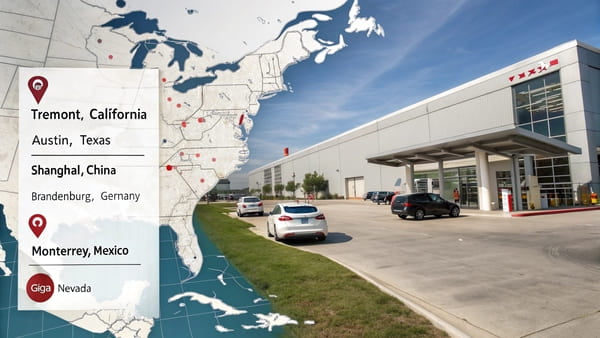
Tesla's primary vehicle assembly plants are in Fremont, California; Austin, Texas; Shanghai, China; and Brandenburg, Germany. A new factory is coming to Monterrey, Mexico4. They also have key component factories, like Giga Nevada5, which focuses on batteries and energy storage products.
A Global Footprint
Tesla's factory network is designed to cover the globe. Each location serves a specific region, making the company a local player in its most important markets. This strategy is much more than just putting buildings in different countries; it's about building a web of production that is efficient and powerful. In the United States, it all started with the Fremont factory in California. More recently, they built Giga Texas6 in Austin, which is now their global headquarters. And we can't forget Giga Nevada5, the huge factory dedicated to making batteries. Over in Asia, Giga Shanghai7 is a powerhouse, building cars for China and many other countries. For Europe, they built Giga Berlin8 in Germany to serve the continent directly. Soon, Giga Mexico will come online to support North America.
Here is a simple table to show their main locations:
| Continent | Location | Primary Role |
|---|---|---|
| North America | Fremont, California, USA | Vehicle Assembly (S,3,X,Y) |
| North America | Austin, Texas, USA | Vehicle Assembly (Y, Cybertruck) |
| North America | Sparks, Nevada, USA | Battery & Powertrain |
| North America | Monterrey, Mexico4 | Future Vehicle Assembly |
| Asia | Shanghai, China | Vehicle Assembly (3,Y) |
| Europe | Brandenburg, Germany | Vehicle Assembly (Y) |
This global layout helps Tesla avoid many of the shipping delays and import taxes that other car companies face.
What Does Each Tesla Gigafactory Produce in Different Regions?
A factory is just a building. To understand Tesla's plan, you need to know what each factory actually makes. Let's look at the specific products from each location.
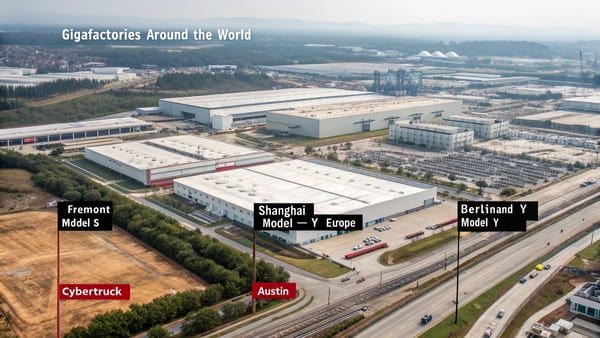
Each Gigafactory builds cars for its local region. Fremont makes the S, 3, X, and Y. Shanghai produces the Model 3 and Y for Asia and other markets. Berlin builds the Model Y for Europe. Austin focuses on the Model Y and the Cybertruck.
Regional Production for Regional Markets
Tesla doesn't make every car in every factory. Instead, they assign specific models to each location based on local demand and the factory's capabilities. This makes production much more efficient. For example, Giga Nevada5 is not a car factory at all. It's the heart of their battery operations, producing the battery cells, Powerwalls, and other energy products9 that power everything else. The original Fremont factory is still important, producing the entire range of models, including the high-end Model S and Model X. Giga Shanghai7 has become a huge success story. It focuses on the Model 3 and Model Y, and it's known for its incredible production speed and quality. It not only supplies the massive Chinese market but also exports cars to Europe, Australia, and other parts of Asia. Giga Berlin8 in Germany is focused on building the Model Y for European customers, using advanced techniques like giant casting machines10 to build car bodies in just one or two pieces. Finally, Giga Texas6 is the future. It builds the popular Model Y with new battery technology and is also the exclusive home of the Cybertruck11.
Here’s a breakdown of what each factory makes:
| Factory | Key Products |
|---|---|
| Giga Nevada5 | Batteries, Powerwall, Powerpack, Megapack |
| Fremont Factory | Model S, Model 3, Model X, Model Y |
| Giga Shanghai7 | Model 3, Model Y (for Asia & export) |
| Giga Berlin8 | Model Y (for Europe) |
| Giga Texas6 | Model Y, Cybertruck |
This specialization helps Tesla master its manufacturing processes and deliver cars to customers faster.
Why Did Tesla Choose the US, China, Germany, and Mexico for Manufacturing?
Tesla's factory locations might seem scattered across the map. But these choices are very smart and tell us a lot about their business plan. Here are the reasons behind each location.
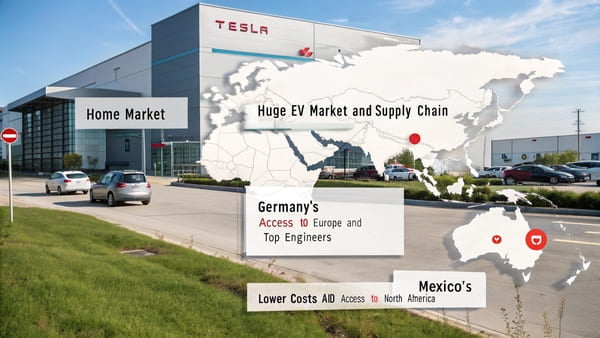
Tesla's choices are strategic. The US is its home market. China offers a huge EV market12 and an unbeatable supply chain. Germany provides access to Europe and top engineers13. Mexico offers lower costs and easy access to North America14.
Strategic Locations for a Global Supply Chain
Choosing where to build a multi-billion dollar factory is one of the most important decisions a company can make. For Tesla, each location was picked for very specific reasons. The US is their home base. It’s where the company started, where much of its research happens, and where it has a strong brand identity. Government incentives also make it a good place to build. China was a game-changer. It’s the world's largest car market, and the government strongly supports electric vehicles. But just as important is China's incredible network of factories.
From my own experience in the auto parts business, I know that making Tesla components is extremely difficult. The machines need to be incredibly precise. For some core parts, the manufacturing process has at least three steps, with the cooling and shaping stage being the hardest. The best machines for this work are usually found in factories around Shanghai or in the coastal Fujian province. Factories in other areas often can't meet the high standards. I learned this the hard way on a project for a client from Pakistan. The parts we made "shrank" a bit after cooling. I was nervous, but the client actually loved the result. It was a lucky mistake, but it taught me how sensitive this kind of manufacturing is. Tesla needs access to suppliers who can handle this complexity, and China has them in abundance.
Germany puts Tesla right in the heart of Europe's traditional auto industry. This gives them access to some of the best automotive engineers in the world and allows them to sell cars in Europe without facing big import taxes. Finally, Mexico is a smart move for North America. Its location provides low-cost labor and easy, tariff-free access to the US market thanks to trade agreements. It also helps Tesla build a supply chain that is less dependent on Asia.
Conclusion
Tesla's Gigafactories are much more than just car plants. They are smart, strategic hubs placed in the world's most important markets to build cars locally and control the supply chain.
Understanding how Tesla reduces shipping costs reveals their efficiency strategy and how it benefits customers with faster delivery and lower prices. ↩
Learning how Tesla sidesteps import taxes shows how they keep prices competitive and expand globally without extra costs. ↩
Exploring Tesla's supply chain control explains how they ensure quality, reduce delays, and respond quickly to market changes. ↩
Tesla's Mexico factory offers cost advantages and market access—see how this location strengthens their North American presence. ↩
Discovering Giga Nevada's role highlights Tesla's innovation in batteries and energy storage, crucial for their electric vehicle leadership. ↩
Giga Texas is Tesla's global HQ and Cybertruck hub—explore why it's central to their next phase of growth. ↩
Giga Shanghai is a key to Tesla's Asian market success and export strategy—learn why it's a model for global manufacturing. ↩
Giga Berlin's advanced techniques and local production help Tesla compete in Europe—find out how it shapes the EV market there. ↩
Tesla's energy products like Powerwalls are transforming energy storage—discover their impact beyond electric vehicles. ↩
Tesla's casting technology speeds up production and improves quality—find out how this innovation changes car building. ↩
Knowing where the Cybertruck is built reveals Tesla's manufacturing priorities and the importance of Giga Texas. ↩
China's massive EV market drives Tesla's growth—explore why it's essential for their global strategy. ↩
Germany's engineering talent and market access give Tesla a competitive edge—see why this matters for innovation. ↩
Mexico's advantages help Tesla scale production and reach customers faster—learn how this supports their expansion. ↩