-Choosing the wrong brake pads1 can risk your safety and your business reputation. Sourcing them from overseas adds another layer of complexity, making the right choice feel almost impossible.
Front brake pads1 handle most of the braking force, so they are larger and wear out faster. Rear brake pads1 are smaller and last longer. To choose a supplier in China, you must verify their IATF 16949 certification2, in-house formula development3, and stable cross-border logistics capabilities4.
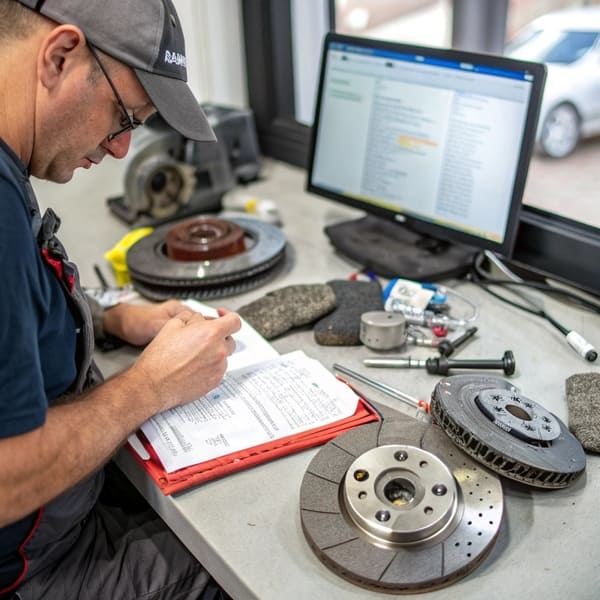
Finding the right brake pad is more than just a technical decision. It’s a critical business choice, especially when you are sourcing internationally. The technical differences between pads are the easy part to learn. The much harder part is finding a manufacturing partner who can deliver the right quality, consistency, and compliance for your market. I learned this through years of working with global clients. Let’s break down both sides of the problem, starting with the basics of the product itself.
What Are Brake Pads and Why Are They Essential for Vehicle Safety?
You know brake pads1 are important, but do you truly understand their critical role? A small defect is not an inconvenience. It is a direct safety risk that can have severe consequences.
Brake pads are the friction components5 within a car's braking system. They press against the brake rotors to create the friction needed to slow and stop the vehicle. Their performance and reliability are absolutely essential for ensuring the safety of everyone on the road.
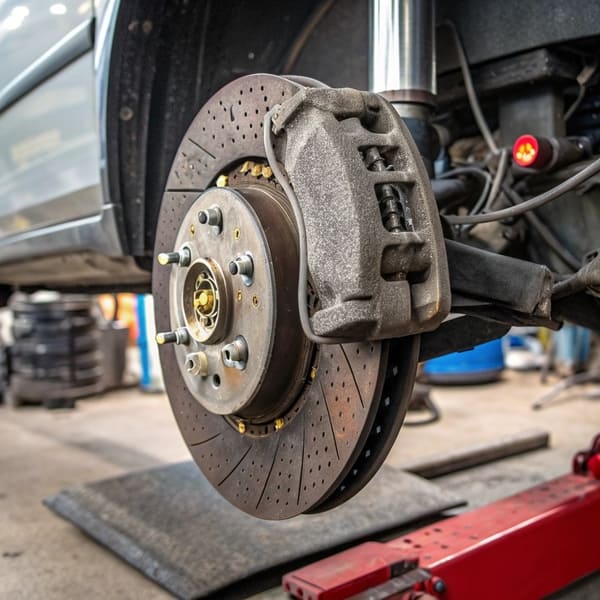
Brake pads are designed to be consumable parts, which means they wear down over time and need replacement. This is by design. Their job is to convert the kinetic energy of a moving car into thermal energy, or heat. When you hit the brakes, the pads are subjected to immense pressure and incredible temperatures. The quality of the brake pad material directly determines how well it can handle this heat and pressure without failing. A high-quality pad provides consistent stopping power, a short stopping distance, and gives the driver confidence in any situation. A low-quality pad can overheat, fade, or wear out prematurely, leading to a dangerous loss of braking ability. As a parts supplier, I see it as my responsibility to ensure that every pad we develop can handle these extreme demands without question. This is why the material science6 and formula development behind the pad are far more important than the price tag.
How Do Brake Pads Work in a Modern Disc Braking System?
The term "disc brakes7" is used everywhere, but do you know how the components work together? Misunderstanding the system makes it nearly impossible to source the right parts for the right application.
When you press the brake pedal, hydraulic fluid8 inside the brake lines transfers that force to a piston in the brake caliper9. This piston then clamps the brake pads1 against the spinning brake rotor, creating the friction that stops the car.
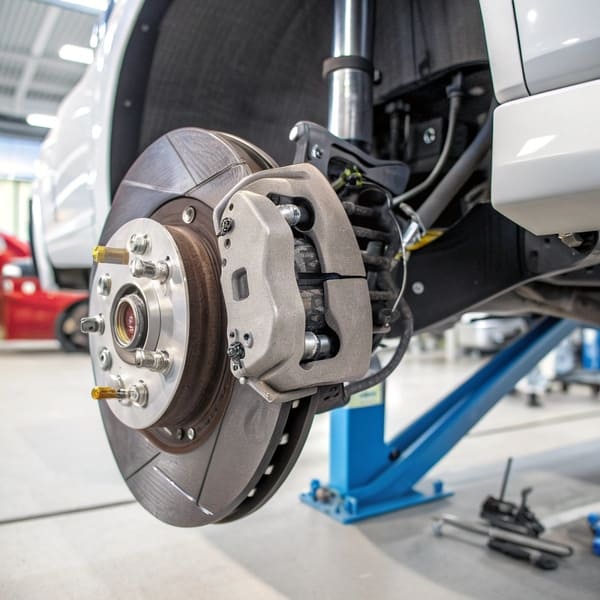
The process is a precise chain of events. It all starts with your foot on the pedal and ends with your vehicle coming to a safe stop. During braking, a car's weight shifts forward. This means the front brakes do most of the work, sometimes handling up to 70-80% of the total braking force. Because of this, front brake pads10s](https://shuipet.com/why-do-some-cars-have-8-brake-pads/)%%%FOOTNOTE_REF_1%%% are almost always larger, thicker, and made from materials designed to handle higher temperatures and more friction. Rear brake pads1 handle less force, so they are typically smaller and don't wear out as quickly. This fundamental difference is why you can't just use the same pads on the front and back. A supplier must understand this and provide correctly specified parts for each axle.
The Key Components in a Disc Brake System
| Component | Function |
|---|---|
| Brake Pedal | The driver's input to start the braking process. |
| Master Cylinder | Converts the pedal's mechanical force into hydraulic pressure. |
| Brake Lines | Tubes that carry high-pressure hydraulic fluid8 to the wheels. |
| Brake Caliper | Houses the brake pads1 and pistons. It receives the hydraulic pressure. |
| Pistons | Pushed by hydraulic fluid8 to clamp the brake pads1 onto the rotor. |
| Brake Pads | The friction material that makes contact with the rotor. |
| Brake Rotor | The disc that rotates with the wheel. Friction from the pads slows it down. |
Understanding this system makes it clear why every component, especially the pads, must meet exact specifications.
What Are the Main Types of Brake Pads Available in the Market?
You need to order brake pads1, but you see terms like "ceramic" and "semi-metallic." Choosing the wrong material type can lead to customer complaints about noise, excessive dust, or poor performance.
The three main types of brake pads1 are organic, semi-metallic, and ceramic. Organic pads are quiet but wear quickly. Semi-metallic pads offer excellent high-temperature performance but can be noisy. Ceramic pads provide a clean, quiet, and smooth braking experience.
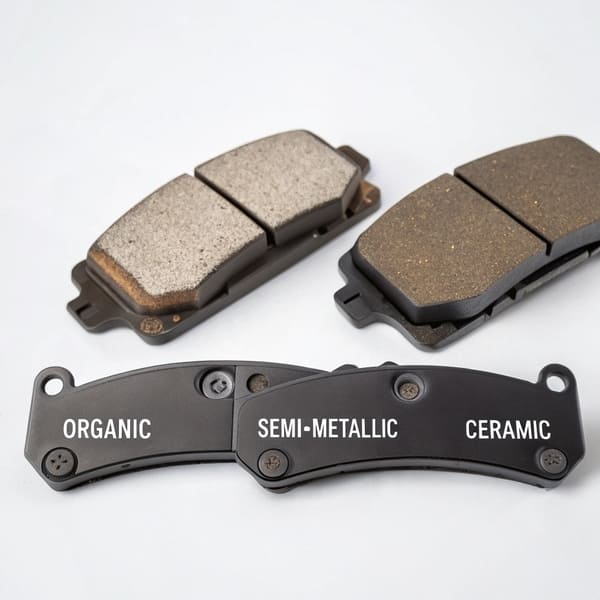
Choosing the right material is about matching the formula to the vehicle's specific needs. It’s a balancing act. For a daily-driving passenger car, a ceramic formula is often ideal because it offers quiet operation and low dust, which keeps wheels clean. For a heavy-duty truck or a performance vehicle, a semi-metallic formula is usually better. It can handle much higher temperatures without "fading," which is a dangerous loss of braking power.
I learned this lesson the hard way on one of my first big projects. A client from Pakistan needed brake pads1 for their aftermarket truck business. We initially provided a standard formula, but we quickly got reports that the pads were wearing out too fast on their local heavy-load vehicles. It was a classic formula mismatch. We went back to our engineers, and within weeks, we developed and shipped a new batch with a robust semi-metallic formula designed for high heat and heavy loads. The client was not upset. In fact, they were impressed with our ability to quickly adjust the formula to meet their market's specific needs. This experience taught me that being a true partner means having the R&D capability to create solutions, not just sell off-the-shelf products.
Matching the Formula to the Mission
| Material Type | Key Strengths | Best For |
|---|---|---|
| Ceramic | Quiet operation, low dust, stable friction | Daily drivers, luxury vehicles |
| Semi-Metallic | High-temperature resistance, excellent stopping power | Trucks, performance cars, towing |
| Organic (NAO) | Very quiet, low cost | Small, lightweight cars with low demands |
| EV-Specific11 | Low drag torque, quiet operation | Electric and hybrid vehicles |
How Do You Find a Truly Reliable Brake Pad Supplier in China?
You know you need a supplier from China, but the number of options is overwhelming. Choosing a bad partner can lead to quality disasters, shipping delays, and major compliance headaches for your business.
A truly reliable supplier has IATF 16949 certification2, in-house formula R&D, and their own bench testing capabilities. You should focus your search on manufacturers in industrial hubs like Shandong or the Yangtze River Delta, not just small trading companies.
Sourcing high-quality brake pads1 from China is extremely difficult if you only compare prices. To meet global standards, you need to go much deeper. I've built my business around a three-step verification process that filters out the low-quality factories and trading companies.
The Three-Step Verification Process
First, I look at geography. The best friction material manufacturers are often concentrated in industrial zones like Laizhou and Dongying in Shandong province12. For more advanced, intelligent factories, especially those with foreign investment experience, I look to the Yangtze River Delta region13. These areas have the supply chain and talent needed for high-level production.
Second, I verify their capabilities. The most important certification is IATF 16949. This ensures they have a quality management system for consistent batch production, which is non-negotiable for automotive parts. I also confirm they have their own formula R&D team and bench testing equipment. A factory that only does assembly cannot develop pads that meet specific requirements like low drag torque for EVs or pass compliance tests like ECE R90 in Europe14 or FMVSS in North America15.
Finally, I audit their entire process. This is the hardest part. It involves confirming they can balance formula adaptation with supply chain stability. For example, can they produce a low-noise ceramic pad for one client and a high-fade resistance semi-metallic pad for another, all while managing LCL shipping from Qingdao port and printing multi-language compliance labels? This final audit is where most potential suppliers fail.
Conclusion
Understanding front vs. rear pads and material types is step one. The real work is finding a certified supplier with true R&D and supply chain expertise to deliver what you need.
Learn the fundamental role of brake pads in vehicle safety and why choosing the right ones is critical for your business and customers. ↩
Explore the significance of IATF 16949 certification to ensure your supplier meets global quality standards for automotive parts. ↩
Find out how in-house formula development impacts product quality and customization for specific vehicle needs. ↩
Learn how robust logistics capabilities can prevent delays and compliance issues when importing brake pads internationally. ↩
Gain insight into the science behind friction components and their role in safe and effective braking. ↩
Explore how advanced material science ensures brake pads withstand extreme conditions and deliver consistent performance. ↩
Get a comprehensive overview of disc brake systems to make better technical and sourcing decisions. ↩
Learn about hydraulic fluid's function in transferring force and ensuring reliable braking performance. ↩
Discover the importance of brake calipers in the braking process and their impact on pad selection. ↩
Discover why front brake pads are larger and wear out faster, helping you make informed sourcing and maintenance decisions. ↩
Explore the unique requirements of electric vehicles and how EV-specific pads address them for optimal performance. ↩
Learn about the advantages of sourcing from these industrial zones to ensure high-quality production and supply chain reliability. ↩
Discover how this region's talent and supply chain support innovative and compliant brake pad production. ↩
Understand European compliance standards to ensure your products meet legal and safety requirements. ↩
Learn about North American compliance standards to avoid regulatory issues and guarantee product safety. ↩