-Struggling to understand modern car headlights? They look like one piece, making repairs seem complicated and expensive. Let's demystify them so you know exactly what you're dealing with.
A composite headlight is a modern automotive light assembly where the housing, reflector, and lens are all integrated into a single, replaceable unit.1 This design allows for more aerodynamic shapes and is styled to match the vehicle's body, unlike older, standardized sealed-beam headlights.
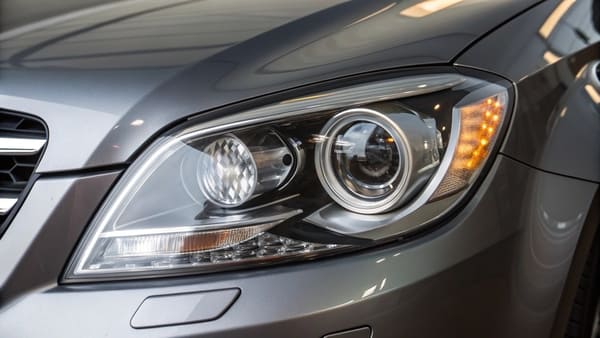
You've probably noticed that headlights aren't just simple round lights anymore. They are complex, beautifully shaped components that define the "face" of a car. This evolution from a simple functional part to a key design element is all thanks to the composite headlight. But there's a lot more to them than just looks. Let's dive deeper into what they are, why they have their name, and the intricate engineering that makes them work.
What Exactly Defines a Composite Headlight?
Feeling confused by the jump from simple old headlights to today's complex designs? This change can make repairs feel intimidating. Let's break down what truly makes a headlight "composite."
A composite headlight is an assembly that combines multiple components—the housing, reflector, and lens—into one sealed unit. Unlike old sealed beams where the entire unit was the bulb, these have a replaceable bulb and are designed to perfectly match the car's body lines.
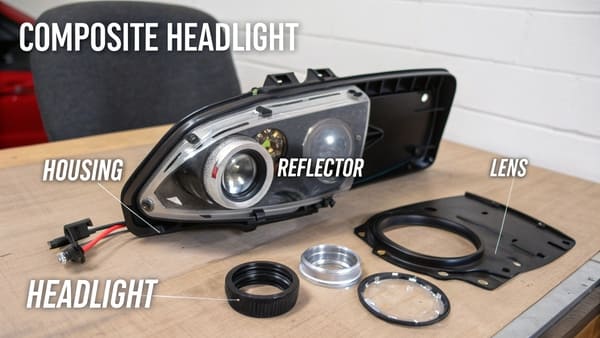
To really get it, you have to look back at what came before: the sealed beam headlight. For decades, cars in the US had to use standardized round or rectangular sealed beams.2 The bulb, reflector, and lens were one permanently sealed part. When the filament burned out, you replaced the whole thing. Composite headlights changed everything. They are "composite" because they are a composition of separate parts that form one assembly. The housing is typically made of plastic, and the lens is now almost always a durable, clear polycarbonate.3 This allows designers to create headlights in any shape they can imagine, improving both the car's style and its aerodynamics.4 This shift was less about lighting technology at first and more about design freedom.
| Feature | Sealed Beam Headlight | Composite Headlight |
|---|---|---|
| Construction | Single, sealed glass unit | Multi-part assembly (housing, lens, reflector) |
| Bulb | Integrated, not replaceable | Separately replaceable (Halogen, HID, LED) |
| Shape | Standardized (round, rectangular) | Custom, aerodynamic shapes |
| Lens | Glass, often with fluting to aim light | Polycarbonate, usually clear |
| Repair | Replace entire unit | Replace bulb or entire assembly if damaged |
Why Do They Call It a "Composite" Headlight?
The term "composite" sounds technical, maybe like it's made from carbon fiber or some other exotic material. This isn't quite right and can be confusing.5 The real reason is much simpler.
It's called a "composite" headlight because it's a composition, or an assembly, of multiple separate parts. The housing, reflector, and lens are all designed and built to fit together into one single, integrated component that is then installed on the car.
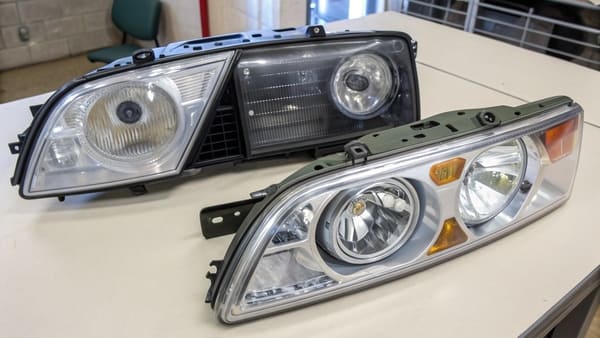
The name comes from the fact that it's an assembly of parts, not that it's made from "composite materials." The main parts are the plastic housing, the metallic-coated reflector, the clear polycarbonate lens, and the replaceable bulb. The manufacturing of these plastic parts is incredibly difficult. Standard injection molding machines often can't achieve the precision needed. For example, the plastic housing requires a multi-step process, and the cooling stage is the most critical and difficult part.
I learned this the hard way on my first project for a client from Pakistan. We were making the plastic components for a composite headlight, and we were still gaining experience. After injection molding, the parts "shrank" more than we anticipated during the cooling process. I was so worried we had failed. But when the client received them, he was thrilled. He said the slightly smaller size gave a tighter, more secure fit in the final assembly. It was a lucky break, but it taught me a valuable lesson about the tiny tolerances and complexities involved. We’ve since perfected our cooling process, but it showed me just how precise you have to be. High-precision machines for this work are usually found in coastal manufacturing hubs, not just anywhere.6
How Does a Composite Headlight Actually Work?
So you know what it is, but how does the assembly create a focused beam of light on the road? The real performance isn't just from the bulb; it's how all the parts work together.
A composite headlight works by using a precisely shaped reflector and a clear lens to control and direct the light from a replaceable bulb. The reflector gathers the light and aims it, while the lens protects the internals and helps fine-tune the final beam pattern.
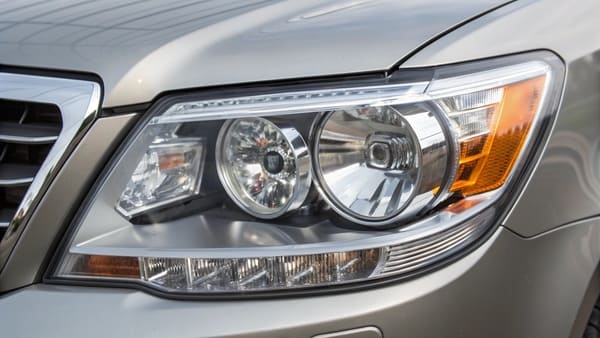
The magic of a composite headlight is in the synergy of its components. Each part has a specific job to turn the raw light from a bulb into a safe, effective beam pattern that illuminates the road without blinding other drivers. Let’s break down how they cooperate.
The Reflector's Role
The reflector is the shiny, mirror-like surface behind the bulb. Its job is to capture as much light as possible from the bulb and direct it forward in a controlled beam. Most reflectors are shaped like a parabola. This geometric shape has a special property: any light originating from its focal point (where the bulb's filament is placed) will reflect outwards in a straight, parallel line.7 This is how the headlight creates a concentrated beam instead of just scattering light everywhere. The precision of this shape is critical for performance.
The Lens's Function
In older composite headlights, the glass lens had patterns or "flutes" molded into it to bend and shape the light beam.8 Today, most lenses are made of perfectly clear polycarbonate. In these modern designs, the reflector does 100% of the work of aiming the light. The clear lens simply acts as a protective cover against rocks, rain, and UV rays. This change allows for much more precise beam control directly from the reflector's design.
The Bulb and Modern Technology
The composite design is versatile. It can house different types of bulbs, from basic halogens to brighter High-Intensity Discharge (HID/Xenon) bulbs and now, highly efficient Light Emitting Diodes (LEDs).9 Each type requires a slightly different reflector and housing design to manage heat and optimize light output. Adding other features, like an amber turn signal inside the same housing, adds another layer of manufacturing complexity. You have to stop the injection molding machine, open the mold to add the colorant for the amber section, and then resume. This interruption can easily ruin the precise cooling cycle, leading to a warped part if not handled by expert technicians with advanced machinery.
| Component | Primary Function |
|---|---|
| Bulb | Generates the light (Halogen, HID, LED). |
| Reflector | Gathers and aims the light into a beam. |
| Lens | Protects the internal parts and helps shape the beam. |
| Housing | Mounts all parts and attaches the assembly to the car. |
Conclusion
A composite headlight is an integrated assembly of parts that provides design freedom and better performance. Understanding this helps you make smarter decisions about vehicle maintenance, repair, and upgrades.
"Headlamp - Wikipedia", https://en.wikipedia.org/wiki/Headlamp. Automotive engineering sources define composite headlights as assemblies where the housing, reflector, and lens are integrated into a single, replaceable unit, distinguishing them from sealed beam designs. Evidence role: definition; source type: encyclopedia. Supports: A composite headlight is a modern automotive light assembly where the housing, reflector, and lens are all integrated into a single, replaceable unit.. Scope note: Some sources may use slightly different terminology or definitions depending on region or manufacturer. ↩
"Federal Motor Vehicle Safety Standards; Lamps, Reflective Devices ...", https://www.federalregister.gov/documents/2022/02/22/2022-02451/federal-motor-vehicle-safety-standards-lamps-reflective-devices-and-associated-equipment-adaptive. US automotive regulations mandated the use of standardized sealed beam headlights for several decades, typically in round or rectangular shapes. Evidence role: historical_context; source type: government. Supports: For decades, cars in the US had to use standardized round or rectangular sealed beams.. Scope note: Regulations varied by country; this applies specifically to the US. ↩
"Headlamp - Wikipedia", https://en.wikipedia.org/wiki/Headlamp. Manufacturing sources report that composite headlight housings are usually made of plastic, with lenses commonly constructed from clear polycarbonate for durability and impact resistance. Evidence role: general_support; source type: education. Supports: The housing is typically made of plastic, and the lens is now almost always a durable, clear polycarbonate.. Scope note: Some high-end vehicles may use alternative materials. ↩
"Don't understand why people love repeating the *hate* of split ...", https://www.facebook.com/aurizn/posts/dont-understand-why-people-love-repeating-the-hate-of-split-headlights-split-hea/1206661908176548/. Automotive design literature notes that composite headlights allow for custom shapes, which can enhance vehicle aesthetics and aerodynamics compared to standardized sealed beam units. Evidence role: mechanism; source type: education. Supports: This allows designers to create headlights in any shape they can imagine, improving both the car's style and its aerodynamics.. Scope note: Aerodynamic improvements depend on overall vehicle design, not just headlight shape. ↩
"Headlamp - Wikipedia", https://en.wikipedia.org/wiki/Headlamp. Automotive glossaries clarify that 'composite' in headlight terminology refers to an assembly of parts, not necessarily the use of composite materials like carbon fiber. Evidence role: definition; source type: encyclopedia. Supports: The term "composite" sounds technical, maybe like it's made from carbon fiber or some other exotic material. This isn't quite right and can be confusing.. Scope note: Some confusion persists due to overlapping terminology in materials science. ↩
"Automotive Manufacturing | US EPA", https://www.epa.gov/trinationalanalysis/automotive-manufacturing. Industry reports note that high-precision automotive manufacturing, including headlight production, is often concentrated in coastal hubs with advanced infrastructure. Evidence role: general_support; source type: institution. Supports: High-precision machines for this work are usually found in coastal manufacturing hubs, not just anywhere.. Scope note: Exceptions exist; some inland regions also host advanced facilities. ↩
"Parabolic reflector - Wikipedia", https://en.wikipedia.org/wiki/Parabolic_reflector. Physics and engineering sources confirm that parabolic reflectors direct light from the focal point into parallel beams, a principle widely used in automotive headlights. Evidence role: mechanism; source type: education. Supports: Most reflectors are shaped like a parabola. This geometric shape has a special property: any light originating from its focal point (where the bulb's filament is placed) will reflect outwards in a straight, parallel line.. Scope note: Some modern headlights use alternative reflector shapes for specific beam patterns. ↩
"[PDF] Auto headlight glass: visible features of forensic utility", https://nvlpubs.nist.gov/nistpubs/Legacy/SP/nbsspecialpublication480-17.pdf. Automotive engineering sources describe how older headlight lenses featured molded fluting to shape and direct the light beam. Evidence role: historical_context; source type: education. Supports: In older composite headlights, the glass lens had patterns or "flutes" molded into it to bend and shape the light beam.. Scope note: Modern designs often rely on reflector geometry instead of lens fluting. ↩
"Headlamp - Wikipedia", https://en.wikipedia.org/wiki/Headlamp. Technical sources confirm that composite headlight assemblies are designed to accommodate a range of bulb types, including halogen, HID/Xenon, and LED technologies. Evidence role: general_support; source type: education. Supports: The composite design is versatile. It can house different types of bulbs, from basic halogens to brighter High-Intensity Discharge (HID/Xenon) bulbs and now, highly efficient Light Emitting Diodes (LEDs).. Scope note: Specific compatibility depends on headlight design and vehicle model. ↩