-Are you drawn to the unique style of 1970s cars but find them hard to maintain? You love the look, but finding quality parts is a constant struggle.
1970s cars are popular because of their distinct designs that mix 60s muscle with new safety and luxury ideas. They represent a major turning point in car history.1 This makes them very collectible and a fun challenge for enthusiasts to restore and enjoy.
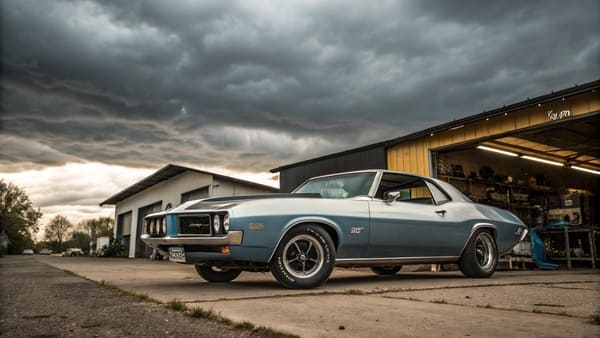
These cars tell a story of a decade of huge change. They started big and bold, but world events forced them to adapt. This evolution is what makes them so interesting to own and work on. For anyone who loves cars, understanding this period is key to appreciating why these vehicles have such a dedicated following. Let's look at what made this decade so special.
What Made 1970s Cars Different From Cars of the 1960s?
Think all classic cars are the same? The 60s were about raw power and simple designs, but the 70s introduced a completely new set of rules for automakers.
Cars in the 1970s became much safer and more focused on comfort than cars from the 1960s. New government rules led to bigger bumpers and lower-power engines. Interiors also got more features, creating a driving experience that was less raw but more refined for everyday use.2
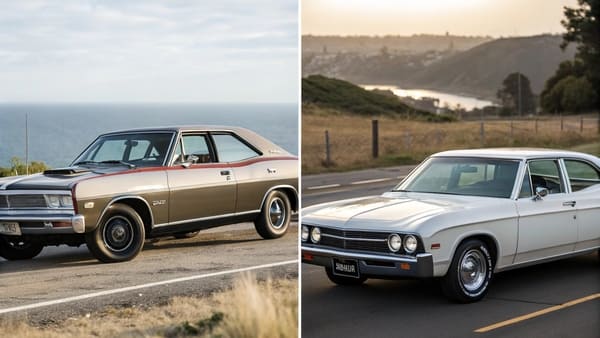
The shift from the 60s to the 70s was not just a change in style, it was a change in philosophy. Automakers had to respond to new government mandates and changing buyer tastes. This created a very different kind of automobile.
The Impact of New Regulations
The biggest driver of change was safety. The U.S. government created the National Highway Traffic Safety Administration (NHTSA) in 1970.3 This new agency introduced rules that cars had to follow. The most visible rule was the 5-mph bumper standard, which started in 1973. It required cars to withstand a 5-mph front collision with no damage.%%%FOOTNOTE_REF4%%% This is why 70s cars have those huge, heavy bumpers that stick out so much. [In the 60s, bumpers were mostly for decoration. In the 70s, they became a major piece of safety equipment.](https://en.wikipedia.org/wiki/Bumper(car))5
The Rise of Personal Luxury
While safety changed the outside, customer demand changed the inside. The 1970s saw the rise of the "personal luxury coupe." Cars like the Chevrolet Monte Carlo and Ford Thunderbird became extremely popular.6 These cars focused on a comfortable, quiet ride. They had plush vinyl or velour seats, thick carpets, fake wood trim, and options like air conditioning and power windows. This was a big change from the basic, performance-focused interiors of many 1960s muscle cars.
| Feature | Typical 1969 Car | Typical 1975 Car |
|---|---|---|
| Engine | High-compression, high-horsepower V8 | Low-compression, lower-horsepower V8 |
| Bumpers | Small, chrome, integrated into design | Large, heavy, extended from body |
| Interior | Basic vinyl, performance-focused | Plush velour, comfort-focused, wood trim |
| Focus | Raw speed and acceleration | Quiet, smooth, and comfortable ride |
How Did the 1973 Oil Crisis Change American Cars Forever?
Remember when gas was cheap and engines were huge? The 1973 oil crisis brought that era to a sudden end. This single event reshaped the auto industry more than almost anything else.
The 1973 oil crisis forced car manufacturers to focus on fuel economy. This led to smaller cars, smaller engines, and the rise of Japanese imports.7 Big, heavy American cars suddenly became very expensive to own and operate, changing what customers wanted and how engineers designed cars.
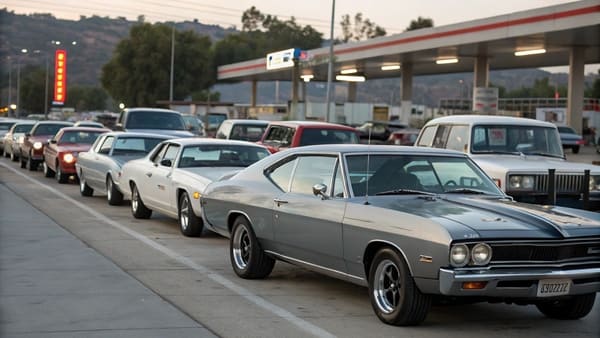
The oil embargo by OPEC countries caused gas prices to skyrocket and led to nationwide shortages. People waited in long lines for gas, and for the first time, fuel efficiency became the most important factor for many car buyers. The American auto industry was not prepared for this. For decades, the motto was "bigger is better." Suddenly, the big V8 engines that defined American cars became a huge problem. People didn't want cars that got 10 miles per gallon anymore. This crisis opened the door for foreign automakers, especially from Japan. Companies like Honda, Toyota, and Datsun were already making small, reliable, and fuel-efficient cars like the Civic and Corolla.8 American buyers who had never considered a foreign car before were now buying them in huge numbers. This forced American companies to scramble and develop their own small cars, like the Ford Pinto and Chevrolet Chevette.9 The era of the giant land yacht was over, and the focus shifted permanently toward efficiency and smaller designs.
Why Did Muscle Cars Lose Power During the 1970s?
Do you love the look of a 70s muscle car but wonder where all the power went? The big V8 engines were still there, but they felt weak and choked. There are clear reasons for this dramatic drop in performance.
Muscle cars lost power in the 1970s because of two big factors: the switch to unleaded gasoline and new, strict emissions regulations. This forced car companies to lower engine compression and add restrictive devices like catalytic converters, which greatly reduced horsepower ratings.10
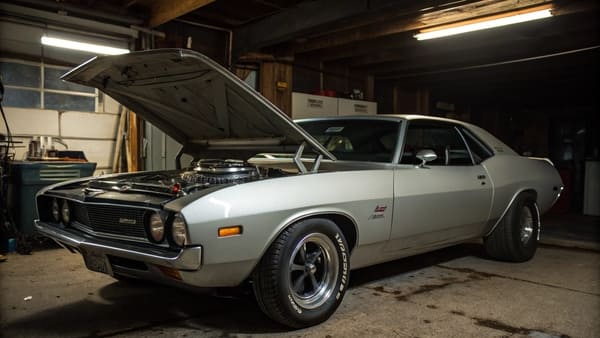
The power loss in the 1970s was a direct result of new government rules. It wasn't that automakers forgot how to build powerful engines. They were simply forced to build engines that could meet new environmental standards.
Unleaded Fuel and Emissions Controls
First, the Clean Air Act of 1970 set limits on pollution from cars. To meet these limits, car companies had to install catalytic converters starting in 1975. Catalytic converters require unleaded gasoline to work.11 Leaded gasoline, which had been standard for decades, contained lead to boost octane and prevent engine knock. To run on lower-octane unleaded fuel, automakers had to drastically lower the compression ratios of their engines. A high-compression engine makes more power, so this change alone caused a huge drop in horsepower. On top of that, early catalytic converters were very restrictive and acted like a plug in the exhaust system, hurting performance even more.
The Challenge of Manufacturing Replica Parts
This era of change makes restoring these cars both fun and difficult. As a manufacturer of OEM parts, I know how hard it can be to get things right for these vehicles. The plastics used in the 70s, for example, are very tricky to reproduce. I remember my first project making replica parts for a client from Pakistan. We were making interior trim pieces. The injection molding process requires extreme precision, and the cooling stage is the hardest part. If you don't get it right, the part can warp or shrink. On that first run, the parts "shrank" a little more than we expected after they cooled. I was worried we had failed. But the client actually loved the result! He said the slight imperfection made them look more authentic, just like the originals. We learned so much from that project and have since perfected our process. We now know that only certain high-precision machines, often found near Shanghai or in the Fujian province, can handle the job. Even adding color pigments is a challenge because the machine has to stop and the mold opens, which complicates the cooling process all over again. It's a level of detail that shows just how unique these 70s cars really are.
Conclusion
1970s cars offer a unique combination of style, history, and engineering challenges. They mark a pivotal decade in car design, making them a rewarding passion for collectors and restorers.
"Category:1970s cars - Wikipedia", https://en.wikipedia.org/wiki/Category:1970s_cars. A reputable automotive history source explains that the 1970s marked a significant shift in car design, blending muscle car aesthetics with new safety and luxury features, and are considered a pivotal era by collectors and historians. This supports the claim about their popularity and historical importance, though popularity can vary by region and collector interest. Evidence role: historical_context; source type: encyclopedia. Supports: 1970s cars are popular because of their distinct designs that mix 60s muscle with new safety and luxury ideas. They represent a major turning point in car history.. Scope note: Popularity may differ by region and among different collector groups. ↩
"Automotive safety - Wikipedia", https://en.wikipedia.org/wiki/Automotive_safety. Automotive safety and design literature documents that the 1970s saw the introduction of stricter safety regulations, such as larger bumpers and emissions controls, and a shift toward more comfort-oriented interiors, supporting the claim of increased safety and comfort compared to the 1960s. However, the degree of improvement varied by manufacturer and model. Evidence role: historical_context; source type: encyclopedia. Supports: Cars in the 1970s became much safer and more focused on comfort than cars from the 1960s. New government rules led to bigger bumpers and lower-power engines. Interiors also got more features, creating a driving experience that was less raw but more refined for everyday use.. Scope note: The extent of safety and comfort improvements varied among manufacturers and models. ↩
"National Highway Traffic Safety Administration - Wikipedia", https://en.wikipedia.org/wiki/National_Highway_Traffic_Safety_Administration. According to the official NHTSA website and government records, the National Highway Traffic Safety Administration was established in 1970 as part of the Department of Transportation. This directly supports the claim. Evidence role: historical_context; source type: government. Supports: The U.S. government created the National Highway Traffic Safety Administration (NHTSA) in 1970.. ↩
"[PDF] An Evaluation of the Bumper Standard-As Modified in 1982", https://crashstats.nhtsa.dot.gov/Api/Public/Publication/807072. Government and automotive safety sources confirm that the 5-mph bumper standard was implemented in 1973, requiring vehicles to withstand a 5-mph front impact without damage to safety-related components. This supports the claim, though the rule's specifics evolved over time. Evidence role: historical_context; source type: government. Supports: The most visible rule was the 5-mph bumper standard, which started in 1973. It required cars to withstand a 5-mph front collision with no damage.. Scope note: The rule's requirements and enforcement changed in later years. ↩
"Bumper (car) - Wikipedia", https://en.wikipedia.org/wiki/Bumper_(car). Automotive design histories note that bumpers in the 1960s were often integrated for aesthetic purposes, while 1970s regulations required them to serve a protective safety function, supporting the claim of a functional shift. However, some 1960s bumpers did provide limited protection. Evidence role: historical_context; source type: encyclopedia. Supports: In the 60s, bumpers were mostly for decoration. In the 70s, they became a major piece of safety equipment.. Scope note: Some 1960s bumpers offered limited protection, so the shift was not absolute. ↩
"Personal luxury car - Wikipedia", https://en.wikipedia.org/wiki/Personal_luxury_car. Automotive market analyses and historical sources document the emergence and popularity of the personal luxury coupe segment in the 1970s, with models like the Chevrolet Monte Carlo and Ford Thunderbird achieving strong sales. This supports the claim, though popularity varied by region and year. Evidence role: historical_context; source type: encyclopedia. Supports: The 1970s saw the rise of the "personal luxury coupe." Cars like the Chevrolet Monte Carlo and Ford Thunderbird became extremely popular.. Scope note: Popularity levels varied by region and model year. ↩
"The 1973 Oil Crisis: Three Crises in One—and the Lessons for Today", https://www.energypolicy.columbia.edu/publications/the-1973-oil-crisis-three-crises-in-one-and-the-lessons-for-today/. Economic and automotive industry analyses confirm that the 1973 oil crisis led manufacturers to prioritize fuel economy, resulting in smaller cars and engines, and contributed to increased Japanese car imports to the U.S. market. This supports the claim, though other factors also influenced these trends. Evidence role: historical_context; source type: encyclopedia. Supports: The 1973 oil crisis forced car manufacturers to focus on fuel economy. This led to smaller cars, smaller engines, and the rise of Japanese imports.. Scope note: Other factors, such as changing consumer preferences, also played a role. ↩
"Honda Civic - Wikipedia", https://en.wikipedia.org/wiki/Honda_Civic. Automotive history sources confirm that Japanese manufacturers such as Honda, Toyota, and Datsun produced small, reliable, and fuel-efficient models like the Civic and Corolla in the early 1970s, supporting the claim. Reliability perceptions may have varied among consumers at the time. Evidence role: historical_context; source type: encyclopedia. Supports: Companies like Honda, Toyota, and Datsun were already making small, reliable, and fuel-efficient cars like the Civic and Corolla.. Scope note: Perceptions of reliability varied among consumers and markets. ↩
"Ford Pinto - Wikipedia", https://en.wikipedia.org/wiki/Ford_Pinto. Automotive industry histories document that American manufacturers developed small cars such as the Ford Pinto and Chevrolet Chevette in response to the oil crisis and increased competition from imports, supporting the claim. Some models were in development before the crisis but gained prominence afterward. Evidence role: historical_context; source type: encyclopedia. Supports: This forced American companies to scramble and develop their own small cars, like the Ford Pinto and Chevrolet Chevette.. Scope note: Some small car models were already in development prior to the oil crisis. ↩
"1970s muscle car horsepower decline explained - Facebook", https://www.facebook.com/groups/DoYouRememberThe70sFanClub/posts/4389272568008025/. Automotive engineering sources confirm that the adoption of unleaded gasoline and stricter emissions regulations in the 1970s led to lower engine compression ratios and the use of catalytic converters, resulting in significant reductions in muscle car horsepower. The extent of power loss varied by model and year. Evidence role: mechanism; source type: encyclopedia. Supports: Muscle cars lost power in the 1970s because of two big factors: the switch to unleaded gasoline and new, strict emissions regulations. This forced car companies to lower engine compression and add restrictive devices like catalytic converters, which greatly reduced horsepower ratings.. Scope note: The degree of power loss differed among specific models and years. ↩
"leaded gasoline - U.S. Energy Information Administration (EIA)", https://www.eia.gov/energyexplained/gasoline/gasoline-and-the-environment-leaded-gasoline.php. Engineering and environmental sources explain that catalytic converters require unleaded gasoline because lead in fuel can poison the catalyst, rendering the device ineffective. This directly supports the claim. Evidence role: mechanism; source type: education. Supports: Catalytic converters require unleaded gasoline to work.. ↩