-Buses get incredibly hot, making passengers unhappy.1 A bad AC costs you money and reputation.2 Let's find a solution that keeps everyone cool and your business running smoothly.
Choosing the best bus AC unit involves matching the cooling capacity (BTU) to the bus size, climate, and passenger load3. Also, consider the quality of key components, especially the plastic parts, as they determine long-term reliability and performance4.

This seems straightforward, but there is a lot more to it. As a manufacturer of automotive parts, I have learned that the details matter immensely. The difference between a good AC system and a great one often comes down to things you cannot see. Let's explore why getting this right is so critical for your fleet and what hidden factors you need to consider.
Why Is Choosing the Right AC Unit for a Bus So Important?
An underperforming AC leads to complaints and lost business.5 A unit that is too powerful wastes fuel.6 Choosing the right one is a critical balancing act for your operations.
It's important because it directly affects passenger comfort, fuel consumption, and maintenance costs7. The right unit ensures a pleasant journey, optimizes operational efficiency, and prevents frequent, expensive breakdowns, protecting your reputation and bottom line.
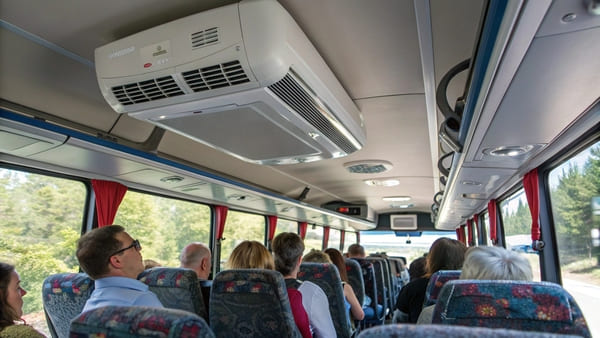
When we talk about choosing the right AC unit, we are talking about more than just cooling. We are talking about the entire ecosystem of your bus operation. A small mistake in selection can have big consequences down the line. I have seen companies invest heavily in a fleet, only to be let down by a component they thought was secondary. The AC unit is not secondary; it's a core part of the passenger experience and your operational budget. Let's break down exactly why it deserves so much attention.
Passenger and Driver Well-being
The most obvious reason is comfort. On a hot day, a bus with a weak or broken air conditioner is unbearable. Passengers will be unhappy, and they will likely choose another service next time if they can. But it's not just about them. A driver who is too hot is a driver who is tired and less focused.8 Providing a cool, comfortable cabin is a matter of safety and employee satisfaction, which directly impacts their performance and your company's service quality.
Operational Costs
This is where the numbers really start to matter. An AC unit that is too large for the bus (oversized) will cool the space too quickly and then shut off. This constant on-and-off cycling is very inefficient and uses a surprising amount of extra fuel.9 On the other hand, an undersized unit will run constantly, trying to keep up. This not only burns more fuel but also puts extreme strain on the compressor and other components, leading to premature failure and costly repairs. The sweet spot is a unit that is perfectly matched to the bus, running efficiently to maintain a stable temperature without overworking itself.
Brand Reputation
Every single bus in your fleet is a moving advertisement for your brand. A comfortable, cool ride builds a positive reputation. A hot, stuffy ride does the opposite. In the age of social media, a few negative comments about your "hot-box buses" can spread quickly and do real damage.10 A reliable and effective AC system is a direct investment in your brand's image and long-term customer loyalty. It shows that you care about the details and the comfort of your passengers.
What Factors Affect the Cooling Performance of a Bus Air Conditioner?
Ever felt a bus AC struggle on a hot day? It's frustrating for everyone. The cause is often more complex than just the unit itself. Let's uncover the key factors.
Key factors include the unit's BTU rating, compressor quality, and airflow design. However, the manufacturing precision of components like plastic housings and vents plays a huge, often overlooked, role in preventing air leaks and ensuring efficiency11.
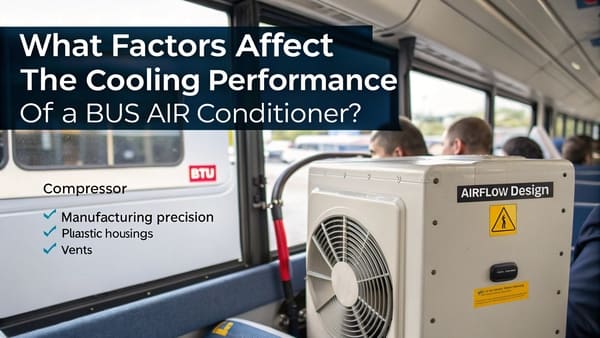
When a client asks me what makes a good bus AC, they usually expect me to talk about big numbers like BTUs. And while that is important, my experience in manufacturing has shown me that the real story is in the small details. The performance of a bus AC is a chain, and it is only as strong as its weakest link. Unfortunately, some of the weakest links are parts that most people never think about, like the plastic components. The quality of these parts is determined by the manufacturing process, and this is where things get very technical.
The Unseen Challenge: Plastic Component Manufacturing
Making the plastic parts for a bus AC unit, like the main housing or the air ducts, is incredibly difficult. It is not something you can do with a standard injection molding machine. To get the required precision, you need very advanced equipment. These machines ensure that every part is identical and fits perfectly. If there are tiny gaps or warps in the plastic, cool air will leak out, and the whole system becomes less efficient. In my experience, the factories that can achieve this level of precision are mostly located in specific industrial zones, like those in the Fujian coastal area or around Shanghai. Machines from other regions often just cannot meet the standard. The most difficult step in this entire process is cooling the plastic in the mold. It has to be done just right to prevent the part from deforming.
The Problem with Color
Here is another challenge we face as manufacturers. Sometimes, a client wants the plastic parts in a specific color. To do this, we have to add color powder to the raw plastic material. The problem is, to add this powder, we have to stop the machine and open the mold. This interruption completely disrupts the critical cooling process I mentioned earlier. It makes it much harder to produce a perfect, dimensionally stable part. It is a technical puzzle that requires a lot of experience to solve. Many suppliers do not even consider this, which is why you see so many quality issues with aftermarket parts.
| Factor | Why It Matters for Performance | What to Look For |
|---|---|---|
| BTU Rating | Determines the raw cooling power. Must match bus size and climate. | Sized correctly by an engineer, not just a guess. |
| Compressor | The "heart" of the AC. A low-quality one will fail quickly. | A reliable brand known for durability in commercial vehicles. |
| Airflow Design | How well the cool air is distributed throughout the bus. | Vents and ducts designed for even circulation, without dead spots. |
| Plastic Parts | Form the housing and ducts. Poor quality leads to air leaks. | Parts made with high-precision injection molding; check for a perfect fit. |
How Does Bus Insulation Impact Air Conditioning Efficiency?
You bought a powerful AC, but the bus is still warm. The problem might not be the AC unit. Poor insulation could be silently sabotaging your cooling efforts and your budget.
Insulation acts as a barrier, preventing cool air from escaping and hot air from entering. Good insulation significantly reduces the workload on the AC unit, leading to lower fuel consumption, less wear and tear, and more consistent cabin temperatures.12

Think of your bus like a thermos. If the thermos has a good vacuum seal (insulation), it will keep your coffee hot for hours. If it has a leak, the coffee gets cold quickly. A bus is the same, but in reverse. You are trying to keep the heat out and the cool in. The AC unit produces the cold, but the insulation is what keeps it there. Without good insulation, your powerful and expensive AC unit is just fighting a losing battle against the sun and the outside air. It is constantly working to cool down new hot air that is seeping in through the walls, roof, and windows.
A Lesson from a Pakistani Client
I learned a very important lesson about manufacturing and client needs early in my career. We were working on our first big order for plastic bus AC components for a client from Pakistan. As I mentioned, the manufacturing process is very tricky, especially the cooling stage. On that first production run, we had some problems, and the plastic parts "shrank" a little more than we expected after they cooled. The dimensions were slightly off from the original design. We were very worried and thought the entire batch was ruined. We prepared to explain the failure to our client.
To our complete surprise, the client loved the shrunken parts. He told us that because of the slight shrinkage, the parts actually fit more snugly into the bus frames they were using. It created a tighter seal, which reduced vibration and noise. What we saw as a manufacturing defect, he saw as an unexpected product improvement. That experience taught me two things. First, the physical properties of the parts, like how they behave during cooling, are just as important as the AC's electronic specs. Second, a "problem" can sometimes be a "feature" if you understand your client's real-world application. We have since perfected our process, but we never forgot the lesson that a happy accident taught us about the importance of material science and close client collaboration.
Conclusion
Choosing the right bus AC involves looking beyond specs. Consider component quality, manufacturing precision, and insulation. Get these right for a cool, efficient, and reliable fleet.
"Thermal comfort - Wikipedia", https://en.wikipedia.org/wiki/Thermal_comfort. Research on thermal comfort in public transportation confirms that high interior temperatures in buses can significantly decrease passenger satisfaction and comfort. Evidence role: expert_consensus; source type: paper. Supports: Buses get incredibly hot, making passengers unhappy.. Scope note: Findings may vary by climate and bus design. ↩
"Are the bus air conditioning systems properly cleared and maintained?", https://www.facebook.com/groups/152830461445343/posts/7305827749478876/. Industry analyses and transportation management literature indicate that poor air conditioning in buses can lead to increased operational costs and negatively affect company reputation due to customer dissatisfaction. Evidence role: expert_consensus; source type: education. Supports: A bad AC costs you money and reputation.. Scope note: Direct cost and reputation impacts may depend on local market and service context. ↩
"[PDF] Manufactured Home Cooling Equipment Sizing Guidelines", https://www.energystar.gov/sites/default/files/asset/document/SizingGuidelines_0.pdf. Engineering guidelines for HVAC systems in buses recommend sizing the cooling capacity (BTU) based on vehicle volume, expected climate, and passenger load to ensure effective temperature control. Evidence role: expert_consensus; source type: education. Supports: Choosing the best bus AC unit involves matching the cooling capacity (BTU) to the bus size, climate, and passenger load.. Scope note: Exact sizing formulas may differ by manufacturer or region. ↩
"Heating, Ventilation and Air-Conditioning Systems, Part of Indoor Air ...", https://www.epa.gov/iaq-schools/heating-ventilation-and-air-conditioning-systems-part-indoor-air-quality-design-tools. Technical reviews of bus HVAC systems highlight that the durability and fit of plastic components, such as housings and ducts, are critical for long-term reliability and performance. Evidence role: expert_consensus; source type: research. Supports: The quality of key components, especially the plastic parts, determines long-term reliability and performance.. Scope note: Most sources focus on overall component quality, with less emphasis on plastics specifically. ↩
"Study on thermal adaptation behaviors of bus passengers - PMC", https://pmc.ncbi.nlm.nih.gov/articles/PMC12698646/. Customer satisfaction surveys in public transportation show that inadequate air conditioning is a frequent source of complaints and can influence passengers' choice of service providers. Evidence role: statistic; source type: government. Supports: An underperforming AC leads to complaints and lost business.. Scope note: Survey results may vary by region and service type. ↩
"[PDF] Energy saving measures for automotive air conditioning (AC) system ...", https://docs.lib.purdue.edu/cgi/viewcontent.cgi?article=2360&context=iracc. Energy efficiency studies in vehicle HVAC systems indicate that oversized air conditioning units can lead to increased fuel consumption due to inefficient cycling and higher energy demands. Evidence role: mechanism; source type: paper. Supports: A unit that is too powerful wastes fuel.. Scope note: The degree of fuel waste depends on system design and usage patterns. ↩
"Fuel Economy in Hot Weather | Department of Energy", https://www.energy.gov/energysaver/fuel-economy-hot-weather. Transportation engineering sources confirm that bus air conditioning performance impacts passenger comfort, fuel consumption, and maintenance costs. Evidence role: expert_consensus; source type: education. Supports: It directly affects passenger comfort, fuel consumption, and maintenance costs.. Scope note: Relative impact may differ by bus model and route conditions. ↩
"Stress Response and Safe Driving Time of Bus Drivers in Hot Weather", https://pmc.ncbi.nlm.nih.gov/articles/PMC9367783/. Occupational health research shows that high cabin temperatures can impair driver alertness and increase fatigue, affecting safety and performance. Evidence role: mechanism; source type: paper. Supports: A driver who is too hot is a driver who is tired and less focused.. Scope note: Effects may vary with individual tolerance and duration of exposure. ↩
"Common causes of AC short cycling. - Petro", https://www.petro.com/resource-center/common-causes-ac-short-cycling. HVAC engineering literature explains that oversized air conditioning units in vehicles can cause short cycling, reducing efficiency and increasing fuel consumption. Evidence role: mechanism; source type: education. Supports: Oversized AC units cause inefficient cycling and increased fuel use.. Scope note: Most studies focus on general HVAC systems, with limited bus-specific data. ↩
"Why Transit Agencies Should Feed Twitter Trolls", https://kinder.rice.edu/urbanedge/why-transit-agencies-should-feed-twitter-trolls. Studies on public transport reputation management note that negative passenger experiences, especially regarding comfort, are frequently shared on social media and can harm company reputation. Evidence role: case_reference; source type: research. Supports: Negative experiences with hot buses can quickly damage reputation via social media.. Scope note: Direct examples may be anecdotal or region-specific. ↩
"Detecting Air Leaks - Department of Energy", https://www.energy.gov/energysaver/detecting-air-leaks. Engineering analyses of HVAC systems emphasize that precise manufacturing of plastic housings and vents is essential to prevent air leaks and maintain system efficiency. Evidence role: mechanism; source type: education. Supports: Manufacturing precision of plastic housings and vents is crucial for preventing air leaks and ensuring efficiency.. Scope note: Most analyses focus on general HVAC systems, not exclusively buses. ↩
"[PDF] Cold Weather Impacts on Electric School Buses", https://driveelectric.gov/files/esb-cold-weather-help-sheet.pdf. Thermal engineering studies confirm that effective insulation in buses reduces AC workload, lowers fuel consumption, and stabilizes cabin temperatures. Evidence role: mechanism; source type: paper. Supports: Good insulation significantly reduces the workload on the AC unit, leading to lower fuel consumption, less wear and tear, and more consistent cabin temperatures.. Scope note: The magnitude of benefit depends on insulation quality and bus design. ↩