-Your car's brake system is critical for safety, but do you know how it works? A small failure in one part can lead to big problems1. Understanding each component is key.
The main parts of a car's brake system are the brake pedal, master cylinder, brake lines, and the brake assemblies at each wheel. These assemblies are typically disc brakes (caliper, pads, rotor) or drum brakes (drum, shoes, wheel cylinder)2. They work together using hydraulic pressure to stop the vehicle3.
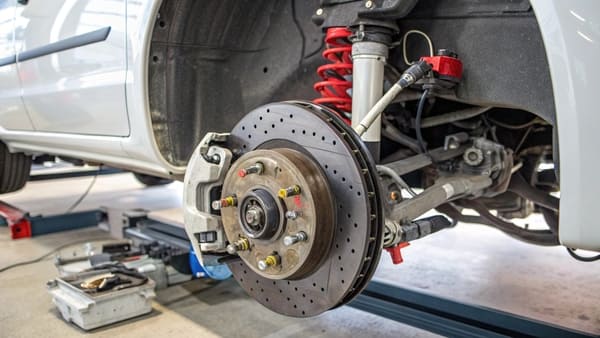
You press the brake pedal, and your car slows down. It feels simple, but it's a complex process involving hydraulics, friction, and heat management. As a manufacturer, we deal with these components every day, from the large metal rotors to the smallest plastic clips. Understanding how they all fit together is essential for producing reliable parts. Let's break down the entire system, piece by piece, so you can see how it all functions to keep you safe on the road.
What Does a Car Brake System Do?
A car in motion is a powerful force. Stopping thousands of pounds of moving metal safely is a serious job that can't be left to chance. The brake system is your only tool for this.
A car's brake system converts movement (kinetic energy) into heat through friction4. When you press the pedal, hydraulic fluid creates immense pressure5. This pressure activates mechanisms at the wheels that press high-friction materials against rotating surfaces, slowing and ultimately stopping the car safely.
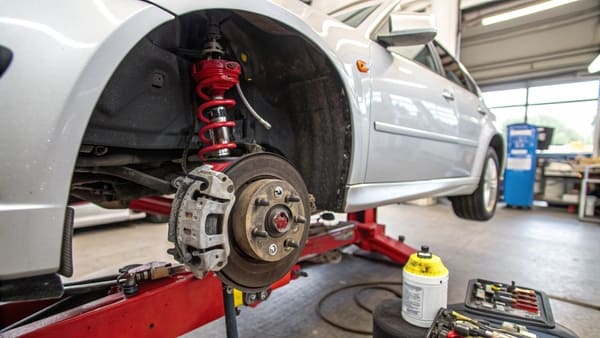
The core principle behind a modern brake system is hydraulics. The system is sealed and filled with a special brake fluid that cannot be compressed. When you push the brake pedal, you are actually pushing a piston inside a component called the master cylinder. This action pressurizes the fluid throughout a network of brake lines and hoses that run to each wheel. This hydraulic pressure acts as a force multiplier6. A small amount of force from your foot is turned into a massive amount of clamping force at the wheels. This force is then used to create friction. The friction is what stops the car, but in the process, it generates an incredible amount of heat. A good brake system isn't just about stopping power; it's also about managing and dissipating this heat effectively to prevent brake failure.
What Are the Main Parts of a Disc Brake System?
Most modern cars need powerful and consistent braking. If brakes overheat, they can fade and lose their stopping power, which is extremely dangerous. Disc brakes provide superior performance and heat dissipation for this reason7.
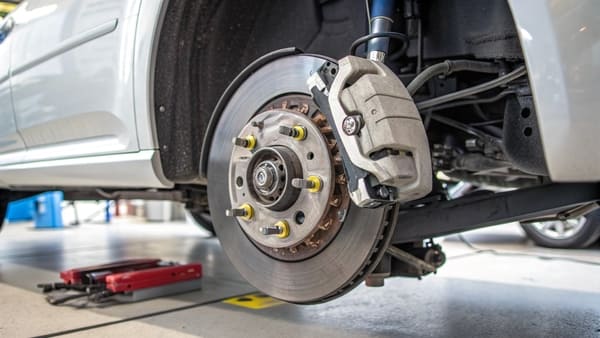
A disc brake system uses a hydraulic caliper to squeeze brake pads against a spinning disc, or rotor, that is attached to the wheel. The three main components are the brake rotor, the brake caliper, and the brake pads. This friction is what slows the wheel down.
Let's dive deeper into how these parts work together. The disc brake is the most common type found on the front wheels of cars today8, and often on the rear as well. Its open design is excellent at getting rid of heat.
| Component | Function | Key Details |
|---|---|---|
| Brake Rotor | The metal disc that spins with the wheel. | It's the surface the brake pads clamp onto. Can be solid or vented (with internal fins) to improve cooling. |
| Brake Caliper | Houses the brake pads and pistons. | When you brake, hydraulic fluid pushes pistons inside the caliper, which then squeezes the brake pads against the rotor. |
| Brake Pads | The friction material. | A steel backing plate with a high-friction material bonded to it. This material is designed to wear down over time. |
Even the smaller components are critical. For example, we manufacture many of the plastic parts used in brake assemblies. Making these is extremely difficult. A standard injection molding machine just doesn't have the precision needed for brake components. Our process has at least three stages, and the hardest one is cooling. I remember my first time producing these parts for a client from Pakistan. We were inexperienced, and the plastic components "shrank" more than expected after cooling. The precision machines needed for this job are usually found in coastal areas like Fujian or near Shanghai, not inland. Luckily, the client actually preferred the smaller, denser parts. We learned a valuable lesson and haven't had an issue since.
What Are the Main Parts of a Drum Brake System?
Not every car needs high-performance disc brakes on all four wheels. Using the wrong system can just add cost without any real benefit. Drum brakes are a very cost-effective and reliable solution.
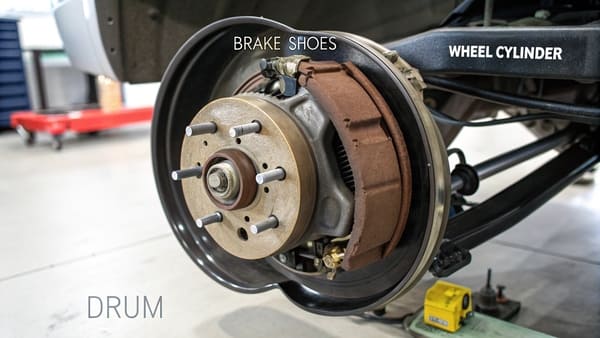
A drum brake system uses a wheel cylinder to push curved brake shoes outward against the inside surface of a spinning drum. The main parts are the brake drum, the brake shoes, and the wheel cylinder, which all work together inside the drum.
Drum brakes are an older design, but they are still widely used today, especially on the rear wheels of many passenger cars and trucks9. Their enclosed design protects the braking components from dirt and water10, and they are less expensive to manufacture. The main components work in a completely different way than a disc brake.
| Component | Function | Key Details |
|---|---|---|
| Brake Drum | A cast iron drum that rotates with the wheel. | It encloses all the other parts. The brake shoes press against the inner surface of the drum to create friction. |
| Brake Shoes | Curved metal platforms with friction lining. | They are pushed outward by the wheel cylinder to make contact with the drum. |
| Wheel Cylinder | A hydraulic component with two pistons. | When you brake, hydraulic fluid pushes the pistons outward, which in turn pushes the brake shoes against the drum. |
| Springs & Adjuster | Various springs and a self-adjusting mechanism. | The springs pull the shoes away from the drum when you release the brake. The adjuster keeps the shoes close to the drum as they wear down. |
One key reason drum brakes are still used on rear axles is that their design makes it easy to add a mechanical parking brake mechanism11. While disc brakes have better heat dissipation and are less prone to "brake fade" during heavy use, drum brakes provide excellent stopping power and are very durable for everyday driving situations12.
Conclusion
Understanding your brake system's main parts, from calipers and rotors to drums and shoes, helps you source reliable components for safe and effective braking performance.
"Railway air brake - Wikipedia", https://en.wikipedia.org/wiki/Railway_air_brake. Automotive safety literature notes that failures in individual brake system components can compromise the entire system's effectiveness, increasing the risk of accidents. Evidence role: expert_consensus; source type: encyclopedia. Supports: A small failure in one part can lead to big problems.. Scope note: This is a general safety principle and may not account for all possible brake system designs or redundancies. ↩
"Disc brake - Wikipedia", https://en.wikipedia.org/wiki/Disc_brake. Automotive engineering references describe the main types of brake assemblies as disc brakes and drum brakes, each with their characteristic components. Evidence role: definition; source type: encyclopedia. Supports: These assemblies are typically disc brakes (caliper, pads, rotor) or drum brakes (drum, shoes, wheel cylinder).. Scope note: Some vehicles may use alternative or hybrid braking systems. ↩
"Hydraulic brake - Wikipedia", https://en.wikipedia.org/wiki/Hydraulic_brake. Standard automotive brake systems use hydraulic pressure to transmit force from the pedal to the wheel mechanisms, as described in engineering textbooks. Evidence role: mechanism; source type: education. Supports: They work together using hydraulic pressure to stop the vehicle.. Scope note: Some vehicles, such as those with air brakes or electric systems, may use different mechanisms. ↩
"Regenerative braking - Wikipedia", https://en.wikipedia.org/wiki/Regenerative_braking. Physics and automotive engineering sources explain that braking systems convert kinetic energy into heat via friction between brake components. Evidence role: mechanism; source type: education. Supports: A car's brake system converts movement (kinetic energy) into heat through friction.. Scope note: The principle applies to friction-based brakes; regenerative braking systems may differ. ↩
"How Do Diesel Hydraulic Brakes Work? - Universal Technical Institute", https://www.uti.edu/blog/diesel/hydraulic-brakes. Automotive engineering texts state that hydraulic fluid transmits and amplifies force in brake systems, generating high pressure to actuate braking mechanisms. Evidence role: mechanism; source type: education. Supports: hydraulic fluid creates immense pressure.. Scope note: The term 'immense' is qualitative; actual pressures vary by system design. ↩
"How Do Diesel Hydraulic Brakes Work? - Universal Technical Institute", https://www.uti.edu/blog/diesel/hydraulic-brakes. Engineering sources explain that hydraulic systems multiply input force, allowing a small pedal force to generate much larger braking force at the wheels. Evidence role: mechanism; source type: education. Supports: This hydraulic pressure acts as a force multiplier.. Scope note: The degree of force multiplication depends on system design and component sizes. ↩
"[PDF] A Test Track Study of Light Vehicle ABS Performance Over ... - NHTSA", https://www.nhtsa.gov/sites/nhtsa.gov/files/nhtsaabst4finalrpt.pdf. Automotive engineering literature indicates that disc brakes generally offer better heat dissipation and more consistent performance under heavy use compared to drum brakes. Evidence role: expert_consensus; source type: education. Supports: Disc brakes provide superior performance and heat dissipation for this reason.. Scope note: Performance advantages may vary depending on specific vehicle design and use case. ↩
"Bicycle brake - Wikipedia", https://en.wikipedia.org/wiki/Bicycle_brake. Industry surveys and automotive references report that disc brakes are standard on the front wheels of most modern passenger vehicles. Evidence role: statistic; source type: encyclopedia. Supports: The disc brake is the most common type found on the front wheels of cars today.. Scope note: Some older or specialized vehicles may use drum brakes on the front wheels. ↩
"Drum brake - Wikipedia", https://en.wikipedia.org/wiki/Drum_brake. Automotive industry sources confirm that drum brakes, though an older technology, remain common on the rear axles of many modern vehicles due to cost and packaging advantages. Evidence role: historical_context; source type: encyclopedia. Supports: Drum brakes are an older design, but they are still widely used today, especially on the rear wheels of many passenger cars and trucks.. Scope note: The trend may be shifting as more vehicles adopt four-wheel disc brakes. ↩
"Drum brake - Wikipedia", https://en.wikipedia.org/wiki/Drum_brake. Engineering references note that drum brakes' enclosed structure helps shield internal components from environmental contaminants such as dirt and water. Evidence role: mechanism; source type: education. Supports: Their enclosed design protects the braking components from dirt and water.. Scope note: Protection is not absolute; severe conditions can still affect drum brakes. ↩
"How Parking Brakes Work - YouTube", https://www.youtube.com/watch?v=h6ej2BoAmvA. Automotive engineering sources explain that drum brakes facilitate integration of mechanical parking brake mechanisms, which is a factor in their continued use on rear axles. Evidence role: mechanism; source type: education. Supports: One key reason drum brakes are still used on rear axles is that their design makes it easy to add a mechanical parking brake mechanism.. Scope note: Some disc brake systems also incorporate parking brakes, though often with more complexity. ↩
"Brake Disc vs. Drum Brakes: Which Is Right for You? - MAT Foundry", https://www.matfoundrygroup.com/blog/brake-disc-vs-drum-brakes-which-is-right-for-you. Automotive engineering literature states that drum brakes offer sufficient stopping power and durability for typical passenger vehicle applications, though they may be less effective under heavy or repeated braking. Evidence role: expert_consensus; source type: education. Supports: drum brakes provide excellent stopping power and are very durable for everyday driving situations.. Scope note: Performance may decline under high thermal loads compared to disc brakes. ↩