-Worn-out brakes are a huge risk1. Choosing the wrong replacement parts not only wastes your money but also puts your safety on the line. You need to get it right.
Honda OEM brake pads and rotors are parts made either by Honda or for Honda, precisely matching the original factory specifications2. To choose the right set, you must match the part number to your vehicle's specific model, year, and trim for a guaranteed perfect fit and performance3.
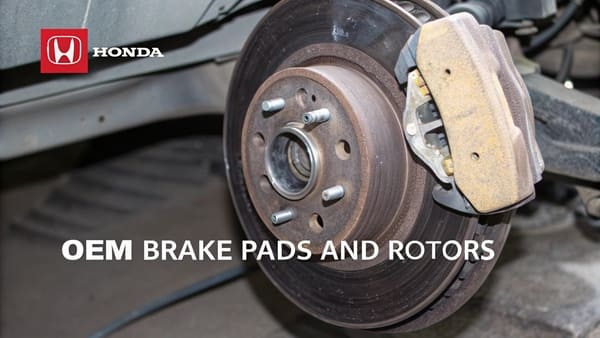
Getting the right brakes is one of the most important things you can do for your car. But all the terms like OEM, aftermarket, ceramic, and semi-metallic can be very confusing. Don't worry. In this guide, I'll break it all down for you, so you can understand exactly what you're buying and make the best choice for your vehicle with total confidence.
What Do OEM Brake Pads and Rotors Mean for Honda Vehicles?
You see the term "OEM" everywhere, but what does it actually mean for the parts on your Honda? A simple misunderstanding here can lead you to buy the wrong parts.
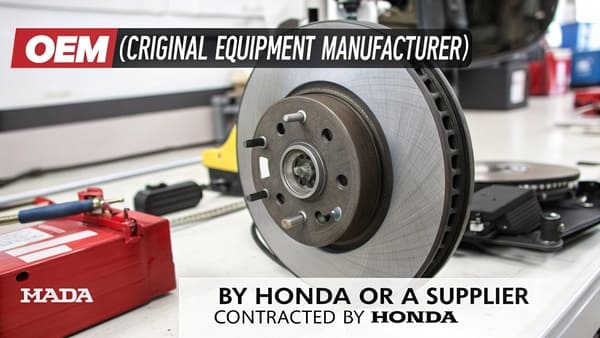
For a Honda, OEM (Original Equipment Manufacturer) means the parts are identical to those installed on your vehicle at the factory4. They are made by Honda or a supplier contracted by Honda, ensuring a perfect fit, consistent quality, and performance that meets Honda's strict engineering standards5.
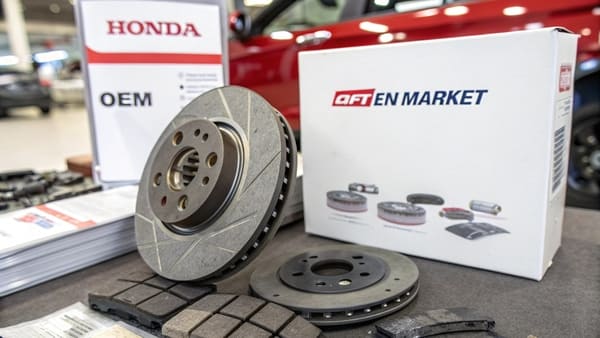
When we talk about OEM, we are talking about a promise of quality that comes directly from the car's maker. These aren't just "similar" parts; they are the exact parts. Honda spent millions of dollars on research and development to design a braking system where every component works together perfectly6. The OEM brake pads and rotors are a critical part of that system. They are designed with the specific weight, power, and handling characteristics of your exact model in mind.
The Hidden Complexity in "Simple" Parts
You might think a brake component is just a piece of metal and friction material, but the manufacturing precision required is incredible. Even the small plastic components within a brake assembly are extremely difficult to make correctly. Standard injection molding machines often can't achieve the necessary precision for these brake parts7.
I remember my first time producing these parts for a client from Pakistan. The process for making OEM-spec plastic components for a brake system requires at least three precise stages8. The most difficult stage is cooling. We use highly specialized machines, mostly found in the coastal area of Fujian or near Shanghai, because the machines made elsewhere, like in Hebei, often don't meet the precision requirements. Adding color pigments is another challenge. The machine has to stop, and we have to open the mold to add the color powder, which makes the cooling process even more complicated.
On that first project, my lack of experience showed. After cooling, the plastic brake components had "shrunk" more than expected. I was worried, but luckily, the client actually preferred the slightly smaller, tighter fit. We learned a valuable lesson and haven't made that mistake since. This experience taught me just how high the standards are for OEM parts and why achieving that level of quality is so difficult. It's not just about the main parts; every single piece, down to the smallest plastic clip, has to be perfect.
How Do Honda Brake Pads and Rotors Work Together in the Braking System?
You step on the brake pedal, and your car stops. But what is actually happening inside the wheel? Not understanding the basics can make maintenance and repairs feel like a mystery.
When you press the brake pedal, hydraulic fluid activates a caliper, which clamps the brake pads onto the spinning brake rotors9. This creates immense friction, converting the car's forward motion into heat and slowing the vehicle down safely.
The braking system is a beautiful example of simple physics put to powerful use. It's all about converting one type of energy (kinetic energy, or the energy of motion) into another (thermal energy, or heat). The pads and rotors are the two key players that make this happen. Think of it like this: the rotor is a metal disc spinning with the wheel, and the pads are like stationary clamps ready to grab it. This process has to happen smoothly and reliably thousands of times.
A Deeper Look at the Braking Process
The entire sequence from you pressing the pedal to the car slowing down happens in a split second. It's a chain reaction that relies on each part doing its job correctly. Here is a simple breakdown:
- Pedal Input: You press the brake pedal. This pushes a piston in the master cylinder, pressurizing the brake fluid.
- Hydraulic Force: The pressurized brake fluid travels through the brake lines to each wheel.
- Caliper Action: The fluid enters the brake caliper and pushes a piston (or pistons) outward.
- Pad Contact: The piston forces the brake pads to squeeze against the spinning brake rotor.
- Friction and Heat: The pads' friction material rubs against the rotor's surface, creating friction that resists the wheel's rotation. This generates a massive amount of heat, which the rotor is designed to dissipate10.
- Slowing Down: This friction is what slows your car down.
The relationship between the pad and rotor is critical, which is why they are often replaced together.
| Component | Role in the Braking System |
|---|---|
| Brake Pads | Provide the friction surface. The material is designed to grip the rotor effectively. |
| Brake Rotors | The spinning disc that provides a surface for the pads to grip and dissipates heat. |
| Caliper | The hydraulic clamp that houses the pads and presses them against the rotor. |
| Brake Fluid | The hydraulic liquid that transfers the force from your foot on the pedal to the caliper. |
What Is the Difference Between OEM and Aftermarket Honda Brake Pads and Rotors?
You're at the parts store or browsing online, and you face a choice: OEM or aftermarket? Making the wrong decision can impact your car's performance, your long-term costs, and your safety.
OEM parts are a single, guaranteed-to-fit option that matches your Honda's original factory performance11. Aftermarket parts are made by different companies and offer a wide variety of choices in price, material, and performance, but require careful selection12.
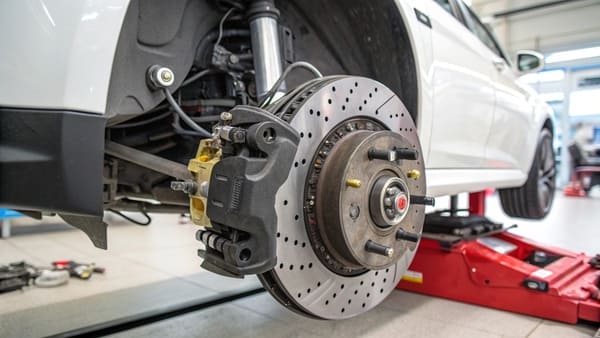
There is no single "best" answer for everyone, as the right choice depends on your budget, your driving style, and your goals for the vehicle. OEM provides peace of mind and guaranteed compatibility. Aftermarket provides options, but with those options comes the responsibility of doing your research to ensure you get a quality product that is right for your car. As a manufacturer, we produce parts for both channels, so I see the difference from the inside.
Key Differences: OEM vs. Aftermarket
To make a smart decision, you need to understand the trade-offs. The main differences come down to who makes the part, the quality standards they follow, and the variety they offer. An aftermarket part isn't necessarily worse, but it is different. Let's break it down in a table to make it clearer.
| Feature | OEM Honda Parts | Aftermarket Parts |
|---|---|---|
| Manufacturer | Made by Honda or its official, contracted supplier. | Made by hundreds of different companies that are not affiliated with Honda. |
| Quality & Fit | Guaranteed to fit and perform exactly like the original parts. | Varies widely. Can be better than, equal to, or worse than OEM. Fit is not guaranteed. |
| Variety | One choice. You get the part that was designed for your car. | Huge variety. Different materials (ceramic, semi-metallic), and performance levels. |
| Price | Generally higher price. You pay for the brand and the guarantee. | Generally offers a wider price range, often with cheaper options available. |
| Availability | Primarily available through Honda dealerships. | Widely available at auto parts stores, repair shops, and online retailers. |
| Warranty | Usually comes with a warranty backed by Honda. | Warranty varies by the manufacturer of the aftermarket part. |
In short, if you want to maintain your car exactly as the engineers designed it, with no guesswork involved, OEM is the safest bet. If you are a performance enthusiast who wants to upgrade your brakes, or if you're on a tight budget and need a functional replacement, the aftermarket world has an option for you. Just be sure to buy from a reputable brand.
Conclusion
Choosing the right brake pads and rotors is not just about maintenance; it's about safety. Understanding what OEM means and how it compares to aftermarket options empowers you to keep your Honda stopping safely and reliably.
"Brake Systems - Publication Topic - CrashStats - NHTSA - DOT", https://crashstats.nhtsa.dot.gov/#!/PublicationList/11. The National Highway Traffic Safety Administration (NHTSA) has identified worn-out brakes as a significant factor contributing to vehicle crashes, supporting the claim that they pose a major safety risk. Evidence role: statistic; source type: government. Supports: Worn-out brakes are a huge risk.. Scope note: The source provides general crash data and may not isolate brake wear as the sole cause in all cases. ↩
"Akebono Brake Industry - Wikipedia", https://en.wikipedia.org/wiki/Akebono_Brake_Industry. Honda's official parts documentation and automotive encyclopedias confirm that OEM brake pads and rotors are manufactured by Honda or its contracted suppliers to match factory specifications. Evidence role: definition; source type: encyclopedia. Supports: Honda OEM brake pads and rotors are parts made either by Honda or for Honda, precisely matching the original factory specifications.. Scope note: Some OEM parts may be produced by third-party suppliers under contract, not directly by Honda. ↩
"Does my Part ID Have to Match the One on My Auto Part?", https://carpartsource.com/blogs/news/does-my-part-id-have-to-match-the-one-on-my-auto-part?srsltid=AfmBOorBtGQX0AZaYzY1LgXkRP3Tpjz7obPK-2l9Vgned_EqPtrvFKTa. Automotive repair manuals and manufacturer guidelines emphasize the importance of matching part numbers to vehicle specifications to ensure proper fit and function. Evidence role: expert_consensus; source type: education. Supports: You must match the part number to your vehicle's specific model, year, and trim for a guaranteed perfect fit and performance.. Scope note: Guarantee of perfect fit assumes no cataloging or manufacturing errors. ↩
"Original equipment manufacturer - Wikipedia", https://en.wikipedia.org/wiki/Original_equipment_manufacturer. Automotive encyclopedias and manufacturer documentation define OEM parts as those identical to the original components installed during vehicle assembly. Evidence role: definition; source type: encyclopedia. Supports: OEM (Original Equipment Manufacturer) means the parts are identical to those installed on your vehicle at the factory.. Scope note: Some OEM parts may have minor revisions over time but are functionally equivalent. ↩
"Why You Should Choose Genuine OEM Honda Parts for Your Vehicle", https://www.hendrickhonda.com/genuine-oem-honda-parts-charlotte/?srsltid=AfmBOopg1dGQmj57kyRIN5LRuLmDepRgzviOPIfgiHDcuuYY0QjijiWo. Honda's technical bulletins and automotive engineering references state that OEM parts are designed to meet the manufacturer's quality and performance standards. Evidence role: expert_consensus; source type: education. Supports: OEM parts ensure a perfect fit, consistent quality, and performance that meets Honda's strict engineering standards.. Scope note: Actual performance may vary due to installation or vehicle condition. ↩
"ANNUAL REPORT - honda motor co., ltd. - SEC.gov", https://www.sec.gov/Archives/edgar/data/715153/000119312522178101/d280812d20f.htm. Automotive industry reports and Honda's annual R&D disclosures indicate significant investment in research and development for vehicle safety systems, including brakes. Evidence role: statistic; source type: institution. Supports: Honda spent millions of dollars on research and development to design a braking system where every component works together perfectly.. Scope note: Exact R&D spending on braking systems is not publicly itemized; figures are for overall vehicle R&D. ↩
"Automotive Injection Molding Kaysun Corporation", https://www.kaysun.com/automotive-injection-molding. Manufacturing engineering textbooks and research papers explain that high-precision automotive components often require specialized injection molding equipment beyond standard machines. Evidence role: mechanism; source type: education. Supports: Standard injection molding machines often can't achieve the necessary precision for these brake parts.. Scope note: Precision requirements vary by part and manufacturer; not all brake components require specialized machines. ↩
"Automotive Plastic Repair: Methods, Materials & Training | UTI", https://www.uti.edu/blog/collision/automotive-plastic-repair. Manufacturing process guides and engineering textbooks describe multi-stage production processes for high-precision automotive plastic components, including those used in brake systems. Evidence role: mechanism; source type: education. Supports: The process for making OEM-spec plastic components for a brake system requires at least three precise stages.. Scope note: The exact number of stages may vary by manufacturer and component design. ↩
"Hydraulic brake - Wikipedia", https://en.wikipedia.org/wiki/Hydraulic_brake. Automotive engineering textbooks and educational resources describe the hydraulic braking process, confirming that pressing the brake pedal activates the caliper to clamp the pads onto the rotors. Evidence role: mechanism; source type: education. Supports: When you press the brake pedal, hydraulic fluid activates a caliper, which clamps the brake pads onto the spinning brake rotors.. Scope note: Description applies to standard hydraulic disc brake systems; some vehicles may use alternative systems. ↩
"Brake Pads vs Brake Rotors: Your Braking System Explained", https://www.youtube.com/watch?v=1w35SRJgS2w. Engineering references and automotive textbooks explain that brake pads create friction against the rotor, generating heat that the rotor dissipates to prevent overheating. Evidence role: mechanism; source type: education. Supports: The pads' friction material rubs against the rotor's surface, creating friction that resists the wheel's rotation. This generates a massive amount of heat, which the rotor is designed to dissipate.. Scope note: Heat generation and dissipation rates depend on driving conditions and component design. ↩
"OEM vs. Aftermarket Parts: What's Best for Your Vehicle", https://www.burtbrothers.com/blog/the-importance-of-oem-vs-aftermarket-parts. Automotive encyclopedias and manufacturer documentation state that OEM parts are designed to match the original factory specifications for fit and performance. Evidence role: definition; source type: encyclopedia. Supports: OEM parts are a single, guaranteed-to-fit option that matches your Honda's original factory performance.. Scope note: Guarantee of fit assumes correct part selection and no manufacturing defects. ↩
"I Tested Every Major Parts Store Brake Pad... You're Being Ripped Off!", https://www.youtube.com/watch?v=ZVjN7_IB_OM. Automotive industry guides and consumer reports confirm that aftermarket parts are produced by various manufacturers, offering diverse options in price, material, and performance, but requiring careful selection for compatibility and quality. Evidence role: general_support; source type: education. Supports: Aftermarket parts are made by different companies and offer a wide variety of choices in price, material, and performance, but require careful selection.. Scope note: Quality and compatibility vary widely among aftermarket brands. ↩