-Your truck's AC just gave out on a hot day. A sweltering cab isn't just uncomfortable, it's a distraction. Understanding the core parts is the first step to a fast fix.
The most important truck AC parts are the compressor, condenser, receiver-drier, expansion valve, and evaporator.1 These components work together in a closed loop to move heat from inside your cab to the outside, using a special fluid called refrigerant to create cold air.2
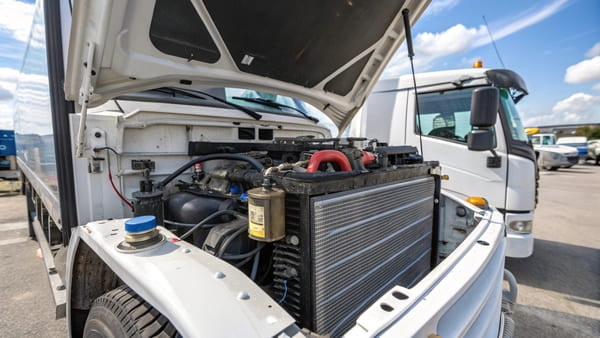
When your livelihood depends on spending hours on the road, a working air conditioner is not a luxury, it's a necessity.3 But when it fails, the system can seem like a complex black box. My goal here is to open that box for you. We'll look at each major part, one by one, so you can understand exactly what’s happening and why quality components are so critical. Let's get started.
What Are AC Truck Parts?
You hear the term "AC parts" all the time, but it feels vague. This makes it hard to diagnose problems or find the right replacements. Let's define what these parts actually are.
AC truck parts are the individual components that form the complete air conditioning system.4 They work together to move heat from inside the truck to the outside air, using a refrigerant that changes between liquid and gas. This system is a perfect example of a closed loop.
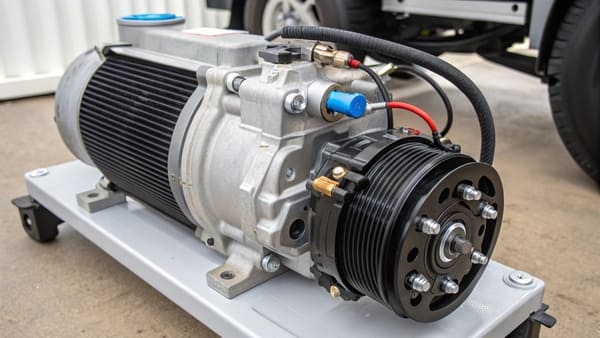
When we talk about these parts, we're covering everything from large metal assemblies to small plastic housings. The system is a closed loop, meaning the refrigerant is sealed inside and continuously cycles through the different components. It picks up heat inside the cab and releases it outside. The main parts are made of metal, like the aluminum condenser and evaporator that handle heat exchange.5 Hoses and lines connect everything. But there are also many critical plastic parts, like the main housing, vents, and internal ductwork.
From a manufacturing standpoint, these plastic parts are surprisingly difficult to make correctly. Standard injection molding machines often can't achieve the precision needed.6 For example, when we produce plastic housings for AC units, the process has several critical steps, and the cooling stage is the most challenging. The machines that can handle this level of precision are usually found in the coastal industrial zones, like in Fujian or near Shanghai.
I learned this the hard way. On my first project making these parts for a client in Pakistan, I didn't have enough experience. After the injection and molding process, the plastic parts shrank more than expected during cooling. I was worried we had failed. But when the client received them, he was actually happier with the result. The slightly smaller size fit his specific assembly better. It was a lucky break, but it taught me a valuable lesson about controlling every variable, especially cooling, to manage material shrinkage. We've perfected that process since and never leave it to chance.
What Components Make Up a Complete Truck Air Conditioning System?
The AC system can seem like a tangled mess of pipes and wires. You don't know where to start looking when something goes wrong. Here are the main players you need to know.
A complete truck air conditioning system is built around five core components: the compressor, condenser, receiver-drier (or accumulator), expansion valve (or orifice tube), and the evaporator.7 Each one performs a specific task in the cooling cycle to keep your cab comfortable.
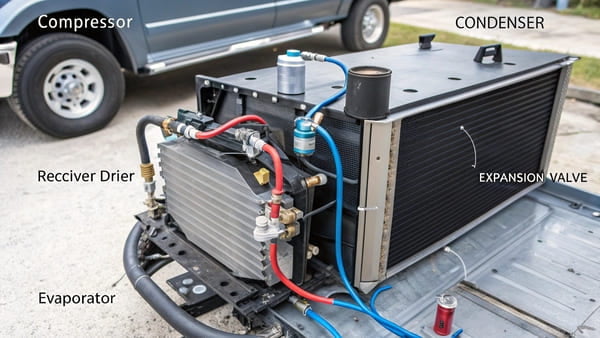
Each part of the truck AC system has a distinct role, but they all must work together perfectly. If one part fails, the entire system stops cooling.8 Think of it as a relay race where the refrigerant is the baton. It gets passed from one component to the next, changing form along the way to move heat. To make it clearer, let's break down each part and its job in a simple table.
The Main Players in a Truck AC System
| Component | Primary Function |
|---|---|
| Compressor | The "heart" of the system. It pumps and pressurizes the refrigerant gas. |
| Condenser | Located at the front of the truck. It releases heat from the refrigerant. |
| Receiver-Drier | Acts as a filter and safety reservoir for the liquid refrigerant. |
| Expansion Valve | A small valve that creates a pressure drop, rapidly cooling the refrigerant. |
| Evaporator | Located inside the cab. It absorbs heat from the cab's air, creating cold. |
| Refrigerant | The specialized fluid that absorbs and releases heat as it circulates. |
The cycle starts at the compressor, which pressurizes low-pressure refrigerant gas into a high-pressure, hot gas.9 This hot gas flows to the condenser, which looks like a small radiator. Air flowing over the condenser fins cools the gas until it turns into a high-pressure liquid. This liquid then moves to the receiver-drier, which removes any moisture and debris. From there, the clean, high-pressure liquid refrigerant goes to the expansion valve. The valve causes a sudden drop in pressure, making the refrigerant intensely cold as it turns into a fine, freezing mist. This cold mist enters the evaporator inside the dashboard. A fan blows cab air over the evaporator, the mist absorbs the heat from the air, and you get cold air blowing out of your vents. The refrigerant, now a low-pressure gas again, cycles back to the compressor to start the whole process over.
What Does a Truck AC Compressor Do?
People call the compressor the "heart" of the AC system, but why? Because if it fails, the entire system dies. Let's look at its vital role in keeping you cool.
The AC compressor is a powerful pump driven by the truck's engine via a belt. Its only job is to take low-pressure refrigerant gas from the evaporator and compress it into a high-pressure, high-temperature gas before sending it on its way to the condenser.
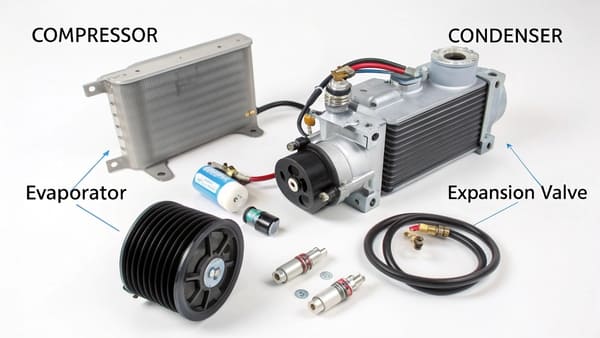
The compressor is where the entire cooling process gets its energy.10 It's connected to the engine’s crankshaft by a serpentine belt. However, it doesn’t run all the time. It uses an electromagnetic clutch on its pulley. When you turn the AC on, an electric signal engages this clutch, connecting the pulley to the compressor's internal pump and starting the compression cycle. When you turn the AC off, or when the system reaches the right pressure, the clutch disengages. This saves fuel and reduces wear and tear on the compressor.
There are different types of compressors used in trucks. The most common are fixed-displacement and variable-displacement.
- Fixed-Displacement Compressors: These pump a set amount of refrigerant with every rotation. They are simple, durable, and reliable, but they cycle on and off frequently to regulate temperature, which can be less efficient.
- Variable-Displacement Compressors: These can change the amount of refrigerant they pump, even while spinning continuously. They adjust their output based on the cooling demand, which makes them much more fuel-efficient and provides more stable temperatures. However, they are more complex and can be more expensive to replace.
As a manufacturer, we know the compressor is the most mechanically stressed part of the system. The internal tolerances are incredibly tight to handle the extreme pressures.11 Common failures include a worn-out clutch that won't engage, leaking seals that let refrigerant escape, or internal bearing failure from a lack of oil. This is why using a high-quality, well-built compressor is non-negotiable for a reliable AC system.
Conclusion
Understanding your truck's AC means knowing its core parts: the compressor, condenser, and evaporator. Each plays a vital role in moving heat, and using quality components ensures reliable, long-lasting cooling.
"Air conditioning - Wikipedia", https://en.wikipedia.org/wiki/Air_conditioning. A standard truck air conditioning system typically consists of a compressor, condenser, receiver-drier (or accumulator), expansion valve (or orifice tube), and evaporator, as described in technical manuals and automotive engineering references. Evidence role: definition; source type: encyclopedia. Supports: The most important truck AC parts are the compressor, condenser, receiver-drier, expansion valve, and evaporator.. Scope note: Some systems may use an accumulator instead of a receiver-drier, depending on design. ↩
"How Does Car AC Work? | UTI - Universal Technical Institute", https://www.uti.edu/blog/automotive/air-conditioning. Refrigerants are specialized fluids used in air conditioning systems to absorb and release heat, enabling the cooling of air inside vehicle cabins, as explained in HVAC engineering literature. Evidence role: mechanism; source type: education. Supports: The AC system uses a special fluid called refrigerant to create cold air.. Scope note: The refrigerant does not directly 'create' cold air but facilitates heat transfer. ↩
"Are motor carriers legally obligated to provide air conditioning in ...", https://www.fmcsa.dot.gov/faq/are-motor-carriers-legally-obligated-provide-air-conditioning-commercial-motor-vehicles. Occupational safety guidelines recognize that air conditioning in commercial vehicles is important for driver comfort and alertness, which can impact safety and productivity. Evidence role: expert_consensus; source type: government. Supports: A working air conditioner is not a luxury, it's a necessity for truck drivers.. Scope note: Necessity may vary by region and regulation; not all jurisdictions require AC in trucks. ↩
"Automotive air conditioning - Wikipedia", https://en.wikipedia.org/wiki/Automotive_air_conditioning. The term 'AC truck parts' generally refers to the individual components that make up a truck's air conditioning system, as defined in automotive repair and maintenance guides. Evidence role: definition; source type: encyclopedia. Supports: AC truck parts are the individual components that form the complete air conditioning system.. Scope note: Terminology may vary in different regions or industries. ↩
"How Does Car AC Work? | UTI - Universal Technical Institute", https://www.uti.edu/blog/automotive/air-conditioning. Automotive engineering sources confirm that condensers and evaporators in vehicle AC systems are typically constructed from aluminum due to its thermal conductivity and corrosion resistance. Evidence role: mechanism; source type: education. Supports: The main parts are made of metal, like the aluminum condenser and evaporator that handle heat exchange.. Scope note: Some older or specialized systems may use other metals. ↩
"40 CFR Part 82 Subpart B -- Servicing of Motor Vehicle Air ... - eCFR", https://www.ecfr.gov/current/title-40/chapter-I/subchapter-C/part-82/subpart-B. Manufacturing literature notes that producing complex automotive plastic parts, such as AC housings, may require specialized injection molding equipment to achieve the necessary tolerances and precision. Evidence role: expert_consensus; source type: research. Supports: Standard injection molding machines often can't achieve the precision needed for AC plastic parts.. Scope note: Precision requirements depend on part design and manufacturer capabilities. ↩
"Automotive air conditioning - Wikipedia", https://en.wikipedia.org/wiki/Automotive_air_conditioning. Technical manuals and automotive engineering textbooks describe the five core components of a typical truck AC system as the compressor, condenser, receiver-drier or accumulator, expansion valve or orifice tube, and evaporator. Evidence role: definition; source type: education. Supports: A complete truck air conditioning system is built around five core components: the compressor, condenser, receiver-drier (or accumulator), expansion valve (or orifice tube), and the evaporator.. Scope note: Component names and configurations may vary by vehicle make and model. ↩
"Troubleshooting Tips for Your Car's AC Unit", https://autotraining.edu/auto-repair-tips/car-ac/. Automotive repair guides explain that failure of any major AC component, such as the compressor or evaporator, can prevent the system from producing cold air. Evidence role: mechanism; source type: education. Supports: If one part fails, the entire system stops cooling.. Scope note: Some minor failures may only reduce efficiency rather than cause total loss of cooling. ↩
"How Does Car AC Work? | UTI - Universal Technical Institute", https://www.uti.edu/blog/automotive/air-conditioning. The refrigeration cycle in vehicle AC systems begins with the compressor, which increases the pressure and temperature of the refrigerant gas, as described in HVAC engineering textbooks. Evidence role: mechanism; source type: education. Supports: The cycle starts at the compressor, which pressurizes low-pressure refrigerant gas into a high-pressure, hot gas.. Scope note: Some schematic diagrams may depict the cycle starting at different points for illustration. ↩
"[PDF] Energy saving measures for automotive air conditioning (AC) system ...", https://docs.lib.purdue.edu/cgi/viewcontent.cgi?article=2360&context=iracc. In automotive air conditioning systems, the compressor is powered by the engine and provides the energy required to circulate refrigerant and drive the cooling cycle, as explained in technical references. Evidence role: mechanism; source type: education. Supports: The compressor is where the entire cooling process gets its energy.. Scope note: Energy input is ultimately from the engine; the compressor is the primary AC system component using this energy. ↩
"How Car AC Compressors Work and How to Make Them Last Longer", https://www.youtube.com/watch?v=7peUC5fGP5A&vl=en-US. Engineering analyses of automotive AC compressors note that these components require precise internal tolerances to withstand high operating pressures and ensure reliability. Evidence role: mechanism; source type: research. Supports: The internal tolerances are incredibly tight to handle the extreme pressures in AC compressors.. Scope note: Exact tolerances vary by compressor design and manufacturer. ↩