-Choosing the wrong brake pads for your truck can risk your safety and performance1. This leads to costly repairs and vehicle downtime. Let's find the best options for your truck's needs.
The best truck brake pads depend entirely on your application. For heavy-duty towing, ceramic or semi-metallic pads with high heat resistance are ideal. For daily driving, organic pads offer quiet performance. The key is matching the material to your specific performance, safety, and load requirements.
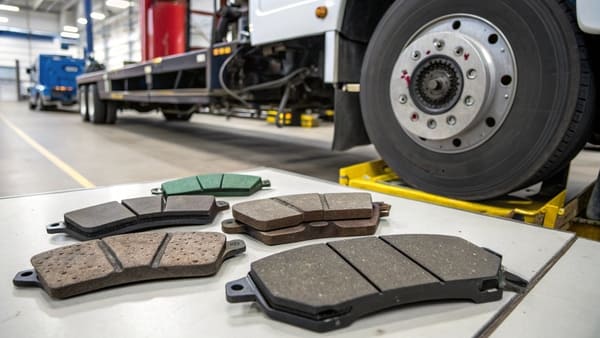
Finding the right brake pad can feel overwhelming, but it's one of the most important decisions you'll make for your vehicle. The difference between a smooth stop and a dangerous situation often comes down to that small component. I've spent years in the automotive parts industry, and I've seen firsthand how the right brake pad technology can transform a truck's safety profile. We'll break down everything you need to know, so you can make a confident choice that keeps you, your cargo, and others on the road safe. Let's get into it.
What Are Truck Brake Pads and Why Are They So Important?
Are you unsure why brake pads are so critical for your truck? Ignoring them can lead to brake failure. Understanding their function is the first step to ensuring your vehicle's safety.
Truck brake pads are the friction components that press against the brake rotors to slow or stop your vehicle. They are crucial for safety, especially under heavy loads, because they convert kinetic energy into heat. Their effectiveness directly impacts stopping distance and overall vehicle control2.
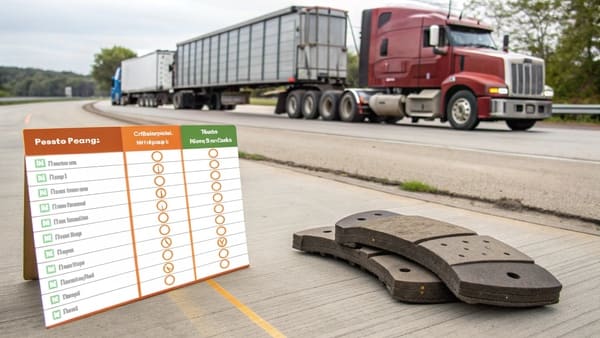
Let's dive a little deeper into how this works. Your truck's brake system is a powerhouse of engineering. When you press the brake pedal, you're sending hydraulic fluid to a caliper, which houses the brake pads. This caliper acts like a clamp, squeezing the brake pads against the spinning brake rotor attached to your wheel. The friction created is what stops your truck. Think about the immense force needed to stop a multi-ton vehicle, especially one that's hauling a heavy load or going downhill. All that forward motion, or kinetic energy, has to go somewhere. The brake pads convert it into thermal energy, or heat. This is why their ability to manage heat is so critical. If they overheat, a condition known as "brake fade" occurs, and your stopping power disappears3. Every component in this system, from the pads to the smallest plastic accessory, must be manufactured with extreme precision to handle these forces reliably every single time.
What Types of Truck Brake Pads Are Available?
Feeling overwhelmed by all the brake pad options on the market? Choosing the wrong one can waste your money and compromise your safety. Let's break down the main types to simplify your decision.
The main types of truck brake pads are Organic (NAO), Semi-Metallic, and Ceramic4. Each type uses different friction materials, offering a unique balance of stopping power, noise level, dust creation, and lifespan. The right choice depends entirely on your truck's usage and your priorities.
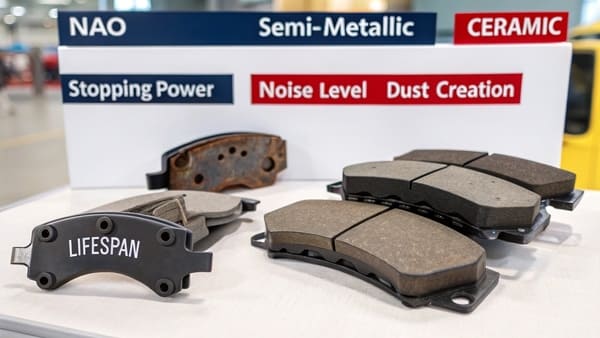
Each material has its own set of strengths and weaknesses. There is no single "best" type; the ideal choice is always the one that best fits how you use your truck. I've worked with global brands to develop brake systems, and the first question is always about the vehicle's intended application. A pad designed for a light-duty daily driver will fail catastrophically on a heavy-duty commercial truck. Understanding the core differences between these materials is the most important step in making an informed purchase.
Organic Brake Pads (NAO)
Organic pads, also known as Non-Asbestos Organic (NAO) pads, are made from a mixture of materials like fiber, glass, rubber, and even Kevlar, all held together by a resin5. They are generally the softest type of brake pad. This makes them very quiet and easy on your brake rotors, causing less wear over time. They are also typically the most affordable option. However, their softness is also their biggest weakness. They wear out faster than other types and produce a fair amount of brake dust. More importantly, they don't handle high heat well, which means they are not suitable for heavy-duty towing, performance driving, or long, steep descents where brake fade is a serious risk.
Semi-Metallic Brake Pads
Semi-metallic brake pads are a big step up in performance6. They are made with a mix of 30% to 70% metals, including steel, iron, and copper, combined with graphite and other fillers. The metal content makes them extremely durable and excellent at conducting heat away from the rotor7. This gives them fantastic stopping power and makes them very resistant to brake fade, which is why they are a popular choice for heavy-duty and commercial trucks. The downsides are that they tend to be noisier, produce more brake dust (which can be corrosive to wheels), and are harder on the brake rotors, causing them to wear out faster than with other pad types.
Ceramic Brake Pads
Ceramic brake pads represent the top tier of brake pad technology8. They are made from dense ceramic fibers and non-ferrous filler materials, bonded together. Their biggest advantages are that they are extremely quiet, produce very little, light-colored dust, and are very stable across a wide range of temperatures. This means they provide consistent, reliable braking performance without the noise and harshness of semi-metallic pads. They also last a very long time and are gentle on rotors. The main drawback is their cost; they are the most expensive option. While they perform well in most conditions, some drivers feel they don't have the same aggressive initial "bite" as semi-metallic pads, especially when cold.
Here is a simple table to compare them:
| Feature | Organic (NAO) | Semi-Metallic | Ceramic |
|---|---|---|---|
| Stopping Power | Good | Excellent | Very Good |
| Heat Resistance | Low | Excellent | Very Good |
| Noise Level | Very Quiet | Can be Noisy | Very Quiet |
| Dust Creation | High | High | Low |
| Rotor Wear | Low | High | Low |
| Lifespan | Short | Long | Very Long |
| Cost | Low | Medium | High |
Which Brake Pad Material Is Best for Different Truck Applications?
Worried you will pick the wrong material for your specific truck? This decision directly impacts your safety and your budget. Let's match the right pad to your exact needs.
For heavy-duty towing and hauling, semi-metallic or high-performance ceramic pads are best due to their heat resistance9. For daily driving and light-duty trucks, organic pads offer a quiet, smooth ride10. Performance trucks benefit most from semi-metallic or specialized ceramic formulas for maximum stopping power11.
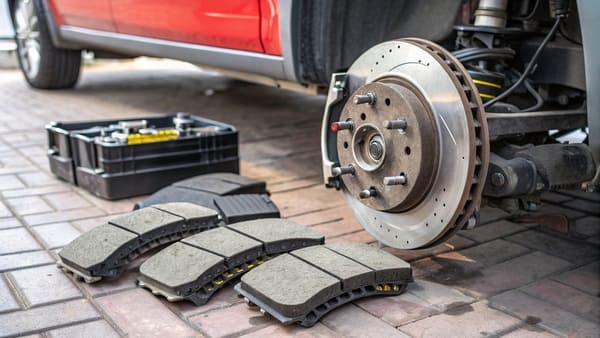
When we develop components for heavy-duty brake systems as an OEM supplier, we know that every single part, even the small plastic accessories, requires incredible precision. I remember my first project developing brake system components for a client from Pakistan. We were making these small plastic parts for a truck brake pad assembly. The manufacturing process is incredibly complex; your standard injection molding machine just can't do it. The cooling stage is especially tricky and requires specialized equipment, usually found in the high-tech manufacturing hubs along China's coast. On that first production run, the parts "shrank" a bit more than expected after cooling. I was worried it was a failure, but the client actually preferred the tighter fit it created! It was a lesson in how even tiny variations can have unexpected outcomes in high-performance systems. We learned from it and perfected our process, because in heavy-duty applications, there is simply no room for error.
Let's break down the best choice for your truck.
Heavy-Duty Towing & Commercial Trucks
For trucks that work hard, heat is the enemy. You need a brake pad that can take the abuse of stopping thousands of pounds over and over again without fading.
- Best Choice: Semi-Metallic Pads. Their excellent heat dissipation and powerful bite make them the industry standard for commercial and heavy-duty use.
- Alternative: Heavy-Duty Ceramic Pads. Specially formulated ceramic pads designed for trucks can also be a great option, offering better noise and dust control than semi-metallics, but ensure they are rated for the weight you'll be hauling.
Daily Driving & Light-Duty Trucks
If your truck is primarily for commuting, light errands, or occasional light hauling, your priorities shift towards comfort and cost-effectiveness.
- Best Choice: Organic (NAO) Pads. They offer a quiet, smooth ride and are gentle on your rotors and your wallet.
- Alternative: Standard Ceramic Pads. If you want to reduce brake dust and get a longer lifespan without the noise of semi-metallics, ceramic pads are an excellent upgrade for a daily driver.
Off-Road & Performance Trucks
For trucks built for speed or tackling tough trails, you need a brake pad that bites hard and can handle rapid temperature changes.
- Best Choice: Semi-Metallic Pads. Their aggressive initial bite gives you the confidence you need for performance driving or technical off-roading.
- Alternative: Performance Ceramic Pads. These specialized formulas are designed to provide a stronger bite and better heat management than standard ceramics, giving you a great balance of performance and refinement.
Here’s a quick reference table:
| Application | Primary Recommendation | Why? |
|---|---|---|
| Heavy-Duty / Towing | Semi-Metallic | Best heat resistance and stopping power under load. |
| Daily Driving | Organic (NAO) | Quietest operation, low cost, and smooth feel. |
| Performance / Off-Road | Semi-Metallic | Aggressive initial bite and fade resistance. |
| Low Dust / Long Life | Ceramic | Cleanest, quietest, and longest-lasting option for most uses. |
Conclusion
Choosing the right truck brake pads means matching the material to your application. This ensures maximum safety, performance, and durability for your heavy-duty, performance, or daily driving needs.
"Brake Pad Timeline - Department of Toxic Substances Control", https://dtsc.ca.gov/scp/brake-pad-timeline/. Research and safety analyses indicate that improper selection of brake pads can compromise vehicle safety and braking performance, increasing the risk of accidents and mechanical failures. Evidence role: expert_consensus; source type: government. Supports: Choosing the wrong brake pads for your truck can risk your safety and performance.. Scope note: While general safety risks are documented, specific outcomes depend on vehicle type and usage. ↩
"Tribological and performance assessment of two wheeler brake ...", https://pmc.ncbi.nlm.nih.gov/articles/PMC12479935/. Automotive engineering literature confirms that brake pad effectiveness is a key factor in determining stopping distance and vehicle control during braking maneuvers. Evidence role: mechanism; source type: education. Supports: Their effectiveness directly impacts stopping distance and overall vehicle control.. Scope note: Exact impact varies with vehicle design and brake system condition. ↩
"Brake fade - Wikipedia", https://en.wikipedia.org/wiki/Brake_fade. Technical sources describe brake fade as a loss of braking power due to overheating of friction materials, which reduces their effectiveness. Evidence role: mechanism; source type: education. Supports: If they overheat, a condition known as "brake fade" occurs, and your stopping power disappears.. Scope note: Severity of brake fade depends on pad material and driving conditions. ↩
"Brake pad - Wikipedia", https://en.wikipedia.org/wiki/Brake_pad. Automotive encyclopedias and technical guides classify truck brake pads into organic (NAO), semi-metallic, and ceramic types based on their material composition. Evidence role: definition; source type: encyclopedia. Supports: The main types of truck brake pads are Organic (NAO), Semi-Metallic, and Ceramic.. Scope note: Some sources may include additional subtypes or proprietary blends. ↩
"Differences in Wear and Material Integrity of NAO and Low ...", https://pmc.ncbi.nlm.nih.gov/articles/PMC8509441/. Technical references describe Non-Asbestos Organic (NAO) brake pads as being composed of fibers, glass, rubber, and sometimes Kevlar, bonded with resin. Evidence role: definition; source type: education. Supports: Organic pads, also known as Non-Asbestos Organic (NAO) pads, are made from a mixture of materials like fiber, glass, rubber, and even Kevlar, all held together by a resin.. Scope note: Exact composition may vary by manufacturer and application. ↩
"What's the Difference Between Ceramic & Metallic Brake Pads?", https://tires.bridgestone.com/en-us/learn/automotive/tire-maintenance/ceramic-vs-metallic-brake-pads. Comparative studies indicate that semi-metallic brake pads generally offer improved performance characteristics, such as higher heat resistance and stopping power, compared to organic pads. Evidence role: statistic; source type: paper. Supports: Semi-metallic brake pads are a big step up in performance.. Scope note: Performance improvements depend on specific formulations and vehicle use. ↩
"Initial Selection of Disc Brake Pads Material based on the ... - PMC", https://pmc.ncbi.nlm.nih.gov/articles/PMC7078729/. Engineering sources explain that the high metal content in semi-metallic brake pads enhances durability and thermal conductivity, aiding in heat dissipation during braking. Evidence role: mechanism; source type: education. Supports: The metal content makes them extremely durable and excellent at conducting heat away from the rotor.. Scope note: Actual durability and heat conduction depend on the specific metal blend used. ↩
"Are ceramic brake pads better? - Quora", https://www.quora.com/Are-ceramic-brake-pads-better. Automotive engineering reviews often describe ceramic brake pads as advanced due to their stability, low noise, and minimal dust production, positioning them as a premium option. Evidence role: expert_consensus; source type: education. Supports: Ceramic brake pads represent the top tier of brake pad technology.. Scope note: 'Top tier' is a qualitative assessment and may vary by application and user preference. ↩
"Best brake pad material for towing - Forest River Forums", https://www.forestriverforums.com/threads/best-brake-pad-material-for-towing.385613/. Industry guidelines and technical recommendations suggest that semi-metallic and certain high-performance ceramic brake pads are preferred for heavy-duty towing due to superior heat resistance and fade performance. Evidence role: expert_consensus; source type: institution. Supports: For heavy-duty towing and hauling, semi-metallic or high-performance ceramic pads are best due to their heat resistance.. Scope note: Suitability depends on the specific pad formulation and vehicle requirements. ↩
"How do we feel about ceramic brakes? : r/MechanicAdvice - Reddit", https://www.reddit.com/r/MechanicAdvice/comments/6cv8x8/how_do_we_feel_about_ceramic_brakes/. Automotive maintenance guides note that organic brake pads are commonly chosen for daily driving and light-duty trucks due to their quiet operation and smooth braking feel. Evidence role: expert_consensus; source type: education. Supports: For daily driving and light-duty trucks, organic pads offer a quiet, smooth ride.. Scope note: Noise and ride quality can vary with pad brand and vehicle model. ↩
"Brake Pads Tested So You Know What To Expect - Diesel Army", http://www.dieselarmy.com/tech-stories/brake-pads-testing-to-get-the-shortest-stopping-distance/. Performance vehicle technical manuals recommend semi-metallic or specialized ceramic brake pads for enhanced stopping power and fade resistance in high-performance applications. Evidence role: expert_consensus; source type: education. Supports: Performance trucks benefit most from semi-metallic or specialized ceramic formulas for maximum stopping power.. Scope note: Effectiveness depends on the specific brake system and driving style. ↩