-Confused by body kit materials? The wrong choice can lead to bad fitment and costly repairs. This guide breaks down the common materials so you can choose wisely.
The most common materials for car body kits are plastics like Polyurethane (PU) and Acrylonitrile Butadiene Styrene (ABS), as well as composites like Fiberglass (FRP) and Carbon Fiber.1 Each material offers a different balance of durability, flexibility, weight, and cost for your vehicle.
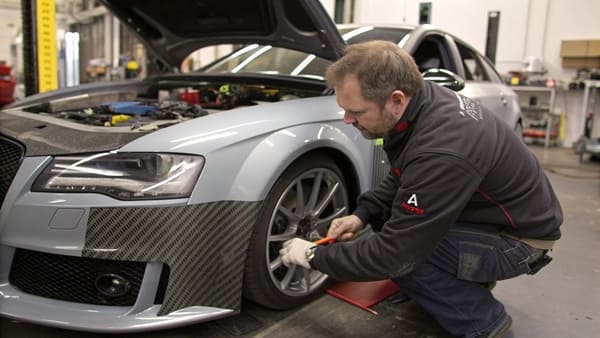
Choosing a body kit is a big decision for any car enthusiast or parts importer. The material directly impacts how the part fits, how it holds up to daily driving, and how much it costs. Understanding these differences is the first step to sourcing high-quality products that your customers will love. Let's dive deeper into what these parts are actually made of.
What Are Car Body Kits Made Of?
You see body kits online that look similar but have very different prices. This is confusing. The price difference often comes down to the material used to make them.
Car body kits are mainly made from four types of materials: polyurethane (PU), ABS plastic, fiberglass (FRP), and carbon fiber. Each one has its own unique pros and cons that affect durability, fitment, and the final price of the product.
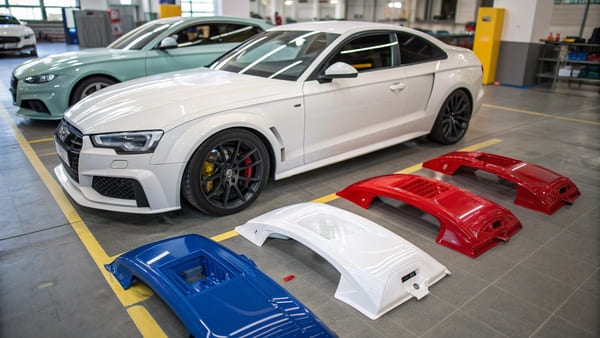
When we talk about body kits, we are usually talking about a few key materials. The choice of material is one of the biggest factors in the quality and price of the final part. As a manufacturer, we work with all of them, and each serves a different purpose for our clients, whether they are global brands or wholesale distributors. Let's break them down in a simple table so you can see the differences clearly.
| Material | Key Feature | Best For | Common Issues |
|---|---|---|---|
| Fiberglass (FRP) | Low Cost & Rigid | Custom, one-off builds; budget projects | Brittle, can crack on impact, requires prep work |
| Polyurethane (PU) | Highly Flexible & Durable | Daily driven cars, premium aftermarket parts | Heavier, more expensive to produce |
| ABS Plastic | Balanced & OEM-like | Mass-produced kits, parts needing good fitment | Can become brittle in extreme cold |
| Carbon Fiber | Ultra Lightweight & Strong | Racing, high-performance, and luxury cars | Very expensive, difficult to repair |
Each material has its place. Fiberglass is great for someone on a tight budget who wants a unique look.2 Polyurethane is what I recommend for parts that need to withstand daily bumps and scrapes.3 ABS is the workhorse, offering a great balance that's similar to what car manufacturers use themselves.4 And carbon fiber is the ultimate choice for performance, where every pound of weight matters.5
Are All Body Kits Made of Plastic?
Many people hear the term "body kit" and immediately think of plastic. This is a common mistake that can lead you to overlook other great options for your car or product line. Let's clear up this misunderstanding.
No, not all body kits are made of plastic. While plastics like ABS and polyurethane are very popular, materials like fiberglass reinforced plastic (FRP) and high-end carbon fiber are also widely used.6 The term "plastic" is often used loosely to cover these different synthetic materials.
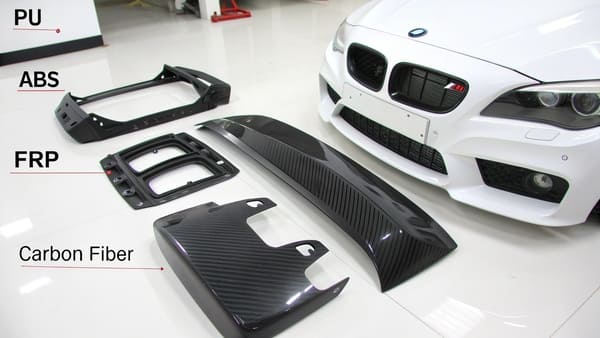
It's easy to group all body kits under the "plastic" umbrella, but that isn't accurate. The materials are quite different. Fiberglass Reinforced Plastic, or FRP, is a good example. It's not a simple plastic. It's a composite material made by mixing fine strands of glass with a polyester resin.7 This makes it strong and rigid, but also brittle. It's popular for custom kits because it's easy to shape and repair, but it can crack on impact.8
Then you have carbon fiber. This is another composite, but it's in a league of its own. It's made by weaving strands of carbon into a fabric, which is then laid into a mold and set with a hard epoxy resin.9 The result is a part that is incredibly strong and extremely lightweight. This is why you see it on race cars and supercars. The downside is the cost. The materials and labor-intensive process make carbon fiber the most expensive option by far. So, while plastics like PU and ABS are common, fiberglass and carbon fiber offer different benefits for different needs.
What Types of Plastic Are Used for Body Kits?
You know that plastic is a common material for body kits. But "plastic" is a very general term, and different types are used. Let's look at the most common ones for cars.
The main types of plastic used for body kits are Polyurethane (PU) and Acrylonitrile Butadiene Styrene (ABS). PU is famous for its flexibility and ability to take minor impacts. ABS is known for its strength, good fit, and balanced cost, making it a factory favorite.
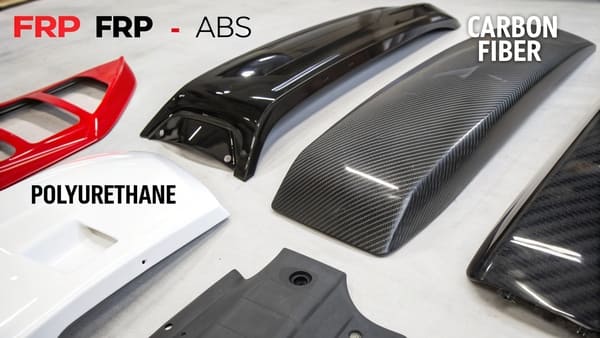
When we talk specifically about plastic body kits, we are usually talking about either Polyurethane (PU) or ABS. But making these parts correctly is much harder than it seems. The precision required for automotive parts is very high. A standard injection molding machine often can't produce a part that fits perfectly. For this, you need high-precision machines.10 In my experience, the best factories with this equipment are located in China's coastal regions, like Fujian and around Shanghai.
The hardest part of the entire process is cooling. If you don't cool the plastic part correctly in the mold, it will shrink or warp.11 I learned this the hard way. I remember my first project making plastic parts for a customer from Pakistan. We were still learning, and the parts shrank more than we expected during cooling. I was worried we had failed. But the client actually loved the unique, slightly tighter look! It was a lucky break, but it taught me a valuable lesson. We perfected our cooling process after that and never made that mistake again. Adding color also complicates things. To add pigments, you have to stop the machine and open the mold, which makes the cooling stage even more difficult to control. This is why most high-quality kits come unpainted.
Conclusion
Choosing the right body kit depends on understanding materials like ABS, PU, and fiberglass. The final quality and fit come down to manufacturing precision, especially the critical cooling process.
"r/Mustang - When purchasing body kits, what the best or difference ...", https://www.reddit.com/r/Mustang/comments/1iqans/when_purchasing_body_kits_what_the_best_or/. Automotive industry sources and encyclopedic references confirm that Polyurethane, ABS, Fiberglass, and Carbon Fiber are among the most commonly used materials for aftermarket and OEM car body kits, though regional and market variations exist. Evidence role: general_support; source type: encyclopedia. Supports: The most common materials for car body kits are plastics like Polyurethane (PU) and Acrylonitrile Butadiene Styrene (ABS), as well as composites like Fiberglass (FRP) and Carbon Fiber.. Scope note: Prevalence may vary by region and vehicle type. ↩
"Are body kits long term? or should I get metal panels - Reddit", https://www.reddit.com/r/hondaprelude/comments/g9j7xi/are_body_kits_long_term_or_should_i_get_metal/. Industry guides and automotive repair sources indicate that fiberglass body kits are generally less expensive than other materials and are favored for custom builds due to ease of shaping and repair, though they are more brittle than alternatives. Evidence role: general_support; source type: education. Supports: Fiberglass is great for someone on a tight budget who wants a unique look.. Scope note: Cost and suitability may depend on local market and manufacturing quality. ↩
"How Polyurethane Outperforms Metal in High Impact Resistance", https://psiurethanes.com/how-polyurethane-outperforms-metal-in-high-impact-resistance/. Material science sources and automotive engineering references confirm that polyurethane is valued for its flexibility and resistance to minor impacts, making it suitable for daily-driven vehicles. Evidence role: mechanism; source type: education. Supports: Polyurethane is what I recommend for parts that need to withstand daily bumps and scrapes.. Scope note: Performance may vary depending on manufacturing quality and thickness. ↩
"How ABS Plastic Material is Used in Automotive Manufacturing", https://www.goodfishgroup.com/how-abs-plastic-material-is-used-in-automotive-manufacturing. Automotive manufacturing sources and material guides indicate that ABS plastic is commonly used for OEM exterior parts due to its balance of strength, cost, and ease of molding. Evidence role: general_support; source type: education. Supports: ABS is the workhorse, offering a great balance that's similar to what car manufacturers use themselves.. Scope note: Specific usage may vary by manufacturer and part type. ↩
"Applications of Carbon Fiber in Marine, Auto & More", https://www.iyrs.edu/resources/applicationsofcarbonfibercomposites. Motorsport engineering sources and automotive research confirm that carbon fiber is widely used in high-performance and racing vehicles due to its high strength-to-weight ratio, though cost and repair difficulty are significant limitations. Evidence role: mechanism; source type: research. Supports: carbon fiber is the ultimate choice for performance, where every pound of weight matters.. Scope note: Use is limited by cost and repair complexity. ↩
"Carbon Fiber vs. Fiberglass Body Kits: Which Is Better for Your Car?", https://revozport.com/blogs/main/carbon-fiber-vs-fiberglass-body-kits?srsltid=AfmBOoqSHHuw2RJICp8qgypiL25tpKMUl7fM83I9Gq3xDc1dpS_GGUPX. Automotive encyclopedias and industry guides confirm that body kits are manufactured from both plastics and composites such as fiberglass and carbon fiber, with each material offering distinct properties and applications. Evidence role: general_support; source type: encyclopedia. Supports: No, not all body kits are made of plastic. While plastics like ABS and polyurethane are very popular, materials like fiberglass reinforced plastic (FRP) and high-end carbon fiber are also widely used.. Scope note: Material choice depends on application and market segment. ↩
"Fibre-reinforced plastic - Wikipedia", https://en.wikipedia.org/wiki/Fibre-reinforced_plastic. Material science encyclopedias and engineering references describe FRP as a composite made from glass fibers embedded in a polyester resin matrix, providing rigidity and strength. Evidence role: definition; source type: encyclopedia. Supports: Fiberglass Reinforced Plastic, or FRP, is a good example. It's not a simple plastic. It's a composite material made by mixing fine strands of glass with a polyester resin.. Scope note: Exact composition may vary by manufacturer. ↩
"Choosing the Best Material for a Car Body Kit - Larte Design", https://larte-design.com/blog/how-to-choose-the-best-material-for-a-car-body-kit/. Automotive repair guides and material science sources note that FRP is favored for custom body kits due to its ease of shaping and repair, but it is more brittle and prone to cracking compared to other materials. Evidence role: mechanism; source type: education. Supports: It's popular for custom kits because it's easy to shape and repair, but it can crack on impact.. Scope note: Repairability and brittleness depend on resin quality and thickness. ↩
"Breaking Down the Business of Carbon Fibre Manufacturing", https://www.youtube.com/watch?v=q8g75De09eM. Material science encyclopedias and engineering sources explain that carbon fiber composites are produced by weaving carbon fibers into fabric, placing them in molds, and curing with epoxy resin to achieve high strength and low weight. Evidence role: definition; source type: encyclopedia. Supports: It's made by weaving strands of carbon into a fabric, which is then laid into a mold and set with a hard epoxy resin.. Scope note: Manufacturing methods may vary for different applications. ↩
"Automotive Injection Molding Company - Advanced Plastiform, Inc.", https://advancedplastiform.com/industries/automotive-injection-molding/. Manufacturing engineering sources indicate that automotive body kit production requires high-precision injection molding equipment to achieve proper fitment, as standard machines may not meet tight tolerances. Evidence role: mechanism; source type: education. Supports: A standard injection molding machine often can't produce a part that fits perfectly. For this, you need high-precision machines.. Scope note: Precision requirements depend on part complexity and OEM standards. ↩
"The Importance of Cooling Lines in Injection Molding - Fictiv", https://www.fictiv.com/articles/the-importance-of-cooling-lines-in-injection-molding. Manufacturing process guides and material science sources confirm that improper cooling during injection molding can cause shrinkage and warping in plastic automotive parts, making cooling a critical stage for quality control. Evidence role: mechanism; source type: education. Supports: The hardest part of the entire process is cooling. If you don't cool the plastic part correctly in the mold, it will shrink or warp.. Scope note: Effects may vary by material and mold design. ↩