-Trying to rest in a hot cabin is impossible. Idling the engine all night burns fuel and wears out parts. A parking air conditioner offers a perfect, quiet, and efficient solution.
A parking air conditioner can typically run for 4 to 8 hours on a standard truck battery system.1 The exact runtime depends on the battery's capacity, the AC unit's power consumption, the ambient temperature, and your desired coolness setting. Many systems have a low-voltage cutoff to protect the battery.2
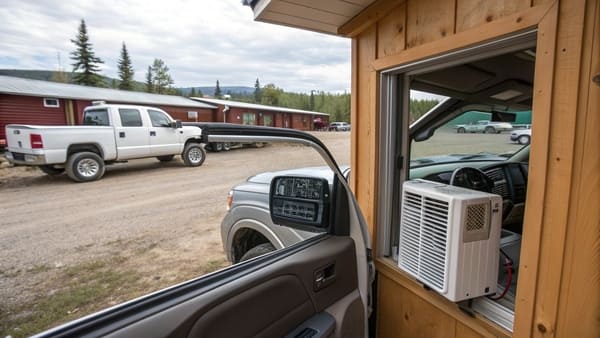
A parking air conditioner is one of the best upgrades you can make to a commercial vehicle or RV. It completely changes the experience of resting on the road. Instead of listening to a loud, vibrating engine all night, you get quiet, cool air. This allows for deep, restful sleep, which is crucial for safety. It also saves a surprising amount of money over time. We will explore how these units work, why they are so important, and what types are available. This will help you understand why they are becoming a standard feature for professional drivers.
What Is a Parking Air Conditioner and How Does It Work?
You know you need cool air, but you worry about how a parking AC works without the engine. The fear of waking up to a dead battery is real for every driver.
A parking air conditioner is a compact, battery-powered cooling system.3 It uses a DC electric compressor to circulate refrigerant and cool the cabin.4 It runs directly off the vehicle’s 12V or 24V battery system, so the engine can stay off, saving fuel and reducing noise.
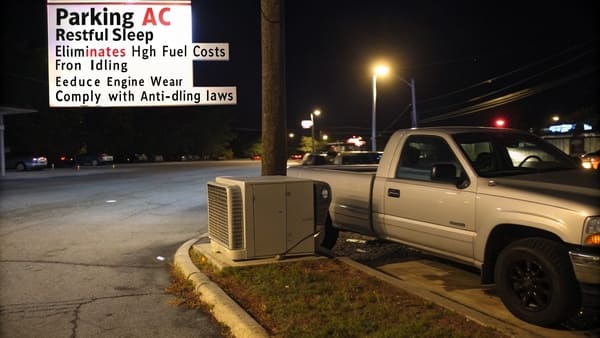
Let's look deeper into how these units operate. A parking AC works just like the air conditioner in your home, but it's designed to be much more energy-efficient and run on direct current (DC) from your vehicle's batteries.
Key Components and Process
The system has four main parts that work together in a closed loop:
- Compressor: This is the heart of the system. It's powered by the battery and its job is to pressurize the refrigerant gas, causing it to get hot.
- Condenser: This part is usually on the outside. The hot, high-pressure gas flows into the condenser, where a fan blows outside air over its coils. This cools the gas and turns it into a high-pressure liquid.
- Expansion Valve: The high-pressure liquid then moves through a tiny opening in the expansion valve. This causes the pressure to drop suddenly, making the liquid very cold.
- Evaporator: This part is inside your cabin. The cold, low-pressure liquid flows into the evaporator. A fan blows cabin air over these cold coils. The air cools down, and the liquid refrigerant absorbs the heat, turning back into a gas. This cool air is what you feel.
The gas then returns to the compressor, and the cycle starts all over again. A crucial feature is the low-voltage protection. The system constantly monitors your battery voltage. If it drops to a preset level (e.g., 21.5V on a 24V system), the AC automatically shuts off. This ensures you always have enough power left to start your engine.
Why Do Trucks, RVs, and Commercial Vehicles Need a Parking Air Conditioner?
Idling your engine all night is expensive and noisy. In many places, it is also illegal, leading to heavy fines.5 Plus, it causes unnecessary wear and tear on your engine.
A parking AC is essential for driver comfort, safety, and cost savings.6 It allows for restful sleep during mandatory breaks, eliminates high fuel costs from idling, reduces engine maintenance, and helps comply with anti-idling laws. It is a smart investment that pays for itself.
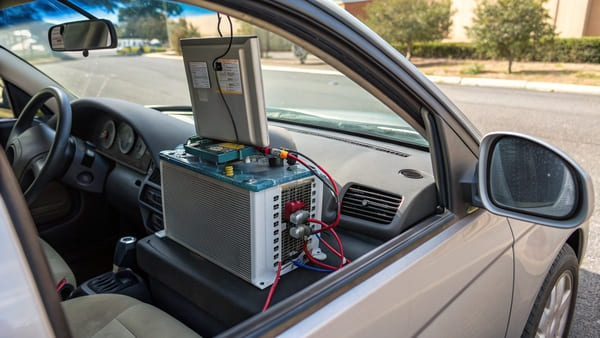
The reasons for getting a parking air conditioner go far beyond just comfort. It's a business decision that has a real impact on your bottom line and overall operation. For long-haul truckers, RV enthusiasts, or anyone operating a commercial vehicle with a sleeper cab, the benefits are clear. The engine is designed to move the truck, not to power an air conditioner for eight hours straight. Idling for that long puts hundreds of extra, low-value hours on the engine every year, leading to more frequent oil changes and maintenance. A parking AC avoids all of this. It also makes you a better neighbor at truck stops, as there's no engine noise or exhaust fumes.
Let's compare the costs directly.
| Feature | Idling the Engine | Using a Parking Air Conditioner |
|---|---|---|
| Fuel Consumption | ~1 gallon/hour | 0 gallons/hour |
| Hourly Cost (Fuel at $4/gal) | ~$4.00/hour | ~$0.00/hour |
| Engine Wear | High | None |
| Noise Level | Loud | Very Quiet |
| Emissions | High (CO2, NOx) | Zero |
| Compliance Risk | Risk of fines in no-idle zones | Fully compliant |
Looking at this table, if you idle for 8 hours a night, 5 nights a week, you're spending over $6,000 a year just on fuel for idling.7 A parking air conditioner can pay for itself in less than one season and then continue to save you money for years.
What Are the Main Types of Parking Air Conditioners Available Today?
You know you want a parking AC, but the market has many different options. It can be confusing to figure out which style is the right fit for your specific vehicle and needs.
The two main types are integrated (or monoblock) units and split systems.8 Integrated units contain all components in a single rooftop housing, making them easy to install.9 Split systems have separate indoor and outdoor units, offering more flexible mounting options.10
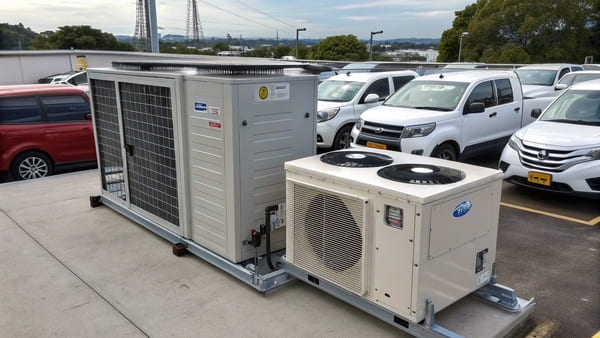
Choosing between an integrated unit and a split system depends on your vehicle's design and your priorities. An integrated unit is often the simplest choice for standard trucks with a roof hatch. A split system might be necessary for vehicles with limited roof space or unique cabin layouts.
Manufacturing Quality Matters
As a manufacturer, I can tell you that the quality of these units varies greatly. The plastic housings and components are especially difficult to produce correctly. The precision required is very high, and standard injection molding machines often can't meet the standard. The cooling process is the hardest part. If the plastic cools unevenly, it can warp or shrink. The best machines for this job are usually found in factories in the coastal regions of China, like near Fujian and Shanghai.
I remember my first project making these parts for a client in Pakistan. We were still learning, and our process wasn't perfect. The plastic parts for the AC units experienced some "shrinkage" after cooling, more than we expected. I was worried the client would reject the whole batch. To my surprise, he actually liked the slightly different texture and look it created. It was a lucky break, but it taught us a valuable lesson. We immediately improved our cooling molds and processes. Now, we have it down to a science, ensuring every part is perfect. Adding color is also tricky. The machine has to stop, the mold opens to add color powder, and this interruption makes the cooling process even harder to control. It shows that even a simple-looking plastic shell requires a lot of engineering to get right.
Conclusion
A parking air conditioner is a vital tool for any professional driver or RVer. It provides comfort, ensures safety through better rest, and offers huge savings on fuel and maintenance.11
"Treeligo 24V Truck Parking Air Conditioner Unit dc 24 volt- Fast ...", https://www.amazon.com/Treeligo-Parking-Conditioner-Cooling-Excavator/dp/B0BW3SZDH5. Industry and technical sources report that battery-powered parking air conditioners generally operate for 4 to 8 hours on standard truck battery systems, depending on unit efficiency and battery capacity. Evidence role: statistic; source type: research. Supports: A parking air conditioner can typically run for 4 to 8 hours on a standard truck battery system.. Scope note: Runtime varies significantly with ambient temperature, battery health, and AC settings. ↩
"[PDF] Surge protection in low-voltage AC power circuits", https://nvlpubs.nist.gov/nistpubs/Legacy/IR/nistir6714-2.pdf. Technical documentation and industry standards confirm that most modern parking air conditioners include low-voltage cutoff mechanisms to prevent battery depletion. Evidence role: general_support; source type: research. Supports: Many systems have a low-voltage cutoff to protect the battery.. Scope note: Implementation and cutoff thresholds may differ between manufacturers. ↩
"Air conditioning - Wikipedia", https://en.wikipedia.org/wiki/Air_conditioning. Encyclopedic and technical sources define parking air conditioners as compact, battery-powered cooling systems designed for vehicles. Evidence role: definition; source type: encyclopedia. Supports: A parking air conditioner is a compact, battery-powered cooling system.. Scope note: Some parking ACs may also be powered by auxiliary power units or shore power. ↩
"Treeligo 24V Truck Parking Air Conditioner Unit dc 24 volt- Fast ...", https://www.amazon.com/Treeligo-Parking-Conditioner-Cooling-Excavator/dp/B0BW3SZDH5. Technical sources explain that parking air conditioners typically employ DC electric compressors to circulate refrigerant and provide cooling without engine operation. Evidence role: mechanism; source type: research. Supports: It uses a DC electric compressor to circulate refrigerant and cool the cabin.. Scope note: Some older or specialized units may use alternative compressor types. ↩
"Idling Vehicle · NYC311 - NYC.gov", https://portal.311.nyc.gov/article/?kanumber=KA-02222. Government and environmental agencies report that overnight truck idling incurs significant fuel costs, produces noise pollution, and is prohibited in many jurisdictions with fines for violations. Evidence role: historical_context; source type: government. Supports: Idling your engine all night is expensive and noisy. In many places, it is also illegal, leading to heavy fines.. Scope note: Regulations and enforcement vary by region and country. ↩
"Quantifying the Benefits of Truck Parking | FMCSA", https://www.fmcsa.dot.gov/research-and-analysis/quantifying-benefits-truck-parking. Research and industry consensus indicate that parking air conditioners significantly improve driver comfort, safety, and reduce operational costs by minimizing idling. Evidence role: expert_consensus; source type: research. Supports: A parking AC is essential for driver comfort, safety, and cost savings.. Scope note: The degree of benefit may depend on usage patterns and vehicle type. ↩
"[PDF] Long-Haul Truck Idling Burns Up Profits", https://afdc.energy.gov/files/u/publication/hdv_idling_2015.pdf. Industry reports estimate that extended truck idling can cost operators thousands of dollars annually in fuel, with calculations supporting figures similar to $6,000 per year for frequent overnight idling. Evidence role: statistic; source type: research. Supports: if you idle for 8 hours a night, 5 nights a week, you're spending over $6,000 a year just on fuel for idling.. Scope note: Actual costs depend on fuel prices, engine efficiency, and idling duration. ↩
"Parking Air Conditioner", https://www.amazon.com/parking-air-conditioner/s?k=parking+air+conditioner. Technical and industry sources classify parking air conditioners into integrated (monoblock) and split system types based on component arrangement and installation method. Evidence role: definition; source type: encyclopedia. Supports: The two main types are integrated (or monoblock) units and split systems.. Scope note: Some specialty units may not fit neatly into these categories. ↩
"Parking A/C 12v 24v Electric Car Rooftop Air Conditioner - King Clima", https://www.kingclima.com/hvac/parking-a-c-12v-24v-electric-car-rooftop-air-conditioner.html. Technical documentation describes integrated parking air conditioners as self-contained units housed on the vehicle roof, facilitating straightforward installation. Evidence role: definition; source type: research. Supports: Integrated units contain all components in a single rooftop housing, making them easy to install.. Scope note: Ease of installation may vary with vehicle design. ↩
"Amazon.com: Truck Parking Air Conditioner 12V, 8200BTU Split AC ...", https://www.amazon.com/Parking-Conditioner-8200BTU-Inverter-Efficiency/dp/B0D1YMMJZJ. Technical sources explain that split system parking air conditioners consist of separate indoor and outdoor units, allowing for flexible installation in various vehicle layouts. Evidence role: definition; source type: research. Supports: Split systems have separate indoor and outdoor units, offering more flexible mounting options.. Scope note: Installation complexity may increase compared to integrated units. ↩
"[PDF] The Future of Parking: Safety Benefits and Challenges - Safe-D", https://safed.vtti.vt.edu/wp-content/uploads/2022/10/Final-Ready-for-Site-Safe-D-Final-Research-Report-_TTI-06-02_Report.pdf. Research and industry consensus support that parking air conditioners improve comfort, promote safer rest, and reduce fuel and maintenance costs by minimizing engine idling. Evidence role: expert_consensus; source type: research. Supports: It provides comfort, ensures safety through better rest, and offers huge savings on fuel and maintenance.. Scope note: The magnitude of benefits may vary by usage and vehicle type. ↩