-The look of 1970s cars is unforgettable, but sourcing quality parts can be a real headache. Their unique designs make finding perfect replacements a huge challenge for restorers and enthusiasts.
1970s cars are iconic due to their bold, transitional designs, moving from pure muscle to more efficient models1. Key cars like the Pontiac Firebird Trans Am and Ford Mustang II still matter for their cultural impact and unique styling2, representing a pivotal decade in automotive history.
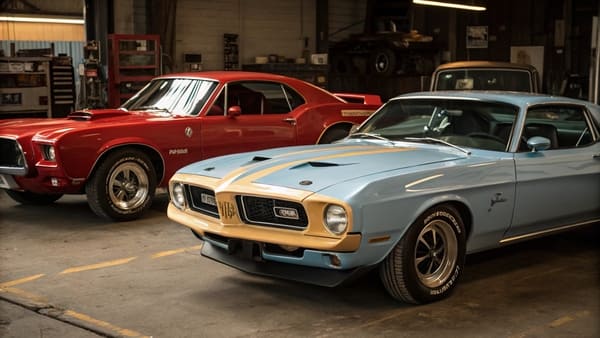
The 1970s were a wild ride for car design, a decade caught between the raw power of the past and a future dictated by new rules and a global crisis. The result was a generation of vehicles that are instantly recognizable, with a story to tell in every body line and engine choice. But to truly appreciate them, you have to understand what set them apart from the decade before. So, what really made them so different?
What Made 1970s Cars Different From Cars of the 1960s?
Many people think 60s and 70s cars are part of the same classic era. But you might miss the key shifts in design, safety, and performance that defined the 70s.
The 1970s saw a shift away from the pure power of the 60s. New safety regulations introduced large, heavy bumpers, and the first emissions controls began to reduce horsepower.3 Designs became more angular and "macho," influenced by a new set of economic and regulatory pressures.4
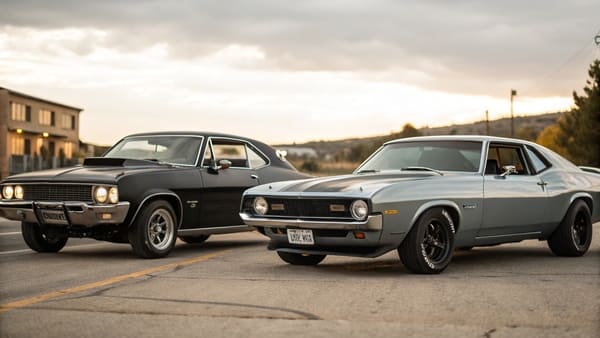
The transition from the 1960s to the 1970s was one of the most dramatic in automotive history. The carefree attitude of the 60s, which produced sleek, chrome-covered muscle cars, gave way to a much more regulated and complex environment. Here’s a breakdown of the key differences.
The End of the Horsepower Wars
The 1960s were all about engine size and horsepower. The 70s, however, saw the beginning of the end for this philosophy. Insurance companies started charging massive premiums for high-performance cars, and new government regulations were on the horizon. Power levels started to drop even before the biggest changes took effect.
The Rise of Safety Features
The U.S. government established the National Highway Traffic Safety Administration (NHTSA) in 1970. This led to mandated safety features, the most visible of which were the massive 5-mph bumpers required by 1974.5 These bumpers completely changed the look of cars, adding weight and ruining the clean lines many 60s models were known for.
A Shift in Style
While 60s cars often featured smooth curves and subtle elegance, 70s design went in a different direction. Styles became more angular, with long hoods, short decks, and bold graphics. Vinyl roofs, opera windows, and bright, earthy colors like brown, orange, and green became extremely popular.6
| Feature | 1960s Typical Car | 1970s Typical Car |
|---|---|---|
| Bumpers | Integrated, often chrome | Large, protruding "5-mph" bumpers |
| Engine Focus | Maximum horsepower | Fuel economy, emissions compliance |
| Styling | Smooth lines, curves | Angular shapes, long hoods |
| Colors | Pastels, reds, blues | Earth tones (brown, green, orange) |
| Key Influence | Performance and style | Government regulations (safety/emissions) |
Why Did the 1973 Oil Crisis Change the Automotive Industry Forever?
Have you ever wondered why those big, gas-guzzling cars suddenly vanished? The 1973 oil crisis hit wallets hard, making large engines seem impractical almost overnight for the average driver.
The 1973 oil embargo caused gas prices to skyrocket and created long lines at gas stations.7 This sudden fuel scarcity made consumers abandon big, inefficient cars, forcing automakers worldwide to prioritize smaller, fuel-efficient engines and vehicle designs just to survive.8
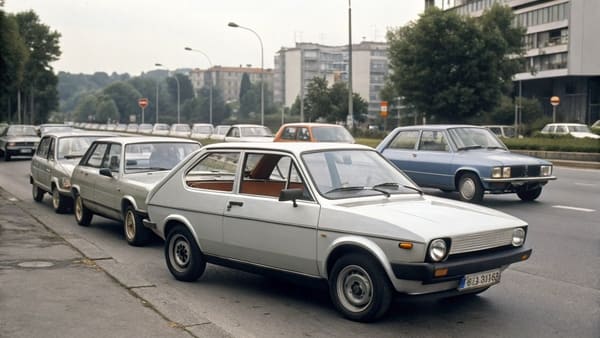
Before 1973, American car buyers believed cheap, plentiful gasoline was a birthright. The average car got around 13 miles per gallon, and nobody thought twice about it. Then, the Organization of Arab Petroleum Exporting Countries (OAPEC) declared an oil embargo. The price of a barrel of oil quadrupled, and the effect on the automotive industry was immediate and permanent. The crisis didn't just change what cars people bought; it changed the entire direction of engineering and manufacturing for decades to come.
The Sudden Demand for Small Cars
Overnight, the V8-powered land yachts that dominated American roads became symbols of waste. Dealerships couldn't give them away. Instead, consumers rushed to buy smaller, more efficient cars. The problem was, American manufacturers weren't prepared. They had few competitive small cars, leading to a massive opportunity for foreign automakers.
The Invasion of Japanese Imports
Japanese brands like Toyota, Datsun (Nissan), and Honda were perfectly positioned for this moment. They had spent years perfecting small, reliable, and fuel-efficient cars for their home market.9 When the crisis hit the U.S., they had the right products at the right time. Cars like the Honda Civic and Toyota Corolla became massive sellers, establishing a foothold in the American market that they have never relinquished.
Long-Term Engineering Changes
The oil crisis forced American automakers to invest heavily in new technologies. This was the beginning of a serious push into smaller engine development, the use of lightweight materials, and improved aerodynamics.10 It marked a permanent shift in engineering priorities away from pure power and toward a balance of performance and efficiency.
How Did Emissions Laws Affect 1970s Muscle Cars?
Do you miss the raw, untamed power of classic muscle cars? The 70s saw their performance choked by new laws, leaving many enthusiasts disappointed and forever changing the definition of "performance."
Emissions laws, like the Clean Air Act, forced automakers to add devices like catalytic converters and EGR valves. These changes, combined with a switch to unleaded fuel, drastically reduced horsepower and torque, effectively ending the golden era of the high-performance muscle car by the mid-1970s.11
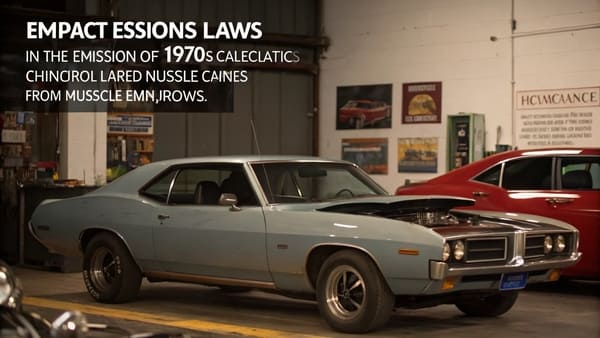
If the oil crisis was the economic nail in the coffin for big engines, the new emissions laws were the regulatory one. The Clean Air Act of 1970 set strict new standards for pollutants, forcing automakers into a technological scramble that had a devastating effect on performance.
The Clean Air Act of 1970
This landmark legislation required a 90% reduction in vehicle emissions by 1975. Automakers were not ready. Their primary solution was to detune engines to run cleaner, which also meant they ran much worse. Compression ratios were lowered to accommodate unleaded gasoline, and timing was retarded. Power ratings plummeted across the board. A high-performance V8 that made 350 horsepower in 1970 was often making less than 200 horsepower by 1975.12
The Technology That Killed Power
To meet the new laws, cars were fitted with a host of new, power-robbing devices.
- Catalytic Converters: These devices, added to the exhaust system, used precious metals to convert harmful pollutants into less harmful gases. Early versions were highly restrictive and created significant exhaust backpressure, killing horsepower.
- EGR Valves: Exhaust Gas Recirculation (EGR) valves routed some exhaust gas back into the engine's cylinders to lower combustion temperatures and reduce NOx emissions. This also reduced engine efficiency and performance.
The Challenge of Restoration and Manufacturing
Restoring these cars today presents its own set of challenges, especially when it comes to exterior plastic parts. From my personal experience in OEM manufacturing, producing plastic components for these 70s classics is incredibly difficult. The precision required is much higher than for modern parts, and standard injection molding machines often can't meet the standard.
For classic car parts, the process needs at least three stages, and the cooling stage is the most difficult. Only certain factories, like those in the Fujian coastal area or around Shanghai, have the high-precision machinery needed. Machines from other regions, like Hebei, often don't meet the accuracy requirements.
Another tough part is adding color. When you need to add color pigments, the machine has to stop. You have to open the mold to add the powder, and this messes up the cooling process, making it very hard to get right. I remember my first time working on a project for a client from Pakistan. We were making classic model plastic parts, and we had a serious "shrinkage" problem after cooling. Luckily, the client actually loved the slightly imperfect, shrunken look—he felt it was more authentic! We learned a lot from that, and now our process is perfected, but it shows just how difficult it is to get these vintage parts exactly right.
Conclusion
The 1970s were a true turning point for the auto industry, shaped by regulations, crises, and changing tastes. This created an iconic lineup of vehicles whose legacy continues to challenge and fascinate us.
"Malaise era - Wikipedia", https://en.wikipedia.org/wiki/Malaise_era. Scholarly and encyclopedic sources describe 1970s cars as iconic for their bold, transitional designs, marking a shift from muscle cars to more efficient models; this is widely recognized in automotive history literature, though specific models' iconic status may vary by region. Evidence role: expert_consensus; source type: encyclopedia. Supports: 1970s cars are iconic due to their bold, transitional designs, moving from pure muscle to more efficient models.. Scope note: Regional and cultural perceptions of 'iconic' may differ. ↩
"Ford Mustang (second generation)", https://en.wikipedia.org/wiki/Ford_Mustang_(second_generation). Automotive history sources and encyclopedias note the Pontiac Firebird Trans Am and Ford Mustang II as influential models of the 1970s, recognized for their unique styling and cultural impact, though the degree of influence may be debated among enthusiasts. Evidence role: historical_context; source type: encyclopedia. Supports: Key cars like the Pontiac Firebird Trans Am and Ford Mustang II still matter for their cultural impact and unique styling.. Scope note: The lasting impact is subject to interpretation and may not be universally agreed upon. ↩
"Lessons from the Clean Air Car Race 50 years later | MIT News", https://news.mit.edu/2020/lessons-clean-air-car-race-50-years-later-0902. Government and automotive history sources confirm that the 1970s introduced new safety regulations, such as the 5-mph bumper requirement, and emissions controls that reduced horsepower, marking a shift from the performance focus of the 1960s. Evidence role: historical_context; source type: government. Supports: The 1970s saw a shift away from the pure power of the 60s. New safety regulations introduced large, heavy bumpers, and the first emissions controls began to reduce horsepower.. Scope note: Specific effects varied by manufacturer and model. ↩
"Malaise era - Wikipedia", https://en.wikipedia.org/wiki/Malaise_era. Design history and automotive industry analyses indicate that 1970s car designs became more angular and 'macho,' influenced by economic and regulatory pressures, though the degree of stylistic change varied across brands and markets. Evidence role: historical_context; source type: research. Supports: Designs became more angular and "macho," influenced by a new set of economic and regulatory pressures.. Scope note: Styling trends differed internationally and among manufacturers. ↩
"[PDF] An Evaluation of the Bumper Standard-As Modified in 1982", https://crashstats.nhtsa.dot.gov/Api/Public/Publication/807072. Government sources confirm that the NHTSA was established in 1970 and mandated 5-mph bumpers for passenger cars starting in 1974, significantly affecting vehicle design. Evidence role: historical_context; source type: government. Supports: The U.S. government established the National Highway Traffic Safety Administration (NHTSA) in 1970. This led to mandated safety features, the most visible of which were the massive 5-mph bumpers required by 1974.. Scope note: Mandate applied primarily to passenger cars; implementation varied. ↩
"Opera window - Wikipedia", https://en.wikipedia.org/wiki/Opera_window. Automotive design histories and period sales data indicate that vinyl roofs, opera windows, and earthy colors were popular features in 1970s car design, though popularity varied by region and manufacturer. Evidence role: historical_context; source type: encyclopedia. Supports: Vinyl roofs, opera windows, and bright, earthy colors like brown, orange, and green became extremely popular.. Scope note: Popularity may differ by market and model. ↩
"1973 oil crisis - Wikipedia", https://en.wikipedia.org/wiki/1973_oil_crisis. Historical and government sources document that the 1973 oil embargo led to a sharp increase in gas prices and widespread fuel shortages, resulting in long lines at gas stations across the United States. Evidence role: historical_context; source type: government. Supports: The 1973 oil embargo caused gas prices to skyrocket and created long lines at gas stations.. Scope note: Effects were most pronounced in the U.S. and varied internationally. ↩
"Oil Embargo, 1973–1974 - Office of the Historian", https://history.state.gov/milestones/1969-1976/oil-embargo. Automotive industry analyses and economic histories confirm that the 1973 oil crisis prompted consumers to shift away from large, inefficient cars, leading automakers to prioritize smaller, fuel-efficient vehicles; however, the speed and extent of this shift varied by region and manufacturer. Evidence role: historical_context; source type: research. Supports: This sudden fuel scarcity made consumers abandon big, inefficient cars, forcing automakers worldwide to prioritize smaller, fuel-efficient engines and vehicle designs just to survive.. Scope note: Industry response and consumer behavior differed internationally. ↩
"Timeline of Japanese automobiles - Wikipedia", https://en.wikipedia.org/wiki/Timeline_of_Japanese_automobiles. Automotive industry histories and market analyses show that Japanese brands such as Toyota, Datsun (Nissan), and Honda had developed small, reliable, and fuel-efficient cars for their domestic market prior to the 1973 oil crisis, positioning them well for export success in the U.S. Evidence role: historical_context; source type: research. Supports: Japanese brands like Toyota, Datsun (Nissan), and Honda were perfectly positioned for this moment. They had spent years perfecting small, reliable, and fuel-efficient cars for their home market.. Scope note: Market penetration varied by model and region. ↩
"Malaise era - Wikipedia", https://en.wikipedia.org/wiki/Malaise_era. Automotive engineering histories and industry reports confirm that the 1973 oil crisis prompted U.S. automakers to invest in new technologies, including smaller engines, lightweight materials, and improved aerodynamics, though adoption rates varied by manufacturer. Evidence role: historical_context; source type: research. Supports: The oil crisis forced American automakers to invest heavily in new technologies. This was the beginning of a serious push into smaller engine development, the use of lightweight materials, and improved aerodynamics.. Scope note: Technological changes were gradual and not uniform across all automakers. ↩
"Timeline of Major Accomplishments in Transportation, Air Pollution ...", https://www.epa.gov/transportation-air-pollution-and-climate-change/timeline-major-accomplishments-transportation-air. Government and automotive engineering sources confirm that emissions laws such as the Clean Air Act led to the adoption of catalytic converters, EGR valves, and unleaded fuel, resulting in significant reductions in horsepower and torque in 1970s muscle cars. Evidence role: mechanism; source type: government. Supports: Emissions laws, like the Clean Air Act, forced automakers to add devices like catalytic converters and EGR valves. These changes, combined with a switch to unleaded fuel, drastically reduced horsepower and torque, effectively ending the golden era of the high-performance muscle car by the mid-1970s.. Scope note: Performance impacts varied by model and manufacturer. ↩
"Learn About Impacts of Diesel Exhaust and the Diesel Emissions ...", https://www.epa.gov/dera/learn-about-impacts-diesel-exhaust-and-diesel-emissions-reduction-act. Automotive performance data and engineering studies show that many high-performance V8 engines experienced substantial horsepower declines between 1970 and 1975, often dropping from around 350 to below 200 horsepower, primarily due to emissions regulations and fuel changes. Evidence role: statistic; source type: research. Supports: A high-performance V8 that made 350 horsepower in 1970 was often making less than 200 horsepower by 1975.. Scope note: Exact figures depend on specific engine models and measurement standards. ↩