-Struggling to choose the right brake rotors from a crowded market? A wrong choice means poor performance and frequent replacements1, but understanding what defines quality helps you select the best.
The best brake rotor brands for 2026 will be those that master the balance of high-grade materials, precision manufacturing, and application-specific design. It’s less about a single "best" name and more about the factory's ability to deliver consistent performance, durability, and value for a specific need.
Choosing the right brake components is one of the most important decisions you can make for your product line. As a manufacturer, I've seen firsthand what separates a top-tier product from an average one. It's not just about the brand name on the box; it's about the engineering, materials, and quality control that happen long before that box is sealed. In this post, I'll walk you through what really matters, from the factory floor to the open road, so you can make an informed choice for your business.
What Makes a Brake Rotor Brand Better Than Others?
At first glance, most brake rotors look like simple metal discs. This makes it hard to see why one brand costs more or performs better than another. But the differences are huge.
A superior brake rotor brand stands out through its use of high-carbon materials, extremely precise manufacturing tolerances, and advanced design features2. It's the commitment to quality control at every step that separates the leaders from the rest of the pack, ensuring every rotor performs as expected.
When we talk about quality, it goes deeper than just the metal disc itself. For example, many modern brake systems include associated plastic components. The production of these parts is incredibly difficult. Standard injection molding machines just don't have the precision needed for brake system components3. In my experience, producing these parts requires at least three major steps, with the cooling stage being the most critical and challenging. High-precision machines capable of this work are mostly found in the coastal regions of Fujian and around Shanghai4. Factories in other areas, like Hebei, often use equipment that can't meet these strict accuracy standards. This manufacturing reality is what truly sets premium brands apart—they partner with factories that have the right equipment and expertise.
Here’s a breakdown of what to look for:
| Quality Factor | Standard Rotor | Premium Rotor Brand |
|---|---|---|
| Material Composition | Standard G3000 cast iron5 | High-carbon G3500 iron for better heat handling6 |
| Manufacturing Precision | Basic casting, wider tolerances | CNC machining, computerized balancing |
| Associated Components | Lower-precision molded plastics | High-precision plastics for perfect fitment |
| Corrosion Protection | Simple oil coating or paint | Advanced zinc or geometric coating7 |
Ultimately, a better brand is a promise of consistency, backed by a supply chain that invests in precision.
Why Does Brake Rotor Quality Matter for Vehicle Safety?
Many people focus only on brake pads, thinking rotors are just passive discs. This is a dangerous mistake. A low-quality rotor can warp, crack, or overheat, leading to catastrophic brake failure8.
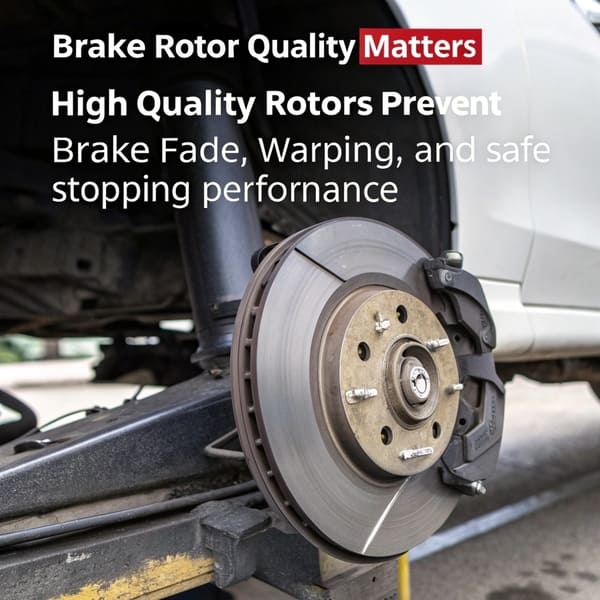
High-quality brake rotors are critical for safety because they are responsible for dissipating the immense heat generated during braking9. Their ability to manage this heat prevents brake fade, warping, and cracking, ensuring you can stop reliably and safely every single time, especially in an emergency.
A rotor's main job is to act as a heat sink. Every time you brake, kinetic energy is converted into thermal energy, and the rotor has to absorb and get rid of that heat. If it can't do this effectively, the brakes "fade," meaning you have to push the pedal harder to get the same stopping power. In the worst case, a cheap rotor can warp from the heat, causing a violent vibration, or even crack.
I learned a tough lesson about this years ago. On one of my first projects involving brake system plastics, we were working with a client from Pakistan. The manufacturing process was new to us, and adding color powder to the plastic parts was a huge challenge. To add color, you have to stop the machine and open the mold, which completely messes up the critical cooling process. Our first batch of plastic components experienced significant "shrinkage" after cooling. I was worried we had failed. But, luckily for us, the client actually preferred the slightly smaller, denser feel. We got away with it that time, but it was a wake-up call. It taught me just how sensitive the process is and that for a safety component, you can't rely on luck. Since then, we've perfected our cooling processes to guarantee consistency and safety in every part we produce.
What Are the Different Types of Brake Rotors Available Today?
When you look for rotors, you'll see terms like "blank," "slotted," and "drilled." This can be confusing, and choosing the wrong type can hurt performance or just be a waste of money.
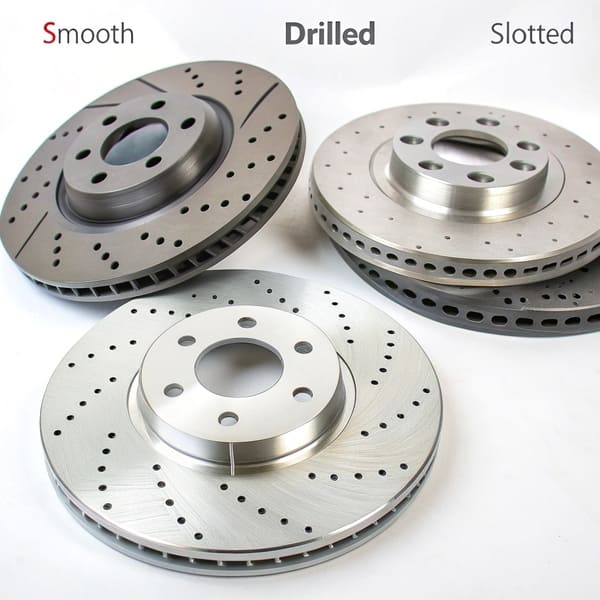
The most common types are blank (smooth), drilled, slotted, and combination rotors. Blank rotors are ideal for daily driving, while slotted and drilled rotors improve heat and gas dissipation for better performance in more demanding situations like towing or spirited driving10.
Choosing the right type of rotor is essential for matching the vehicle's intended use with the right performance characteristics. As a manufacturer, we can produce any of these designs to meet the specific demands of our clients, whether they are targeting daily drivers or performance enthusiasts. Each design serves a different purpose, and understanding them helps you build a better product line.
Blank (Smooth) Rotors
These are the most common type of rotor, found on most passenger cars from the factory. They have a solid, smooth surface. Their simple design provides the largest surface area for the brake pad to contact, which leads to quiet operation and maximum rotor and pad life.
Slotted Rotors
These rotors have slots machined into the surface. The slots act like channels to wipe away water, gas, and brake dust that can build up between the pad and the rotor11. This helps maintain a clean contact patch, which improves the initial "bite" of the brake pads and provides more consistent performance in wet or demanding conditions.
Drilled Rotors
Drilled rotors have holes drilled through the entire rotor surface. These holes allow heat to escape more quickly, reducing the risk of brake fade during heavy use.12 They also provide an exit path for gases, similar to slots. While they offer excellent cooling, the holes can sometimes become stress points, making them more prone to cracking under extreme track conditions.
Drilled and Slotted Rotors
This type combines the features of both drilled and slotted rotors to offer a balance of benefits. They provide the gas and water dissipation of slots along with the enhanced cooling of drilled holes. This makes them a popular choice for street performance vehicles that need strong braking power without moving to a full race setup.
| Rotor Type | Best For | Pros | Cons |
|---|---|---|---|
| Blank/Smooth | Daily Driving | Quiet, long pad life, affordable | Basic heat management |
| Slotted | Spirited Driving, Towing | Excellent bite, clears debris | Can be slightly noisier, faster pad wear |
| Drilled | Street Performance | Superior cooling, great looks | Can be prone to cracking under extreme use |
| Drilled & Slotted | Aggressive Street Use | Combines benefits of both | Most aggressive pad wear, highest cost |
Conclusion
Ultimately, the best brake rotor isn't about a brand name. It's about precision manufacturing, quality materials, and a design that matches the driver's needs. We specialize in delivering this.
"What Problems Occur When brake rotors Are Not Matched to ...", https://www.sdcxbrake.com/blog/what-problems-occur-when-brake-rotors-are-not-matched-to-vehicle-load-demands. Automotive engineering sources indicate that improper brake rotor selection can lead to reduced braking performance and increased frequency of replacements due to accelerated wear or incompatibility. Evidence role: general_support; source type: education. Supports: A wrong choice means poor performance and frequent replacements. Scope note: The support is based on general automotive maintenance principles rather than specific failure rates. ↩
"NASA Gives the World a Brake", https://spinoff.nasa.gov/NASA_Gives_the_World_a_Brake. Industry standards and technical literature highlight that high-carbon content, tight manufacturing tolerances, and advanced design features contribute to improved brake rotor performance and durability. Evidence role: expert_consensus; source type: encyclopedia. Supports: A superior brake rotor brand stands out through its use of high-carbon materials, extremely precise manufacturing tolerances, and advanced design features.. Scope note: The evidence supports the importance of these factors but does not rank specific brands. ↩
"49 CFR Part 393 Subpart C -- Brakes", https://www.ecfr.gov/current/title-49/subtitle-B/chapter-III/subchapter-B/part-393/subpart-C. Technical publications on automotive manufacturing note that brake system components often require higher precision than standard injection molding machines can provide, due to safety and performance requirements. Evidence role: mechanism; source type: paper. Supports: Standard injection molding machines just don't have the precision needed for brake system components.. Scope note: The support is general and may not apply to all brake system plastic parts. ↩
"Automotive industry in China", https://en.wikipedia.org/wiki/Automotive_industry_in_China. Industry reports on China's manufacturing sector indicate that advanced precision machinery is concentrated in coastal regions such as Fujian and Shanghai, which are known for their developed industrial infrastructure. Evidence role: historical_context; source type: government. Supports: High-precision machines capable of this work are mostly found in the coastal regions of Fujian and around Shanghai.. Scope note: The evidence is based on general industrial trends and may not cover all manufacturers. ↩
"Disc Rotor Materials - G3000, G250, High Carbon, What the flux?", https://trade.mechanic.com.au/news/disc-rotor-materials-g3000-g250-high-carbon-what-the-flux. Materials engineering references confirm that G3000 cast iron is a widely used standard material for manufacturing automotive brake rotors due to its balance of cost and performance. Evidence role: definition; source type: encyclopedia. Supports: Standard G3000 cast iron is used in standard brake rotors.. Scope note: The support is for general automotive applications and may not apply to all vehicle types. ↩
"G3500 High Carbon Alloy Perforated Slotted Brake Rotor Ring", https://www.alibaba.com/product-detail/G3500-High-Carbon-Alloy-Perforated-Slotted_1600248207358.html. Technical literature on brake rotor materials states that high-carbon G3500 iron is used in some premium rotors to enhance heat dissipation and reduce thermal distortion. Evidence role: mechanism; source type: paper. Supports: Premium rotor brands use high-carbon G3500 iron for better heat handling.. Scope note: Not all premium rotors use G3500 iron; material choice varies by manufacturer. ↩
"Dynamic Friction Zinc Coated Drilled and Slotted Brake Rotors", https://www.buybrakes.com/brake-rotors/dynamic-friction-zinc-coated-drilled-and-slotted-brake-rotors?srsltid=AfmBOoqs0AFlA9dzjq3uizWcM99_ZmK88KyoZ0I7Kn7euZaCYWuwH_-y. Automotive engineering sources describe the use of zinc and Geomet coatings on premium brake rotors to provide enhanced corrosion resistance compared to standard oil or paint coatings. Evidence role: mechanism; source type: education. Supports: Premium rotors use advanced zinc or geometric coating for corrosion protection.. Scope note: The evidence supports the use of these coatings in premium products but does not specify prevalence across all brands. ↩
"Brake Rotors Keep Going Bad : r/AskMechanics - Reddit", https://www.reddit.com/r/AskMechanics/comments/13onw0o/brake_rotors_keep_going_bad/. Automotive safety studies report that rotors made from inferior materials or with poor manufacturing can be more susceptible to warping, cracking, and overheating, which may compromise braking performance and safety. Evidence role: statistic; source type: research. Supports: A low-quality rotor can warp, crack, or overheat, leading to catastrophic brake failure.. Scope note: The evidence is based on general trends and does not quantify the risk for all low-quality rotors. ↩
"Why Brake Rotor Maintenance is Essential for Safe Driving", https://www.auctiondirectusa.com/blog/brake-rotor-service-in-raleigh-nc/. Engineering textbooks and safety authorities emphasize that brake rotors play a vital role in dissipating heat generated during braking, which is essential for maintaining safe and effective stopping power. Evidence role: mechanism; source type: education. Supports: High-quality brake rotors are critical for safety because they are responsible for dissipating the immense heat generated during braking.. Scope note: The evidence supports the general principle but does not address all possible failure modes. ↩
"Drilled & Slotted Rotors vs Blank : r/MechanicAdvice", https://www.reddit.com/r/MechanicAdvice/comments/10d0hcy/drilled_slotted_rotors_vs_blank/. Automotive engineering sources explain that blank rotors are typically used for standard driving due to their durability and quiet operation, while slotted and drilled rotors are designed to enhance heat and gas dissipation for improved performance under demanding conditions. Evidence role: expert_consensus; source type: education. Supports: Blank rotors are ideal for daily driving, while slotted and drilled rotors improve heat and gas dissipation for better performance in more demanding situations like towing or spirited driving.. Scope note: The recommendation is general and may not apply to all vehicle models or driving styles. ↩
"Drilled vs Slotted Rotors, Which is Better for You? - PowerStop Brakes", https://www.powerstop.com/resources/drilled-vs-slotted-rotors-what-is-better/. Technical literature on brake rotor design states that slots are engineered to channel away water, gases, and debris from the contact surface, improving braking consistency and performance. Evidence role: mechanism; source type: education. Supports: The slots act like channels to wipe away water, gas, and brake dust that can build up between the pad and the rotor.. Scope note: The effectiveness of slots may vary depending on design and application. ↩
"Drilled vs Slotted Rotors, Which is Better for You? - PowerStop Brakes", https://www.powerstop.com/resources/drilled-vs-slotted-rotors-what-is-better/. Engineering analyses confirm that drilled holes in brake rotors facilitate heat dissipation and gas venting, which can help reduce brake fade during intensive braking. Evidence role: mechanism; source type: paper. Supports: Drilled rotors have holes drilled through the entire rotor surface. These holes allow heat to escape more quickly, reducing the risk of brake fade during heavy use.. Scope note: Drilled rotors may be more prone to cracking under extreme conditions, as noted in technical literature. ↩