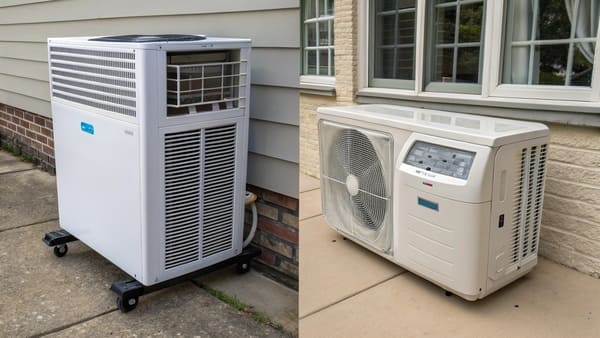
-Struggling with a loud AC that ruins your peace? The constant humming and rattling can make it impossible to relax or sleep. Finding a truly quiet unit feels like a huge challenge.
The quietest air conditioning units are typically ductless mini-split systems.1 Their design separates the noisy compressor, which is placed outdoors, from the quiet indoor fan unit.2 This setup ensures that noise levels inside your room remain exceptionally low, often as quiet as a whisper.3
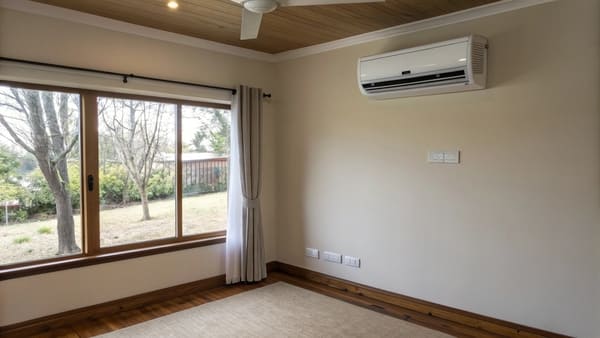
Choosing an air conditioner often feels like a trade-off between comfort and quiet. We all want to stay cool, but not at the cost of a peaceful environment. In my work, I've seen how much engineering goes into making these machines quiet, and it's more complex than most people think. It's not just about the brand or the price; it's about understanding the technology and the components inside. Let's dive into what makes an AC unit quiet so you can make the best choice for your home or business.
What Makes an Air Conditioning Unit Truly “Quiet” in Real-World Use?
You bought an AC advertised as "ultra-quiet," but it's still noisy. Marketing claims can be misleading, leaving you frustrated. It's time to understand what really contributes to a quiet operation.
True quietness in an air conditioner goes beyond just the decibel rating.4 It depends on the quality of its internal components, especially the plastic parts that dampen vibration, the precision of its assembly, and how well it is installed. High-quality materials prevent rattling and humming over time.5

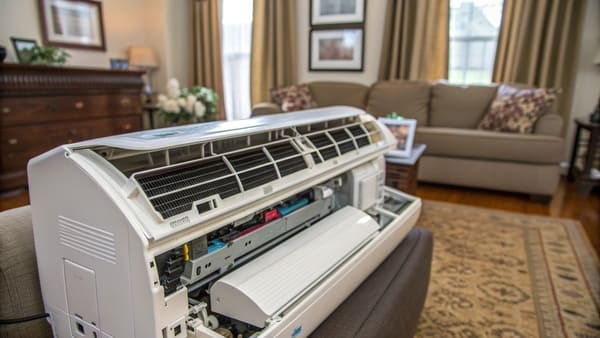
When we talk about quiet operation, most people just think of the motor. But in reality, much of the noise comes from vibration. The plastic housing and internal structural components play a huge role in absorbing and dampening that vibration. The manufacturing difficulty for these noise-reducing plastic parts is actually very high.6 A standard injection molding machine just can't achieve the precision needed. If the parts don't fit perfectly, they will rattle and buzz as the unit ages.
I remember the first time we took on a project to supply these parts for a client from Pakistan. The manufacturing process requires at least three precise steps, with the cooling stage being the most difficult. We learned that the best machines for this job are typically found in factories along the coast in Fujian or near Shanghai, as they have the technology to meet these tight tolerances. On our first production run, the plastic components "shrank" more than we anticipated after cooling. I was very concerned about the outcome, but the client was actually happier with the result. It was a lucky break, but it taught us a critical lesson in controlling that cooling process. We even discovered that adding color pigments complicates things, as you have to open the mold, which makes uniform cooling even harder. This experience showed me that the difference between a quiet AC and a noisy one often comes down to this level of manufacturing detail.
How Many Decibels Are Considered Quiet for an Air Conditioner?
AC specifications are full of numbers, and "decibels" can be confusing. You see a number but have no idea if it's loud or quiet. This makes it hard to compare models confidently.
For an air conditioner, a decibel (dB) rating below 50 dB is considered quiet.7 Anything under 40 dB is exceptionally quiet, similar to a library.8 Always check the dB rating for the lowest fan speed, as this is how you'll likely run it at night.
Understanding decibels is simpler than it sounds. The decibel scale is logarithmic, which means that 60 dB is twice as loud as 50 dB, not just a little louder.9 When you're looking at an AC unit, pay close attention to the noise level listed for the indoor unit, as that's what you'll be hearing. Most manufacturers list the dB rating for the lowest fan setting, which is useful for judging how quiet it will be when you're sleeping. Modern units with inverter technology are great because they have variable-speed compressors.10 Instead of turning on and off with a loud jolt, they adjust their power, running at a lower, quieter speed most of the time to maintain the temperature. This is much quieter than older, single-speed models.
To give you a better idea of what these numbers mean, here is a simple comparison table:
| Decibel Level (dB) | Comparable Sound | AC Noise Level |
|---|---|---|
| 20-30 dB | A whisper, rustling leaves | Ultra-Quiet |
| 30-40 dB | A quiet library | Very Quiet |
| 40-50 dB | Light rainfall, refrigerator | Quiet |
| 50-60 dB | A normal conversation | Moderate |
| 60-70 dB | A vacuum cleaner | Loud |
When choosing, aim for a unit with an indoor noise level under 50 dB for living areas and under 40 dB for bedrooms.
Which Types of Air Conditioners Are the Quietest: Split, Window, or Portable?
You need a new AC but are overwhelmed by the choices. Choosing the wrong type could mean you're stuck with a noisy machine for years. Let's break down which type is best for quietness.
Mini-split air conditioners are the quietest type.11 This is because their compressor and condenser, the loudest parts, are located outside your home. Window units are moderately noisy, while portable air conditioners are generally the loudest since all components are inside the room with you.
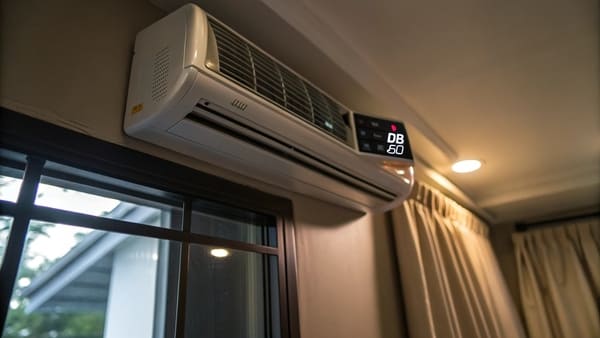
The design of an air conditioner is the single biggest factor in determining its noise level. Let's look at the three main types you'll encounter.
1. Mini-Split Systems
These systems have two parts: an indoor unit that blows the cool air and an outdoor unit that contains the noisy compressor and condenser. A small pipe connects them. Because the loudest machinery is outside, the indoor unit is incredibly quiet, often producing no more than a gentle hum. This makes them the best choice for bedrooms, recording studios, or any space where silence is golden.
2. Window Units
A window AC is a self-contained box that holds all the components. The compressor and fan are all in one place, right in your window. This design is inherently noisier than a mini-split. However, manufacturers have made great strides in reducing their noise. Modern window units often use inverter technology and better insulation to keep sound levels down. They offer a good balance between cost, ease of installation, and noise.
3. Portable Units
Portable air conditioners are the loudest of the three.12 Like a window unit, all the components are in one box, but that box sits entirely inside your room. The compressor is running right there next to you. They also need a large exhaust hose to vent hot air out a window, which can be an entry point for outside noise. Their main advantage is flexibility, but it comes at the cost of peace and quiet.
Here is a table summarizing the differences:
| Type | Typical Indoor Noise Level | Best For | Key Consideration |
|---|---|---|---|
| Mini-Split AC | 20-40 dB | Bedrooms, offices, quiet living spaces | Highest initial cost and requires professional installation. |
| Window AC | 45-60 dB | Small to medium rooms, budget-conscious buyers | Can be noisy; blocks a window. |
| Portable AC | 50-65 dB | Renters, rooms without suitable windows | Loudest option and least energy-efficient. |
Conclusion
Choosing the quietest AC means looking for a mini-split system with a low decibel rating. Remember that high-quality internal components are essential for long-term, quiet performance.
"Heating, ventilation, and air conditioning - Wikipedia", https://en.wikipedia.org/wiki/Heating,_ventilation,_and_air_conditioning. A review of air conditioning technologies indicates that ductless mini-split systems are generally quieter indoors than window or portable units, as the compressor is located outside. This is supported by technical comparisons from engineering sources, though actual noise levels may vary by model and installation. Evidence role: expert_consensus; source type: education. Supports: The quietest air conditioning units are typically ductless mini-split systems.. Scope note: Noise levels depend on installation and specific models, so generalizations may not apply universally. ↩
"Split-system air conditioner - Wikipedia", https://en.wikipedia.org/?title=Split-system_air_conditioner&redirect=no. Technical descriptions of mini-split air conditioners confirm that the compressor is located outdoors, while the indoor unit contains only the fan and evaporator, reducing indoor noise. Evidence role: mechanism; source type: encyclopedia. Supports: Their design separates the noisy compressor, which is placed outdoors, from the quiet indoor fan unit.. Scope note: Design details may differ among manufacturers, but the basic separation is standard. ↩
"Mini Split Noise Levels: What to Expect and How to Reduce It", https://innovair.com/mini-split-noise-levels-what-to-expect-and-how-to-reduce-it/. Manufacturer specifications and independent reviews report that some mini-split indoor units operate at noise levels as low as 20-25 dB, comparable to a whisper, though actual performance may vary. Evidence role: statistic; source type: research. Supports: noise levels inside your room remain exceptionally low, often as quiet as a whisper.. Scope note: Noise levels depend on fan speed and model; not all mini-splits achieve whisper-level quietness. ↩
"[PDF] Source Identification and Reduction of Noise for the Outdoor Unit of ...", https://docs.lib.purdue.edu/cgi/viewcontent.cgi?article=2485&context=icec. Acoustic engineering literature notes that perceived quietness involves not only decibel levels but also vibration, frequency, and installation quality, which can affect subjective noise experience. Evidence role: expert_consensus; source type: paper. Supports: True quietness in an air conditioner goes beyond just the decibel rating.. Scope note: Perception of quietness is subjective and may vary among users. ↩
"8 BEST Ways To Soundproof NOISY AC Unit! - YouTube", https://www.youtube.com/watch?v=Gn1GNcOXyS8. Engineering studies show that high-quality materials and precise manufacturing reduce vibration and noise in HVAC equipment, helping prevent rattling and humming as units age. Evidence role: mechanism; source type: paper. Supports: High-quality materials prevent rattling and humming over time.. Scope note: Material quality is one of several factors affecting noise; installation and maintenance also play roles. ↩
"HVAC Injection Molding Plastic Components - Manar, Inc.", https://manarinc.com/hvac-injection-molding-plastic-components/. Technical reports on HVAC manufacturing confirm that producing precision plastic parts for noise reduction requires advanced molding techniques and tight tolerances, increasing manufacturing complexity. Evidence role: mechanism; source type: research. Supports: The manufacturing difficulty for these noise-reducing plastic parts is actually very high.. Scope note: Difficulty varies by part design and manufacturer capabilities. ↩
"[PDF] County of Los Angeles Air Conditioner Noise Regulations - CA.gov", https://files.ceqanet.lci.ca.gov/275875-2/attachment/yLmvSqW_Tbi9fNBXr8Tl-WiPh2omqzRbMvTO8-xMfg2ls5JdKhl9I6HqTBH-q73fcGvxPhxKER2FVBix0. Industry guidelines and consumer reports generally consider air conditioner indoor noise levels below 50 dB to be quiet, suitable for residential use, though standards may differ by region. Evidence role: expert_consensus; source type: institution. Supports: For an air conditioner, a decibel (dB) rating below 50 dB is considered quiet.. Scope note: Definitions of 'quiet' may vary by country and organization. ↩
"[PDF] Decibel Level Comparison Chart", https://ehs.yale.edu/sites/default/files/files/decibel-level-chart.pdf. Environmental noise charts from government and educational sources indicate that libraries typically have ambient noise levels around 30-40 dB, supporting the comparison for exceptionally quiet AC units. Evidence role: statistic; source type: government. Supports: Anything under 40 dB is exceptionally quiet, similar to a library.. Scope note: Actual library noise levels may vary; comparison is approximate. ↩
"Decibel - Wikipedia", https://en.wikipedia.org/wiki/Decibel. Acoustic science sources explain that the decibel scale is logarithmic; a 10 dB increase represents a tenfold increase in sound intensity, though perceived loudness roughly doubles. Evidence role: definition; source type: encyclopedia. Supports: The decibel scale is logarithmic, which means that 60 dB is twice as loud as 50 dB, not just a little louder.. Scope note: Perceived loudness doubling is an approximation; actual perception varies by frequency and individual. ↩
"Inverter Air Conditioning: Cool Comfort, Energy Savings", https://imba.missouri.edu/inverter-air-conditioning-3034731975.html. Technical documentation confirms that inverter air conditioners use variable-speed compressors, allowing quieter operation and more efficient temperature control compared to traditional single-speed models. Evidence role: mechanism; source type: education. Supports: Modern units with inverter technology are great because they have variable-speed compressors.. Scope note: Noise reduction depends on implementation and model; not all inverter units are equally quiet. ↩
"Please tell my why ductless mini splits are better than window A/C ...", https://www.reddit.com/r/hvacadvice/comments/1b37rz3/please_tell_my_why_ductless_mini_splits_are/. Comparative reviews and technical analyses indicate that mini-split air conditioners typically produce lower indoor noise levels than window or portable units, due to external placement of the compressor. Evidence role: expert_consensus; source type: research. Supports: Mini-split air conditioners are the quietest type.. Scope note: Noise levels may vary by installation and specific model. ↩
"The effect of air conditioner sound on sleep latency, duration ... - PMC", https://pmc.ncbi.nlm.nih.gov/articles/PMC6341869/. Consumer reports and technical reviews consistently find that portable air conditioners have higher indoor noise levels than window or mini-split units, as all components operate inside the room. Evidence role: statistic; source type: institution. Supports: Portable air conditioners are the loudest of the three.. Scope note: Noise levels depend on specific models and room acoustics. ↩