-An uncomfortable bus ride can ruin a whole trip. The stuffy air, extreme heat, or biting cold makes everyone miserable. A reliable HVAC system is the simple solution for this1.
A tour bus HVAC system is a specialized climate control unit designed to manage the temperature, humidity, and air quality inside a large vehicle2. It combines heating, ventilation, and air conditioning to ensure all passengers are comfortable on long journeys, no matter the weather outside3.
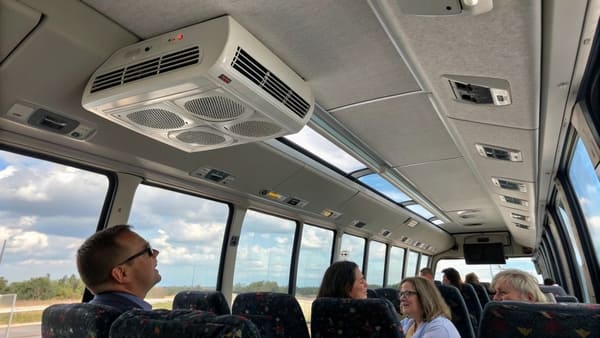
Understanding these systems is crucial. For passengers, it's about comfort. For bus operators and fleet managers, it's about providing a quality service and avoiding costly breakdowns. As a manufacturer of automotive parts, I've seen firsthand how complex these systems are, especially the parts you don't see. Let's dive into what makes these systems work and what you need to know when choosing or maintaining one.
What Is a Tour Bus HVAC System?
You often hear the term "HVAC," but what does it really mean for a big tour bus? This can make choosing or repairing one very confusing. Let's break it down.
A tour bus HVAC system is a powerful climate control unit made specifically for large passenger vehicles. It heats, cools, and circulates fresh air to keep everyone on board comfortable, from the first row to the very back, maintaining a consistent and pleasant environment.
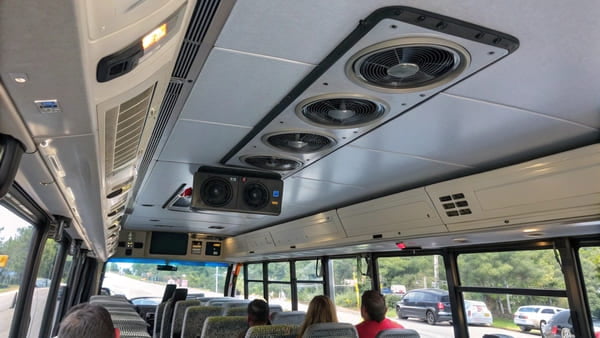
A tour bus HVAC system is much more than a simple car air conditioner. It's a combination of three distinct functions working together. The "H" stands for Heating, the "V" for Ventilation, and the "AC" for Air Conditioning. Each part plays a vital role in creating a comfortable cabin environment. The heating function keeps passengers warm during cold weather, often using heat from the engine4. The ventilation function is critical for health and safety. It brings in fresh air from outside, circulates it throughout the long cabin, and pushes out stale, carbon dioxide-heavy air5. This prevents the space from feeling stuffy and keeps passengers alert. The air conditioning part cools the air and, just as importantly, removes humidity, which is key for comfort on hot, sticky days6. Because a bus has such a large volume of air and so many passengers generating body heat, these systems have to be incredibly robust and powerful7.
| Feature | Car HVAC | Tour Bus HVAC |
|---|---|---|
| Area to Cool/Heat | Small cabin (2-4 m³) | Large cabin (30-50 m³) |
| Power Source | Vehicle's main engine | Vehicle's main engine or separate APU |
| Complexity | Simple, integrated unit | Complex, multi-zone system |
| Airflow Needs | Lower CFM (Cubic Feet per Minute) | Very high CFM for full cabin circulation |
How Does a Tour Bus HVAC System Work?
How a bus stays cool in the summer and warm in the winter can seem like magic. But not knowing the basics makes it tough to fix or buy parts. Let’s look at the process.
The system works by using a refrigerant cycle to cool the air and the engine's heat to warm it8. Fans and a network of ducts then distribute this conditioned air evenly throughout the bus9. Meanwhile, the ventilation function constantly exchanges stale indoor air with fresh outdoor air.
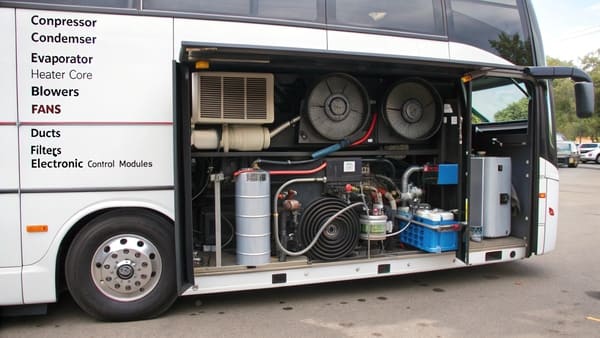
The whole process is a well-coordinated cycle managed by a central control unit. For cooling, the system relies on a refrigerant cycle, just like your fridge at home but on a much larger scale. The compressor pressurizes a refrigerant gas, which then moves to the condenser. Here, it releases heat to the outside air and turns into a liquid. This liquid then flows through an expansion valve, which causes it to become very cold. Finally, it enters the evaporator inside the bus cabin. A blower fan pushes cabin air across the cold evaporator coils, cooling the air before sending it out through the vents. For heating, the process is simpler. The system taps into the engine's own cooling system. Hot coolant from the running engine is pumped through a small radiator called a heater core. A fan blows air over this hot core, warming the air and distributing it into the cabin. All of this is managed by the driver through a control panel, which regulates temperature, fan speed, and where the air is directed, ensuring the environment is just right for the passengers.
What Components Make Up a Tour Bus HVAC System?
You need to replace an HVAC part, but the list of components is overwhelming. Buying the wrong part is a waste of money and leads to more downtime. Let's identify the key parts.
Key components include the compressor, condenser, evaporator, and heater core. The system also has blowers, fans, ducts, filters, and electronic control modules10. Many of these parts, especially the plastic ductwork and housings, require extremely precise manufacturing to work correctly.
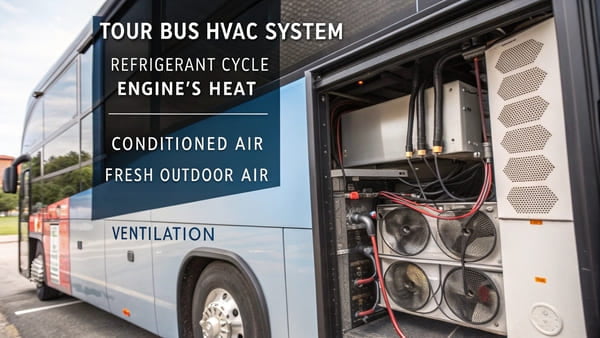
From my experience as an OEM manufacturer, the plastic components are deceptively complex. Making plastic housings and ducts for a tour bus HVAC system is very difficult. Standard injection molding machines often can't achieve the precision needed11. The parts must fit perfectly to prevent air leaks, which would make the entire system inefficient. The manufacturing process has at least three major steps, and the cooling stage is the most critical. If the plastic doesn't cool uniformly, it can warp or shrink12. I learned this the hard way on a project for a Pakistani client. It was my first time making these specific parts, and they "shrank" more than expected after cooling. I was worried we had failed, but the client actually preferred the result because the parts were denser and felt more solid. It was a lucky mistake, but it taught me an invaluable lesson about precision control. Now, we use specialized high-precision machines, the kind you typically only find in the coastal manufacturing hubs of Fujian and around Shanghai. Adding color is another challenge because you have to stop the machine and open the mold, which complicates the crucial cooling process.
| Component | Function | Manufacturing Note |
|---|---|---|
| Compressor | Pressurizes the refrigerant; the "heart" of the AC. | Requires robust mechanical engineering. |
| Condenser & Evaporator | Heat exchangers for cooling. | Fins must be perfectly spaced for airflow. |
| Ducts & Vents | The air delivery network. | Plastic molding requires extreme precision to prevent leaks. |
| Blower Fans | Move air through the system. | Must be balanced to avoid noise and vibration. |
| Control Module | The "brain" that manages all functions. | Requires reliable electronics and software. |
Conclusion
A quality tour bus HVAC system is essential for passenger comfort and a successful business. Understanding its definition, how it works, and its core components helps you make better choices.
"Estimating on-board passenger comfort in public transport vehicles ...", https://pmc.ncbi.nlm.nih.gov/articles/PMC9712033/. Research on passenger comfort in buses indicates that effective HVAC systems significantly improve perceived comfort by regulating temperature and air quality, though individual preferences and maintenance quality can affect outcomes. Evidence role: general_support; source type: paper. Supports: A reliable HVAC system is the simple solution for uncomfortable bus rides caused by stuffy air, extreme heat, or biting cold.. Scope note: Passenger comfort is influenced by multiple factors beyond HVAC, such as seating and ride smoothness. ↩
"Heating, ventilation, and air conditioning - Wikipedia", https://en.wikipedia.org/wiki/Heating,_ventilation,_and_air_conditioning. Encyclopedic sources describe tour bus HVAC systems as specialized units for controlling temperature, humidity, and air quality in large passenger vehicles, confirming their multi-functionality. Evidence role: definition; source type: encyclopedia. Supports: A tour bus HVAC system is a specialized climate control unit designed to manage the temperature, humidity, and air quality inside a large vehicle.. Scope note: Descriptions may vary by region and bus type. ↩
"Basics of Bus Air Conditioning Systems - Trans Air Manufacturing", https://www.transairmfg.com/basics-of-bus-air-conditioning.cfm. Technical manuals and industry standards confirm that tour bus HVAC systems integrate heating, ventilation, and air conditioning to maintain passenger comfort in varying weather conditions. Evidence role: mechanism; source type: education. Supports: Tour bus HVAC systems combine heating, ventilation, and air conditioning to ensure passenger comfort on long journeys regardless of external weather.. Scope note: Actual comfort depends on system maintenance and design quality. ↩
"Heater core - Wikipedia", https://en.wikipedia.org/wiki/Heater_core. Technical guides explain that bus HVAC heating commonly utilizes engine coolant to warm cabin air, supporting the claim that engine heat is used for passenger comfort. Evidence role: mechanism; source type: education. Supports: The heating function in bus HVAC systems keeps passengers warm during cold weather, often using heat from the engine.. Scope note: Some buses may use auxiliary heaters instead of engine heat. ↩
"How can ventilation be improved on public transportation buses ...", https://repository.library.noaa.gov/view/noaa/68275. Studies and guidelines from transportation authorities emphasize that proper ventilation in buses is vital for health and safety, as it reduces CO2 buildup and improves air quality. Evidence role: expert_consensus; source type: government. Supports: The ventilation function in bus HVAC systems is critical for health and safety, bringing in fresh air and expelling stale, CO2-heavy air.. Scope note: Ventilation effectiveness depends on system design and maintenance. ↩
"Efficient Dehumidifier Makes Air Conditioning a Breeze | Feature", https://www.pnnl.gov/news-media/efficient-dehumidifier-makes-air-conditioning-breeze. Technical resources confirm that air conditioning systems in buses both cool and dehumidify cabin air, improving passenger comfort in hot, humid conditions. Evidence role: mechanism; source type: education. Supports: The air conditioning part of bus HVAC systems cools the air and removes humidity, which is key for comfort on hot days.. Scope note: Dehumidification efficiency varies with system design and maintenance. ↩
"Bus Air Conditioner, Bus Air Conditioning System - GUCHEN", https://www.guchen.com/bus-air-conditioner/. Engineering literature notes that the large cabin volume and passenger heat load in buses require HVAC systems with high capacity and robust performance. Evidence role: statistic; source type: research. Supports: Bus HVAC systems must be robust and powerful due to the large air volume and passenger-generated body heat.. Scope note: Exact requirements depend on bus size and occupancy. ↩
"Bus Air Conditioning Refrigerant Comparison - TKT HVAC", https://www.busthermo.com/bus-air-conditioning-refrigerant-news/. Technical documentation describes bus HVAC systems as employing a refrigerant cycle for cooling and engine heat for warming, matching the described mechanisms. Evidence role: mechanism; source type: education. Supports: Tour bus HVAC systems use a refrigerant cycle for cooling and engine heat for warming.. Scope note: Some buses may use alternative heating sources. ↩
"[PDF] Design Guide for Heating, Ventilating, and Air Conditioning Systems", https://www.usbr.gov/tsc/techreferences/mands/mands-pdfs/HVACManl.pdf. Engineering sources confirm that bus HVAC systems utilize fans and duct networks to distribute conditioned air throughout the cabin, ensuring even airflow. Evidence role: mechanism; source type: education. Supports: Fans and a network of ducts distribute conditioned air evenly throughout the bus.. Scope note: Distribution effectiveness depends on duct design and maintenance. ↩
"HVAC System Overview: Common HVAC Parts & Their Functions", https://heavyequipmentcollege.edu/hvac-parts-and-their-functions/. Technical manuals and industry guides list compressor, condenser, evaporator, heater core, blowers, fans, ducts, filters, and control modules as standard components of bus HVAC systems. Evidence role: definition; source type: education. Supports: Key components of a tour bus HVAC system include compressor, condenser, evaporator, heater core, blowers, fans, ducts, filters, and electronic control modules.. Scope note: Component lists may vary by manufacturer and bus model. ↩
"Solving Commercial Ductwork Problems", https://www.tessiers.com/solving-commercial-ductwork-problems-with-custom-fabrication/. Manufacturing literature notes that HVAC ductwork for buses requires high precision in plastic molding to prevent air leaks, and standard machines may not meet these tolerances. Evidence role: expert_consensus; source type: research. Supports: Making plastic housings and ducts for a tour bus HVAC system is very difficult, and standard injection molding machines often can't achieve the required precision.. Scope note: Specific requirements depend on design and manufacturer capabilities. ↩
"Optimization of the Reduction of Shrinkage and Warpage for Plastic ...", https://pmc.ncbi.nlm.nih.gov/articles/PMC9740879/. Technical sources on plastic molding emphasize that uniform cooling is crucial to prevent warping and shrinkage, especially for HVAC ductwork and housings. Evidence role: mechanism; source type: education. Supports: The manufacturing process for bus HVAC plastic components has at least three major steps, with cooling being the most critical; uneven cooling can cause warping or shrinkage.. Scope note: Process details may vary by material and manufacturing technology. ↩