-Feeling lost when looking at a car's components? Vehicles seem very complex, and telling parts apart is tough. Let's break down the essential components so you understand how it all works.
The main parts of a vehicle are the chassis, body, engine, and drivetrain. These core systems work together to provide structure, power, and motion. Other key groups include the suspension, braking, and electrical systems, which are essential for ensuring control, safety, and functionality on the road.1
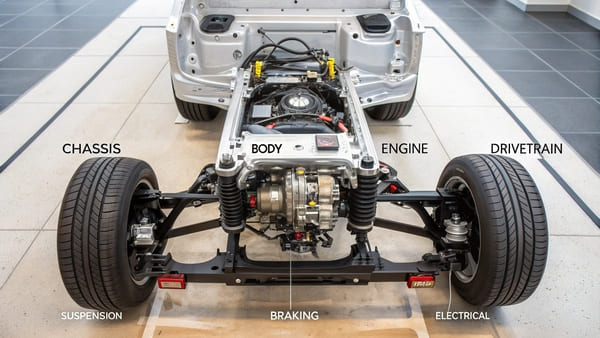
A car is much more than what you see on the surface. As a manufacturer, I've spent years working with every single one of these components. From the smallest electronic sensor to the largest body panel, each part has a specific purpose. Understanding how they connect helps you appreciate the engineering that goes into every vehicle. It also helps you make better decisions when you need to source, replace, or customize parts. Let's start by looking at the main groups of components that form a complete vehicle.
What Are the Main Parts of a Vehicle?
Ever wonder what truly makes a car a car? It's more than just an engine and four wheels. Understanding the main groups of parts helps you see the bigger picture.
A vehicle is primarily made of its chassis (the frame), the body (exterior and interior panels), the powertrain (engine and transmission), and other systems like suspension, brakes, and electronics. Each group has a specific job, from providing structure to creating movement.2
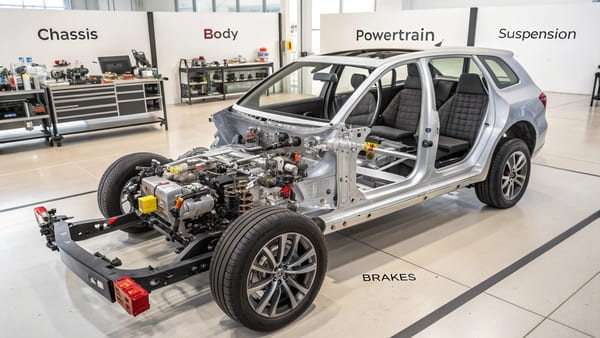
When we build or supply parts for vehicles, we think in terms of these major systems. It helps us organize the complex process of manufacturing and assembly. Each system relies on the others to function correctly. The chassis is the skeleton, the body is the skin, and the powertrain is the heart and muscles. Then you have the nervous system, which is all the electronics that control everything.3 Thinking about it this way makes the entire vehicle much easier to understand. Below, I'll break down these systems to show how they all fit together and what they do. This is the foundation for understanding any car on the road.
Core Vehicle Systems
A modern vehicle is a collection of highly integrated systems. Each one performs a critical role, and they must all work together perfectly. As an OEM supplier, we produce components for nearly all of these categories, so I see firsthand how they interact.
| System Group | Primary Function | Key Components |
|---|---|---|
| Chassis | Provides the structural frame and supports the vehicle. | Frame, Axles, Suspension, Steering System |
| Body | Forms the exterior and interior enclosure of the vehicle. | Doors, Hood, Fenders, Bumpers, Seats, Dashboard |
| Powertrain | Generates power and delivers it to the wheels. | Engine, Transmission, Driveshaft, Differential |
| Electrical System | Powers all electronics, lights, and ignition. | Battery, Alternator, Wiring Harnesses, ECU |
| Brake System | Slows and stops the vehicle. | Brake Pads, Rotors, Calipers, Brake Lines |
| HVAC System | Controls the climate inside the cabin. | Compressor, Condenser, Heater Core, Vents |
These systems are the building blocks of any car. For example, the chassis must be strong enough to support the weight of the body and powertrain, while the electrical system must reliably power everything from the engine's spark plugs to the interior lights.
What Are the Exterior Parts of a Vehicle and Their Functions?
A car's exterior is its first impression. But these parts do more than just look good. They are absolutely critical for safety, aerodynamics, and protecting the important components inside.
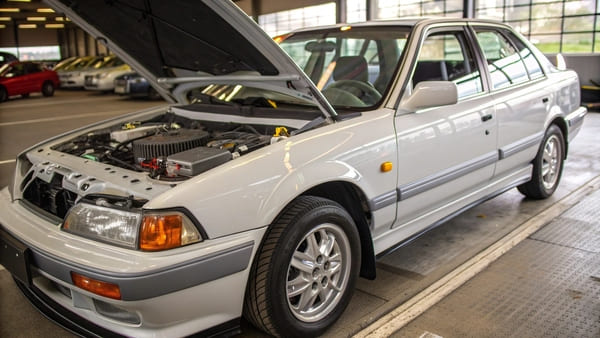
Exterior parts include body panels like doors, the hood, and the trunk lid. They also include bumpers, lighting systems such as headlights and taillights, and windows. These parts provide structural integrity, protect occupants in a crash, improve fuel efficiency, and ensure visibility.4
Let's dive deeper into the specific functions of these exterior components. They are the vehicle's first line of defense against the elements and impacts. They also play a huge role in defining the car's identity and performance. From the shape of the mirrors to the material of the bumper, every detail is engineered with a purpose. Many of these parts, especially plastic ones, are surprisingly difficult to manufacture correctly. The precision required is extremely high, and not all factories can achieve it. I learned this lesson the hard way early in my career.
Body Panels and Bumpers
The body panels are the "skin" of the car. This includes the doors, fenders, hood, and trunk lid. Their main job is to protect the occupants and the mechanical parts from weather and impacts. Bumpers, which are usually located at the very front and rear, are designed specifically to absorb energy during low-speed collisions, protecting the more expensive and critical parts of the car.5 Aerodynamics are also key. The shape of every panel is designed to help the car cut through the air smoothly, which improves fuel economy and stability at high speeds.6
Automotive Lighting Systems
Lighting is one of the most important safety features on any vehicle. Headlights illuminate the road ahead, while taillights and brake lights make the car visible to other drivers. Turn signals communicate your intentions.7 We manufacture a lot of lighting systems, from standard halogen units to advanced LED and laser headlights. The design of these lights is complex. It involves not just the light source but also the optics of the projector or reflector, the heat dissipation system to keep LEDs cool, and the housing that protects it all from moisture and vibration.
The Challenge of Manufacturing Plastic Parts
Many exterior parts, like grilles, bumper covers, and light housings, are made from plastic. Making these parts is extremely difficult. The injection molding machines need to be incredibly precise to meet automotive standards. The cooling process is the hardest part. If it’s not done perfectly, the part can warp or shrink.8 I remember my first time managing a large order for a client from Pakistan. We were making plastic trim pieces. At the time, we were still learning some advanced techniques. After production, the parts had "shrunk" more than we expected because our cooling control wasn't perfect. I was very worried. But when the client saw them, he actually preferred the tighter, more compact look. We got lucky, but it was a big lesson. We perfected our cooling process after that and have never had that issue again. It just shows how much precision goes into what seems like a simple piece of plastic.
What Are the Main Mechanical Parts of a Vehicle?
The engine roars, but what else is happening to make the car move? A vehicle's mechanical core is a complex system of powerful parts. Let's explore the key components.
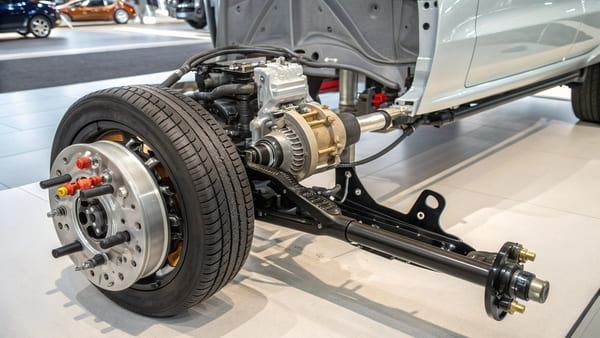
The main mechanical parts are the engine, transmission, drivetrain (axles, driveshaft), suspension, and brakes. The engine creates power, the transmission manages it, the drivetrain delivers it to the wheels, and the suspension and brakes handle ride quality and stopping.9
These are the parts that do the heavy lifting. They convert fuel into motion, transfer that motion to the road, and keep the car stable and safe. As a parts supplier, we focus heavily on the quality and reliability of these components. A failure in the powertrain or brake system can be catastrophic. That's why the engineering and manufacturing standards are so high. Let's break down how these systems work together to get you from point A to point B.
The Powertrain: Engine and Transmission
The powertrain is the heart of the vehicle. It starts with the engine, which is an internal combustion engine in most cars. It burns fuel to create rotational force. This force then goes to the transmission. The transmission is a gearbox that manages the engine's power. It uses different gear ratios to send the right amount of power to the wheels, whether you're starting from a stop or cruising on the highway.10 In our work, we deal with components for both, like ignition systems for engines and control modules for modern automatic transmissions. The coordination between these two is critical for both performance and fuel efficiency.
Drivetrain and Suspension
After the transmission, the power travels through the drivetrain to the wheels. The drivetrain includes the driveshaft, the differential, and the axles. The driveshaft is a spinning rod that transfers power from the front to the back of the car. The differential splits this power between the two wheels, allowing them to spin at different speeds when you turn.11 The suspension system connects the wheels to the car's frame. It uses springs, shock absorbers, and control arms to absorb bumps in the road, providing a smooth ride and keeping the tires in contact with the ground for better control. High-quality chassis parts, like control arms and bushings, are vital for safety here.
Braking System
Finally, you need to be able to stop. That's the job of the braking system. When you press the brake pedal, you activate a hydraulic system that pushes brake pads against spinning discs (rotors) attached to each wheel. The friction created between the pads and rotors slows the car down. It's a simple concept, but it has to be incredibly reliable. We manufacture brake pads, rotors, and wear sensors. The materials used for these parts are engineered to withstand extreme heat and pressure without failing. A good braking system is arguably the most important safety feature in any vehicle.
Conclusion
Understanding a vehicle's parts, from its body panels to its engine, helps you appreciate its complexity. Each component is vital for the car's overall performance, safety, and function.
"Car Components 101: What Are Their Functions? | UTI", https://www.uti.edu/blog/automotive/car-components. A reputable automotive encyclopedia outlines the main vehicle systems as the chassis, body, powertrain, suspension, braking, and electrical systems, supporting the classification of these as essential groups in modern vehicles. Evidence role: definition; source type: encyclopedia. Supports: The main parts of a vehicle are the chassis, body, engine, and drivetrain. Other key groups include the suspension, braking, and electrical systems.. Scope note: Some sources may use slightly different terminology or groupings depending on vehicle type. ↩
"Automotive Technology: Drivetrain & Chassis", https://wiregrass.libguides.com/c.php?g=1035978&p=7510014. An educational resource from a university automotive engineering department describes the primary vehicle systems as the chassis, body, powertrain, suspension, brakes, and electronics, supporting this breakdown. Evidence role: definition; source type: education. Supports: A vehicle is primarily made of its chassis, body, powertrain, suspension, brakes, and electronics, each with a specific function.. Scope note: Descriptions may vary for electric or specialty vehicles. ↩
"Make me a list of car body parts which have analogies to human ...", https://erickimphotography.com/blog/2024/10/08/make-me-a-list-of-car-body-parts-which-have-analogies-to-human-body-parts/. A university automotive engineering textbook uses similar analogies to describe the chassis as the skeleton, the body as the skin, the powertrain as the heart and muscles, and the electronics as the nervous system of a vehicle. Evidence role: definition; source type: education. Supports: The chassis is the skeleton, the body is the skin, the powertrain is the heart and muscles, and the electronics are the nervous system of a vehicle.. Scope note: These are analogies and may not be used in all technical literature. ↩
"The Role of Auto Body Repair in Vehicle Safety - Ken Rocha Collision", https://www.kenrochacollision.com/blog/auto-body-repair/the-role-of-auto-body-repair-in-vehicle-safety. A government vehicle safety guide lists exterior parts such as body panels, bumpers, lighting, and windows, and describes their roles in structural integrity, crash protection, aerodynamics, and visibility. Evidence role: mechanism; source type: government. Supports: Exterior parts include body panels, bumpers, lighting, and windows, which provide structural integrity, crash protection, aerodynamics, and visibility.. Scope note: Some functions, like aerodynamics, may be more relevant to certain vehicle designs. ↩
"5.1.9 Rear-End Protection (393.86) - CSA", https://csa.fmcsa.dot.gov/safetyplanner/myfiles/SubSections.aspx?ch=22&sec=64&sub=138. A U.S. Department of Transportation fact sheet explains that bumpers are designed to absorb energy in low-speed collisions to protect vehicle components and reduce repair costs. Evidence role: mechanism; source type: government. Supports: Bumpers are designed to absorb energy during low-speed collisions, protecting critical vehicle parts.. Scope note: Bumper standards and effectiveness may vary by country and vehicle type. ↩
"How much do aerodynamics matter in relation to a vehicle's MPG?", https://www.reddit.com/r/askscience/comments/uwmbj/how_much_do_aerodynamics_matter_in_relation_to_a/. A university automotive aerodynamics course notes that body panel shapes are engineered to reduce drag, thereby improving fuel economy and high-speed stability. Evidence role: mechanism; source type: education. Supports: Body panel shapes are designed to improve aerodynamics, fuel economy, and stability.. Scope note: The degree of aerodynamic optimization varies by vehicle model and class. ↩
"Automotive lighting - Wikipedia", https://en.wikipedia.org/wiki/Automotive_lighting. A government road safety publication emphasizes the critical role of automotive lighting in visibility, signaling, and accident prevention. Evidence role: mechanism; source type: government. Supports: Automotive lighting is essential for visibility, signaling, and safety.. Scope note: Relative importance may vary depending on driving conditions and regulations. ↩
"A Review on Injection Molding: Conformal Cooling Channels ...", https://pmc.ncbi.nlm.nih.gov/articles/PMC11991609/. A technical paper on automotive plastics manufacturing discusses the precision required in injection molding and highlights cooling as a critical step to prevent warping and shrinkage. Evidence role: mechanism; source type: paper. Supports: Injection molding for automotive plastics requires high precision, and improper cooling can cause warping or shrinkage.. Scope note: Specific manufacturing challenges may vary by part design and material. ↩
"Drivetrain - Wikipedia", https://en.wikipedia.org/wiki/Drivetrain. A university automotive engineering curriculum lists the engine, transmission, drivetrain, suspension, and brakes as the main mechanical systems, describing their respective functions in power generation, management, delivery, and vehicle control. Evidence role: definition; source type: education. Supports: The main mechanical parts of a vehicle are the engine, transmission, drivetrain, suspension, and brakes, each with a specific function.. Scope note: Some modern vehicles (e.g., electric cars) may have different configurations. ↩
"Examination of Transmission Zeros in the MIMO Sensor-Based ...", https://pmc.ncbi.nlm.nih.gov/articles/PMC10857117/. A university automotive engineering textbook explains that the transmission uses gear ratios to optimize engine power delivery for various driving conditions. Evidence role: mechanism; source type: education. Supports: The transmission manages engine power using gear ratios to match driving conditions.. Scope note: Transmission types and gear ratio strategies may differ between vehicles. ↩
"Differential Equations - Pauls Online Math Notes - Lamar University", https://tutorial.math.lamar.edu/classes/de/de.aspx. A university automotive engineering course describes the differential as a device that allows wheels to rotate at different speeds during turns by splitting engine power. Evidence role: mechanism; source type: education. Supports: The differential splits power to allow wheels to spin at different speeds during turns.. Scope note: Some vehicles use alternative driveline systems (e.g., electric motors per wheel). ↩