-Confused about your headlights at night? Using the wrong beam can blind others or limit your own view, creating a major safety hazard.1 Let's make it simple.
Use low beams for normal night driving in traffic, pointing light down and to the right to avoid blinding others. Use high beams on empty, dark roads for maximum visibility, but always switch back to low beams when you see another vehicle approaching.
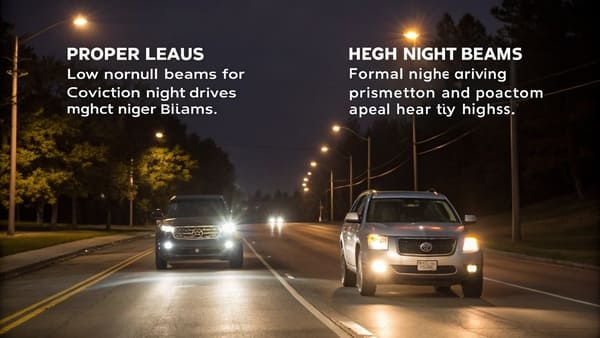
Understanding the basic rules is a great start. But have you ever wondered what's happening inside the headlight assembly itself? The technology that directs the light is surprisingly complex. To really master your vehicle's lighting, let's look closer at what makes each beam unique, starting with the one you use most often.
What Are Low Beam Lights and How Do They Work?
Ever wonder how your low beams illuminate the road ahead without blinding oncoming drivers? It’s not magic, but a precise engineering solution designed for everyday safety.
Low beam lights provide short-range, downward-angled illumination for city and traffic driving.2 They work by using a specific filament or LED position and a reflector with a cutoff shield, which creates a sharp line to prevent light from shining into other drivers' eyes.3
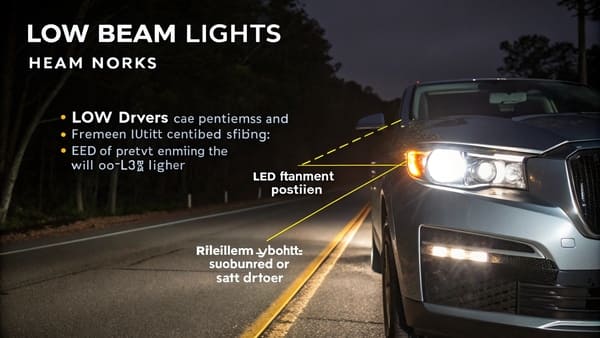
The real magic of a low beam light is in its precision. The light source, whether it's a halogen bulb, HID, or LED, is positioned very carefully inside the headlight housing. The reflector bowl is designed with a specific shape to gather the light and project it forward. The most critical part, however, is the cutoff shield.
The Role of the Cutoff Shield
This small piece of metal or a specific design feature in the projector lens blocks the upper portion of the light beam. This creates that distinct horizontal line of light you see on a garage door. It’s what keeps the light on the road surface and out of the eyes of oncoming traffic. The precision of this cutoff is non-negotiable for safety and regulatory compliance.4
Manufacturing Challenges
This is where my experience as a manufacturer comes in. The plastic components that make up the reflector and housing must be incredibly precise. Standard injection molding often can't meet the required tolerances. I remember my first project for a Pakistani client involving these parts. The plastic components "shrank" more than expected after cooling. We learned a tough lesson about material stability and cooling processes, which is the most difficult step in producing high-quality headlight parts. Luckily, the client liked the slightly altered beam pattern, but it taught us to perfect our production process for all future orders.
What Are High Beam Lights and Why Are They Brighter?
Driving on a dark, empty road, you flip a switch and the world lights up. But why are high beams so much brighter and far-reaching than low beams?
High beams aren't necessarily "brighter" in terms of raw power.5 Instead, they work by using a different filament or a reflector design that casts light straight ahead and upward, without a cutoff shield.6 This illuminates the road and surroundings much farther away.
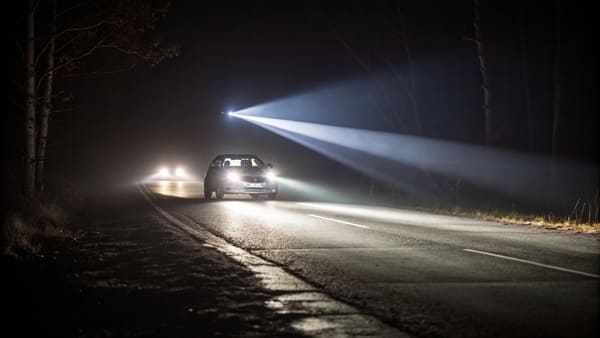
The power of high beams comes from how they distribute light, not just how much light they produce. In many headlight assemblies, the high beam and low beam share the same bulb, which has two separate filaments.7 In others, they are separate bulbs or LED arrays.
How High Beams Achieve Maximum Distance
The key difference is the absence of a cutoff shield. The reflector for the high beam is designed to capture all the light and project it straight and far.8 This provides maximum illumination down the road, lighting up signs, potential hazards, and the road surface well into the distance. It is designed for one purpose: seeing as far as possible when no one else is around.
The Difficulty in Production
From a manufacturing standpoint, even this "simpler" design has its challenges. The plastic reflectors must be perfectly smooth and shaped to avoid dark spots or uneven patterns. Another tricky part is adding colorants to the plastic for specific components. The process requires stopping the machine and opening the mold, which can interfere with the critical cooling stage. This is a common issue that requires high-end machinery, the kind you typically find in specialized factories near Shanghai or in the Fujian province, to get right. Low-precision machines, like some made in the Hebei region, often can't meet these standards.
What Is the Main Difference Between Low Beam and High Beam Lights?
So you know how each beam works, but what’s the single biggest takeaway? Understanding the core difference is key to using them correctly and safely every single time.
The main difference is light direction. Low beams are aimed down and to the side with a sharp cutoff to avoid blinding other drivers.9 High beams are aimed straight ahead and upward to maximize distance visibility on empty roads, with no cutoff.10
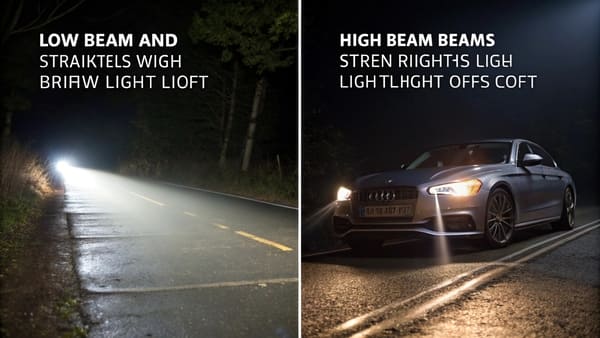
Let's break down the differences in a simple, direct way. It all comes down to their intended purpose, which dictates their design and how you should use them. One is for driving with others, and the other is for driving alone.
Headlight Beam Comparison
Here is a simple table to summarize everything:
| Feature | Low Beam Lights | High Beam Lights |
|---|---|---|
| Primary Use | Driving in traffic, cities, towns | Driving on dark, empty roads |
| Light Direction | Downward and to the right | Straight ahead and upward |
| Key Feature | Has a sharp "cutoff" line | No cutoff, illuminates everything |
| Goal | Illuminate the immediate road | Maximize long-distance visibility |
| Effect on Others | Minimizes glare for other drivers | Blinds oncoming drivers |
As a manufacturer, we see these differences at the component level. The precision required for a low beam's projector and shield is far greater than for a high beam's simple reflector.11 This is why OEM headlight assemblies are complex systems; they are engineered for two very different but equally important safety functions.12 Getting that plastic injection molding just right is the foundation of a safe and reliable headlight.
Conclusion
In short, use low beams for traffic and high beams for empty roads. Understanding this simple rule and the technology behind it makes you a safer, more responsible driver.
"Interpretation ID: nht92-7.4 - NHTSA", https://www.nhtsa.gov/interpretations/nht92-74. Government transportation safety agencies note that improper use of headlights, such as using high beams in traffic, can cause glare and reduce visibility for other drivers, increasing the risk of accidents. Evidence role: expert_consensus; source type: government. Supports: Using the wrong beam can blind others or limit your own view, creating a major safety hazard.. Scope note: The source may discuss general safety risks rather than specific accident statistics. ↩
"Headlamp - Wikipedia", https://en.wikipedia.org/wiki/Headlamp. Automotive engineering references describe low beam headlights as providing a short-range, downward-angled light pattern suitable for use in traffic and urban environments. Evidence role: definition; source type: encyclopedia. Supports: Low beam lights provide short-range, downward-angled illumination for city and traffic driving.. Scope note: Descriptions may vary slightly by country or vehicle type. ↩
"What creates the cut-off in a an automotive reflector headlight", https://www.candlepowerforums.com/threads/what-creates-the-cut-off-in-a-an-automotive-reflector-headlight.425073/. Technical sources on automotive lighting explain that low beam headlights use a cutoff shield or lens design to create a sharp horizontal light pattern, minimizing glare for oncoming drivers. Evidence role: mechanism; source type: education. Supports: They work by using a specific filament or LED position and a reflector with a cutoff shield, which creates a sharp line to prevent light from shining into other drivers' eyes.. Scope note: Some modern designs use projector lenses instead of traditional reflectors. ↩
"Interpretation ID: Bailes.1 - NHTSA", https://www.nhtsa.gov/interpretations/bailes1. Automotive lighting regulations, such as those from UNECE or NHTSA, require precise cutoff patterns in low beam headlights to ensure safety and compliance. Evidence role: expert_consensus; source type: government. Supports: The precision of this cutoff is non-negotiable for safety and regulatory compliance.. Scope note: Regulations may differ by region but generally require a defined cutoff. ↩
"Your low-beam "upgrade" should not be any brighter than stock. Or ...", https://www.reddit.com/r/cars/comments/1b5oh2w/your_lowbeam_upgrade_should_not_be_any_brighter/. Automotive lighting literature clarifies that high beams are not always higher in wattage but differ in beam pattern and direction, resulting in greater perceived brightness and range. Evidence role: mechanism; source type: education. Supports: High beams aren't necessarily "brighter" in terms of raw power.. Scope note: Some vehicles may use higher wattage bulbs for high beams, but the main difference is beam pattern. ↩
"High Beam Reflector - Amazon.com", https://www.amazon.com/high-beam-reflector/s?k=high+beam+reflector. Engineering sources explain that high beam headlights use a different filament position or reflector design to project light straight ahead and upward, lacking the cutoff shield found in low beams. Evidence role: mechanism; source type: education. Supports: they work by using a different filament or a reflector design that casts light straight ahead and upward, without a cutoff shield.. Scope note: Some modern headlights use separate bulbs or LED arrays for high beams. ↩
"Dual Filament 12VDC Bulb - How It Works - YouTube", https://www.youtube.com/watch?v=-99uqDCPBz0. Automotive repair manuals and technical guides state that many vehicles use dual-filament bulbs to provide both high and low beam functions in a single headlight assembly. Evidence role: mechanism; source type: education. Supports: In many headlight assemblies, the high beam and low beam share the same bulb, which has two separate filaments.. Scope note: Some vehicles use separate bulbs or LED modules for each beam. ↩
"Reflective Optics Design for an LED High Beam Headlamp of ... - PMC", https://pmc.ncbi.nlm.nih.gov/articles/PMC4414011/. Engineering textbooks on automotive lighting describe high beam reflectors as being shaped to direct the maximum amount of light straight ahead for long-distance illumination. Evidence role: mechanism; source type: education. Supports: The reflector for the high beam is designed to capture all the light and project it straight and far.. Scope note: Designs may vary between reflector and projector systems. ↩
"[PDF] state of california handbook for lamp adjusters and stations", https://www.bar.ca.gov/pdf/lamp-handbook-9.3.15.pdf. Automotive safety organizations explain that low beams are angled downward and to the side, with a cutoff to reduce glare for oncoming traffic. Evidence role: mechanism; source type: government. Supports: Low beams are aimed down and to the side with a sharp cutoff to avoid blinding other drivers.. Scope note: Exact beam angles may differ by country or vehicle model. ↩
"How to align high/full beam headlights? : r/MechanicAdvice - Reddit", https://www.reddit.com/r/MechanicAdvice/comments/aawkec/how_to_align_highfull_beam_headlights/. Government and automotive safety sources state that high beams are designed to project light straight ahead and upward, without a cutoff, to maximize visibility on unlit roads. Evidence role: mechanism; source type: government. Supports: High beams are aimed straight ahead and upward to maximize distance visibility on empty roads, with no cutoff.. Scope note: Some adaptive systems may modify the beam pattern dynamically. ↩
"[PDF] Vehicle Headlamp Aim Angle Test Procedure and Tolerance ...", https://rosap.ntl.bts.gov/view/dot/88136/dot_88136_DS1.pdf. Engineering literature on headlight manufacturing notes that low beam projectors and shields require tighter tolerances and more precise manufacturing than high beam reflectors due to regulatory and safety requirements. Evidence role: expert_consensus; source type: research. Supports: The precision required for a low beam's projector and shield is far greater than for a high beam's simple reflector.. Scope note: Some high-performance high beams may also require precise manufacturing. ↩
"Interpretation ID: nht92-7.4 - NHTSA", https://www.nhtsa.gov/interpretations/nht92-74. Automotive engineering sources describe OEM headlight assemblies as complex systems designed to fulfill both low and high beam safety requirements. Evidence role: expert_consensus; source type: education. Supports: OEM headlight assemblies are complex systems; they are engineered for two very different but equally important safety functions.. Scope note: Complexity may vary by vehicle class and technology level. ↩