Confused by how a Tesla works without gears? You are not alone. It feels automatic, but its single-speed system is a whole new world for drivers coming from gasoline cars.
The Tesla Model S does not have a traditional multi-gear automatic transmission. Instead, it uses a single-speed direct-drive system1m](https://www.kollmorgen.com/en-us/blogs/direct-drive-vs-mechanical-transmissions-on-lab-equipment)%%%FOOTNOTE_REF_2%%%. This means power from the electric motor goes directly to the wheels without shifting, providing instant torque3 and smooth, continuous acceleration unlike any gas car.
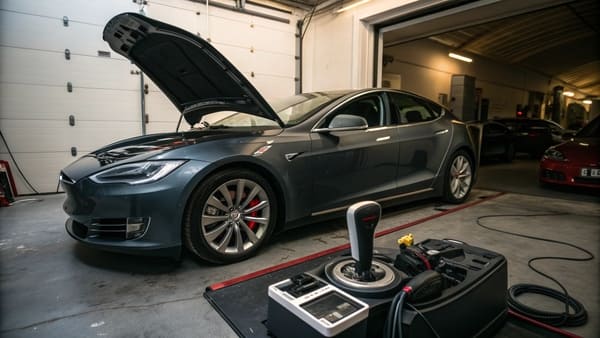
This unique setup is central to the electric vehicle experience. It completely changes how the car feels, how it responds, and how it delivers power to the road. This difference is not just on the surface; it goes all the way down to how the components are engineered and manufactured. Let's explore what this really means for the driver and why it feels so different from anything you have driven before.
Does the Tesla Model S Have a Traditional Automatic Transmission?
You hear "automatic" and probably picture a standard gearbox. Teslas do not have one. This can make it tricky to understand how they move so smoothly without any shifting.
No, the Tesla Model S lacks a traditional automatic transmission with multiple gears. It uses a single-gear transaxle. This simplified system connects the electric motor directly to the wheels, which eliminates the need for gear shifting and provides a seamless, quiet driving experience4.
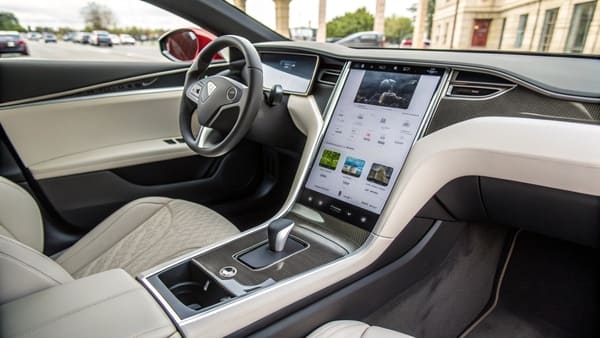
To understand this better, we need to look at why gas cars need so many gears in the first place. A gasoline engine only produces its best power and efficiency in a narrow range of revolutions per minute (RPM). A transmission with multiple gears is necessary to keep the engine in that sweet spot, whether you are starting from a stop or cruising on the highway. Electric motors are completely different. They are efficient and produce nearly maximum torque from 0 RPM all the way up to very high speeds. This huge operational range means a single gear is enough for everything. This design choice has huge benefits. It means fewer moving parts5, less maintenance, and a lighter, more compact drivetrain6. The car just goes when you press the pedal, with no hesitation.
How is a Single-Gear System Made?
The concept sounds simple, but manufacturing these components is incredibly complex. The precision required for the gears and housing7 is extremely high to handle the instant torque3 from the motor without creating noise or wearing out quickly. The parts for these intelligent driving systems require specialized equipment. In my experience, factories in the coastal regions of Fujian or near Shanghai have the high-precision machinery8 needed for this work. Equipment from other regions, like Hebei, often can't meet the tight tolerances. The process has at least three critical stages, with the cooling and setting phase9 being the most difficult. Any small error here can compromise the final part, affecting the car's performance and reliability.
How Is Tesla Model S Driving Different From Gas Cars?
Switching from a gas car to an electric one can feel strange. The car accelerates differently, it slows down differently, and it even sounds different. It takes a little time to adjust.
Driving a Model S is very different. You get instant acceleration the moment you press the pedal, with no lag. It also features "one-pedal driving10" through regenerative braking11, which slows the car down as soon as you lift your foot, sending energy back to the battery.
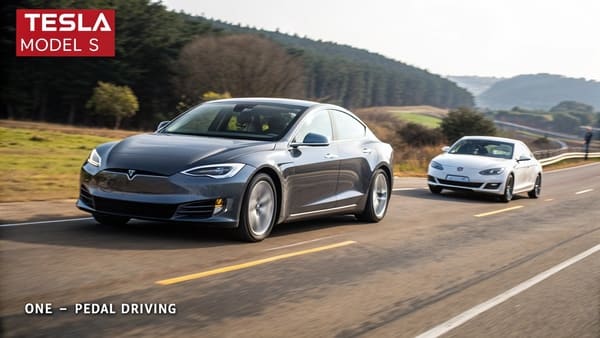
The most noticeable difference is the instant torque3. In a gas car, you press the pedal, the engine revs, and the transmission might downshift before you feel the full force of acceleration. In a Model S, the power is immediate and silent. It’s a smooth, continuous push that feels very futuristic. The other major change is regenerative braking11. When you lift your foot off the accelerator, the electric motor works in reverse, acting like a generator to recharge the battery. This creates a braking force that slows the car down significantly without you ever touching the brake pedal. This is the foundation of "one-pedal driving10," where you can manage your speed in most traffic situations just by modulating the accelerator.
The Manufacturing Story Behind the Smooth Ride
The components that manage this power delivery have to be perfect. I remember my first project making a key component for an intelligent driving system for a client from Pakistan. We were new to it, and our first batch had a "shrinking" issue after the cooling process. This happened because the raw material composition was slightly off. The manufacturing process is incredibly sensitive. The machine has to be stopped and the mold opened to add materials, which makes the cooling stage very hard to control. An imperfect part can lead to a jerky or unreliable feel for the driver. Luckily for us, that client actually preferred the slightly smaller, shrunken part for his application. It was a happy accident, but it taught us a valuable lesson in precision that we have never forgotten.
Is Tesla Model S Easier to Drive Than Automatic Vehicles?
Are you worried about learning a whole new way to drive? The Model S simplifies many things, but some of its unique features do have a small learning curve.
For many, the Model S is easier to drive after a short adjustment period. The lack of gear shifts and the one-pedal driving10 feature simplify control in traffic. However, the powerful, instant acceleration and strong regenerative braking11 require some getting used to for smooth operation.
The initial adjustment period is usually short. The main thing to learn is how to be smooth with the accelerator pedal. Because the response is so instant, jerky foot movements will lead to a jerky ride. Once you master modulating the pedal for both acceleration and braking, driving in stop-and-go traffic becomes much less work. You barely need to move your foot over to the brake pedal. Parking is also simple, with a clear gear selector stalk for Drive, Neutral, Reverse, and Park12. There is no "creep" like in a gas automatic unless you enable that feature, so the car stays still until you press the accelerator.
Comparing Driving Actions
The best way to see the difference is to compare common driving actions side-by-side.
| Action | Traditional Automatic Car | Tesla Model S |
|---|---|---|
| Start Moving | Press accelerator; feel slight lag and gear engagement. | Press accelerator; feel instant, silent movement. |
| Accelerating | Engine noise increases; feel distinct gear shifts. | Silent, smooth, and continuous acceleration. |
| Coasting | Lift off accelerator; car rolls freely with little resistance. | Lift off accelerator; car immediately starts slowing down. |
| Slowing Down | Move foot to brake pedal and apply pressure. | Modulate lift-off on accelerator; use brake pedal for hard stops. |
| Stopping | Apply brake until the car comes to a complete stop. | Car can come to a complete stop just by lifting off the accelerator. |
This feeling of "easy" driving depends entirely on high-tech, precision manufacturing. The control modules and sensors13 that make one-pedal driving10 work must be produced with incredible accuracy. This is why the manufacturing process is so critical. A simple, intuitive user experience is often the result of a very complex and demanding engineering and production process behind the scenes.
Conclusion
The Tesla Model S is not a traditional automatic. It uses a simpler, direct-drive system2 that completely redefines the driving experience. It is different, but not harder to master.
Learn how this innovative system delivers seamless power and why it's a game-changer compared to traditional transmissions. ↩
Compare the mechanics of direct-drive and multi-gear systems to understand Tesla's unique approach. ↩
Discover why instant torque makes Teslas feel so responsive and how it transforms the driving experience. ↩
Find out what makes EVs like Tesla so smooth and silent compared to gasoline cars. ↩
See how fewer moving parts lead to less maintenance and greater reliability in EVs. ↩
Discover the advantages of a simplified drivetrain for performance, efficiency, and design flexibility. ↩
Learn why manufacturing precision is critical for EV performance and longevity. ↩
Discover the advanced equipment behind the flawless components in Teslas and other EVs. ↩
Understand how this phase impacts the quality and reliability of electric vehicle parts. ↩
Explore how one-pedal driving simplifies control and enhances efficiency in Teslas and other EVs. ↩
Understand how regenerative braking saves energy and enables one-pedal driving in electric vehicles. ↩
Get familiar with Tesla's intuitive gear selection system for easy parking and maneuvering. ↩
See how advanced electronics enable features like one-pedal driving and smooth acceleration. ↩