-Your car's radiator and AC condenser look similar and sit together. This can be confusing. Understanding how they cooperate is key to keeping your car healthy and your cabin comfortable.
The radiator and AC system work together by sharing airflow at the front of the car. The AC condenser is positioned in front of the radiator to release heat from the cabin's refrigerant first.1 Both components then use the same airflow from driving and the same cooling fan to dissipate heat.2
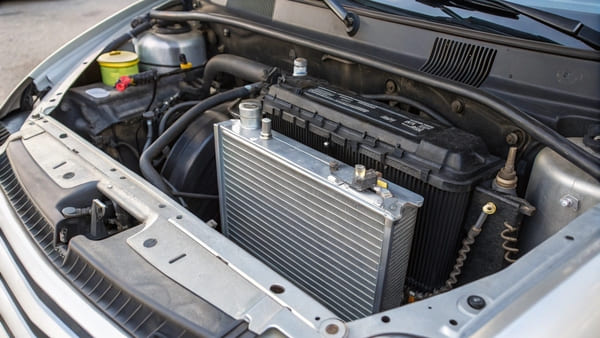
It sounds simple when you put it that way, but both systems are complex on their own. To really get how this partnership works, we need to look at each part separately. This will help you understand why their placement and shared components are so important. Let's start with the part that keeps your engine from overheating.
What Does a Car Radiator Actually Do?
An overheating engine is a driver's worst nightmare. It can lead to expensive repairs and leave you stranded on the side of the road. Your car's radiator is the hero that prevents this disaster.
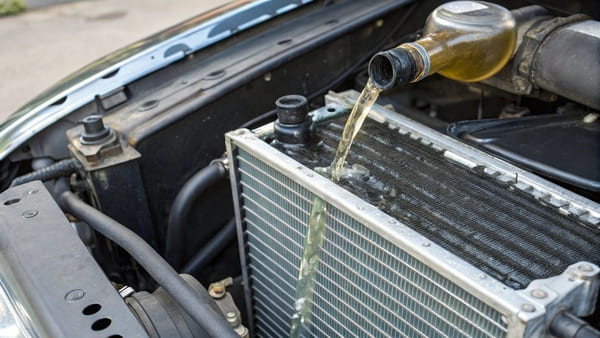
A car radiator's main job is to cool the hot liquid (coolant) that flows from the engine.3 As this coolant passes through the radiator's thin tubes and fins, airflow removes the heat. The cooled liquid then returns to the engine to absorb more heat, repeating the cycle.
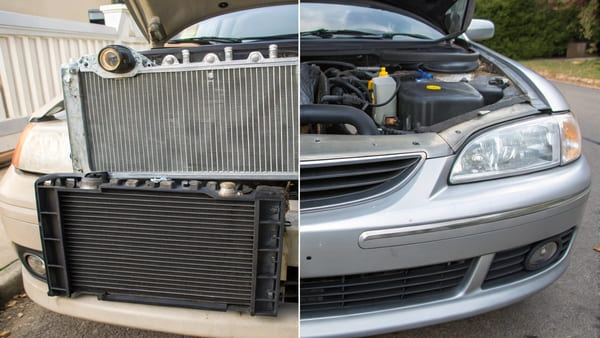
The radiator is the heart of your car's cooling system.4 It works as a large heat exchanger. Hot coolant, which has picked up heat from the engine block, enters one side of the radiator. It then travels through a network of small tubes surrounded by thin metal fins. As your car moves, or when the cooling fan turns on, air flows over these fins. This airflow pulls heat away from the coolant inside. The now-cooler liquid exits the other side of the radiator and goes back to the engine to start the process all over again. The plastic tanks on the sides and the support brackets are just as important as the metal core. These parts must be made with extreme precision. If the plastic housing doesn't fit perfectly, it can cause leaks or reduce the system's efficiency.5
| Step | Action | Purpose |
|---|---|---|
| 1 | Hot coolant enters the radiator | Transfers heat away from the engine. |
| 2 | Coolant flows through tubes/fins | Increases surface area for heat to escape. |
| 3 | Air flows over the fins | Removes heat from the coolant. |
| 4 | Cooled coolant returns to the engine | Absorbs more engine heat to repeat the cycle. |
Manufacturing the plastic components for these systems, especially the combined radiator and AC support frames, is very difficult.6 It requires high-precision injection molding machines that many factories don't have. Standard machines just can't meet the tight tolerances needed for a perfect seal and fit.
How Does a Car Air Conditioning System Work?
No one enjoys sitting in a sweltering car on a hot day. A faulty AC system can make any trip unbearable. Luckily, your car's air conditioning is a clever system designed to move heat out.
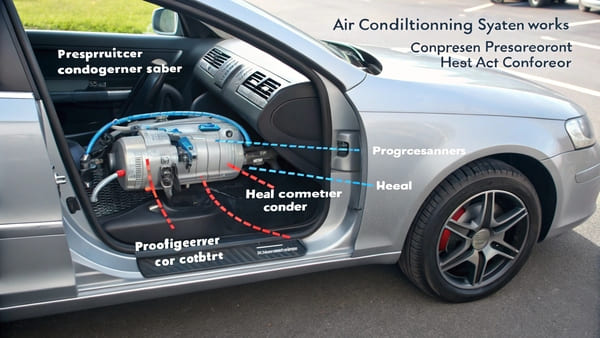
A car's AC works by using a special fluid called refrigerant to move heat from inside the cabin to the outside air.7 The compressor pressurizes the refrigerant, which then flows to the condenser at the front of the car to cool down and release its heat.8
Your car's AC doesn't create "cold" air; it removes heat from the air that's already inside. The system circulates a refrigerant to do this. The cycle starts at the compressor, which squeezes the refrigerant gas, making it very hot and high-pressure. This hot gas then flows to the condenser. After the condenser, the now-cooler liquid refrigerant goes through an expansion valve, which causes a rapid drop in pressure and temperature. This super-cold refrigerant flows into the evaporator inside your dashboard. A fan blows cabin air over the cold evaporator coils, cooling the air before it blows out of your vents. The refrigerant, having absorbed the heat from the cabin, turns back into a gas and returns to the compressor to start the cycle again. The plastic frame holding the condenser and radiator together is a complex part. We've learned that even adding color pigments can be tricky. It requires stopping the machine and opening the mold, which can interfere with the critical cooling stage of the plastic. This is why high-precision machines, mostly found in coastal industrial areas like Fujian or near Shanghai, are essential for this kind of work.
| Component | Function | Location |
|---|---|---|
| Compressor | Pressurizes refrigerant | Engine bay, driven by a belt |
| Condenser | Releases heat from the refrigerant | Front of the radiator |
| Evaporator | Absorbs heat from cabin air | Inside the dashboard |
| Expansion Valve | Lowers refrigerant pressure/temp | Between condenser & evaporator |
What Is the Difference Between a Radiator and an AC Condenser?
Looking at the front of your car, you see two similar-looking parts stacked together. It is very easy to confuse them. But mixing them up can cause headaches when diagnosing a problem.
The main difference is their function and the fluid they handle. A radiator cools engine coolant, which is a liquid. An AC condenser cools high-pressure refrigerant, turning it from a gas into a liquid. The condenser always sits in front of the radiator.9
Although they look alike and work together, the radiator and AC condenser have very different jobs. The condenser is part of a high-pressure system, so its tubes are built to handle that.10 The radiator deals with lower-pressure liquid coolant.11 Their placement is the biggest giveaway: the condenser is always placed in front of the radiator. This allows it to get the first and coolest blast of oncoming air, which is crucial for the AC system to work efficiently.12 I remember an early project for a client from Pakistan. We were making a complex plastic support frame that holds both the radiator and condenser. After the injection molding, the part had a bit more "shrinkage" than the design specified because the cooling step is so hard to control perfectly. I was worried, but the client found that the slightly tighter fit actually worked better for his assembly. It was a good lesson, and we've since perfected our process to control for these variables. It just shows how demanding manufacturing these parts is.
| Feature | Radiator | AC Condenser |
|---|---|---|
| Function | Cools engine coolant | Cools AC refrigerant |
| Fluid | Liquid (Coolant/Antifreeze) | Gas-to-Liquid (Refrigerant) |
| Pressure | Low Pressure (~15-20 psi) | High Pressure (~200-300 psi) |
| Location | Behind the condenser | In front of the radiator |
Conclusion
In short, the radiator cools your engine and the AC condenser helps cool your cabin. They work as a team, sharing airflow to keep your vehicle running smoothly and comfortably.
"Automotive air conditioning - Wikipedia", https://en.wikipedia.org/wiki/Automotive_air_conditioning. Automotive engineering sources confirm that the AC condenser is typically mounted in front of the radiator to maximize heat dissipation from the refrigerant before it reaches the radiator. Evidence role: mechanism; source type: encyclopedia. Supports: The AC condenser is positioned in front of the radiator to release heat from the cabin's refrigerant first.. Scope note: This is standard in most modern vehicles but may vary in some specialty or older designs. ↩
"Why does engine cooling fan turn on with the ac ? : r/MechanicAdvice", https://www.reddit.com/r/MechanicAdvice/comments/zp75jl/why_does_engine_cooling_fan_turn_on_with_the_ac/. Automotive textbooks and technical manuals describe how the radiator and AC condenser share airflow and, in many vehicles, the same cooling fan to enhance heat dissipation. Evidence role: mechanism; source type: education. Supports: Both components then use the same airflow from driving and the same cooling fan to dissipate heat.. Scope note: Some vehicles may have separate fans or additional cooling strategies. ↩
"Radiator (engine cooling) - Wikipedia", https://en.wikipedia.org/wiki/Radiator_(engine_cooling). Automotive engineering references state that the primary function of a car radiator is to cool engine coolant by transferring heat to the air. Evidence role: definition; source type: encyclopedia. Supports: A car radiator's main job is to cool the hot liquid (coolant) that flows from the engine.. ↩
"How Does a Car Radiator Work? | UTI - Universal Technical Institute", https://www.uti.edu/blog/automotive/radiators. Automotive maintenance guides often refer to the radiator as the central component of the engine cooling system. Evidence role: general_support; source type: education. Supports: The radiator is the heart of your car's cooling system.. Scope note: This is a common metaphor and not a technical designation. ↩
"Leak in radiator plastic pipe. Will this patch the leak? - Reddit", https://www.reddit.com/r/AskMechanics/comments/12q5clx/leak_in_radiator_plastic_pipe_will_this_patch_the/. Engineering sources note that improper fit of radiator plastic housings can lead to coolant leaks and decreased cooling efficiency. Evidence role: mechanism; source type: education. Supports: If the plastic housing doesn't fit perfectly, it can cause leaks or reduce the system's efficiency.. Scope note: Specific failure rates depend on manufacturing quality and vehicle design. ↩
"Advanced Injection Molding Methods: Review - PMC", https://pmc.ncbi.nlm.nih.gov/articles/PMC10489002/. Manufacturing engineering literature discusses the challenges of producing high-precision plastic components for automotive cooling system assemblies. Evidence role: mechanism; source type: education. Supports: Manufacturing the plastic components for these systems, especially the combined radiator and AC support frames, is very difficult.. Scope note: Difficulty varies with design complexity and manufacturing technology. ↩
"Air conditioning - Wikipedia", https://en.wikipedia.org/wiki/Air_conditioning. Automotive HVAC references explain that car air conditioning systems use refrigerant to transfer heat from the cabin to the exterior environment. Evidence role: mechanism; source type: encyclopedia. Supports: A car's AC works by using a special fluid called refrigerant to move heat from inside the cabin to the outside air.. ↩
"Automotive air conditioning - Wikipedia", https://en.wikipedia.org/wiki/Automotive_air_conditioning. Automotive engineering textbooks describe the AC compressor's role in pressurizing refrigerant and directing it to the condenser for heat dissipation. Evidence role: mechanism; source type: education. Supports: The compressor pressurizes the refrigerant, which then flows to the condenser at the front of the car to cool down and release its heat.. ↩
"Why is the condenser in front of the radiator? : r/CarTalkUK - Reddit", https://www.reddit.com/r/CarTalkUK/comments/1c3of3x/why_is_the_condenser_in_front_of_the_radiator/. Automotive design guides state that the AC condenser is typically mounted in front of the radiator to maximize cooling efficiency. Evidence role: mechanism; source type: education. Supports: The condenser always sits in front of the radiator.. Scope note: While this is standard, some exceptions exist in non-standard vehicle layouts. ↩
"Automotive Refrigerant Pressure Charts - A/C Pro®", https://acprocold.com/system-pressure-chart/. Automotive engineering sources explain that the AC condenser operates under high pressure and is constructed to withstand these conditions. Evidence role: mechanism; source type: education. Supports: The condenser is part of a high-pressure system, so its tubes are built to handle that.. Scope note: Exact pressure ratings depend on refrigerant type and system design. ↩
"Pressure is building in my cooling system slowly, causing reservoir ...", https://www.reddit.com/r/MechanicAdvice/comments/xjmgll/pressure_is_building_in_my_cooling_system_slowly/. Automotive cooling system references indicate that radiators typically operate at lower pressures compared to AC condensers, handling liquid coolant under moderate pressure. Evidence role: mechanism; source type: education. Supports: The radiator deals with lower-pressure liquid coolant.. Scope note: Operating pressure varies by vehicle and cooling system design. ↩
"Automotive air conditioning - Wikipedia", https://en.wikipedia.org/wiki/Automotive_air_conditioning. Automotive HVAC engineering texts note that placing the condenser in front of the radiator ensures it receives the coolest air, improving AC efficiency. Evidence role: mechanism; source type: education. Supports: This allows it to get the first and coolest blast of oncoming air, which is crucial for the AC system to work efficiently.. Scope note: Efficiency gains depend on vehicle speed and airflow design. ↩