-Worried about the high cost of Mercedes maintenance? The dealer's quote for a simple brake job1 can be shocking, but understanding what you're paying for helps you find smarter options.
The average cost to replace Mercedes brake pads2 is typically between $300 and $800 per axle. The final price depends on your specific model, whether you use OEM or aftermarket parts, and the labor rates of the dealership or independent shop you choose.
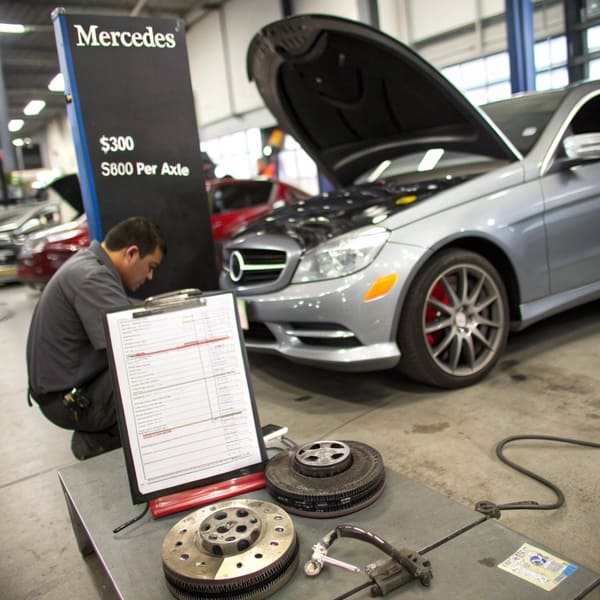
Replacing brake pads is a normal part of owning any car. But for a Mercedes-Benz, it often feels like it comes around too quickly and costs too much. Many owners wonder if they are paying a "luxury tax3" or if there's a real reason behind the expense. The truth is, it's a bit of both. In this article, I'll break down the real costs, explain why these parts are so unique, and share some of my own manufacturing experiences to help you make an informed decision for your car. Let's get into the details so you can keep your Mercedes stopping perfectly without overpaying.
Why Do Mercedes Brake Pads Wear Out Faster Than Other Cars?
Are you replacing your Mercedes brake pads more often than you expected? This frequent maintenance adds up in both cost and time, making you wonder if something is wrong with your car.
Mercedes brake pads wear faster because they are designed for performance. They use a softer material compound4 that grips the rotors aggressively for shorter, smoother stops. This focus on braking power and comfort comes at the expense of longevity compared to harder, economy-car pads.
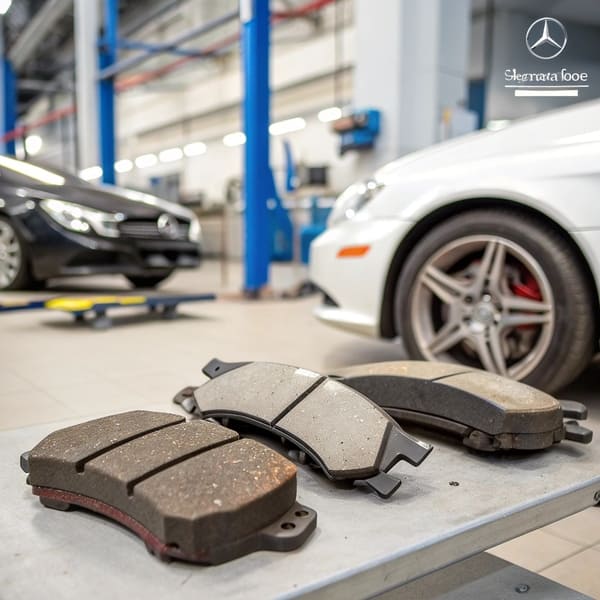
When you drive a Mercedes, you expect a certain level of refinement and performance. The engineers at Mercedes-Benz know this, and every component is designed to deliver that experience, including the brakes. Unlike a standard commuter car that prioritizes long-lasting parts, a Mercedes prioritizes stopping power and a quiet, smooth pedal feel. To achieve this, they use a specific formula for their brake pads.
Performance-First Engineering
The number one goal for a Mercedes braking system is to stop the car quickly and safely, with minimal noise and vibration. This is achieved by using brake pads with a softer friction material. These softer pads create more friction against the steel brake rotors with less pedal effort. The result is that powerful "bite" you feel when you tap the brakes. The downside is that this softer material wears away more quickly. It also produces more of that black brake dust5 you see on your wheels.
Vehicle Weight and Dynamics
Mercedes-Benz vehicles are generally heavier than many other cars on the road. They are built with more steel for safety, packed with luxury features, and equipped with powerful engines. All this extra weight puts a greater demand on the braking system. Every time you stop, the brakes have to work harder to convert that kinetic energy into heat. This increased workload naturally leads to faster wear on the pads and rotors.
How Brake Wear Sensors Work
Modern Mercedes vehicles have electronic brake wear sensors. These are small plastic sensors with a wire loop embedded in them. As the brake pad wears down, it eventually makes contact with the sensor, wearing it down until the wire breaks. This breaks the circuit and triggers the "Brake Wear" warning light on your dashboard. However, these sensors are designed to give you an early warning. They typically trigger when there is still 2-3mm of pad material left, which is a safe amount. This can make it seem like the pads wore out "early," when in reality, it's just a conservative safety feature.
| Feature | Mercedes-Benz Pads | Standard Economy Pads |
|---|---|---|
| Material | Softer, organic/ceramic mix | Harder, semi-metallic |
| Performance | Excellent stopping power, quiet | Good stopping power, can be noisy |
| Lifespan | 20,000-40,000 miles | 40,000-70,000 miles |
| Brake Dust | High | Low to moderate |
| Feel | Smooth, strong initial bite | Firmer, more pedal effort needed |
Which Factors Affect the Cost of Mercedes Brake Pad Replacement?
You received a high quote for a brake job and feel confused. Another shop might offer a much lower price, but you're not sure if it's a fair comparison.
The cost is mainly driven by four things: the parts (OEM vs. aftermarket), labor rates (dealer vs. independent)6, your car's model (an AMG costs more than a C-Class), and if you also need new rotors, sensors, or brake fluid.
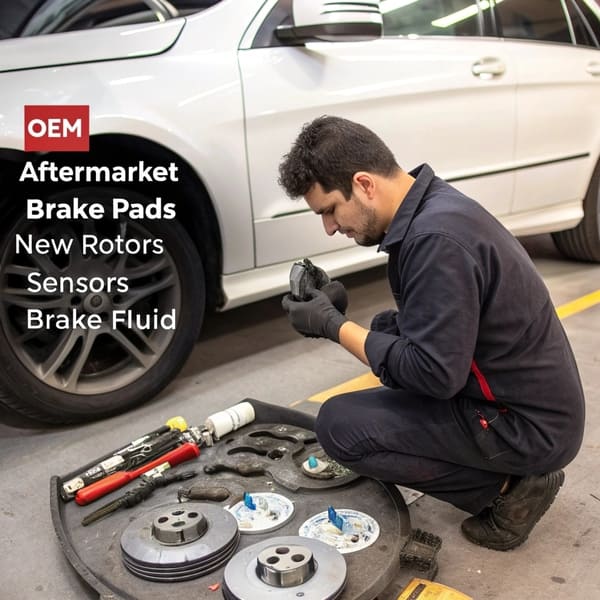
Getting a quote for a brake job on a Mercedes can be a confusing experience. The price can vary by hundreds of dollars from one shop to another. This isn't because someone is trying to rip you off (though it can happen). It's usually because they are quoting for different parts and labor. Understanding these key factors will help you ask the right questions and evaluate a quote properly. You need to make sure you are comparing apples to apples7.
Parts: OEM vs. OES vs. Aftermarket
This is the biggest variable. OEM (Original Equipment Manufacturer) pads are the exact same parts sold by Mercedes-Benz, with their logo on the box. They are the most expensive. OES (Original Equipment Supplier) pads are often made by the same company that makes the OEM pads, but sold in their own box without the Mercedes logo. They offer the same quality for less money. Aftermarket pads are made by many different companies to fit your car. Their quality and price can range from very cheap to better-than-OEM. Choosing OEM guarantees a perfect match, but a high-quality aftermarket brand can provide similar performance for a fraction of the cost.
Labor Rates: Dealership vs. Independent Shop
A Mercedes-Benz dealership typically has the highest labor rates, often charging $150-$250 per hour. They have specialized tools and factory-trained technicians. An independent European auto shop will have lower rates, usually between $90-$150 per hour. They can be just as skilled, especially if they specialize in German cars. A general mechanic will be the cheapest but may lack the specific experience for your Mercedes. The higher labor rate at a dealership contributes significantly to the higher overall cost.
Your Specific Model Matters
Not all Mercedes are the same. The brake parts for a high-performance AMG GT are much larger, more complex, and more expensive than those for a C300 sedan. AMG models8 often use multi-piston calipers9 and two-piece or carbon-ceramic rotors10, which dramatically increase the replacement cost for both parts and labor.
Here is a sample cost breakdown to illustrate the difference:
| Item | Dealership (OEM Parts) | Independent Shop (OES/Aftermarket) |
|---|---|---|
| Front Brake Pads | $250 | $120 |
| Front Brake Rotors | $400 | $220 |
| Brake Wear Sensors | $50 | $30 |
| Labor (Approx. 2 Hours) | $400 | $240 |
| Total (Approx.) | $1,100 | $610 |
Are OEM Brake Pads Worth the Extra Cost for a Mercedes?
OEM brake pads from the dealer are expensive. It's easy to wonder if you're just paying for the three-pointed star on the box or if there's a real difference in quality.
For many drivers, high-quality aftermarket pads11 offer a great balance of performance and value. However, genuine OEM pads guarantee the exact braking feel, noise level, and performance your car was engineered with, making them the safest bet for high-performance models.
This is a question I deal with all the time as a parts manufacturer. Is the OEM part really better? When it comes to Mercedes-Benz brake pads, the answer is complicated. It's not just about a brand name; it's about an incredibly precise manufacturing process that most factories can't replicate. From my own experience, I can tell you that making a brake pad that meets Mercedes' standards for friction, noise, and durability is extremely difficult.
The Manufacturing Challenge
The precision required to produce a true Mercedes-spec brake pad is very high. Standard equipment simply can't achieve the necessary density and material consistency. The most critical step is a process involving high-temperature curing12 followed by controlled cooling and pressure13 to set the final density. This ensures the pad material is perfectly uniform, which prevents brake fade14 and ensures a consistent pedal feel. The machines capable of this precision are rare. In my experience, they are mostly found in specialized factories in coastal areas like Fujian or near Shanghai. Many lower-cost producers just don't have this capability.
My First-Hand Experience with "Good Enough"
I learned this lesson the hard way. One of my first major projects was producing Mercedes brake pads for a client in Pakistan. We were still dialing in our process, and the first batch we shipped didn't meet the exact density specification. The result was a pad with a "softer" feel. I was worried we had failed. But my client called me and was thrilled! For his market, where traffic is slower and drivers prefer a less aggressive initial bite, the softer feel was actually a selling point. It was a lucky break, but it taught me a valuable lesson: a tiny deviation in the manufacturing process completely changes the character of the brake pad. Since then, we've perfected the process to match the OEM standard exactly.
The Secret in the Mix
Another challenge is getting the friction material formula15 right. The recipe is a closely guarded secret, but it involves a precise mix of fibers, fillers, lubricants, and abrasives. During production, the machine has to be stopped to add these ingredients. When you do that, you have to open the mold slightly, which can interfere with the critical cooling and shaping process. It takes incredible skill and advanced machinery to manage this without creating imperfections in the final product. This is why a cheap aftermarket pad might look the same, but it won't perform the same. It might be noisier, create more dust, or not provide the same stopping power when hot. So, while a good aftermarket pad is fine for daily driving, the OEM part is a product of a much more difficult and expensive manufacturing process.
Conclusion
Replacing Mercedes brake pads costs more due to their performance-focused design and complex manufacturing. By understanding the factors like parts and labor, you can choose between OEM and quality aftermarket options.
Exploring dealer pricing helps you decide if it's worth paying more or seeking alternatives. ↩
Understanding the typical price range helps you budget for maintenance and avoid overpaying at the dealership or shop. ↩
Understanding this concept helps you separate myth from reality and make smarter service decisions. ↩
Learning about the materials used explains why Mercedes brakes perform well but wear faster, helping you make informed choices. ↩
Knowing the source of brake dust helps you manage wheel cleaning and understand the trade-offs of performance pads. ↩
Knowing labor rate differences helps you choose the right shop and potentially save hundreds on repairs. ↩
Learning to compare quotes accurately ensures you get the best value and avoid hidden costs. ↩
Understanding AMG-specific parts and labor explains the premium pricing and helps you plan for ownership costs. ↩
Learning about advanced brake technology helps you appreciate the engineering and maintenance needs of performance cars. ↩
Exploring this technology reveals why some Mercedes brakes are more expensive and how they enhance performance. ↩
Learning about aftermarket options can help you find affordable, high-quality alternatives to dealership parts. ↩
Learning about this process explains the durability and consistency of premium brake pads. ↩
Understanding this step shows why high-quality pads are more reliable and consistent. ↩
Knowing about brake fade helps you appreciate the safety and engineering behind Mercedes braking systems. ↩
Discovering the secret mix helps you understand the performance and longevity differences between pad types. ↩