-Choosing the right school bus AC is tough. A wrong choice means uncomfortable students and wasted money. But understanding the key factors makes selecting the perfect unit simple for your fleet.
To choose the best school bus AC, you must match the unit's cooling capacity (BTUs) to the bus size. You also need to consider the climate. Select integrated rooftop units for hot, dry areas and split systems for more flexibility in humid regions or for specific weight distribution needs.
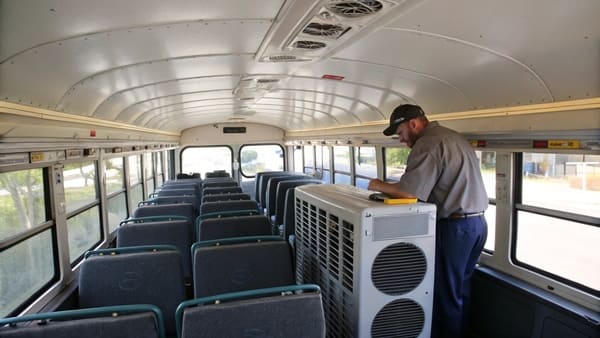
That is the quick answer, but there is much more to it. Getting this decision right involves understanding the technology, the real-world benefits, and the different types of systems available. Before we dive into picking the right unit, let's first explore what these systems are and how they work. This background knowledge will help you make a much better decision for your fleet and ensure the safety and comfort of every student on board. Let's get started.
What Is a School Bus AC Unit and How Does It Work?
You see AC units on top of buses, but do you know how they actually cool the air? It can seem complex. Without this basic knowledge, you can't troubleshoot issues or choose wisely.
A school bus AC unit works just like your car's AC, but it is much larger and more powerful.1 It uses a special chemical called a refrigerant to absorb heat from inside the bus and release that heat outside.2 The main parts are a compressor, a condenser, and an evaporator.3
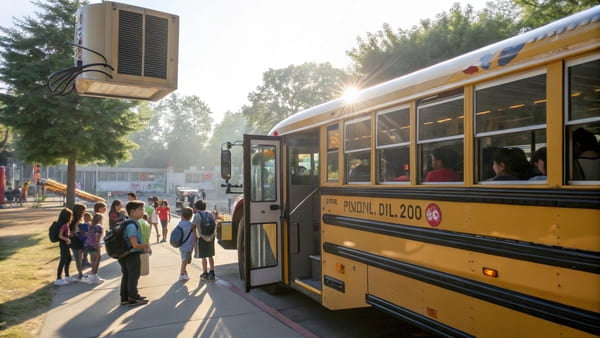
To really understand it, you need to look a little closer at the process. The system is a continuous loop. The parts work together to move heat from one place to another. Making sure the components, especially the plastic housings and air ducts, are made with high precision is critical.4 If they don't fit perfectly, airflow becomes weak, and the entire system can fail. It is a manufacturing challenge we have spent years perfecting to ensure every unit we supply parts for works flawlessly.
The Basic Cooling Cycle
The process is a cycle that repeats over and over to keep the bus cool. It has four main steps:
- Compression: The compressor, which is the heart of the system, squeezes the refrigerant gas. This makes it very hot and high-pressure.
- Condensation: This hot, high-pressure gas flows to the condenser. Fans blow outside air over the condenser's coils, which removes the heat from the refrigerant. As it cools, it turns into a high-pressure liquid.
- Expansion: The high-pressure liquid then goes through an expansion valve. This valve lowers the pressure suddenly, which makes the liquid refrigerant very cold.
- Evaporation: This cold, low-pressure liquid flows into the evaporator inside the bus. A fan blows the warm cabin air over the evaporator's coils. The refrigerant absorbs the heat from the air, and this absorption causes the refrigerant to boil and turn back into a gas. The air that leaves the evaporator is now cold, and it is blown into the bus. The cycle then starts all over again.
Why Are Air Conditioning Systems Essential for School Buses?
Is air conditioning just a luxury for school buses? Many people think so, but this can risk student health. Extreme heat inside a vehicle is a serious danger, not just an inconvenience.5
Air conditioning is essential for school buses to ensure student safety and well-being. It prevents heat-related illnesses like heatstroke, improves air quality by filtering dust and pollutants, and creates a more comfortable and focused environment for students during their commute.6 It's a must-have, not a nice-to-have.
The benefits go far beyond just feeling cool. A controlled climate inside a bus has a direct impact on health, safety, and even behavior. When students and drivers are comfortable, the entire transportation experience becomes safer and more positive. Think about a hot, stuffy bus stuck in traffic. The air gets stale, temperatures rise quickly, and everyone becomes irritable. An AC system solves all these problems. It creates a better environment for everyone on board, from the moment students get on to the moment they arrive at school or home.
Key Benefits of School Bus AC
| Feature | Bus Without AC | Bus With AC |
|---|---|---|
| Temperature | Can exceed 120°F (49°C) in summer7 | Maintained at a safe, comfortable 72°F (22°C)8 |
| Air Quality | Poor; traps dust, pollen, exhaust fumes | Good; filters remove allergens and pollutants |
| Student Health | High risk of heatstroke, dehydration, asthma attacks9 | Low risk; protects vulnerable students |
| Student Behavior | Irritable, restless, and noisy | Calm, focused, and more orderly |
| Driver Focus | Reduced focus due to heat stress and noise | Improved concentration and alertness |
As you can see, the difference is huge. Providing AC is a direct investment in student health and safety. It reduces the chances of medical emergencies caused by heat and ensures the driver can focus completely on the road.
What Types of School Bus AC Units Are Available?
You know you need an AC system, but the options can be confusing. Should you get a rooftop unit or a split system? Making the wrong choice can be a costly mistake in performance and maintenance.
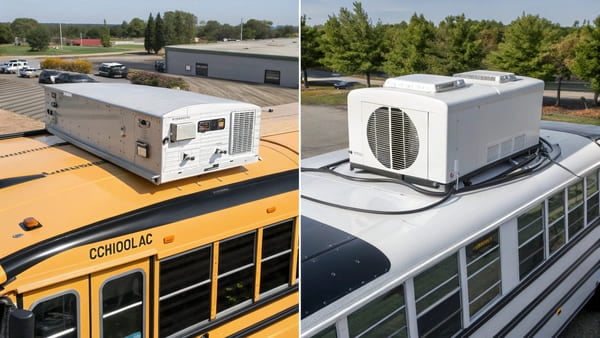
The two main types of AC systems for school buses are rooftop units and split systems. Rooftop units are all-in-one packages mounted on the roof, which is great for saving space inside. Split systems have components inside and outside the bus, offering more flexibility for installation.
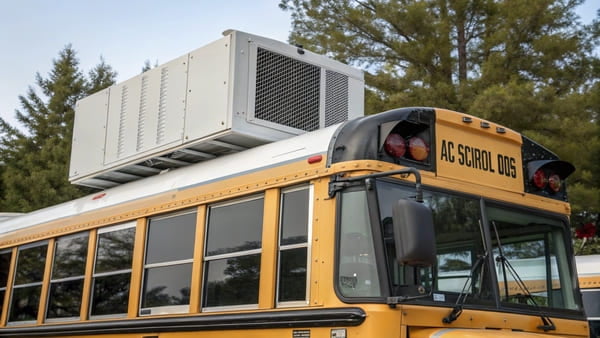
The choice between these types depends on your bus size, your climate, and your maintenance preferences. Making the plastic components for these systems, like the large housings and air vents, is incredibly difficult. I remember one of our first projects for a customer in Pakistan. We were still learning the fine details of producing such large automotive plastic parts. The cooling step in injection molding is the most difficult part to control. On that first batch, the plastic parts shrank more than we expected after they cooled. I was so worried we had failed the client. But it turned out the client actually preferred the slightly smaller, denser parts because they felt stronger. It was a lucky accident, but it taught us a very valuable lesson. We learned that you absolutely need high-precision machines, like the ones found in the coastal regions near Shanghai, to get it right consistently. It's not something you can do with standard equipment. We also learned how tricky it is to add color powders, since you have to open the mold, which messes with the cooling. It's a delicate balance we have mastered over many years.
Rooftop AC Units
Rooftop units contain the compressor, condenser, and evaporator all in one single housing. This entire unit is mounted on the roof of the school bus.
- Pros: They are relatively easy to install since they are self-contained. They also don't take up any valuable space inside the bus. Maintenance can be simpler because all components are in one accessible location.
- Cons: All the weight is concentrated on the roof, which can affect the vehicle's center of gravity. They also increase the bus's overall height, which can be an issue for low-clearance garages or bridges.
Split System AC Units
Split systems, as the name suggests, have their components split into different locations. Typically, the condenser is mounted under the bus or on the rear, while the evaporator units are placed inside the passenger cabin.
- Pros: They allow for much better weight distribution across the vehicle's chassis.10 This is a big advantage for stability and handling. You also have more flexibility in placing the interior cooling units for optimal airflow.11
- Cons: Installation is more complex because it requires running refrigerant lines between the separate components.12 This can also make troubleshooting and repairs more complicated.
Conclusion
Choosing the right school bus AC means matching cooling power to bus size and your local climate. Understanding how the systems work and the types available helps you ensure student safety.
"Automotive air conditioning - Wikipedia", https://en.wikipedia.org/wiki/Automotive_air_conditioning. Automotive air conditioning systems, including those used in buses, operate on the same principles as passenger vehicle AC units, but are scaled up for greater cooling capacity and larger interior volumes. Evidence role: mechanism; source type: encyclopedia. Supports: A school bus AC unit works just like your car's AC, but it is much larger and more powerful.. Scope note: While the basic refrigeration cycle is similar, bus AC systems may have additional features or design differences to accommodate larger spaces. ↩
"Refrigeration - Wikipedia", https://en.wikipedia.org/wiki/Refrigeration. Refrigerants are used in air conditioning systems to transfer heat from the interior to the exterior, enabling cooling in vehicles such as buses. Evidence role: mechanism; source type: encyclopedia. Supports: It uses a special chemical called a refrigerant to absorb heat from inside the bus and release that heat outside.. Scope note: The specific type of refrigerant may vary depending on regulations and system design. ↩
"Air conditioning - Wikipedia", https://en.wikipedia.org/wiki/Air_conditioning. Standard vehicle air conditioning systems consist of a compressor, condenser, and evaporator, which together facilitate the refrigeration cycle. Evidence role: definition; source type: encyclopedia. Supports: The main parts are a compressor, a condenser, and an evaporator.. Scope note: Some systems may include additional components such as expansion valves or receiver-driers. ↩
"Why Precision Manufacturing Is Critical in Automotive ...", https://www.megemplastik.com/en/blogs/why-precision-manufacturing-is-critical-in-automotive-plastic-parts/. Precision manufacturing of plastic components, such as housings and air ducts, is essential for optimal airflow and performance in automotive air conditioning systems. Evidence role: mechanism; source type: education. Supports: Making sure the components, especially the plastic housings and air ducts, are made with high precision is critical.. Scope note: The importance of precision may vary depending on the specific design and application. ↩
"Child Heatstroke Prevention: Prevent Hot Car Deaths - NHTSA", https://www.nhtsa.gov/campaign/heatstroke. Exposure to extreme heat inside vehicles can pose significant health risks, including heatstroke and dehydration, especially for children. Evidence role: expert_consensus; source type: government. Supports: Extreme heat inside a vehicle is a serious danger, not just an inconvenience.. Scope note: The severity of risk depends on ambient temperature, vehicle design, and duration of exposure. ↩
"Air quality in a bus depot and a way of improving it: effect ... - PubMed", https://pubmed.ncbi.nlm.nih.gov/40288630/. Air conditioning in school buses can reduce the risk of heat-related illnesses, improve air quality by filtering particulates, and enhance comfort for passengers. Evidence role: general_support; source type: government. Supports: It prevents heat-related illnesses like heatstroke, improves air quality by filtering dust and pollutants, and creates a more comfortable and focused environment for students during their commute.. Scope note: The degree of benefit depends on system maintenance and environmental conditions. ↩
"[PDF] Hot Weather Impacts on Electric School Buses", https://driveelectric.gov/files/esb-hot-weather-help-sheet.pdf. Interior temperatures in parked vehicles can exceed 120°F (49°C) during summer months, posing health risks to occupants. Evidence role: statistic; source type: government. Supports: Can exceed 120°F (49°C) in summer. Scope note: Actual temperatures depend on location, vehicle color, and exposure duration. ↩
"Hot Weather Impacts on Electric School Buses", https://driveelectric.gov/files/esb-hot-weather-help-sheet.pdf. Air conditioning systems in vehicles are typically designed to maintain interior temperatures around 72°F (22°C) for occupant comfort. Evidence role: statistic; source type: education. Supports: Maintained at a safe, comfortable 72°F (22°C). Scope note: Actual maintained temperature may vary based on system capacity and external conditions. ↩
"Clinical Overview of Heat and Children and Teens with Asthma - CDC", https://www.cdc.gov/heat-health/hcp/clinical-overview/heat-children-asthma.html. Children in overheated vehicles are at increased risk for heatstroke, dehydration, and exacerbation of respiratory conditions such as asthma. Evidence role: expert_consensus; source type: government. Supports: High risk of heatstroke, dehydration, asthma attacks. Scope note: Risk levels depend on individual health, exposure duration, and environmental factors. ↩
"Ductless Mini-Split Air Conditioners - Department of Energy", https://www.energy.gov/energysaver/ductless-mini-split-air-conditioners. Split air conditioning systems in buses can improve weight distribution by placing components in different locations, enhancing vehicle stability. Evidence role: mechanism; source type: education. Supports: They allow for much better weight distribution across the vehicle's chassis.. Scope note: The degree of improvement depends on specific bus design and component placement. ↩
"Ductless Mini-Split Air Conditioners - Department of Energy", https://www.energy.gov/energysaver/ductless-mini-split-air-conditioners. Split air conditioning systems offer greater flexibility in positioning interior cooling units, which can optimize airflow and passenger comfort in buses. Evidence role: mechanism; source type: education. Supports: You also have more flexibility in placing the interior cooling units for optimal airflow.. Scope note: Actual flexibility depends on bus layout and installation constraints. ↩
"Where to mount a 2.5 split system in a bus? - Facebook", https://www.facebook.com/groups/1574182276568866/posts/1849614075692350/. Split air conditioning systems require more complex installation procedures, including the routing of refrigerant lines between components. Evidence role: mechanism; source type: education. Supports: Installation is more complex because it requires running refrigerant lines between the separate components.. Scope note: Installation complexity may vary depending on bus model and system design. ↩