-Finding a reliable brake pad supplier1 is a huge challenge. A wrong choice can risk vehicle safety and damage your brand. Sourcing from the right Chinese partner offers a powerful strategic advantage.
Choosing a brake pads supplier in China gives your business access to large industrial clusters, cost-effective manufacturing2, and advanced formula development3. This combination helps you gain a competitive edge in both quality and price, especially when working with experienced OEM/ODM partners.

Sourcing brake pads from China is more complex than just comparing prices. The decision involves high stakes. You need to look beyond basic cost analysis and check for quality certificates4. To truly succeed in the global supply chain, you need a partner with deep technical capabilities5. But before we dive into the details of sourcing, it is important to understand the basics of brake pads. Let's start with what they are and why they are so vital for every vehicle.
What Are Brake Pads and Why Are They Critical for Vehicle Safety?
Worn-out brake pads are a hidden danger on the road. Ignoring them can lead to brake failure and serious accidents. Understanding their role is the first step to ensuring vehicle safety.
Brake pads are essential parts in a disc brake system6. They create the friction needed to slow or stop a vehicle. Their performance directly impacts safety, controlling stopping distance7 and preventing accidents. High-quality pads ensure reliable braking under all conditions.
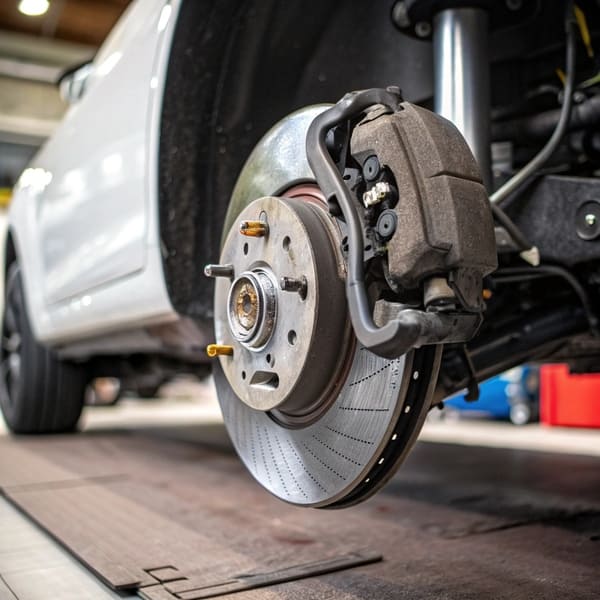
A brake pad might seem like a simple block of material, but it is a highly engineered safety component. Its primary job is to convert motion into heat through friction. When you need to stop, the pads are pushed against a spinning metal disc, called a rotor8. This action creates immense friction and heat, which slows the car down. The quality of the friction material9 determines how well the pad performs this job, especially under pressure. Poor quality pads can overheat and lose their stopping power, a dangerous situation known as brake fade10. For any automotive business, whether you are an importer, distributor, or brand owner, the quality of your brake pads is not a feature you can compromise on. It is the foundation of your customers' safety and your brand's reputation.
The Anatomy of a Brake Pad
A brake pad is made of several key layers, each with a specific job.
| Component | Function |
|---|---|
| Friction Material | This is the part that contacts the rotor8. Its formula determines braking performance, noise, dust, and lifespan. |
| Backing Plate | A steel plate that provides a rigid foundation for the friction material9. It withstands the pressure from the brake caliper11. |
| Shim | A thin layer on the back of the plate that helps absorb vibration and reduce brake noise for a smoother stop. |
| Adhesive Layer | A high-temperature glue that bonds the friction material9 to the backing plate12, ensuring it doesn't separate under force. |
The Direct Link to Safety
The connection between brake pads and vehicle safety is direct and absolute. The stopping distance7 of a vehicle is largely determined by the effectiveness of its brake pads. A pad with a superior friction formula can stop a car several meters shorter in an emergency. This difference can be life-saving. For businesses like ours that supply parts globally, this is not just a technical detail. It is a core responsibility. We ensure our pads meet strict international standards, so our clients can sell them with complete confidence.
How Do Brake Pads Work in Modern Disc Brake Systems?
The mechanics of braking can seem complicated. If you misunderstand how the system works, you might make poor product choices. Let's break down how brake pads function in a simple way.
When you press the brake pedal, hydraulic fluid13 activates a caliper11. The caliper11 squeezes the brake pads against a spinning disc rotor8. This friction converts the wheel's kinetic energy into heat, which slows the vehicle down. The process is simple and very effective.
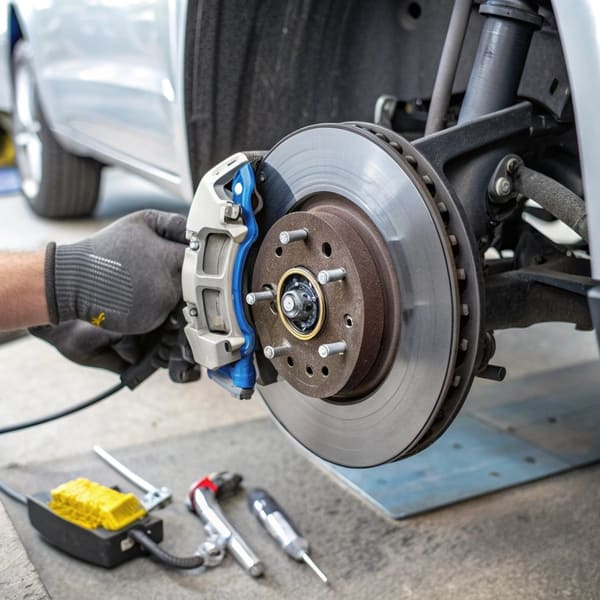
The entire process starts with your foot on the brake pedal. This simple action triggers a powerful hydraulic system. The force you apply is multiplied, first by the brake booster and then by the master cylinder, which pushes hydraulic fluid13 through the brake lines. This pressurized fluid travels to the brake caliper11s at each wheel. Inside each caliper11 are piston14s. The hydraulic pressure forces these piston14s to push the brake pads inward, clamping them against the spinning rotor8. The immense friction generated is what stops your car. The real engineering challenge is managing the incredible amount of heat created during this process. A good brake pad must be able to withstand and dissipate this heat without losing its effectiveness. This is why material science and formula development are so critical in our manufacturing process. We focus on creating pads that perform consistently, from a gentle stop in city traffic to a hard brake on the highway.
The Hydraulic Chain of Command
The braking system is a sequence of events. Each step must work perfectly for the next one to happen.
- Pedal: The driver presses the brake pedal.
- Master Cylinder: This converts the driver's force into hydraulic pressure.
- Brake Lines: These tubes carry the high-pressure brake fluid to the wheels.
- Caliper: The fluid pressure activates piston14s inside the caliper11.
- Pads & Rotor: The piston14s push the brake pads against the rotor8, creating friction and stopping the car.
Key Components and Their Interaction
Understanding how the parts work together helps you appreciate why quality matters at every step.
| Component | Role | Interaction with Brake Pad |
|---|---|---|
| Caliper | Houses the pads and piston14s. | It acts like a clamp, squeezing the pads onto the rotor8. |
| Piston | Pushes the brake pads. | It applies direct hydraulic force to the pad's backing plate12. |
| Rotor | The spinning disc connected to the wheel. | This is the surface that the pad's friction material9 grips to stop. |
For B2B clients, this shows that a high-quality brake pad can only perform its best when the entire system is in good condition. That is why we often provide guidance on system compatibility and best practices for installation to our partners.
What Types of Brake Pads Are Available in the Automotive Market?
There are so many different types of brake pads available. Choosing the wrong one can hurt performance and disappoint your customers. Let's review the main categories so you can make the best choice for your business.
The main types are semi-metallic, organic, and ceramic. Semi-metallic pads are durable and handle heat well. Organic pads are quiet. Ceramic pads offer excellent performance with low dust and noise, making them a popular choice for modern premium vehicles.
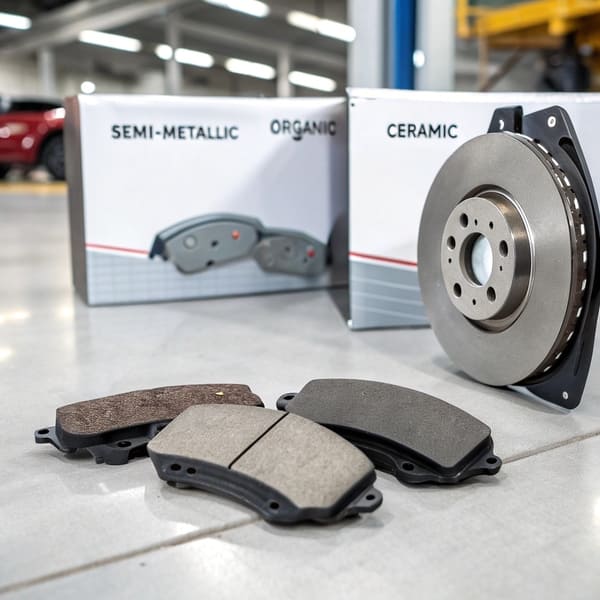
Choosing the right brake pad is about matching the material to the vehicle and its use. There is no single "best" type for every situation. For example, a heavy-duty truck needs a pad that can handle extreme heat and weight, so a semi-metallic formula is often the best choice. A luxury sedan, on the other hand, needs a pad that is quiet, clean, and smooth, which makes ceramic the ideal option. As an OEM/ODM supplier, our job is to go deeper than these basic categories. We work with clients to develop custom formulas15. This is especially important for new energy vehicles (EVs), which require low-wear pads that work well with regenerative braking systems. It is also critical for meeting specific market regulations, like ECE R90 in Europe or FMVSS in North America. Small factories that only produce basic semi-metallic pads16 often lack the testing equipment and engineering expertise to meet these complex demands.
A Comparative Look at Friction Materials
Here is a breakdown to help you understand the differences.
| Type | Key Materials | Pros | Cons | Best For |
|---|---|---|---|---|
| Semi-Metallic | 30-65% metal (steel, iron, copper) | Durable, great heat transfer, cost-effective | Can be noisy, dusty, and hard on rotor8s | Heavy-duty trucks, performance cars, commercial vehicles |
| Organic (NAO) | Fibers, resins, fillers (non-asbestos) | Very quiet, gentle on rotor8s, inexpensive | Wears faster, creates more dust, limited heat tolerance | Standard passenger cars for daily driving |
| Ceramic | Ceramic fibers, non-ferrous fillers | Extremely quiet, low dust, stable at high temps | Most expensive, not for extreme track use | Premium passenger cars, luxury vehicles, EVs |
My Sourcing Experience: A Lesson in Customization
I remember one of our first projects with a client from Pakistan. They needed brake pads for their aftermarket business, which served a lot of heavy-duty trucks. We supplied an initial batch based on a standard semi-metallic formula. Soon after, we got feedback that the pads were experiencing severe high-temperature fade under heavy loads. The client was concerned. But this is where the value of a true OEM partner became clear. Instead of just making excuses, we saw it as an engineering challenge. Our team quickly analyzed the feedback and developed a modified formula with higher heat resistance. We produced and shipped a new batch. The client was impressed by how fast we could adjust the product. They also valued the efficient logistics from Qingdao port to Karachi. In the end, they found that our ability to provide a cost-effective, customized solution was a bigger advantage than buying a standard, off-the-shelf product. That project taught me that the most difficult part of this business is not just manufacturing, but balancing scale with customization and quickly adapting to real-world feedback.
Conclusion
Sourcing brake pads from China offers huge benefits. But success depends on finding a partner with deep technical expertise, regulatory knowledge, and a commitment to customization for your specific market needs.
Discovering a trustworthy supplier is crucial for safety and brand reputation. This resource will help you avoid costly mistakes and ensure quality. ↩
Learn how cost-effective manufacturing can boost your competitiveness and profitability without sacrificing product quality. ↩
Understanding formula innovation helps you select pads with superior safety, durability, and performance for your customers. ↩
Quality certificates are vital for compliance and customer trust. This link will clarify which certifications matter most. ↩
Technical expertise ensures reliable, high-performance products. Learn how to assess a supplier’s engineering strength. ↩
Understanding disc brake systems helps you make informed product choices and improve vehicle safety. ↩
Stopping distance is a key safety metric. This link explains how pad quality can save lives in emergency situations. ↩
The rotor is the contact surface for pads. Learn how its quality affects braking and how to maintain it. ↩
Friction material determines braking efficiency and safety. Explore its role and how to choose the best type for your needs. ↩
Brake fade is a dangerous loss of stopping power. This resource explains prevention strategies for safer vehicles. ↩
The caliper is central to braking. Understanding its function helps you ensure compatibility and optimal performance. ↩
The backing plate is essential for pad stability and performance. Learn why its quality matters in brake pad design. ↩
Hydraulic fluid is the backbone of brake operation. Learn how it transmits force and what to look for in maintenance. ↩
The piston’s action is vital for effective braking. This resource explains its role and maintenance tips. ↩
Custom formulas allow tailored performance and compliance. Explore how they give you a competitive edge in your market. ↩
Semi-metallic pads are popular for durability. This link helps you decide if they’re right for your vehicle or business. ↩