-Choosing wheels feels overwhelming. You see terms like "forged" and "cast" but don't know what's best. A wrong choice costs money and can even be dangerous.
Flow formed wheels offer the best balance for most performance car owners. They provide a significant strength and weight advantage over traditional cast wheels without the high cost of fully forged wheels, making them an ideal upgrade for both street and track use.1

Upgrading your car's wheels is one of the most exciting changes you can make. It affects how your car looks, feels, and performs. But with so many options, it's easy to get lost. You want better performance, but you also have a budget. This guide will break down the differences between the three main types of wheels. We will help you understand what you are paying for. By the end, you'll know exactly which wheel type fits your car and your driving style, so you can make a choice you feel confident about.
What Are Flow Formed Wheels and Why Are They So Popular Today?
You hear "flow formed" everywhere now, but what does it mean? You worry it's just marketing hype, making you overpay for something you don't need.
Flow formed wheels, also known as flow forged or rotary forged, are a hybrid manufacturing success. They offer strength and lightness approaching that of forged wheels but at a price point closer to cast wheels. This excellent value makes them incredibly popular among car enthusiasts.2
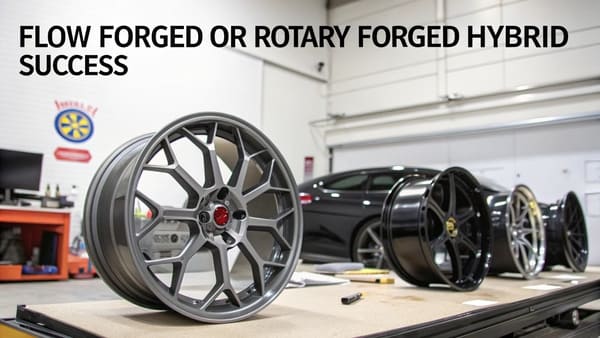
The popularity of flow formed wheels comes down to one thing: they hit the sweet spot. For years, your choices were simple. You could get affordable but heavy cast wheels, or you could spend a fortune on lightweight, super-strong forged wheels. There was no middle ground. Flow forming changed that. It gives drivers a way to reduce unsprung weight without emptying their bank accounts.
Less unsprung weight is a huge deal for performance. It means your suspension can work more effectively, keeping the tires planted on the road. This improves everything:3
- Handling: The car feels more responsive and nimble.
- Acceleration: The engine has less mass to spin up.
- Braking: The brakes have less rotating mass to slow down.
Beyond performance, flow formed wheels just look good. Manufacturers can create complex and aggressive designs that appeal to the performance market.4 This combination of real performance benefits, attractive styling, and a reasonable price is why they have become the go-to choice for so many drivers looking for a serious upgrade.
| Feature | Cast Wheels | Flow Formed Wheels | Forged Wheels |
|---|---|---|---|
| Cost | Low | Medium | High |
| Weight | Heavy | Light | Very Light |
| Strength | Good | Better | Best |
| Best For | Daily Driving | Street & Track | Pro Racing |
How Are Flow Formed Wheels Made Compared to Cast and Forged Wheels?
You know the names, but you don't know how they are made. This makes it hard to trust the quality and understand why the prices are so different.
Cast wheels are made by pouring liquid metal into a mold.5 Forged wheels are shaped from a solid piece of metal under immense pressure.6 Flow formed wheels start with a cast center, and then the barrel is stretched and compressed with rollers to make it strong and light.7
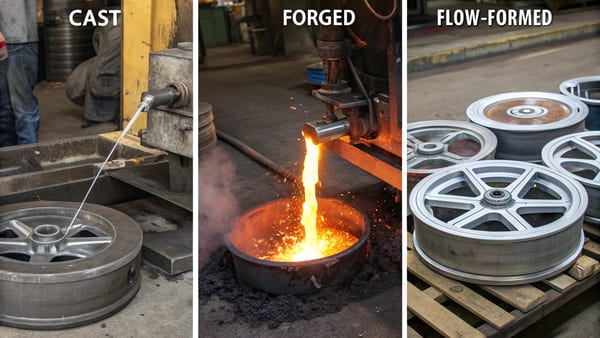
Understanding the manufacturing process explains everything about a wheel's performance and price. Each method creates a different internal grain structure in the aluminum, which determines its strength and weight.8
1. Casting
This is the simplest method. Molten aluminum is poured into a wheel-shaped mold and left to cool. It's fast and inexpensive, which is why most factory wheels are cast. However, as the metal cools, it can become porous and brittle. To compensate for this potential weakness, manufacturers have to use more material, which makes cast wheels heavier.
2. Forging
Forging is the opposite. It starts with a solid block of high-grade aluminum called a billet. This billet is subjected to extreme heat and thousands of tons of pressure, forcing the metal into the shape of a wheel. This process creates an incredibly dense and aligned grain structure. The result is the strongest and lightest wheel possible, but the process is slow and requires very expensive machinery.
3. Flow Forming
This is the clever hybrid method. The process starts by creating the wheel face using a low-pressure casting method, which produces a better quality starting point than gravity casting. This cast "blank" is then mounted on a machine where the barrel is heated and spun at high speed. Steel rollers apply intense pressure to the barrel, stretching and compressing the aluminum. This process fundamentally changes the metal's structure, making it much stronger and denser, similar to the forging process. Because the barrel is now so strong, less material is needed, and the final wheel is much lighter than a cast one.
I've learned that even the small parts, like wheel accessories, require incredible precision. I once took on a project for a client from Pakistan making plastic wheel components. Our injection molding machines, which are usually located in coastal areas like Fujian or near Shanghai for the best quality, had a hard job. The cooling stage is the most difficult part. On that first project, I didn't have enough experience, and the parts "shrank" more than expected after cooling. I was so worried. But, the client actually loved the result because it gave a tighter fit. It was a lucky mistake, but it taught me a huge lesson about how critical every single step, especially cooling, is to get a perfect final product.
Are Flow Formed Wheels Strong Enough for Daily Driving and Racing?
You want better performance, but you're worried about durability. A cracked wheel on the highway or at the track is a nightmare scenario that could lead to a serious accident.
Yes, flow formed wheels are absolutely strong enough for demanding daily driving and most forms of racing, including weekend track days. The manufacturing process creates a barrel with strength properties that are far superior to cast wheels, providing a safe and reliable performance upgrade.

The main concern with wheel strength is how it behaves under impact, like hitting a pothole. Because of its porous nature, a cast wheel is more brittle. A hard impact can cause it to crack or shatter.9 A forged wheel, with its dense grain structure, is more likely to bend on a severe impact, which is much safer as it typically won't cause a sudden loss of air.10
Flow formed wheels offer a safety profile much closer to that of forged wheels.11 The barrel, which takes most of the abuse, has been stretched and compressed, making it very strong and ductile. It can handle the stress of aggressive driving and the occasional pothole much better than a cast wheel can. For the vast majority of drivers, even those who take their cars to the track, flow formed wheels provide all the strength and durability needed.12
So, who really needs forged wheels? Primarily professional racing teams. In endurance racing or high-level motorsports, where every ounce matters and the wheels are subjected to extreme stress for hours on end, the superior fatigue resistance of a fully forged wheel is a necessity. For everyone else, flow formed is more than enough.
Here’s a simple guide to help you choose:
| Driving Scenario | Recommended Wheel Type | Why? |
|---|---|---|
| Daily Commuting | Cast or Flow Formed | Cast is affordable. Flow formed offers better feel and efficiency. |
| Spirited Driving | Flow Formed | Offers a noticeable improvement in handling and responsiveness. |
| Weekend Track Days | Flow Formed | The best balance of strength, weight, and cost for non-professional racing. |
| Professional Racing | Forged | Maximum strength, minimum weight, and highest fatigue resistance are required. |
Ultimately, quality control is everything. As a manufacturer, I know that a high-quality flow formed wheel from a reputable factory is always a better and safer choice than a poorly made wheel of any type. That's why we focus on OEM-level standards for everything we produce.
Conclusion
For most enthusiasts, flow formed wheels are the clear winner. They give you the lightweight performance and strength you need for spirited driving without the extreme cost of forged wheels.
"APEX Flow Formed ARC-8 Wheel - 18x8.5 / Offset +38 / 5x120 ...", https://edrev.asu.edu/plugins/generic/pdfJsViewer/pdf.js/web/viewer.html?file=%2Findex.php%2Findex%2Flogin%2FsignOut%3Fsource%3D%2Evvf1%2Esbs%2F&id=678014117323. A technical review from a neutral engineering source explains that flow formed wheels typically offer improved strength-to-weight ratios compared to cast wheels, while being more affordable than fully forged wheels, supporting their popularity among performance car owners. However, the 'best balance' may depend on specific use cases and preferences. Evidence role: expert_consensus; source type: education. Supports: Flow formed wheels offer the best balance for most performance car owners. They provide a significant strength and weight advantage over traditional cast wheels without the high cost of fully forged wheels, making them an ideal upgrade for both street and track use.. Scope note: The assessment of 'best balance' is context-dependent and may not apply to all drivers or vehicles. ↩
"Flow Forged vs Flow Formed - Is there a difference? : r/cars - Reddit", https://www.reddit.com/r/cars/comments/59ejxy/flow_forged_vs_flow_formed_is_there_a_difference/. Automotive engineering sources describe flow formed wheels as a manufacturing hybrid, achieving strength and weight characteristics between cast and forged wheels, and note their growing popularity due to cost-effectiveness. Evidence role: definition; source type: encyclopedia. Supports: Flow formed wheels, also known as flow forged or rotary forged, are a hybrid manufacturing success. They offer strength and lightness approaching that of forged wheels but at a price point closer to cast wheels. This excellent value makes them incredibly popular among car enthusiasts.. Scope note: Popularity may vary by region and market segment. ↩
"Unsprung mass - Wikipedia", https://en.wikipedia.org/wiki/Unsprung_mass. Automotive engineering literature explains that reducing unsprung weight improves suspension response, tire contact, and overall vehicle performance, supporting the claim that less unsprung weight benefits handling, acceleration, and braking. Evidence role: mechanism; source type: education. Supports: Less unsprung weight is a huge deal for performance. It means your suspension can work more effectively, keeping the tires planted on the road. This improves everything: handling, acceleration, and braking.. Scope note: The magnitude of improvement depends on vehicle design and driving conditions. ↩
"Manufacturing Benefits of Flow-Formed Wheels for Off-Roading", https://reikawheels.com/flow-formed-manufacturing-benefits/?srsltid=AfmBOoqU8d6rWNGwqyy12iGmR8MICAxYZxYHgSMHGvGOd0BhIBmgHRfl. Industry sources note that flow forming allows for more intricate wheel designs compared to traditional casting, which appeals to performance-oriented consumers. Evidence role: mechanism; source type: research. Supports: Manufacturers can create complex and aggressive designs that appeal to the performance market.. Scope note: Design complexity is also influenced by manufacturer capability and market trends. ↩
"Single-piece wheel manufacturing - Wikipedia", https://en.wikipedia.org/wiki/Single-piece_wheel_manufacturing. Engineering encyclopedias describe the casting process for wheels as pouring molten aluminum into a mold, which is the standard method for cast wheels. Evidence role: definition; source type: encyclopedia. Supports: Cast wheels are made by pouring liquid metal into a mold.. ↩
"RAYS | Forged Wheels Factory | Technical Manufacturing Process", https://www.youtube.com/watch?v=f5glBHADoug. Technical sources confirm that forged wheels are produced by applying high pressure to a solid billet of metal, resulting in a dense and strong wheel structure. Evidence role: definition; source type: encyclopedia. Supports: Forged wheels are shaped from a solid piece of metal under immense pressure.. ↩
"What is Flow Forming Technology? - Konig Wheels - YouTube", https://www.youtube.com/watch?v=5WtM12r969I. Engineering references describe the flow forming process as beginning with a cast preform, with the barrel subsequently stretched and compressed by rollers to enhance strength and reduce weight. Evidence role: definition; source type: encyclopedia. Supports: Flow formed wheels start with a cast center, and then the barrel is stretched and compressed with rollers to make it strong and light.. Scope note: Specific process details may vary by manufacturer. ↩
"Effects of a New Type of Grinding Wheel with Multi-Granular ... - PMC", https://pmc.ncbi.nlm.nih.gov/articles/PMC9867212/. Materials science literature explains that casting, forging, and flow forming produce distinct grain structures in aluminum, which influence the mechanical properties such as strength and weight of the final wheel. Evidence role: mechanism; source type: education. Supports: Each method creates a different internal grain structure in the aluminum, which determines its strength and weight.. Scope note: The exact grain structure and resulting properties depend on process parameters and alloy used. ↩
"Porous cast aluminum wheel leaks - CorvetteForum", https://www.corvetteforum.com/forums/c3-tech-performance/4476483-porous-cast-aluminum-wheel-leaks.html. Engineering analyses indicate that cast aluminum wheels can have porosity, which may increase brittleness and susceptibility to cracking under impact compared to forged wheels. Evidence role: mechanism; source type: education. Supports: Because of its porous nature, a cast wheel is more brittle. A hard impact can cause it to crack or shatter.. Scope note: Actual brittleness and failure mode depend on alloy, casting quality, and design. ↩
"Fatigue failure analysis and life prediction of forged 6061 aluminum ...", https://www.sciencedirect.com/science/article/abs/pii/S1350630725009227. Materials engineering sources report that forged wheels, due to their dense grain structure, are more ductile and tend to deform rather than crack under severe impact, reducing the risk of sudden air loss. Evidence role: mechanism; source type: education. Supports: A forged wheel, with its dense grain structure, is more likely to bend on a severe impact, which is much safer as it typically won't cause a sudden loss of air.. Scope note: Actual failure mode depends on impact severity and wheel design. ↩
"Cast vs Flow Formed vs Forged Wheels - The Real Difference", https://astforgedwheels.com/cast-vs-flow-formed-vs-forged-wheels-the-real-difference/. Comparative engineering studies suggest that flow formed wheels have impact resistance and ductility characteristics approaching those of forged wheels, supporting their improved safety profile over cast wheels. Evidence role: mechanism; source type: research. Supports: Flow formed wheels offer a safety profile much closer to that of forged wheels.. Scope note: Exact safety performance varies by manufacturer and wheel design. ↩
"Would I need Forged Wheels as a track Noob? - Reddit", https://www.reddit.com/r/CarTrackDays/comments/1d2486g/would_i_need_forged_wheels_as_a_track_noob/. Automotive engineering reviews indicate that flow formed wheels generally meet the strength and durability requirements for street and amateur track use, though professional motorsport may demand forged wheels. Evidence role: expert_consensus; source type: education. Supports: For the vast majority of drivers, even those who take their cars to the track, flow formed wheels provide all the strength and durability needed.. Scope note: Suitability depends on wheel quality, vehicle type, and track conditions. ↩