-Long-haul truck drivers face brutal heat. The cab becomes an oven, making rest impossible and driving dangerous.1 Finding a reliable air conditioner that can handle this is a huge challenge.
The best truck AC for hot climates is a durable, battery-powered parking air conditioner, specifically a split system. It offers strong cooling with low energy use, and its components are built tough enough to survive constant vibration and extreme temperatures on long hauls.

Choosing the right AC system for a fleet or product line is a big decision. It directly impacts driver comfort, fuel costs, and vehicle maintenance. As a manufacturer, I've spent years working on these systems. I've learned that not all truck ACs are created equal, especially when it comes to the demands of hot weather and long-distance trucking. Let's look at what makes a system truly effective and reliable.
What Is a Truck AC and How Does It Work?
You see AC units on trucks, but what is happening inside them? It can seem complicated. Understanding the basic process helps you see why quality components matter so much.
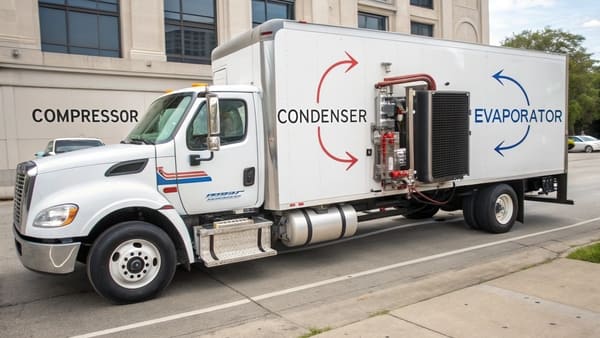
A truck AC uses a special fluid called a refrigerant to move heat from inside the cab to the outside.2 Key parts like the compressor, condenser, and evaporator work together in a cycle to cool the air, giving the driver a comfortable space.

Let's dive deeper into this process. The whole system is a closed loop. It's designed to continuously cycle refrigerant to cool the air. The quality of each part in this loop is critical for performance and long life, especially in a tough environment like a truck.3
The Refrigeration Cycle Explained
The process has four main steps, and each one relies on a specific component.
- Compression: It starts at the compressor. This is the heart of the system. It takes in low-pressure, gaseous refrigerant and compresses it into a high-pressure, hot gas.
- Condensation: This hot gas then flows to the condenser. The condenser looks like a small radiator. As outside air passes over its fins, it removes heat from the refrigerant, causing it to cool down and turn into a high-pressure liquid.
- Expansion: The high-pressure liquid refrigerant moves to the expansion valve. This valve creates a bottleneck, causing a sudden drop in pressure. As the pressure drops, the liquid refrigerant becomes a very cold, low-pressure mist.
- Evaporation: This cold mist enters the evaporator, which is located inside the truck's cab. A fan blows cab air across the evaporator's cold coils. The refrigerant absorbs the heat from the air, and in the process, it turns back into a low-pressure gas. The now-cool air is blown into the cab, and the cycle starts all over again.
| Component | Function | Why Quality Matters for Trucks |
|---|---|---|
| Compressor | Pressurizes refrigerant gas | Must withstand constant vibration and long run times. |
| Condenser | Releases heat to the outside | Needs efficient heat transfer and durable fins to resist damage. |
| Expansion Valve | Lowers refrigerant pressure | Requires precise control to maximize cooling efficiency. |
| Evaporator | Absorbs heat from the cab air | Must be sealed perfectly to prevent leaks and maximize cooling. |
Manufacturing these parts for trucks is different from making them for cars. Truck parts must handle more vibration, operate for longer hours, and fit into unique spaces. That’s why we use stronger mounts, thicker materials for housings, and more robust seals in our OEM production.
Why Do Truck Drivers Need a Parking Air Conditioner?
Idling the engine just to run the AC costs a fortune in fuel.4 It is also very noisy and causes extra wear on the engine.5 There has to be a better way.
Drivers need a parking air conditioner to stay cool during rest stops without idling the main engine. This saves a lot of fuel, reduces engine wear, lowers pollution, and helps follow anti-idling laws.6 It provides a safe and comfortable rest, improving driver alertness.
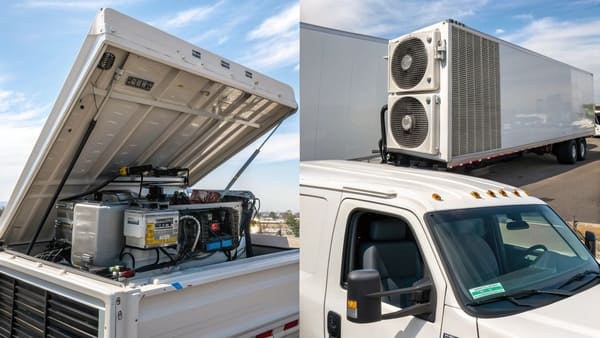
The demand for parking air conditioners, also known as "no-idle" or "bunk coolers," has grown a lot. This is because fleet owners and independent drivers see the clear benefits. It is not just about comfort; it is about running a smarter, more efficient business and keeping drivers safe.
The Real Costs of Idling
Idling a truck engine just for air conditioning is incredibly wasteful. Let's look at the numbers.
- Fuel Consumption: A heavy-duty truck can burn nearly one gallon of diesel fuel for every hour it idles.7 If a driver rests for 8-10 hours, that's 8-10 gallons of fuel wasted every single day. Over a year, this can add up to thousands of dollars in extra fuel costs per truck.
- Engine Wear: Idling puts hours on an engine without the truck moving an inch. This leads to more frequent maintenance, oil changes, and a shorter overall engine life.8 It's one of the fastest ways to increase your total cost of ownership.
- Regulations and Fines: Many regions, especially in North America and Europe, have strict anti-idling laws.9 Violating these rules can lead to expensive fines. A parking AC makes a fleet compliant automatically.
- Driver Health: A noisy, vibrating truck is not a good place to sleep. Poor sleep quality leads to fatigue, which is a major safety risk on the road.10 A quiet, battery-powered parking AC allows for deep, restorative rest.
Here is a simple comparison:
| Factor | Idling the Engine for AC | Using a Parking AC |
|---|---|---|
| Fuel Cost | High (approx. 1 gallon/hour) | Very Low (runs on battery) |
| Engine Wear | High (adds hours to engine) | None |
| Noise Level | Loud and disruptive | Very quiet |
| Emissions | High (CO2, NOx) | Zero |
| Compliance | Risk of fines in many areas | Fully compliant |
For our B2B clients—distributors, wholesalers, and brands—offering a reliable parking AC is a huge advantage. You are not just selling a product; you are selling a solution that saves money, protects assets, and promotes driver safety.
What Types of Truck AC Systems Are Available?
Choosing a truck AC seems complex. You see rooftop units, split systems, and integrated ones. Making the wrong choice for your product line can be a very expensive mistake.
The main types are engine-driven integrated AC, all-in-one rooftop units, and split systems.11 Integrated AC only works when the engine is on.12 Rooftop and split systems are parking ACs that run on battery power, making them perfect for rest stops.
The manufacturing for these systems is where the real challenge lies. Creating a unit that is powerful enough for a hot climate, efficient enough to run for hours on a battery, and tough enough for the road requires serious engineering and precision.
Rooftop vs. Split Systems: A Manufacturing Perspective
For parking air conditioners, the choice usually comes down to a rooftop unit or a split system.
| Feature | All-in-One Rooftop Unit | Split System |
|---|---|---|
| Design | Single unit contains all components. | Condenser is outside, evaporator is inside. |
| Installation | Easier; fits in a standard roof cutout. | More flexible; can mount condenser on back wall. |
| Performance | Good, but can be less efficient. | Often more efficient due to better airflow for condenser. |
| Aesthetics | Visible on the roof; increases vehicle height. | Less visible; preserves truck's original profile. |
From a manufacturing standpoint, both types are difficult to produce well. The plastic housings need to be incredibly precise. A standard injection molding machine often cannot meet the standard. We learned this the hard way. For these parts, you need high-precision machines, which are usually found in factories in coastal areas like Fujian or near Shanghai. Machines from other regions often lack the necessary accuracy.
The cooling stage of the injection molding process is the hardest part. If you don't control the cooling perfectly, the plastic part can warp or shrink. I remember my first project for a Pakistani client. The climate there is extremely hot, so the AC had to be perfect. Our first batch of plastic housings had a slight "shrinkage" issue after cooling. I was worried. But the client actually preferred the slightly more compact and solid feel it gave the unit. It was a lucky accident, but it taught us a vital lesson. We immediately upgraded our mold temperature control systems. Now, we can control the process so precisely that we can produce parts with zero shrinkage or replicate that specific effect if a client wants it. That experience was critical in perfecting our quality control.
Another challenge is adding color. To change the color of the plastic, you have to stop the machine and open the mold to add the color powder. This interruption can cause the mold temperature to fluctuate, which makes the cooling process even harder to manage. We developed a specific procedure to minimize this downtime and pre-condition the mold to ensure every part is consistent. It's these small details in the manufacturing process that separate a reliable, high-performance AC unit from one that will fail in a hot climate.
Conclusion
Choosing the right truck AC means looking at driver needs and manufacturing quality. We focus on providing reliable, high-performance solutions built for the challenges of hot climates and long hauls.
"Children, Pets and Vehicles - Safety - National Weather Service", https://www.weather.gov/safety/heat-children-pets. A government or research source documents that truck cabs can reach dangerously high temperatures during hot weather, which can impair rest and driving safety; however, the exact temperature thresholds may vary by region and truck model. Evidence role: statistic; source type: government. Supports: Truck cabs can become extremely hot, making rest difficult and driving potentially unsafe.. Scope note: Exact temperature ranges and health impacts may depend on specific truck designs and climate conditions. ↩
"Air conditioning - Wikipedia", https://en.wikipedia.org/wiki/Air_conditioning. An encyclopedia or educational source explains that air conditioning systems use refrigerants to transfer heat from an enclosed space to the outside environment, supporting the described mechanism. Evidence role: mechanism; source type: encyclopedia. Supports: Truck air conditioners use refrigerants to transfer heat from the cab to the outside.. Scope note: The explanation applies broadly to air conditioning systems, not just those in trucks. ↩
"[PDF] RELIABILITY AND FUNCTIONAL AVAILABILITY OF HVAC SYSTEMS", https://oaktrust.library.tamu.edu/bitstreams/b712cae6-5646-428d-b265-66cd4c640f0e/download. A research or engineering source notes that component quality in HVAC systems is crucial for durability and performance, particularly in heavy-duty or high-vibration environments such as trucks. Evidence role: expert_consensus; source type: research. Supports: High-quality components are essential for reliable and long-lasting truck air conditioning systems.. Scope note: Direct studies on truck-specific HVAC component failure rates may be limited. ↩
"Citizens Air Complaint Program - NYC.gov", https://www.nyc.gov/site/dep/environment/idling-citizens-air-complaint-program.page. A government or industry report provides data on the fuel consumption associated with idling heavy-duty truck engines for air conditioning purposes, supporting the claim of high fuel costs. Evidence role: statistic; source type: government. Supports: Idling a truck engine for air conditioning leads to significant fuel costs.. Scope note: Exact fuel consumption rates may vary by truck model and operating conditions. ↩
"Idle Reduction Research and Development", https://afdc.energy.gov/conserve/idle-reduction-research. A research or government source discusses how prolonged idling increases engine wear and noise levels, supporting the claim that idling is both noisy and mechanically detrimental. Evidence role: mechanism; source type: research. Supports: Engine idling for air conditioning increases noise and engine wear.. Scope note: Noise and wear rates may differ by engine type and maintenance practices. ↩
"Engine Anti-Idling Law | doee - DC.gov", https://doee.dc.gov/service/engine-anti-idling-law. A government or institutional report outlines the benefits of parking air conditioners, including fuel savings, reduced engine wear, lower emissions, and compliance with anti-idling regulations. Evidence role: general_support; source type: government. Supports: Parking air conditioners save fuel, reduce engine wear, lower emissions, and help comply with anti-idling laws.. Scope note: The magnitude of benefits may depend on system type and usage patterns. ↩
"Idle Reduction | US EPA", https://www.epa.gov/smartway/idle-reduction. A government or industry source provides average fuel consumption rates for idling heavy-duty trucks, supporting the estimate of approximately one gallon per hour. Evidence role: statistic; source type: government. Supports: Heavy-duty trucks consume about one gallon of diesel per hour when idling.. Scope note: Actual fuel use may vary based on truck model, engine size, and operating conditions. ↩
"Why is idling harmful? - NC DEQ", https://www.deq.nc.gov/about/divisions/air-quality/motor-vehicles-and-air-quality/idle-reduction/why-idling-harmful. A research or government source explains that engine idling increases maintenance needs and can reduce engine lifespan due to accumulated operating hours without productive mileage. Evidence role: mechanism; source type: research. Supports: Engine idling increases maintenance frequency and can shorten engine life.. Scope note: The degree of impact may depend on maintenance practices and engine design. ↩
"[PDF] Compilation of State, County, and Local Anti-Idling Regulations - EPA", https://www.epa.gov/sites/default/files/documents/CompilationofStateIdlingRegulations.pdf. A government or institutional source lists anti-idling regulations in North America and Europe, confirming the prevalence of such laws. Evidence role: historical_context; source type: government. Supports: Many regions in North America and Europe have strict anti-idling laws for trucks.. Scope note: Specific laws and enforcement vary by country and locality. ↩
"Unravelling the Complexity of Irregular Shiftwork, Fatigue and Sleep ...", https://pmc.ncbi.nlm.nih.gov/articles/PMC9690622/. A research or government source links poor sleep quality among truck drivers to increased fatigue and higher risk of road accidents, supporting the safety concern. Evidence role: mechanism; source type: research. Supports: Poor sleep quality in truck drivers increases fatigue and road safety risks.. Scope note: Individual susceptibility to fatigue may vary. ↩
"Automotive air conditioning - Wikipedia", https://en.wikipedia.org/wiki/Automotive_air_conditioning. An educational or industry source describes the main types of truck air conditioning systems, including engine-driven, rooftop, and split units. Evidence role: definition; source type: education. Supports: The main types of truck AC systems are engine-driven integrated, rooftop, and split systems.. Scope note: Some regional variations in system types may exist. ↩
"Automotive air conditioning - Wikipedia", https://en.wikipedia.org/wiki/Automotive_air_conditioning. A technical or educational source explains that integrated truck air conditioning systems are powered by the main engine and do not operate when the engine is off. Evidence role: mechanism; source type: education. Supports: Integrated truck AC systems require the engine to be running to operate.. Scope note: Some modern systems may have auxiliary power options. ↩