-Are you curious about what really happens when you press the gas pedal? It seems simple, but if it fails, you could lose speed control, which is a scary thought.
The accelerator, or gas pedal, is the driver's primary control for engine power. In modern cars, it's an electronic sensor that sends signals to the engine's computer, telling it how much power to deliver. It's not just a simple mechanical cable anymore.1
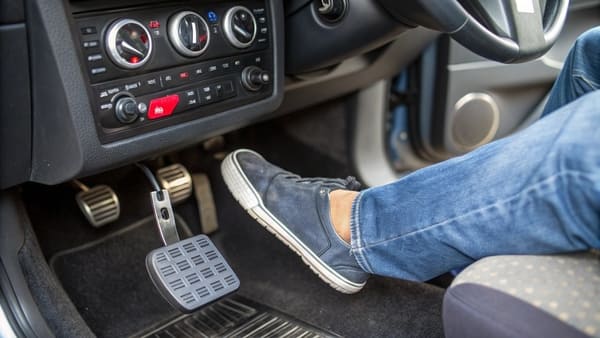
Now that we know the basics, you might be surprised by the complexity hidden in such a simple-looking part. It's the direct link between your intention to go faster and the car's powertrain actually doing it. This system has evolved significantly over the years, moving from simple mechanics to sophisticated electronics. Let's break down what the accelerator really is and how it functions in today's vehicles.
What Is an Accelerator in a Car, Exactly?
People call it the "gas pedal," but that name doesn't tell the whole story, especially with today's technology. This can make it hard to understand how modern cars actually move.
An accelerator is the pedal your foot presses to increase the vehicle's speed. It translates your foot's movement into a signal that tells the engine or electric motor how much power you are requesting. It is the key interface between you, the driver, and the powertrain.
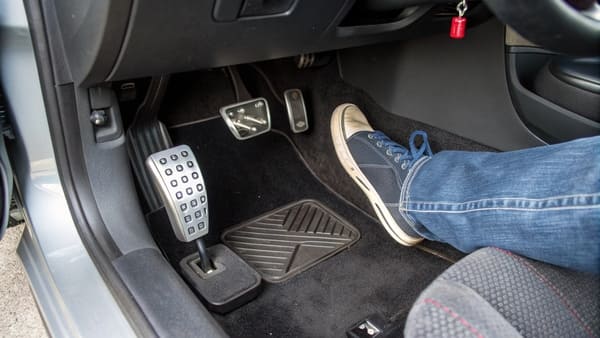
The term "accelerator" is much more accurate than "gas pedal." In older cars, pressing the pedal would mechanically pull a cable connected to the engine's throttle, directly controlling how much fuel and air entered. But modern cars are different. The pedal doesn't directly control anything mechanical. Instead, it sends an electronic request to the Engine Control Unit (ECU). The ECU then looks at your request along with other data, like vehicle speed, engine temperature, and gear, to deliver power efficiently and smoothly.2 This is true for all types of cars, including gasoline, diesel, hybrid, and fully electric vehicles.3 In an EV, the accelerator tells the controller how much power to draw from the battery and send to the motors.4 So, it's a request for acceleration, not just a valve for gas.
Mechanical vs. Electronic Accelerators
| Feature | Mechanical Accelerator (Throttle Cable) | Electronic Accelerator (Drive-by-Wire) |
|---|---|---|
| Connection | A physical steel cable links the pedal to the engine's throttle body. | An electronic sensor at the pedal sends a signal to the ECU. |
| Control | Direct and physical. Pedal movement directly opens the throttle. | Indirect and calculated. The ECU interprets the signal and decides how to respond. |
| Features | Simple, but prone to stretching or snapping. | Enables features like cruise control, traction control, and stability control. |
| Feel | Often provides more direct, raw feedback from the engine. | Smoother, more refined, and programmable for different driving modes (Eco, Sport). |
Where Is the Accelerator Pedal Located in a Car?
You know where the pedal is, but have you ever thought about why it's there? An unfamiliar pedal layout could be confusing or even dangerous, which is why its position is standardized.
The accelerator pedal is located on the far right in the driver's footwell.5 In automatic cars, the brake is to its left. In cars with a manual transmission, the order from right to left is accelerator, brake, and clutch. This layout is consistent across the globe.6
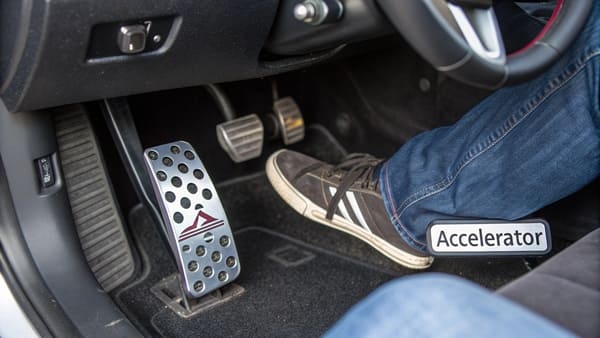
The placement of the accelerator pedal is a global standard for very important reasons, mainly safety and ergonomics. Placing it on the far right ensures that your right foot naturally rests on it to accelerate and pivots inward to apply the brake. This design minimizes the chance of accidentally pressing both pedals at once.7 It also builds muscle memory, so drivers can react instinctively in an emergency without having to think about which pedal is which.8 This standard remains the same whether you are in a Left-Hand Drive (LHD) country like the United States or a Right-Hand Drive (RHD) country like the UK or Japan. The pedals are always in the same order relative to the driver.9 As a manufacturer, we produce pedal assemblies for both LHD and RHD markets, and ensuring they meet these precise ergonomic and safety standards is a top priority in our design and production process.
Standard Pedal Layouts
| Transmission Type | Right-Most Pedal | Middle Pedal | Left-Most Pedal |
|---|---|---|---|
| Automatic | Accelerator | Brake | (None / Footrest) |
| Manual | Accelerator | Brake | Clutch |
How Does an Accelerator Work in a Modern Car?
The old-school mechanical cable is gone from most cars, but many drivers don't know what replaced it. This can make it hard to diagnose a problem if your car's acceleration feels "off."
In a modern car, the accelerator uses a system called "drive-by-wire." The pedal has an Accelerator Pedal Position Sensor (APPS). When you press it, the sensor sends an electronic signal to the Engine Control Unit (ECU), which then electronically commands the engine or motor to produce power.10
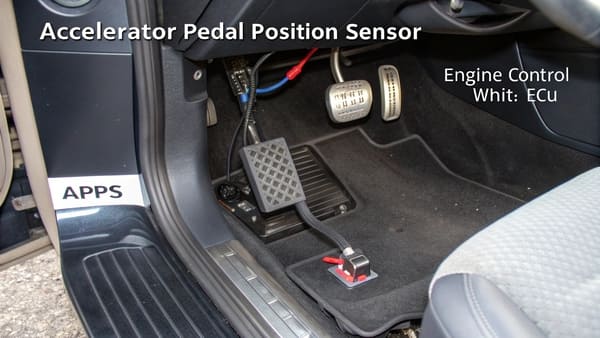
The precision of this drive-by-wire system starts with its physical components. The accelerator pedal assembly, which is often made of high-strength reinforced plastic, is surprisingly complex to manufacture.11 I learned this firsthand a few years ago when my company took on a project for a client from Pakistan. We were tasked with producing the plastic housings for these pedal assemblies. The plastic parts require incredible precision because they hold the electronic sensors. Standard injection molding machines often can't meet these tight tolerances.12 The process has multiple steps, but the most difficult stage is cooling. If the plastic part isn't cooled perfectly, it can shrink or warp, which would ruin the alignment of the sensor.
On that first project, we were still refining our process. The plastic parts shrank a bit more than we had planned. We were worried about telling the client, but when we showed them the samples, they actually liked the denser, more solid feel of the shrunken parts! It was a lucky outcome, but it taught us a huge lesson about controlling every single variable. Since then, we've perfected that process. We can even manage tricky steps like adding color, which requires opening the mold mid-cycle and can easily disrupt the sensitive cooling phase. This focus on manufacturing detail ensures that the physical part is perfect, so the electronic system it supports can be completely reliable.
Conclusion
In short, the accelerator is a smart electronic system, not just a simple pedal. Its location is standardized for safety, and it works by sending precise requests to your car's main computer.
"Electronic throttle control - Wikipedia", https://en.wikipedia.org/wiki/Electronic_throttle_control. According to the U.S. National Highway Traffic Safety Administration (NHTSA), most modern vehicles use electronic throttle control systems, where the accelerator pedal is connected to sensors that communicate with the engine control unit, replacing traditional mechanical linkages. Evidence role: expert_consensus; source type: government. Supports: In modern cars, the accelerator pedal is an electronic sensor that sends signals to the engine's computer, replacing mechanical cables.. Scope note: This describes the general trend in vehicles produced since the early 2000s; some older or specialty vehicles may still use mechanical cables. ↩
"Engine control unit - Wikipedia", https://en.wikipedia.org/wiki/Engine_control_unit. Automotive engineering textbooks and technical guides explain that modern engine control units (ECUs) process accelerator input along with data such as vehicle speed, engine temperature, and gear position to optimize engine response and efficiency. Evidence role: mechanism; source type: education. Supports: The ECU considers accelerator input along with other data, like vehicle speed, engine temperature, and gear, to deliver power efficiently.. Scope note: The specific parameters considered may vary by manufacturer and vehicle model. ↩
"Drive by wire - Wikipedia", https://en.wikipedia.org/wiki/Drive_by_wire. Automotive engineering sources note that electronic accelerator systems are used in gasoline, diesel, hybrid, and electric vehicles, though the specific implementation may differ between powertrains. Evidence role: expert_consensus; source type: education. Supports: Electronic accelerator systems are used in gasoline, diesel, hybrid, and electric vehicles.. Scope note: The underlying control logic may vary between vehicle types, but the use of electronic accelerator input is common. ↩
"ELI5: What happens when I press the accelerator in an EV?", https://www.polestar.com/us/news/eli5-what-happens-when-i-press-the-accelerator-in-an-ev/. Technical guides on electric vehicles explain that the accelerator pedal in EVs sends a signal to the power controller, which regulates the amount of electrical energy supplied from the battery to the electric motors. Evidence role: mechanism; source type: education. Supports: In electric vehicles, the accelerator pedal signals the controller to regulate power from the battery to the motors.. Scope note: The specific control algorithms may differ by manufacturer. ↩
"Car controls - Wikipedia", https://en.wikipedia.org/wiki/Car_controls. Driver's education manuals and international vehicle standards confirm that the accelerator pedal is positioned on the far right in the driver's footwell in both left- and right-hand drive vehicles. Evidence role: definition; source type: education. Supports: The accelerator pedal is located on the far right in the driver's footwell.. Scope note: Some specialty or adaptive vehicles may have alternative layouts. ↩
"[PDF] Untitled - Texas A&M Transportation Institute", https://static.tti.tamu.edu/tti.tamu.edu/documents/TTI-1989-10.pdf. International automotive standards and regulatory bodies specify that the pedal layout (accelerator on the right, brake in the middle, clutch on the left for manuals) is standardized globally for passenger vehicles. Evidence role: expert_consensus; source type: institution. Supports: The pedal layout is consistent across the globe for standard passenger vehicles.. Scope note: There may be exceptions in some specialty or vintage vehicles. ↩
"[PDF] Untitled - Texas A&M Transportation Institute", https://static.tti.tamu.edu/tti.tamu.edu/documents/TTI-1989-10.pdf. Ergonomics research and automotive safety guidelines indicate that the placement of the accelerator pedal on the far right is intended to facilitate natural foot movement and reduce the risk of pressing both pedals simultaneously. Evidence role: mechanism; source type: research. Supports: The rightmost placement of the accelerator pedal is designed for ergonomic and safety reasons, minimizing accidental dual pedal application.. Scope note: Individual driver habits and vehicle modifications can affect outcomes. ↩
"Sample Emergency Action Program | Missouri Department of Labor ...", https://labor.mo.gov/dls/workplace-safety/emergency-action-program. Driver training literature and human factors research support that standardized pedal layouts help drivers develop muscle memory, enabling faster and more accurate responses in emergency situations. Evidence role: expert_consensus; source type: education. Supports: Standardized pedal layouts help drivers build muscle memory for instinctive emergency reactions.. Scope note: Muscle memory development depends on consistent practice and may vary among individuals. ↩
"In countries that drive on the left, are the pedals mirrored or are they ...", https://www.quora.com/In-countries-that-drive-on-the-left-are-the-pedals-mirrored-or-are-they-in-the-same-order. Automotive standards organizations confirm that pedal order (accelerator, brake, clutch) is maintained relative to the driver in both left- and right-hand drive vehicles. Evidence role: definition; source type: institution. Supports: Pedal order is standardized relative to the driver in both LHD and RHD vehicles.. Scope note: Some specialty vehicles may have non-standard arrangements. ↩
"Drive by wire", https://en.wikipedia.org/wiki/Drive_by_wire. Automotive engineering references describe drive-by-wire systems, where the accelerator pedal position sensor transmits electronic signals to the ECU, which then controls engine or motor output. Evidence role: mechanism; source type: education. Supports: Modern cars use drive-by-wire systems with pedal position sensors sending signals to the ECU to control power output.. Scope note: The specific implementation may vary by manufacturer and vehicle type. ↩
"Design & Analysis of Accelerator Pedal for Four Wheeler ...", https://www.academia.edu/35592945/Design_and_Analysis_of_Accelerator_Pedal_for_Four_Wheeler_Commercial_Vehicle. Manufacturing and materials engineering sources note that accelerator pedal assemblies are frequently made from high-strength reinforced plastics, requiring precise manufacturing processes to ensure durability and sensor alignment. Evidence role: expert_consensus; source type: education. Supports: Accelerator pedal assemblies are often made of high-strength reinforced plastic and require complex manufacturing.. Scope note: Material choice and manufacturing complexity can vary by manufacturer and vehicle segment. ↩
"[PDF] Accelerator Pedals Reinforcement Bar Installation - nhtsa", https://static.nhtsa.gov/odi/rcl/2010/RCORRD-10V017-4971.pdf. Plastics engineering literature explains that standard injection molding machines may struggle to achieve the tight tolerances required for automotive sensor housings, necessitating specialized processes or equipment. Evidence role: expert_consensus; source type: education. Supports: Standard injection molding machines may not meet the tight tolerances required for automotive accelerator pedal sensor housings.. Scope note: Advanced or customized molding equipment can address these challenges in high-precision applications. ↩