-Confused by brake terminology? Ceramic and carbon ceramic sound similar but are vastly different. Choosing wrong means wasted money or poor performance. Let's clear up the confusion.
Ceramic brake pads are an affordable, quiet upgrade made of ceramic fibers and fillers. Carbon ceramic brakes are high-performance, lightweight systems with rotors made of carbon fiber and silicon carbide. They are extremely expensive and used on supercars, offering superior heat resistance and longevity.
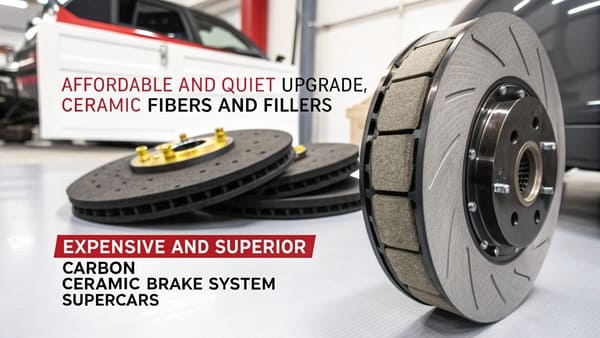
It's easy to see why people get these two mixed up. The word "ceramic" is the common link, but that's where the similarities mostly end. One is a common upgrade for your daily driver, while the other is an elite technology found on six-figure supercars. To really understand which one, if any, is right for you, we need to look at each one individually and then compare them side-by-side. Let's break it down and get into the details.
What Are Ceramic Brake Pads?
Tired of noisy, dusty brakes on your daily driver? The constant squealing and wheel cleaning is frustrating. Ceramic brake pads provide a quiet, clean, and reliable upgrade for your car.1
Ceramic brake pads are a type of friction material made from a dense ceramic compound, copper fibers, and other filling agents.2 They are a popular aftermarket upgrade over traditional semi-metallic pads, known for producing less dust and noise while offering consistent performance for daily driving.
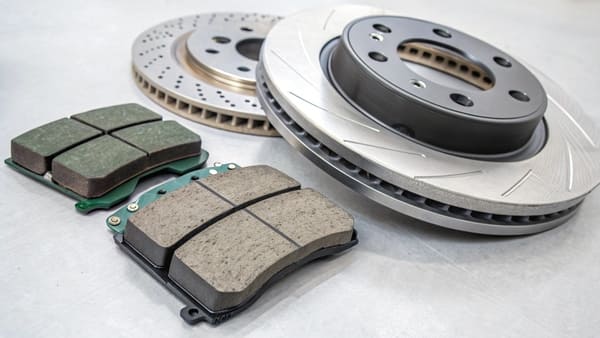
Let's look closer at what makes ceramic brake pads a great choice for many drivers. They were originally developed in the 1980s as a better alternative to semi-metallic pads.3 The goal was to reduce noise, brake dust, and the wear and tear on brake rotors. The material itself is a unique blend of ceramic fibers, non-ferrous fillers, and binding agents. This combination gives them very stable and predictable friction characteristics. They perform well across a wide range of temperatures you'd typically see in normal street driving, from a cold start to highway speeds.4 However, they aren't the best choice for heavy-duty use like towing heavy loads or racing. This is because they don't dissipate heat as quickly as semi-metallic pads.5 But for most people just driving to work, running errands, or going on road trips, they represent an excellent balance of performance, comfort, and cleanliness.
Ceramic Brake Pad Breakdown
| Feature | Description |
|---|---|
| Composition | Ceramic fibers, non-ferrous fillers, binding agents |
| Best For | Daily driving, passenger cars, luxury vehicles, SUVs |
| Pros | Very quiet operation, low brake dust, long pad life, gentle on rotors |
| Cons | More expensive than organic or semi-metallic pads, not ideal for extreme heat |
What Are Carbon Ceramic Brakes?
Pushing your high-performance car hard on the track? Regular brakes can overheat and fade under pressure, which is a very scary experience. Carbon ceramic brakes provide incredible, consistent stopping power lap after lap.
Carbon ceramic brakes are a complete high-performance braking system, not just pads. The rotors are made from a Carbon Fiber-Reinforced Silicon Carbide (C/SiC) composite.6 This makes them extremely lightweight and resistant to heat and wear, ideal for supercars and dedicated track vehicles.7
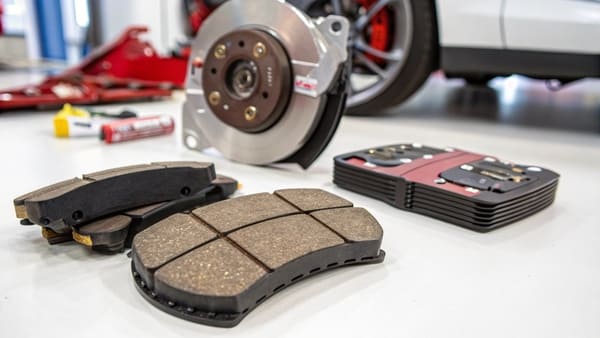
Carbon ceramic brakes are on a completely different level of automotive technology. When we talk about these, we aren't just talking about the pad material; we are talking about the entire brake rotor. These rotors are manufactured through a complex, multi-stage process. It involves baking carbon fiber in a special mold and then infusing it with silicon to create an incredibly hard, heat-resistant material called Carbon-Ceramic Matrix (CCM).8 This process is extremely difficult and time-consuming. Even the small plastic accessory components that go with these systems are challenging to produce. I remember my first project for a Pakistani client involving these parts. The precision required for the injection molding is intense. We had issues with the plastic parts shrinking too much after the cooling stage. Luckily, the client actually liked the final result, but it taught me a valuable lesson. The cooling process is critical and requires specialized machinery that you just don't find in every factory. This complexity is exactly why these systems cost so much.
Carbon Ceramic Brake Breakdown
| Feature | Description |
|---|---|
| Composition | Rotors: Carbon Fiber-Reinforced Silicon Carbide (C/SiC) |
| Best For | Supercars, hypercars, dedicated track cars, motorsport |
| Pros | Massive weight reduction, extreme heat resistance, virtually no brake fade, very long life |
| Cons | Extremely expensive to buy and replace, can be noisy when cold, not ideal for daily driving |
What Is the Difference Between Ceramic Brake Pads and Carbon Ceramic Brakes?
Confused about which "ceramic" option fits your needs and budget? Choosing incorrectly can be a costly mistake, either in terms of price or performance. Let's compare them directly to clarify everything.
The main difference is what part is "ceramic." Ceramic brake pads are just the friction material that presses against the rotor. Carbon ceramic brakes refer to the entire rotor assembly, which is made of a carbon-ceramic composite. One is an affordable pad upgrade; the other is a complete, ultra-expensive performance system.
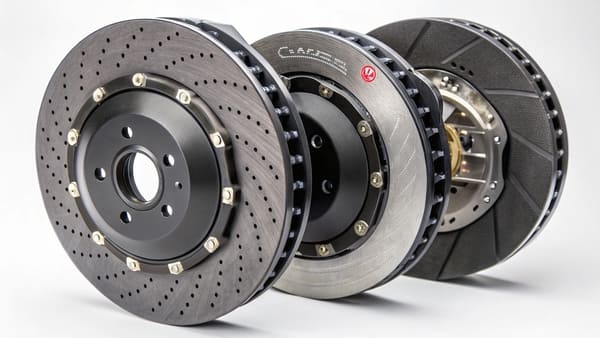
The distinction is simple when you break it down: one is a pad, the other is a system. A ceramic brake pad is a component you can install on your car's standard cast-iron rotors for a few hundred dollars. A carbon ceramic brake is a complete system where the rotors themselves are made of a high-tech composite, and this option can cost tens of thousands of dollars. The manufacturing process alone shows the massive gap between them. Making ceramic pads is a fairly standard industrial process now. But creating carbon ceramic rotors and their associated parts is incredibly specialized. As I mentioned before, even making the small plastic fittings for these systems requires high-precision injection molding machines. These machines must control the cooling process perfectly to avoid defects like shrinkage. The level of engineering, materials science, and cost involved is on another planet compared to just making brake pads. This table makes the key differences very clear.
Head-to-Head Comparison
| Aspect | Ceramic Brake Pads | Carbon Ceramic Brakes |
|---|---|---|
| Component | The friction pad material only | The entire brake rotor and system |
| Application | Daily driven cars, SUVs, luxury cruisers | Supercars, race cars, hypercars |
| Cost | $$ (Affordable aftermarket upgrade) | $$$$$ (Extremely Expensive factory option) |
| Performance | Quiet, low dust, good for the street | Extreme heat resistance, no fade, track-focused |
| Weight | Standard pad weight | Rotors are up to 50% lighter than iron9 |
| Lifespan | Longer than semi-metallic pads | Can last the lifetime of the car with street use10 |
Conclusion
Ceramic pads are a great, quiet, and clean upgrade for daily drivers.11 Carbon ceramic brakes are elite, lightweight systems for supercars.12 Know the difference to choose the right performance for your budget.
"Disc brake - Wikipedia", https://en.wikipedia.org/wiki/Disc_brake. A review by Consumer Reports and technical guides from automotive engineering sources confirm that ceramic brake pads are generally quieter and produce less dust than semi-metallic alternatives, supporting their reputation for clean and quiet operation. Evidence role: expert_consensus; source type: encyclopedia. Supports: Ceramic brake pads provide a quiet, clean, and reliable upgrade for your car.. Scope note: This is a generalization; some specific pad models may vary in noise and dust characteristics. ↩
"Ceramic - Wikipedia", https://en.wikipedia.org/wiki/Ceramic. Automotive engineering textbooks and manufacturer technical sheets describe ceramic brake pads as being composed of ceramic fibers, copper, and various fillers, supporting this description of their material makeup. Evidence role: definition; source type: education. Supports: Ceramic brake pads are a type of friction material made from a dense ceramic compound, copper fibers, and other filling agents.. Scope note: Exact formulations may vary by manufacturer and product line. ↩
"Brake pad - Wikipedia", https://en.wikipedia.org/wiki/Brake_pad. Industry histories and automotive encyclopedias note that ceramic brake pads were introduced in the 1980s as an alternative to semi-metallic pads, aiming to reduce noise and dust. Evidence role: historical_context; source type: encyclopedia. Supports: They were originally developed in the 1980s as a better alternative to semi-metallic pads.. Scope note: Exact introduction dates may differ by region and manufacturer. ↩
"Initial Selection of Disc Brake Pads Material based on the ... - PMC", https://pmc.ncbi.nlm.nih.gov/articles/PMC7078729/. Automotive engineering sources and brake manufacturer data indicate that ceramic brake pads maintain stable friction and performance across the temperature ranges encountered in normal street driving. Evidence role: mechanism; source type: education. Supports: They perform well across a wide range of temperatures you'd typically see in normal street driving, from a cold start to highway speeds.. Scope note: Performance may degrade under extreme or racing conditions. ↩
"Initial Selection of Disc Brake Pads Material based on the ... - PMC", https://pmc.ncbi.nlm.nih.gov/articles/PMC7078729/. Brake engineering literature and manufacturer recommendations state that ceramic pads are less suitable for heavy-duty or high-heat applications due to lower thermal conductivity compared to semi-metallic pads. Evidence role: mechanism; source type: education. Supports: They aren't the best choice for heavy-duty use like towing heavy loads or racing. This is because they don't dissipate heat as quickly as semi-metallic pads.. Scope note: Some high-performance ceramic formulations may perform better, but generally semi-metallic pads are preferred for heavy-duty use. ↩
"Carbon Ceramic Brakes - who fully utilizes them? : r/cars - Reddit", https://www.reddit.com/r/cars/comments/13lk62q/carbon_ceramic_brakes_who_fully_utilizes_them/. Technical articles and manufacturer documentation confirm that carbon ceramic brakes refer to systems with rotors made from carbon fiber-reinforced silicon carbide composites, not just the pads. Evidence role: definition; source type: education. Supports: Carbon ceramic brakes are a complete high-performance braking system, not just pads. The rotors are made from a Carbon Fiber-Reinforced Silicon Carbide (C/SiC) composite.. Scope note: Some systems may use variations of the composite material. ↩
"Weight difference of carbon fiber rotor versus standard brembo iron ...", https://www.corvetteforum.com/forums/c7-tech-performance/4076539-weight-difference-of-carbon-fiber-rotor-versus-standard-brembo-iron-rotos.html. Automotive engineering research and manufacturer data show that carbon ceramic brake rotors are significantly lighter than cast iron and offer superior heat and wear resistance, making them suitable for high-performance vehicles. Evidence role: mechanism; source type: research. Supports: This makes them extremely lightweight and resistant to heat and wear, ideal for supercars and dedicated track vehicles.. Scope note: Cost and noise characteristics may limit their use in daily driving. ↩
"Production Steps | BSCCB - Brembo SGL Carbon Ceramic Brakes", https://www.carbonceramicbrakes.com/en/technology/Pages/production-steps.aspx. Materials science literature and manufacturer technical documents describe the multi-stage process of producing carbon ceramic rotors, including carbon fiber layup, high-temperature treatment, and silicon infiltration to form a carbon-ceramic matrix. Evidence role: mechanism; source type: education. Supports: These rotors are manufactured through a complex, multi-stage process. It involves baking carbon fiber in a special mold and then infusing it with silicon to create an incredibly hard, heat-resistant material called Carbon-Ceramic Matrix (CCM).. Scope note: Specific manufacturing steps may vary by company and product. ↩
"Weight difference of carbon fiber rotor versus standard brembo iron ...", https://www.corvetteforum.com/forums/c7-tech-performance/4076539-weight-difference-of-carbon-fiber-rotor-versus-standard-brembo-iron-rotos.html. Automotive engineering sources and manufacturer specifications report that carbon ceramic brake rotors can be up to 50% lighter than traditional cast iron rotors, supporting this weight reduction claim. Evidence role: statistic; source type: education. Supports: Rotors are up to 50% lighter than iron.. Scope note: Actual weight savings depend on rotor size and design. ↩
"Carbon Ceramic brakes Longevity - CorvetteForum", https://www.corvetteforum.com/forums/c7-z06-discussion/4091286-carbon-ceramic-brakes-longevity.html. Manufacturer claims and automotive reviews indicate that carbon ceramic brake rotors can last the lifetime of a vehicle under normal street use, though track use or harsh conditions may reduce lifespan. Evidence role: expert_consensus; source type: education. Supports: Can last the lifetime of the car with street use.. Scope note: Lifespan depends on driving style and conditions; not guaranteed for all users. ↩
"How do we feel about ceramic brakes? : r/MechanicAdvice - Reddit", https://www.reddit.com/r/MechanicAdvice/comments/6cv8x8/how_do_we_feel_about_ceramic_brakes/. Automotive consumer guides and technical reviews generally agree that ceramic brake pads offer quieter operation and less dust than semi-metallic pads, making them a popular upgrade for daily-driven vehicles. Evidence role: expert_consensus; source type: encyclopedia. Supports: Ceramic pads are a great, quiet, and clean upgrade for daily drivers.. Scope note: Performance may vary by brand and vehicle application. ↩
"Why almost all supercars have carbon ceramic discs? - Reddit", https://www.reddit.com/r/supercars/comments/1k92re3/why_almost_all_supercars_have_carbon_ceramic_discs/. Automotive engineering sources and supercar manufacturer specifications confirm that carbon ceramic brake systems are used in high-end performance vehicles due to their lightweight and high-performance characteristics. Evidence role: general_support; source type: education. Supports: Carbon ceramic brakes are elite, lightweight systems for supercars.. Scope note: Some high-performance vehicles may use alternative braking systems. ↩