-Struggling to understand your car's complex transmission? It's a black box for many, making sourcing quality replacement parts a real challenge for your business and your customers.
A transmission contains gears, shafts, clutches, a torque converter (in automatics), and a valve body.%%%FOOTNOTE_REF1%%% [These parts work together to transfer power from the engine to the wheels, allowing the vehicle to change speed and direction.](https://en.wikipedia.org/wiki/Transmission(mechanical_device))2 Sourcing reliable internal components is key for any repair or build.
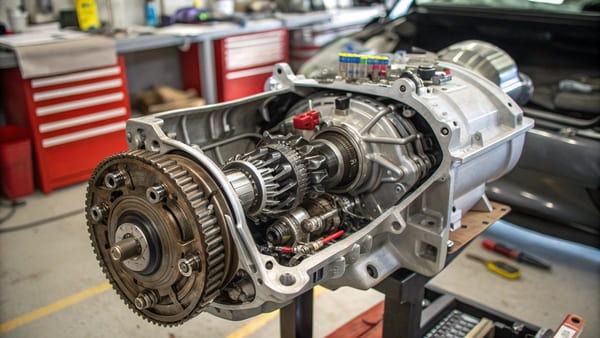
The transmission is one of the most incredible pieces of engineering in a modern vehicle. But for businesses like yours and mine, its complexity isn't just an academic point; it's a daily business challenge. Understanding what's inside is the first step to sourcing or manufacturing parts that won't fail your customers. Let's break it down piece by piece so you can have more confident conversations with your suppliers and clients.
What Is A Car Transmission And How Does It Work?
Explaining a transmission to a client can be tough. Its "black box" nature makes it hard to discuss parts. This can hurt trust and make sales difficult.
A car transmission is a gearbox that uses a set of gears to change the speed and torque delivered from the engine to the wheels.%%%FOOTNOTE_REF3%%% [It allows the engine to operate at its most efficient RPM range, regardless of the vehicle's speed.](https://en.wikipedia.org/wiki/Transmission(mechanical_device))4
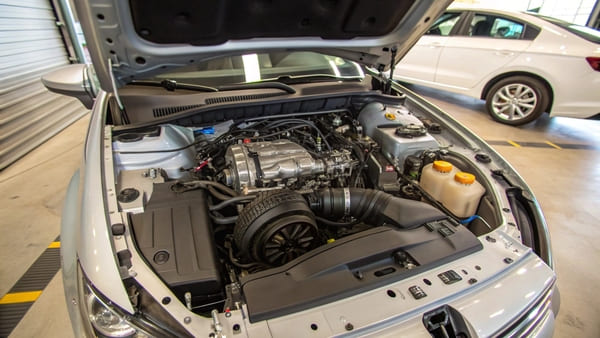
Think of a transmission like the gears on a multi-speed bicycle. When you start pedaling, you use a low gear. It's easy to pedal, but you don't go very fast. This is like first gear in a car—it gives you high torque to get the car moving. As you pick up speed on the bike, you shift to higher gears. Pedaling becomes harder, but each rotation takes you much farther. This is like the higher gears in your car, used for cruising at high speeds on the highway.
The transmission’s job is to manage this process. It takes the power from the engine and, using different gear ratios, adjusts it for different situations.
How It Manages Power
The engine produces power most efficiently within a specific range of revolutions per minute (RPM). The transmission ensures the engine can stay in this sweet spot.
- Low Gears: Provide more torque to the wheels for acceleration from a stop or for climbing hills.
- High Gears: Provide less torque but allow the wheels to spin faster for the same engine RPM, which is perfect for fuel-efficient highway cruising.
This entire process relies on a collection of internal parts working in perfect harmony, from the main gears and shafts to the clutches that engage and disengage them.
Where Are The Transmission Parts Located In A Vehicle?
Can't find the transmission? It's hidden away, making inspection and part identification difficult. This can slow down your repair or manufacturing process, costing you time and money.
The transmission is typically located directly behind the engine. In front-wheel-drive (FWD) cars, it's part of a "transaxle" next to the engine.5 In rear-wheel-drive (RWD) cars, it's under the car's central tunnel, connected to the engine at the front.
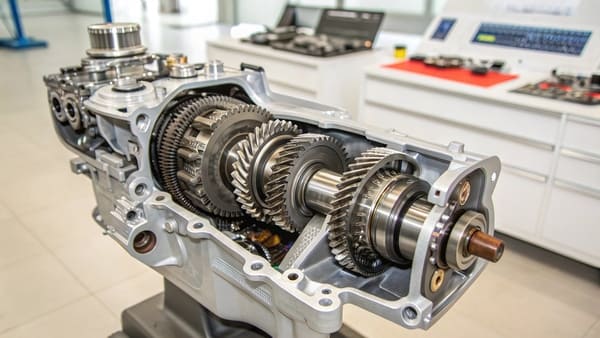
The exact location depends on the vehicle's drivetrain layout. But once you open the transmission case, you find a world of precision components packed tightly together. This is where the real manufacturing challenge begins. It’s not just about the big metal gears; even the smallest parts demand incredible precision.
The Challenge of Internal Components
Inside the transmission, you have gears, clutches, and shafts. But you also have smaller, often overlooked parts like seals, bearings, and plastic separators. As a manufacturer, I can tell you that these small parts are often the most difficult to produce correctly. The tolerances are extremely tight.6
A Manufacturing Lesson in Precision
I learned this the hard way on a project for a Pakistani client. We were tasked with producing the internal plastic separator components. These small parts are critical for keeping other components properly spaced and isolated within the transmission. The problem is that making them requires a very high-end injection molding machine. The precision needed is beyond what standard machines can deliver.
The cooling stage is the most difficult part of the process. If it's not controlled perfectly, the plastic can deform or shrink unevenly. On our first run for the client, the parts "shrank" more than we expected after cooling. I was worried we had failed. But when the client tested them, they found the slightly smaller, denser parts were actually a better fit for their assembly. It was a lucky break, but it taught me a valuable lesson about the microscopic precision required for these "simple" internal parts.
What Are The Different Types Of Car Transmissions?
The variety of transmission types is confusing. Sourcing parts for Manual, Automatic, CVT, and DCT can be a nightmare. Ordering the wrong component wastes time and money.
The main types are Manual (MT), Automatic (AT), Continuously Variable (CVT), and Dual-Clutch (DCT). Each uses different internal parts and mechanisms to transfer power, requiring specific components for manufacturing, repair, and replacement.7
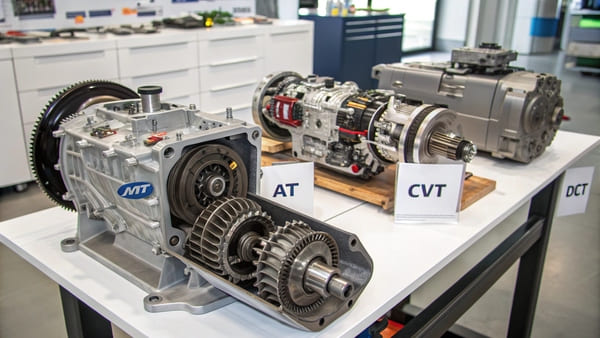
As a parts supplier or manufacturer, you must understand the key differences because each type has a unique bill of materials. A part for a traditional automatic will not work in a DCT. Knowing the fundamentals helps you source correctly and serve your customers better. Let's look at the main types and what makes them different from a parts perspective.
| Transmission Type | How It Works | Key Internal Parts |
|---|---|---|
| Manual (MT) | The driver manually selects gears using a clutch pedal and a gear stick. | Clutch, Flywheel, Pressure Plate, Gear Selector Forks, Synchros |
| Automatic (AT) | Uses a hydraulic system with a torque converter and planetary gearsets to shift gears automatically. | Torque Converter, Planetary Gearsets, Valve Body, Clutches, Bands |
| CVT | Uses a flexible belt or chain running between two variable-diameter pulleys to create infinite gear ratios. | Variable Pulleys, Steel Belt or Chain, Control Unit |
| Dual-Clutch (DCT) | An automated manual transmission with two separate clutches for odd and even gear sets, allowing for rapid shifts. | Dual-Clutch Pack, Mechatronics Unit, Two Mainshafts |
Each of these systems requires a completely different set of engineering and manufacturing capabilities. For our business, this means maintaining separate supply chains and quality control processes for AT torque converters, DCT mechatronics units, and CVT belts. Understanding this diversity is fundamental to being a reliable partner in the automotive parts industry.
Conclusion
Understanding transmission parts is crucial for sourcing reliable components. From gears to precision plastics, every detail matters for performance and durability. We can help you navigate this complexity.
"Chapter 10 Automotive Clutches, Transmissions, and ...", https://media.defense.gov/2014/jun/20/2002655906/-1/-1/1/140620-n-zz182-6550.pdf. Automotive engineering textbooks and technical encyclopedias describe the main internal components of car transmissions, including gears, shafts, clutches, torque converters (for automatics), and valve bodies. Evidence role: definition; source type: encyclopedia. Supports: A transmission contains gears, shafts, clutches, a torque converter (in automatics), and a valve body.. Scope note: Descriptions may vary slightly depending on transmission type and vehicle model. ↩
"Transmission (mechanical device)", https://en.wikipedia.org/wiki/Transmission_(mechanical_device). Standard automotive engineering references explain that the transmission's function is to transfer power from the engine to the wheels, enabling changes in speed and direction. Evidence role: mechanism; source type: encyclopedia. Supports: These parts work together to transfer power from the engine to the wheels, allowing the vehicle to change speed and direction.. Scope note: General descriptions may not cover all specialized transmission designs. ↩
"Transmission function", https://en.wikipedia.org/wiki/Transmission_function. Automotive encyclopedias and textbooks define a car transmission as a gearbox that adjusts speed and torque from the engine to the wheels using gear sets. Evidence role: definition; source type: encyclopedia. Supports: A car transmission is a gearbox that uses a set of gears to change the speed and torque delivered from the engine to the wheels.. Scope note: Some modern transmissions (e.g., CVT) may not use traditional gears but serve the same function. ↩
"Transmission (mechanical device)", https://en.wikipedia.org/wiki/Transmission_(mechanical_device). Engineering textbooks explain that transmissions enable engines to run within their optimal RPM range by adjusting gear ratios, independent of vehicle speed. Evidence role: mechanism; source type: education. Supports: It allows the engine to operate at its most efficient RPM range, regardless of the vehicle's speed.. Scope note: Efficiency ranges may vary by engine and transmission design. ↩
"Transaxle", https://en.wikipedia.org/wiki/Transaxle. Automotive engineering sources describe that in FWD vehicles, the transmission and differential are combined into a transaxle located beside the engine. Evidence role: definition; source type: encyclopedia. Supports: In front-wheel-drive (FWD) cars, it's part of a "transaxle" next to the engine.. Scope note: Some FWD designs may vary, but the transaxle configuration is standard. ↩
"Precision International", https://transmissionkits.com/. Manufacturing engineering literature notes that transmission components require extremely tight tolerances to ensure proper function and durability. Evidence role: expert_consensus; source type: education. Supports: The tolerances are extremely tight.. Scope note: The exact tolerances may vary by part and manufacturer. ↩
"Transmission (mechanical device)", https://en.wikipedia.org/wiki/Transmission_(mechanical_device). Automotive engineering sources explain that different transmission types use distinct internal mechanisms and parts, necessitating specific components for each type. Evidence role: mechanism; source type: education. Supports: Each uses different internal parts and mechanisms to transfer power, requiring specific components for manufacturing, repair, and replacement.. Scope note: Some parts may be similar across types, but core mechanisms differ. ↩