-Confused by car body parts after a minor accident? Getting the terms wrong can be a costly mistake. This guide makes it simple to tell a bumper from a fender.
A car bumper is located at the very front and rear of your vehicle to absorb impact in a collision%%%FOOTNOTE_REF1%%%. [A fender is the panel on the side of the car, positioned over the front wheels, which prevents mud and debris from being thrown by the tires](https://en.wikipedia.org/wiki/Fender(vehicle))2.
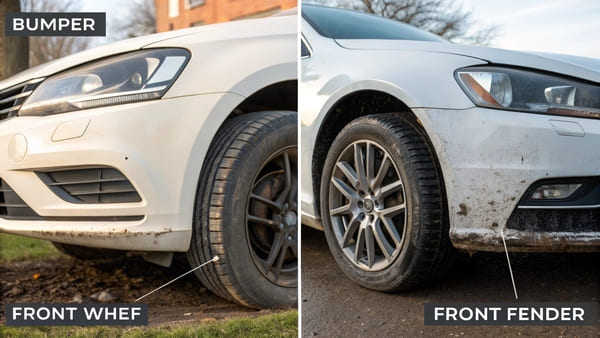
It's easy to get these two parts mixed up, especially when talking to a mechanic or looking for replacement parts online. Both are critical components of your car's exterior, but they serve very different purposes and are located in different areas. Understanding this difference is the first step to getting the right repair done correctly. Let's dive deeper into what each part does, how they are made, and how you can easily tell them apart, so you can approach your next repair with confidence.
What Is a Car Bumper and What Does It Do?
Worried about that damaged plastic piece at the front of your car? That's your bumper, and it’s designed for safety. Knowing its true function helps you understand the repair needed.
A car bumper is a structure attached to the front and rear of a vehicle. Its primary job is to absorb the shock from a low-speed collision, protecting more critical and expensive components like the radiator, engine, and frame, as well as the vehicle's occupants3.
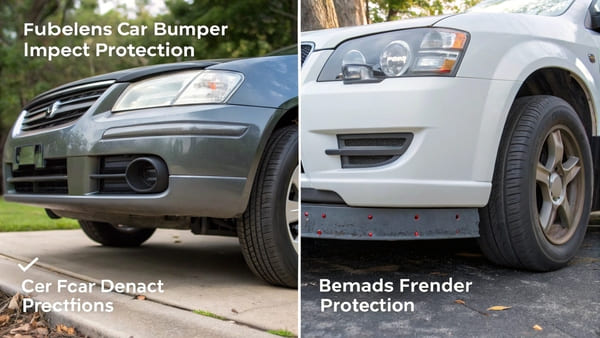
When most people say "bumper," they are actually referring to the bumper cover. This is the painted plastic part you see on the outside. But a modern bumper system is more complex. Behind that cover, there is an energy absorber, usually made of foam or a plastic honeycomb structure. Behind that is the actual bumper beam or reinforcement bar, a strong metal structure bolted to the vehicle's frame. This layered system is engineered to crumple and absorb impact energy.
As a manufacturer, we know making these plastic bumper covers is incredibly difficult. It requires high-precision injection molding machines. Standard machines just can't meet the quality standards. The process has several steps, but the hardest part is cooling. I remember our first project for a client from Pakistan. We were new to this specific type, and after cooling, the bumper covers had some serious "shrinkage." We were worried, but the client ended up loving the slightly different look. We learned a huge lesson and perfected our process, so it never happened again.
What Is a Fender on a Car and What Is Its Purpose?
Noticed a dent or scratch over your front wheel well? That's likely your fender. It's more than just a piece of metal; it plays a key role in protection.
A fender, sometimes called a wing in the UK, is the part of a car's body that frames the wheel well. Its main purpose is to prevent mud, rocks, water, and other road debris from being thrown into the air by the rotating tire4.
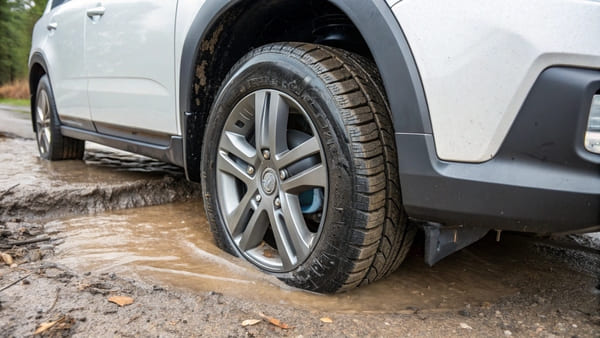
Fenders are found on both sides of the front of your car, extending from the front bumper to the front door. They protect the engine compartment from debris, prevent projectiles from hitting other vehicles or pedestrians, and also contribute to the car's aerodynamics. While rear fenders exist, they are usually integrated into the main body of the car and are called quarter panels. The bolt-on front fender is what people typically refer to when they use the term.
Just like bumpers, producing high-quality plastic or composite fenders is a technical challenge. They also demand high-precision injection molding to ensure a perfect fit against the hood, bumper, and door. Any small error in the manufacturing process can lead to ugly gaps or alignment issues. The cooling stage is again the most critical step. Another major difficulty is adding color. To add color pigments, the machine has to be stopped and the mold opened. This interruption makes the cooling process very tricky. If not managed perfectly, it can cause warping or defects in the final part. This is why specialized factories, like those in the Shanghai or Fujian coastal areas, excel at making them, while machines from other regions often fall short of the required precision.
What Is the Difference Between a Car Bumper and a Fender?
Still struggling to tell them apart when looking at your car? Getting it right is key to ordering the correct part and ensuring a proper fit during repairs.
The key difference is location and function. Bumpers are at the absolute front and rear for impact protection. Fenders are on the sides, over the wheels, to block road debris. You cannot mistake one for the other once you know where to look.
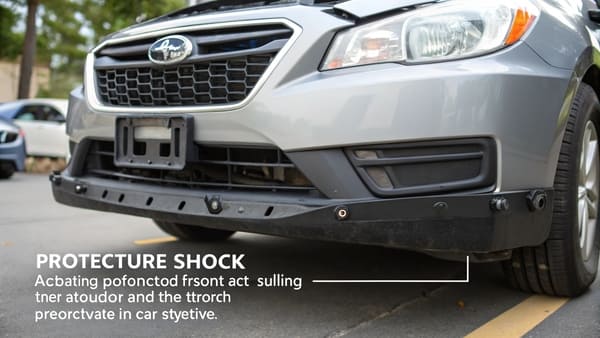
To make it even clearer, let's break down the differences in a simple table. As a supplier, we deal with these distinctions every day. The manufacturing precision required for both parts is extremely high, but for different reasons. The bumper needs to meet safety standards for impact absorption5, while the fender needs perfect dimensional accuracy to align with several other body panels.
Here is a simple breakdown:
| Feature | Car Bumper | Car Fender |
|---|---|---|
| Location | Front-most and rear-most part of the vehicle. | On the sides, arching over the front wheels. |
| Primary Function | Absorb impact energy in a low-speed collision. | Prevent mud, rocks, and debris from being thrown by tires. |
| Common Materials | Plastic cover, foam absorber, metal reinforcement bar. | Steel, aluminum, or plastic/composite materials. |
| Common Damage | Scuffs, cracks, dents from front or rear impacts. | Dents, scratches from side impacts or parking mishaps. |
| Manufacturing Note | Complex injection molding for cover; safety-critical. | High-precision molding needed for perfect fit with other panels. |
The manufacturing process for both involves at least three major stages. But it's that cooling stage that separates a good part from a bad one. The high-precision machines required for this job are not common. They have to control temperature perfectly to prevent the plastic from warping or shrinking unevenly, which would ruin the part's fit. This is why we've invested so heavily in advanced machinery and training. It allows us to deliver parts that fit perfectly, every single time.
Conclusion
In short, bumpers are for bumps, and fenders fend off debris. Knowing this simple difference helps you identify damage correctly and communicate clearly with your mechanic or parts supplier.
"Bumper (car)", https://en.wikipedia.org/wiki/Bumper_(car). According to the National Highway Traffic Safety Administration (NHTSA), car bumpers are designed to absorb impact in low-speed collisions and are located at the front and rear of vehicles. Evidence role: definition; source type: government. Supports: A car bumper is located at the very front and rear of your vehicle to absorb impact in a collision.. Scope note: NHTSA regulations primarily address passenger vehicles in the United States; bumper design and regulations may vary internationally. ↩
"Fender (vehicle)", https://en.wikipedia.org/wiki/Fender_(vehicle). Automotive encyclopedias and repair manuals describe the fender as the body panel over the wheel well, designed to prevent road debris from being thrown by the tires. Evidence role: definition; source type: encyclopedia. Supports: A fender is the panel on the side of the car, positioned over the front wheels, which prevents mud and debris from being thrown by the tires.. Scope note: Some regions use different terminology, such as 'wing' in the UK. ↩
"Bumper (car)", https://en.wikipedia.org/wiki/Bumper_(car). The Insurance Institute for Highway Safety (IIHS) and NHTSA state that bumpers are intended to absorb energy in low-speed collisions to protect vehicle components and reduce repair costs. Evidence role: mechanism; source type: government. Supports: Its primary job is to absorb the shock from a low-speed collision, protecting more critical and expensive components like the radiator, engine, and frame, as well as the vehicle's occupants.. Scope note: Bumpers are not designed to protect occupants in high-speed crashes; their main role is to minimize vehicle damage in minor impacts. ↩
"I thought fenders would protect me/my stuff from dirt.", https://www.reddit.com/r/bicycling/comments/2wfa0e/i_thought_fenders_would_protect_memy_stuff_from/. Automotive engineering sources explain that fenders are designed to block debris from being projected by the tires, protecting the vehicle and other road users. Evidence role: mechanism; source type: education. Supports: Its main purpose is to prevent mud, rocks, water, and other road debris from being thrown into the air by the rotating tire.. Scope note: The effectiveness depends on fender design and vehicle type. ↩
"EVALUATION OF THE BUMPER STANDARD", https://crashstats.nhtsa.dot.gov/Api/Public/Publication/805866. NHTSA regulations require that bumpers meet specific standards for impact absorption in low-speed collisions to minimize vehicle damage. Evidence role: expert_consensus; source type: government. Supports: The bumper needs to meet safety standards for impact absorption.. Scope note: These standards apply primarily to passenger vehicles in the United States. ↩