Confused about the two big finned things behind your car's grille? You're not alone. Let's clear up the confusion so you can understand your car's cooling systems better.
No, a car radiator and an AC condenser are not the same part. The radiator's job is to cool the engine's coolant to prevent overheating.%%%FOOTNOTE_REF1%%% [The AC condenser's job is to cool the refrigerant for your air conditioning system.](https://en.wikipedia.org/wiki/Condenser(heat_transfer))2 They are two separate systems that just happen to sit next to each other.3
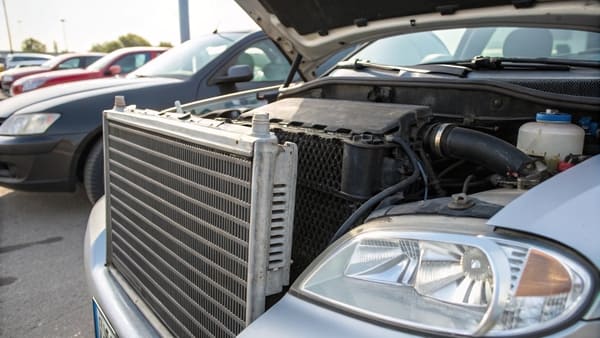
Now that we know they're different, it's easy to see why people get them mixed up. They look very similar and are packed tightly together at the front of the car. To really get it, we need to look at what each one does on its own. Let's break down their unique jobs and see why their teamwork is so important for your car's health and your comfort.
What Is a Car Radiator and What Does It Actually Do?
Your engine generates a massive amount of heat while running. If that heat isn't managed, it can destroy your engine. The radiator is your engine's most important defense against overheating.
A car radiator is a type of heat exchanger designed specifically to cool down the antifreeze/coolant mixture that circulates through your engine block.%%%FOOTNOTE_REF4%%% [It works by transferring the heat from this hot liquid into the surrounding air, keeping your engine at its ideal operating temperature.](https://en.wikipedia.org/wiki/Radiator(engine_cooling))5
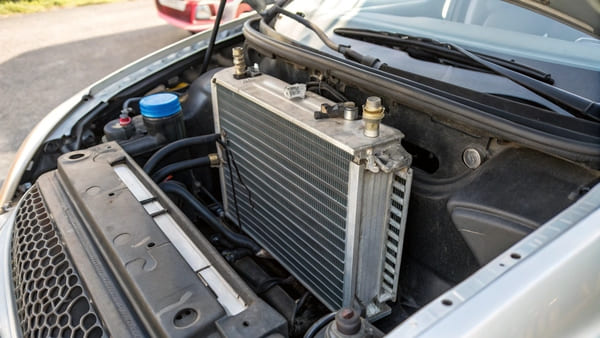
The process is simple but critical. Hot coolant, having absorbed heat from the engine, flows into the radiator. It travels through a series of thin tubes that are covered in small fins. These fins dramatically increase the surface area, allowing air passing through the grille to draw heat away much more effectively. A large fan, either engine-driven or electric, helps pull more air through the radiator, especially when you're stopped in traffic.6 Once the coolant has been cooled, it flows back to the engine to absorb more heat, and the cycle continues. The plastic tanks on the sides or top and bottom of the radiator are also crucial. Manufacturing these parts is surprisingly difficult. The plastic must withstand high temperatures and pressure, and the injection molding process requires extreme precision that standard machines often can't deliver.7 It's a specialized job.
Key Components of a Radiator System
| Component | Function |
|---|---|
| Core (Tubes & Fins) | The main body where heat exchange happens. |
| Inlet/Outlet Tanks | Plastic tanks that distribute coolant and connect to hoses. |
| Radiator Cap | Pressurizes the system to raise the coolant's boiling point. |
| Coolant | The fluid that absorbs and transports heat from the engine. |
What Is an AC Condenser and Why Is It Important?
Trying to drive on a hot summer day without a working air conditioner is miserable. Your comfort inside the car depends heavily on the AC system, and the condenser is a star player.
The AC condenser is also a heat exchanger, but it serves the air conditioning system, not the engine.8 It receives hot, high-pressure refrigerant gas from the AC compressor and cools it down until it condenses into a high-pressure liquid.9
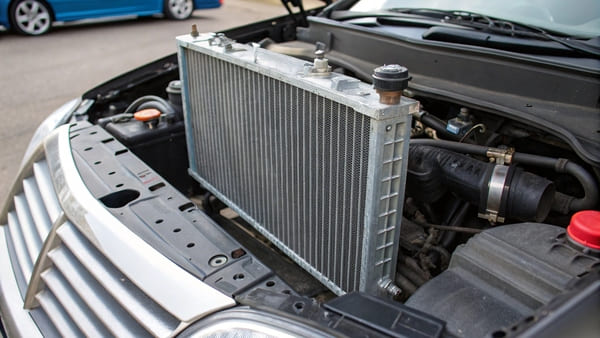
Think of the condenser as the radiator for your AC. After the compressor squeezes the refrigerant into a hot gas, that gas has to release its heat somewhere. The condenser is placed at the very front of the car, right behind the grille, so it gets the first and coolest blast of oncoming air.10 As air flows over its fins and tubes, the heat is pulled out of the refrigerant, causing it to change from a gas back into a liquid. This cooled, high-pressure liquid is now ready for the next step in the cycle, which ultimately creates cold air in your cabin. Just like with radiators, the manufacturing of condenser components is a high-precision task. The process involves several complex steps, with the cooling of the molded plastic parts being the most challenging. The machines needed for this level of accuracy are usually found in specialized factories in coastal regions like Fujian or near Shanghai, as typical machines often can't meet the tight tolerances required.
Are the Radiator and AC Condenser the Same Thing or Completely Different Systems?
They look alike and live in the same neighborhood, so it's a fair question. This confusion can lead to ordering the wrong part or misdiagnosing a problem. Let's finally put the question to rest.
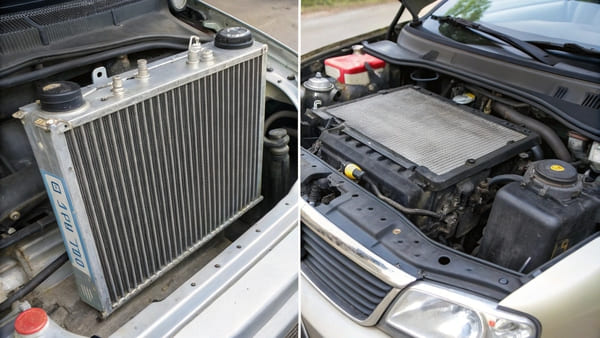
They are completely different systems performing separate functions. The radiator is for engine health, and the condenser is for passenger comfort. They are only packaged together to take advantage of the same airflow coming through the car's front grille.11
I learned a lot about this distinction hands-on. I remember the first time our factory produced plastic fittings for these cooling systems for a new client from Pakistan. We were still refining our process. After injection molding, the plastic parts "shrunk" a little more than the specifications predicted during the critical cooling phase. I was worried we had made a mistake. However, the client tested the parts and found that the slightly tighter fit was actually better for their application! It was a lucky break, but it taught us a valuable lesson about the extreme sensitivity of the cooling process. This is also why adding colors is tricky; the machine must be stopped and the mold opened, which complicates the cooling stage and can affect the final dimensions. It really highlighted that making these parts isn't just about molding plastic; it's a science that requires specialist knowledge and equipment.
Radiator vs. AC Condenser: A Quick Comparison
| Feature | Car Radiator | AC Condenser |
|---|---|---|
| Function | Cools engine coolant | Cools AC refrigerant |
| Fluid Inside | Antifreeze / Coolant | Refrigerant (e.g., R-134a) |
| Typical Location | Behind the AC condenser | At the very front, behind the grille |
| Failure Consequence | Engine overheating, severe damage | No cold air from the AC |
Conclusion
The radiator cools your engine, while the condenser cools your AC system's refrigerant.12 They are separate parts that work together, and manufacturing their components requires specialized precision and expertise.
"Radiator (engine cooling) - Wikipedia", https://en.wikipedia.org/wiki/Radiator_(engine_cooling). A car radiator is designed to dissipate heat from the engine coolant, preventing engine overheating, as described in automotive engineering references. Evidence role: definition; source type: encyclopedia. Supports: The radiator's job is to cool the engine's coolant to prevent overheating.. ↩
"Condenser (heat transfer) - Wikipedia", https://en.wikipedia.org/wiki/Condenser_(heat_transfer). The AC condenser cools and condenses refrigerant vapor into liquid as part of the vehicle's air conditioning system, according to automotive HVAC sources. Evidence role: definition; source type: encyclopedia. Supports: The AC condenser's job is to cool the refrigerant for your air conditioning system.. ↩
"Internal combustion engine cooling - Wikipedia", https://en.wikipedia.org/wiki/Internal_combustion_engine_cooling. Automotive engineering diagrams show that the radiator and AC condenser are distinct systems, typically mounted adjacent to each other for airflow efficiency. Evidence role: general_support; source type: education. Supports: They are two separate systems that just happen to sit next to each other.. Scope note: Exact placement may vary by vehicle model. ↩
"Heat exchanger - Wikipedia", https://en.wikipedia.org/wiki/Heat_exchanger. A car radiator is classified as a heat exchanger that cools the engine coolant, as defined in automotive engineering literature. Evidence role: definition; source type: encyclopedia. Supports: A car radiator is a type of heat exchanger designed specifically to cool down the antifreeze/coolant mixture that circulates through your engine block.. ↩
"Radiator (engine cooling) - Wikipedia", https://en.wikipedia.org/wiki/Radiator_(engine_cooling). Radiators transfer heat from engine coolant to ambient air via conduction and convection, maintaining optimal engine temperature, as explained in thermodynamics and automotive texts. Evidence role: mechanism; source type: education. Supports: It works by transferring the heat from this hot liquid into the surrounding air, keeping your engine at its ideal operating temperature.. ↩
"Fan clutch - Wikipedia", https://en.wikipedia.org/wiki/Fan_clutch. Radiator fans, whether engine-driven or electric, increase airflow through the radiator to enhance cooling, particularly at low vehicle speeds, as documented in automotive engineering sources. Evidence role: mechanism; source type: education. Supports: A large fan, either engine-driven or electric, helps pull more air through the radiator, especially when you're stopped in traffic.. ↩
"A Holistic Approach to Cooling System Selection and Injection ...", https://pmc.ncbi.nlm.nih.gov/articles/PMC9696673/. Automotive radiator plastic tanks are manufactured to withstand high temperatures and pressures, requiring precise injection molding techniques, as outlined in materials engineering studies. Evidence role: mechanism; source type: research. Supports: The plastic must withstand high temperatures and pressure, and the injection molding process requires extreme precision that standard machines often can't deliver.. Scope note: Specific manufacturing tolerances may vary by manufacturer. ↩
"Heat exchanger - Wikipedia", https://en.wikipedia.org/wiki/Heat_exchanger. An AC condenser is a heat exchanger used in automotive air conditioning systems to cool and condense refrigerant, as defined in HVAC engineering literature. Evidence role: definition; source type: encyclopedia. Supports: The AC condenser is also a heat exchanger, but it serves the air conditioning system, not the engine.. ↩
"Automotive air conditioning", https://en.wikipedia.org/wiki/Automotive_air_conditioning. The AC condenser cools high-pressure refrigerant gas from the compressor, causing it to condense into a liquid, as explained in automotive HVAC engineering sources. Evidence role: mechanism; source type: education. Supports: It receives hot, high-pressure refrigerant gas from the AC compressor and cools it down until it condenses into a high-pressure liquid.. ↩
"Air conditioning - Wikipedia", https://en.wikipedia.org/wiki/Air_conditioning. Automotive engineering diagrams indicate that the AC condenser is typically mounted at the front of the vehicle, behind the grille, to maximize exposure to incoming air. Evidence role: general_support; source type: education. Supports: The condenser is placed at the very front of the car, right behind the grille, so it gets the first and coolest blast of oncoming air.. Scope note: Placement may vary in some vehicle designs. ↩
"Radiator (engine cooling) - Wikipedia", https://en.wikipedia.org/wiki/Radiator_(engine_cooling). Radiator and AC condenser are commonly packaged together in the front of vehicles to optimize cooling by sharing airflow, as described in automotive engineering literature. Evidence role: mechanism; source type: education. Supports: They are only packaged together to take advantage of the same airflow coming through the car's front grille.. Scope note: Designs may differ across vehicle models. ↩
"Automotive air conditioning - Wikipedia", https://en.wikipedia.org/wiki/Automotive_air_conditioning. Automotive engineering sources confirm that the radiator cools engine coolant, while the AC condenser cools refrigerant for the air conditioning system. Evidence role: definition; source type: encyclopedia. Supports: The radiator cools your engine, while the condenser cools your AC system's refrigerant.. ↩