-Stuck with a car window that won't close? Bad weather is coming, and your interior is exposed. You need a fast, temporary fix to get your vehicle secure right now.
Yes, you can manually roll up a power window1. The most reliable method is to remove the interior door panel to access the window mechanism. From there, you can push the glass up by hand and secure it with tape or a wedge until you can get it repaired.
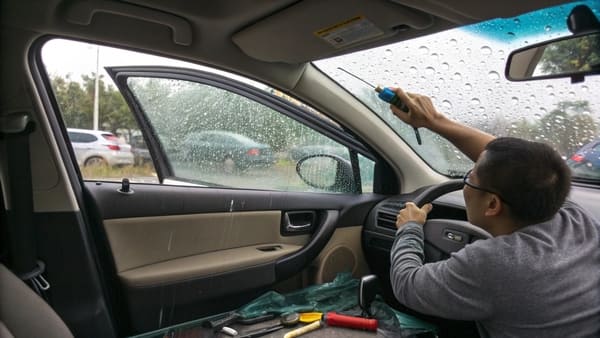
Getting that window up is your top priority. But before we jump into the step-by-step process, it helps to understand what might have gone wrong in the first place. Knowing the cause can help you figure out the best way to fix it, both for now and for the long term. Let's look at the common reasons a power window gets stuck and refuses to move.
Why Won't Your Power Window Roll Up?
You press the button, but nothing happens, or you just hear a grinding noise. A stuck power window can be caused by several different parts failing inside your door panel.
A power window usually fails because of a bad motor, a faulty switch, a blown fuse, or a broken window regulator2. The regulator, especially its plastic guide clips and cable holders, is a very common point of failure3 that causes the window to get stuck or fall down.
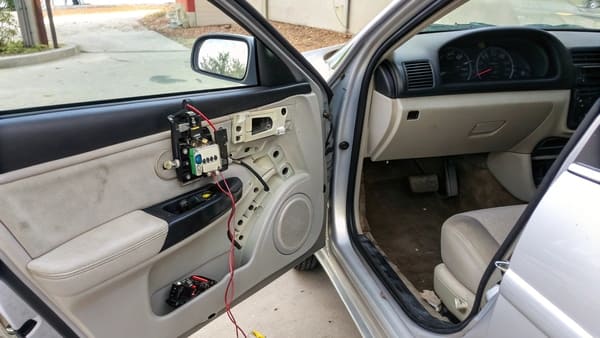
When a customer calls me about a window that won't go up, my first thought is to diagnose the problem by listening. Is there a sound when you press the switch? The answer tells you a lot. If you hear absolutely nothing, the problem is likely electrical4. If you hear a grinding, clicking, or whirring sound, the problem is almost certainly mechanical5. Let's break down the potential culprits.
Common Failure Points
| Part | Symptom When Failing | What It Means |
|---|---|---|
| Fuse | No sound or movement from any window switch. | The fuse protecting the window circuit has blown. This is a simple and cheap fix if it's the only issue. |
| Switch | Only one window won't work from its own switch. | The switch itself has worn out or has a bad connection. Sometimes it works from the master driver's panel. |
| Motor | A faint humming or clicking sound from inside the door. | The motor is receiving power but is too weak or has burned out and can't lift the heavy window glass. |
| Regulator | A loud grinding, popping, or crunching sound. | The mechanical parts, like the cables or plastic clips that lift the glass, have broken. The motor is spinning freely. |
The window regulator is the most common part to fail mechanically6. It's the assembly of arms, cables, and guides that does the actual lifting. Most modern regulators use plastic parts to guide the cables and hold the window glass7. These plastic components become brittle over time from heat and stress, and then they snap.
Can You Roll Up a Power Window Manually Without Removing the Door Panel?
Taking off a door panel seems like a lot of work. You're probably hoping for a quick fix that gets the window up without needing any tools. Is it even possible?
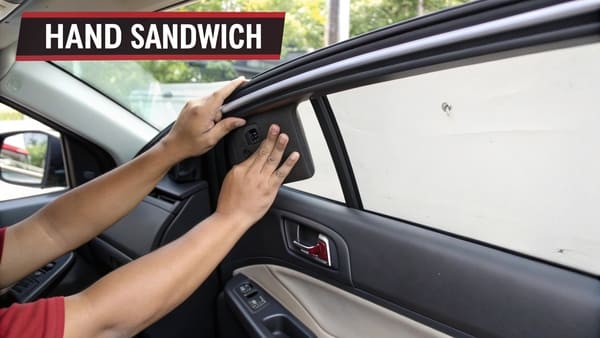
Sometimes, you can. You can try the "hand sandwich" method by pressing the window button up while pressing firmly on both sides of the glass and pulling upwards8. However, this only works if the motor is weak, not if the regulator is mechanically broken.
This quick fix is always worth a try before you start taking things apart. Have a friend help if you can. One person operates the "up" switch while the other places their palms flat on either side of the window glass. Squeeze the glass like you're making a sandwich and try to lift it straight up. If the motor is just weak or the tracks are a bit sticky, this extra help can be enough to get it closed.
However, if you hear a grinding noise when you hit the switch, this method will not work9. That noise means the regulator is broken. The plastic clips that attach the lifting cables to the window glass have likely snapped. When that happens, the motor and cables are just spinning freely inside the door. There is nothing physically connected to the glass to push it up. In this situation, the glass is completely loose on its track, and no amount of pulling will help. The only way to get it up is to go inside the door panel. It's important to understand that these plastic regulator clips look simple, but manufacturing them is extremely difficult. They require high-precision injection molding machines to get the dimensions just right10. If the part isn't cooled perfectly during production, it can shrink and become brittle, leading to premature failure.
How Do You Roll Up a Power Window Manually Step by Step?
The quick tricks didn't work, and you need to get that window closed now. It's time to open up the door panel. Don't worry, it's a more straightforward job than it sounds.
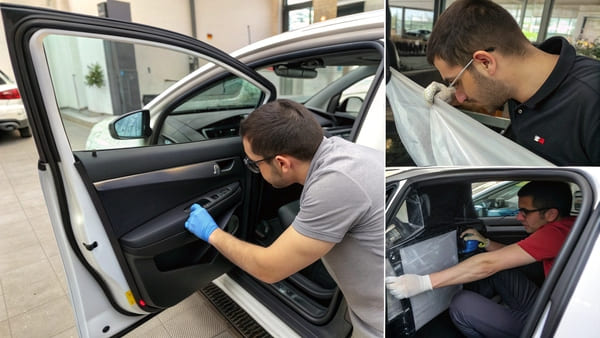
First, disconnect the battery for safety11. Then, carefully remove the door panel by finding and removing all screws and clips. Peel back the plastic weather barrier, push the window glass up by hand, and secure it with strong tape or a suction cup wedge.
This is the most reliable way to secure your car. You'll need a few basic tools: a Phillips head screwdriver, a flathead screwdriver, a plastic trim removal tool, and some strong tape (like duct tape).
1. Disconnect the Battery
Before you start unplugging electrical connectors in the door, it's always safest to disconnect the negative terminal of your car's battery. This prevents any accidental short circuits.
2. Remove the Door Panel
The screws holding the panel are often hidden. Look for them inside the door handle cavity, in the armrest pull cup, and sometimes along the bottom edge of the panel. Once all screws are out, use a plastic trim tool to gently pry the panel away from the door frame. It's held on by plastic clips that will pop out. Once loose, lift the panel up and off the windowsill. Be careful of the wires connected to the switches and speakers. Unplug them so you can set the panel aside.
3. Access the Window
You will now see a plastic or foam sheet covering the inside of the door. This is a weather and sound barrier. Carefully peel it back to expose the inside of the door cavity. You'll see the metal window regulator assembly.
4. Raise and Secure the Glass
Reach inside and grab the bottom of the window glass. You should be able to slide it up to the closed position. Once it's up, you need to secure it. You can run a few strips of strong duct tape over the top of the door frame and onto the glass on both sides. Or, you can wedge a suction cup tool against the glass to hold it up.
When you look inside, you'll see the regulator assembly. Pay attention to the plastic brackets that hold the glass. These are the parts that often break. I remember my first time manufacturing these parts for a client from Pakistan. The manufacturing process is incredibly precise. We had a problem where the plastic brackets were "shrinking" slightly after the cooling stage of the injection molding. The precision needed is immense; only certain factories, mostly around Shanghai or the Fujian coast, have machines that can do it right. Making colored parts is even harder because you have to open the mold to add the color powder, which disrupts the critical cooling cycle. Luckily, for that first Pakistani order, the slight shrinkage actually made for a tighter fit that the customer preferred. We learned a lot and have perfected the process since, but it shows how sensitive and complex these "simple" plastic parts really are.
Conclusion
Manually raising your window is a great temporary fix to protect your car. For a permanent solution, you'll need to replace the faulty part, which is often the entire window regulator assembly12.
"Power window - Wikipedia", https://en.wikipedia.org/wiki/Power_window. A neutral automotive repair guide confirms that it is possible to manually raise a power window by accessing the window mechanism inside the door and physically moving the glass, though this is a temporary solution until proper repairs are made. Evidence role: general_support; source type: encyclopedia. Supports: Yes, you can manually roll up a power window.. Scope note: This method may not work for all vehicle models or if the window is jammed due to severe mechanical failure. ↩
"5 Reasons Power Windows Not Working in Your Car & Cost to Fix", https://www.youtube.com/watch?v=bE4oB20lmTk. Automotive technical manuals and repair guides list common causes of power window failure as including faulty motors, switches, fuses, and window regulators. Evidence role: expert_consensus; source type: encyclopedia. Supports: A power window usually fails because of a bad motor, a faulty switch, a blown fuse, or a broken window regulator.. Scope note: The prevalence of each failure mode may vary by vehicle make and model. ↩
"My window regulator just suddenly broke, how does that ... - Reddit", https://www.reddit.com/r/genesiscoupe/comments/12oh6ls/my_window_regulator_just_suddenly_broke_how_does/. Automotive repair sources note that plastic guide clips and cable holders in window regulators are prone to wear and breakage, making them a frequent cause of power window malfunction. Evidence role: expert_consensus; source type: encyclopedia. Supports: The regulator, especially its plastic guide clips and cable holders, is a very common point of failure that causes the window to get stuck or fall down.. Scope note: Failure rates may differ depending on vehicle design and usage conditions. ↩
"How To Diagnose Power Window Problem - Is the Switch or Motor ...", https://www.youtube.com/watch?v=2tLmH05UKwk&vl=en. Automotive diagnostic guides explain that the absence of any sound when operating a power window switch often indicates an electrical issue, such as a blown fuse or faulty switch. Evidence role: mechanism; source type: encyclopedia. Supports: If you hear absolutely nothing, the problem is likely electrical.. Scope note: Other rare mechanical failures could also cause silence, but electrical faults are most common. ↩
"Car Window Makes Crackling Noise and Grinding When Going Up ...", https://www.youtube.com/watch?v=oXj9M7hvZug. Automotive repair manuals state that grinding, clicking, or whirring noises from inside the door when operating a power window typically indicate mechanical failure, such as a broken regulator or detached cable. Evidence role: mechanism; source type: encyclopedia. Supports: If you hear a grinding, clicking, or whirring sound, the problem is almost certainly mechanical.. Scope note: Some electrical faults can also produce noise, but mechanical issues are the primary cause of these sounds. ↩
"Window Regulators – When You Notice Them, There's Trouble", https://www.trakmotive.com/2024/12/19/podcast-window-regulators-when-you-notice-them-theres-trouble/. Automotive industry reports and repair statistics indicate that the window regulator is frequently the source of mechanical power window failures. Evidence role: statistic; source type: research. Supports: The window regulator is the most common part to fail mechanically.. Scope note: Exact failure rates may vary by manufacturer and model year. ↩
"(PDF) Automobile Window Regulator Paper - Academia.edu", https://www.academia.edu/42129834/Automobile_Window_Regulator_Paper. Automotive engineering sources describe that modern window regulators commonly incorporate plastic components for cable guides and glass holders to reduce cost and weight. Evidence role: historical_context; source type: education. Supports: Most modern regulators use plastic parts to guide the cables and hold the window glass.. Scope note: Some high-end or older vehicles may use metal parts instead. ↩
"Is there a way to manually roll up a power window? : r/MechanicAdvice", https://www.reddit.com/r/MechanicAdvice/comments/ykiqaa/is_there_a_way_to_manually_roll_up_a_power_window/. Automotive troubleshooting guides mention that assisting a weak power window motor by manually lifting the glass while pressing the switch can sometimes help close the window temporarily. Evidence role: case_reference; source type: encyclopedia. Supports: You can try the "hand sandwich" method by pressing the window button up while pressing firmly on both sides of the glass and pulling upwards.. Scope note: This method is only effective if the motor is weak but not if the regulator is broken. ↩
"Window grinding noise and alignment issue - Facebook", https://www.facebook.com/groups/44882731778/posts/10162838125526779/. Automotive repair sources explain that a grinding noise when operating a power window usually indicates a broken regulator, in which case manual assistance from outside the door will not raise the glass. Evidence role: mechanism; source type: encyclopedia. Supports: If you hear a grinding noise when you hit the switch, this method will not work.. Scope note: Rare exceptions may exist depending on the specific failure mode. ↩
"Automotive Injection Molding Company", https://advancedplastiform.com/industries/automotive-injection-molding/. Manufacturing engineering literature notes that producing precise plastic automotive components, such as window regulator clips, requires high-precision injection molding equipment to ensure dimensional accuracy and part reliability. Evidence role: mechanism; source type: education. Supports: They require high-precision injection molding machines to get the dimensions just right.. Scope note: The level of required precision may vary by part complexity and manufacturer standards. ↩
"When should I disconnect the battery to stay safe during repairs?", https://mechanics.stackexchange.com/questions/35764/when-should-i-disconnect-the-battery-to-stay-safe-during-repairs. Automotive safety guidelines recommend disconnecting the vehicle battery before working on electrical components, such as power windows, to prevent accidental short circuits or electric shock. Evidence role: expert_consensus; source type: education. Supports: First, disconnect the battery for safety.. Scope note: Some minor repairs may not require battery disconnection, but it is generally advised for safety. ↩
"Should I replace the power window motor or regulator or both?", https://www.reddit.com/r/Cartalk/comments/46dssl/should_i_replace_the_power_window_motor_or/. Automotive repair manuals state that when a window regulator fails, the recommended permanent fix is to replace the entire regulator assembly, as individual components are often not serviceable. Evidence role: expert_consensus; source type: encyclopedia. Supports: For a permanent solution, you'll need to replace the faulty part, which is often the entire window regulator assembly.. Scope note: Some vehicles allow for replacement of individual components, but full assembly replacement is most common. ↩