-Driving in a hot car without working AC is miserable. A 12-volt portable air conditioner seems like a simple fix, but choosing the right one can be confusing and frustrating.
The best 12-volt portable air conditioner is a unit that balances cooling power (BTU), energy consumption, and physical size for your specific vehicle.1 Look for models with a true compressor, durable housing, and features that match your needs, whether for a car, truck, or RV.
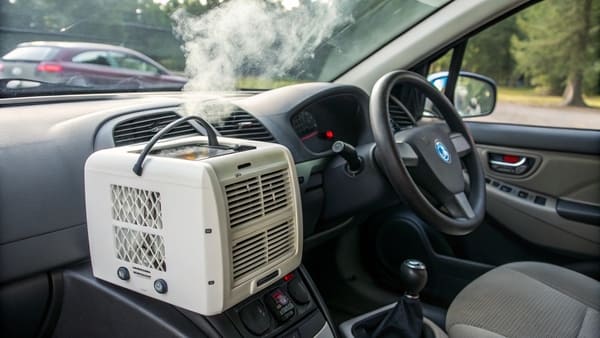
Finding the right portable AC is more than just picking one off a shelf. You need to understand what makes them work and what separates a good unit from a bad one. Let's dive into why these devices are becoming so popular and what you should look for. It's important to know the details before you invest in one.
Why Are 12 Volt Portable Air Conditioners Becoming So Popular?
That summer heat can make any vehicle feel like an oven. Idling your engine just to run the built-in AC is wasteful, noisy, and sometimes not even an option.2
Their popularity comes from their amazing convenience and efficiency. They provide targeted cooling without needing the car's engine to be on. This saves fuel, reduces noise, and makes them perfect for campers, truckers, and owners of cars with broken or non-existent AC systems.3
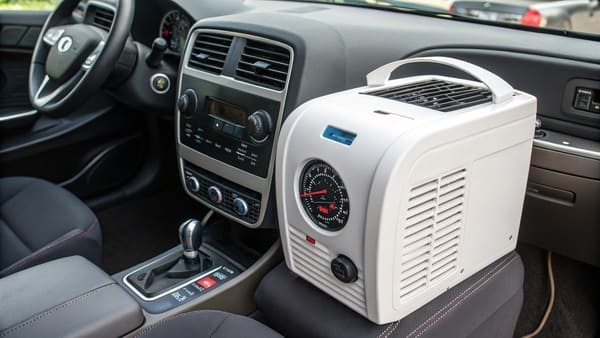
The rise in popularity isn't just about comfort; it's about a change in lifestyle and needs. More people are embracing "van life" and long road trips.4 Long-haul truck drivers need to rest comfortably in their sleeper cabs without idling their engines all night, which is costly and often against regulations.5 Even owners of classic cars, who don't want to perform major surgery to install a modern AC system, find these units to be a perfect, reversible solution. A 12V portable unit offers a practical answer to all these situations. It's a plug-and-play device that provides immediate relief exactly where you need it. The table below shows a simple comparison.
| Feature | Factory-Installed AC | 12V Portable AC |
|---|---|---|
| Fuel Use | Requires engine to run | Runs off the battery |
| Use While Parked | Inefficient and noisy | Ideal for stationary use |
| Portability | Fixed in the vehicle | Can be moved between vehicles |
| Installation | Built-in from factory | Simple plug-and-play |
| Best For | Cooling entire vehicle while driving | Targeted cooling, parked comfort |
How Does a 12V Portable Air Conditioner for a Car Actually Work?
You see these little boxes and might wonder if they're just glorified fans. You're skeptical they can actually produce genuinely cold air, and you don't want to get tricked.
A true 12V portable air conditioner works just like a miniature version of a home or car AC. It uses a compressor, refrigerant, and coils to actively pull heat from the air inside your car and vent it outside, producing genuinely cold air.6
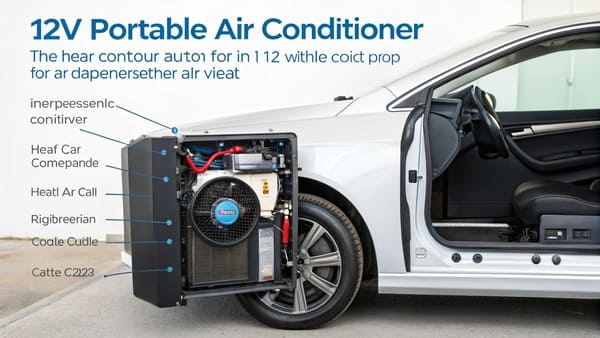
It’s important not to confuse a real portable air conditioner with an evaporative cooler, often called a "swamp cooler." Swamp coolers work by blowing air over a wet pad, which cools the air through evaporation but also adds humidity.7 A true 12V AC uses a proper refrigeration cycle, just like the big units. Here is a simple breakdown of the process:
- Compressor: This is the heart of the system. It takes a special gas, called a refrigerant, and pressurizes it, which makes it very hot.
- Condenser: The hot, high-pressure refrigerant gas flows through coils. A fan blows outside air across these coils, which removes the heat and causes the refrigerant to turn into a liquid. This is how the heat from your car is moved outside.
- Expansion Valve: The high-pressure liquid then passes through a tiny valve, causing its pressure to drop suddenly. This makes it expand and become an extremely cold liquid-gas mix.
- Evaporator: This cold mix flows through another set of coils inside the unit. A fan blows your car's cabin air over these cold coils. The air is chilled, and the refrigerant absorbs the heat, turning back into a gas. This cold air is then blown into your car, and the refrigerant gas goes back to the compressor to start the cycle all over again.
This continuous cycle is what allows a small box to provide significant cooling.
Can a 12 Volt Portable Air Conditioner Really Cool a Car Effectively?
You doubt that a small, plug-in device can really fight the intense heat inside a car. You may have wasted money on other car gadgets that promised a lot but delivered nothing.
Yes, a good quality 12V portable AC can effectively cool a small, enclosed space like a car cabin or sleeper berth. Its performance depends on the unit's cooling power (BTU), the outside temperature, and how well your vehicle is insulated.8 It excels at targeted cooling.9
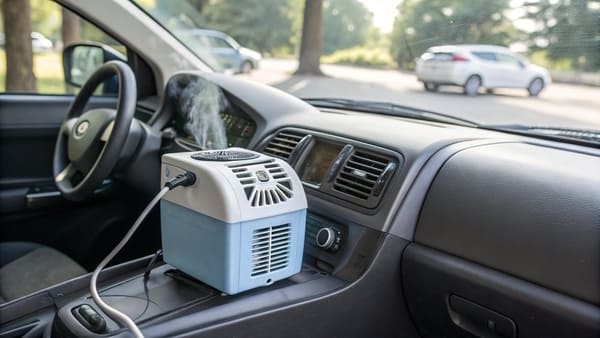
The word "effective" is key here. It won't turn your car into an icebox in seconds like a powerful factory system might. But it will absolutely lower the temperature in your immediate area, reduce humidity, and make a hot, stuffy space livable and comfortable. However, its effectiveness starts with how well the unit is built. From my own experience as a manufacturer, the plastic housing is one of an AC unit's most critical and surprisingly difficult parts to get right.
The precision required is extremely high. A standard injection molding machine just can't produce automotive AC plastic parts to the right standard. The process involves at least three stages, and the most difficult one by far is the cooling stage. The machines with this level of precision are usually found in coastal manufacturing hubs like Fujian or near Shanghai.10 Machines from other regions often can't meet the accuracy we need. Another tricky part is adding color. To add color powder, the machine has to stop, and the mold has to be opened. This makes the critical cooling process even harder to control.
I learned this the hard way on an early project with a client from Pakistan. We were making our first batch of these portable ACs, and after the injection molding, the plastic housings "shrank" a bit more than our calculations predicted during cooling. I was worried. But the client loved the result! He said the slightly smaller size looked more compact and sleek. It was a lucky break for us, but it was a huge lesson. We learned just how much control is needed over the cooling process to ensure every part is perfect. This is why a well-built unit is so important. A good housing means all internal components fit perfectly, preventing air leaks, reducing rattles, and maximizing cooling efficiency.11 A cheap, warped housing does the opposite and hurts performance.
Conclusion
A quality 12V portable air conditioner is an excellent solution for personal cooling in a vehicle.12 The best units balance power and size, are built with manufacturing precision, and offer real comfort.
"What is a good 12 volt air conditioner? - Facebook", https://www.facebook.com/groups/230357380752605/posts/1826400351148292/. Consumer and HVAC buying guides recommend evaluating portable air conditioners based on BTU rating, energy consumption, and size to match the needs of the intended space. Evidence role: expert_consensus; source type: other. Supports: The best 12-volt portable air conditioner is a unit that balances cooling power (BTU), energy consumption, and physical size for your specific vehicle.. Scope note: 'Best' is subjective and depends on user priorities and vehicle specifics. ↩
"[XLS] IdleBase: A Database of Idling Regulations", https://cleancities.energy.gov/files/docs/idlebox_idlebase_database.xlsx. Environmental agencies and transportation authorities report that vehicle idling increases fuel consumption, noise, and emissions, and is restricted or prohibited in many areas. Evidence role: statistic; source type: government. Supports: Idling your engine just to run the built-in AC is wasteful, noisy, and sometimes not even an option.. Scope note: Specific noise and fuel consumption levels depend on vehicle type and duration of idling. ↩
"Energy Conservation Standards for Portable Air Conditioners", https://www.federalregister.gov/documents/2020/01/10/2019-26350/energy-conservation-program-energy-conservation-standards-for-portable-air-conditioners. Government and industry sources confirm that portable 12V air conditioners can operate independently of a vehicle's engine, reducing fuel consumption and noise compared to idling for built-in AC use. Evidence role: mechanism; source type: government. Supports: They provide targeted cooling without needing the car's engine to be on. This saves fuel, reduces noise, and makes them perfect for campers, truckers, and owners of cars with broken or non-existent AC systems.. Scope note: Most sources discuss general use cases; effectiveness may vary by model and vehicle. ↩
"Van-dwelling - Wikipedia", https://en.wikipedia.org/wiki/Van-dwelling. Recent surveys and travel industry reports indicate a growing trend in van life and extended road trips, especially since the late 2010s. Evidence role: statistic; source type: other. Supports: More people are embracing "van life" and long road trips.. Scope note: Exact numbers may vary by region and year; trend is more pronounced in certain demographics. ↩
"IdleBase: A Database of Idling Regulations", https://cleancities.energy.gov/files/docs/idlebox_idlebase_database.xlsx. U.S. Department of Energy and transportation agencies note that anti-idling regulations exist in many regions, and portable air conditioning solutions are recommended for truck driver comfort during rest periods. Evidence role: historical_context; source type: government. Supports: Long-haul truck drivers need to rest comfortably in their sleeper cabs without idling their engines all night, which is costly and often against regulations.. Scope note: Regulations and recommendations may vary by country and state. ↩
"BEST PORTABLE 12v-48v A/C! "EcoFlow Wave 3" 6100 ... - YouTube", https://www.youtube.com/watch?v=-rQD-9onhFQ. Engineering textbooks and HVAC educational resources describe the refrigeration cycle in portable air conditioners, confirming that true compressor-based units use refrigerant and coils to transfer heat and produce cold air. Evidence role: mechanism; source type: education. Supports: A true 12V portable air conditioner works just like a miniature version of a home or car AC. It uses a compressor, refrigerant, and coils to actively pull heat from the air inside your car and vent it outside, producing genuinely cold air.. Scope note: Some portable units marketed as 'air conditioners' may use evaporative cooling instead; only compressor-based models match this description. ↩
"Evaporative Cooling Systems: How and Why They Work", https://extension.msstate.edu/publications/evaporative-cooling-systems-how-and-why-they-work. Encyclopedia and HVAC resources explain that evaporative coolers, or 'swamp coolers,' use evaporation to cool air and increase humidity in the process. Evidence role: mechanism; source type: encyclopedia. Supports: Swamp coolers work by blowing air over a wet pad, which cools the air through evaporation but also adds humidity.. Scope note: Effectiveness depends on ambient humidity; less effective in humid climates. ↩
"Why are portable air conditioners less efficient than outdoor ... - Reddit", https://www.reddit.com/r/heatpumps/comments/1e5q5rn/why_are_portable_air_conditioners_less_efficient/. HVAC educational resources and technical guides confirm that air conditioner performance is influenced by BTU rating, ambient temperature, and insulation quality of the cooled space. Evidence role: mechanism; source type: education. Supports: Its performance depends on the unit's cooling power (BTU), the outside temperature, and how well your vehicle is insulated.. Scope note: Exact performance will vary by specific unit and vehicle conditions. ↩
"portable air conditioner - Target", https://www.target.com/s/portable+air+conditioner. HVAC and consumer resources note that portable air conditioners are most effective for targeted or spot cooling rather than cooling large spaces. Evidence role: expert_consensus; source type: education. Supports: It excels at targeted cooling.. Scope note: Effectiveness is limited to the immediate area around the unit. ↩
"[PDF] China's Manufacturing Innovation Centers", https://nvlpubs.nist.gov/nistpubs/ams/NIST.AMS.600-17.pdf. Industry reports on Chinese manufacturing note that advanced injection molding and precision manufacturing facilities are concentrated in coastal regions such as Fujian and Shanghai. Evidence role: statistic; source type: research. Supports: The machines with this level of precision are usually found in coastal manufacturing hubs like Fujian or near Shanghai.. Scope note: Not all facilities in these regions have the same capabilities; general trend only. ↩
"Air Conditioning - Department of Energy", https://www.energy.gov/energysaver/air-conditioning. Engineering and HVAC design literature note that precise housing construction in air conditioning units is critical for component fit, minimizing air leaks, and optimizing cooling efficiency. Evidence role: mechanism; source type: education. Supports: A good housing means all internal components fit perfectly, preventing air leaks, reducing rattles, and maximizing cooling efficiency.. Scope note: Most sources discuss general HVAC design; specific data on 12V portable units may be limited. ↩
"12v Air Conditioner For Car - Amazon.com", https://www.amazon.com/12v-air-conditioner-car/s?k=12v+air+conditioner+for+car. Consumer reports and automotive publications indicate that high-quality 12V portable air conditioners can provide effective personal cooling in vehicles, especially in small, enclosed spaces. Evidence role: general_support; source type: other. Supports: A quality 12V portable air conditioner is an excellent solution for personal cooling in a vehicle.. Scope note: Performance varies by unit and vehicle size; not all models are equally effective. ↩