-Feeling the pain of high energy bills from your old, noisy air conditioner? The problem might be its outdated compressor. Modern systems use a smarter, more efficient technology inside.
A spiral compressor, also known as a scroll compressor, is a key component in modern HVAC systems that uses two interlocking spirals to compress refrigerant.1 It's popular because it's more efficient, quieter, and has fewer moving parts than older piston-style compressors, leading to better reliability.2
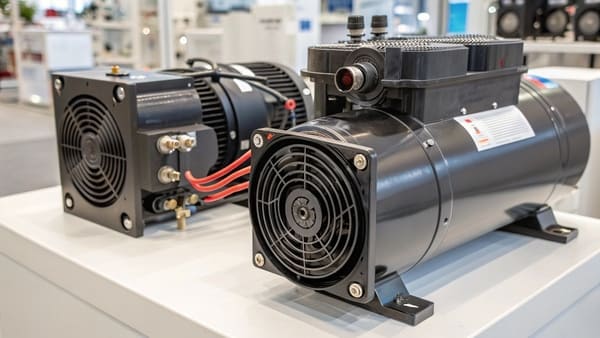
You might hear the terms "spiral" and "scroll" used for these compressors, and it can get a bit confusing. But understanding how they work and why they are better is key to appreciating your modern AC unit. Let's break it down further.
Is a Spiral Compressor the Same as a Scroll Compressor?
Have you ever felt lost in technical terms when looking at HVAC parts? The names "spiral" and "scroll" can be confusing. It's easy to wonder if you're missing something important.
Yes, a spiral compressor and a scroll compressor are exactly the same thing.3 "Scroll" is the more common and technically accurate term in the HVAC industry, while "spiral" is a descriptive term for its shape. They both refer to the same innovative compression technology.
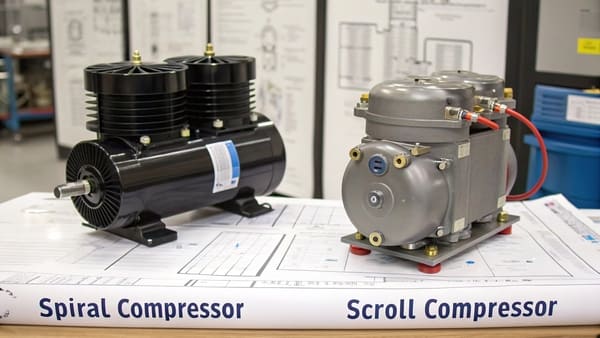
The names are interchangeable, but "scroll" is what you'll see in most technical manuals. The design involves two spirals, one fixed and one orbiting4, which is why the "spiral" description makes sense. But the real story is how hard these are to make. The precision needed for the plastic components is incredibly high. Standard injection molding machines just can't do it. I learned this the hard way. The machines capable of this work are usually found in specific coastal regions of China, like near Fujian or Shanghai. Machines from other areas, like Hebei, often don't meet the tight tolerances required. This precision is what makes the compressor work so well, but it's also why they are a manufacturing challenge. It's a delicate balance to get the parts perfect so they can perform reliably for years.
How Does a Spiral Compressor Work Inside an HVAC System?
Your AC hums along, but what's actually happening inside? A compressor seems complex. Without knowing how it works, you can't really see why it's better than older models.
A scroll compressor uses two spiral-shaped scrolls. One scroll stays stationary while the other orbits around it.5 This motion traps pockets of refrigerant gas at the outer edge, gradually pushing and compressing them toward the center.6 The compressed gas is then discharged through a port in the middle.
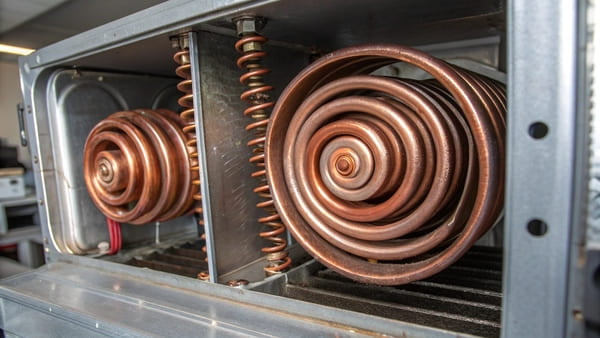
The process is continuous and smooth, unlike the start-stop motion of a piston.7 This is the secret to its quiet operation. Let's look at the steps:
| Step | Action | Result |
|---|---|---|
| 1. Intake | The orbiting scroll pulls refrigerant gas into the outer pockets. | Gas is trapped between the two scrolls. |
| 2. Compression | The orbiting motion makes the pockets smaller, moving them to the center. | The gas pressure and temperature increase. |
| 3. Discharge | The fully compressed gas is released from a port at the center. | High-pressure gas flows to the condenser. |
This elegant design is tough to produce. One of the hardest steps is cooling the molded parts. I remember a project with a client from Pakistan. We were making scroll compressor components, and after cooling, the parts "shrank" more than expected. I was worried, but the client actually preferred the result! We got lucky that time. Another tricky part is adding color pigments. You have to stop the machine and open the mold, which messes with the precise cooling cycle and can ruin the part's dimensions.
Why Are Spiral Compressors More Efficient Than Piston Compressors?
You always hear that new technology is "more efficient." But what does that actually mean for your HVAC system? It's just a buzzword until you see the real, practical advantages.
Spiral compressors are more efficient because they have fewer moving parts, leading to less friction and energy loss.8 Their continuous compression process avoids the energy wasted during the intake and discharge strokes of a piston compressor.9 This results in lower electricity consumption, quieter operation, and greater reliability.
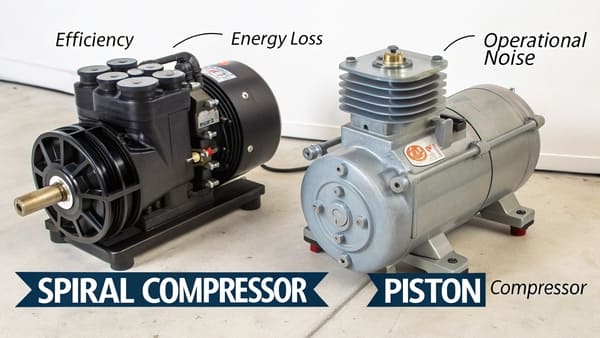
The difference in performance is significant. Piston compressors are an older technology with some built-in drawbacks. Scroll compressors were designed to overcome these issues. The biggest advantage is something called "volumetric efficiency."10 A scroll compressor doesn't have to deal with leftover gas expanding back into the chamber, a problem known as re-expansion loss that plagues piston designs.11 This means nearly all of its motion is used for useful compression.
Here is a simple breakdown:
| Feature | Spiral (Scroll) Compressor | Piston (Reciprocating) Compressor |
|---|---|---|
| Moving Parts | Very few (e.g., two scrolls) | Many (piston, connecting rod, valves) |
| Operation | Smooth, continuous orbiting | Pulsating, back-and-forth strokes |
| Noise & Vibration | Very low | High |
| Energy Efficiency | High | Moderate to low |
| Reliability | Excellent | Good, but more wear and tear |
That high efficiency and reliability all come back to manufacturing. If the scrolls aren't perfectly matched, the seal is lost, and efficiency plummets. This is why getting the molding, materials, and cooling just right is so critical.
Conclusion
In short, the spiral compressor is a superior technology that makes modern HVAC systems quieter, more reliable, and much more energy-efficient, saving you money in the long run.
"[PDF] Hybrid Compressor/Expander Module", https://www.eere.energy.gov/hydrogenandfuelcells/pdfs/ivb4_selecman.pdf. According to the U.S. Department of Energy and HVAC industry literature, scroll compressors use two interleaved spiral-shaped scrolls to compress refrigerant, and are widely used in modern air conditioning systems. Evidence role: definition; source type: government. Supports: A spiral compressor, also known as a scroll compressor, is a key component in modern HVAC systems that uses two interlocking spirals to compress refrigerant.. ↩
"[PDF] Computational Parametric Study of Scroll Compressor Efficiency ...", https://docs.lib.purdue.edu/cgi/viewcontent.cgi?article=1601&context=icec. Multiple engineering reviews and HVAC textbooks report that scroll compressors are generally more efficient, quieter, and have fewer moving parts than reciprocating (piston) compressors, contributing to improved reliability. Evidence role: expert_consensus; source type: education. Supports: it's more efficient, quieter, and has fewer moving parts than older piston-style compressors, leading to better reliability.. Scope note: While general consensus supports these advantages, specific performance may vary by model and application. ↩
"Scroll compressor - Wikipedia", https://en.wikipedia.org/wiki/Scroll_compressor. HVAC technical manuals and engineering encyclopedias confirm that 'spiral compressor' and 'scroll compressor' are interchangeable terms for the same technology, with 'scroll' being the industry standard nomenclature. Evidence role: definition; source type: encyclopedia. Supports: a spiral compressor and a scroll compressor are exactly the same thing.. Scope note: Some regional or trade literature may use the terms differently, but in HVAC they are synonymous. ↩
"[PDF] Structure Design of a Scroll Compressor Using CAE Analysis", https://docs.lib.purdue.edu/cgi/viewcontent.cgi?article=2742&context=icec. Engineering references and HVAC textbooks describe the scroll compressor design as consisting of one fixed and one orbiting spiral element. Evidence role: definition; source type: education. Supports: The design involves two spirals, one fixed and one orbiting.. ↩
"[PDF] A Comprehensive Model of Scroll Compressors Part I - Purdue e-Pubs", https://docs.lib.purdue.edu/cgi/viewcontent.cgi?article=2454&context=icec. Standard HVAC engineering texts explain that scroll compressors operate with one stationary and one orbiting spiral scroll to compress refrigerant. Evidence role: definition; source type: education. Supports: A scroll compressor uses two spiral-shaped scrolls. One scroll stays stationary while the other orbits around it.. ↩
"[PDF] Overall Scroll Compressor Modeling - Purdue e-Pubs", https://docs.lib.purdue.edu/cgi/viewcontent.cgi?article=2455&context=icec. HVAC engineering literature describes how the orbiting motion of the scroll traps refrigerant at the periphery and compresses it toward the center for discharge. Evidence role: mechanism; source type: education. Supports: This motion traps pockets of refrigerant gas at the outer edge, gradually pushing and compressing them toward the center.. ↩
"Scroll compressor - Wikipedia", https://en.wikipedia.org/wiki/Scroll_compressor. Engineering sources note that scroll compressors provide continuous, smooth compression, in contrast to the intermittent, reciprocating action of piston compressors. Evidence role: mechanism; source type: education. Supports: The process is continuous and smooth, unlike the start-stop motion of a piston.. Scope note: Actual smoothness may vary with design and application. ↩
"[PDF] Improvement of R410A Scroll Compressor Efficiency by Reduction ...", https://docs.lib.purdue.edu/cgi/viewcontent.cgi?article=2654&context=icec. HVAC engineering reviews indicate that scroll compressors' reduced number of moving parts results in lower friction and energy losses compared to reciprocating compressors, contributing to higher efficiency. Evidence role: mechanism; source type: education. Supports: Spiral compressors are more efficient because they have fewer moving parts, leading to less friction and energy loss.. Scope note: Efficiency gains depend on specific design and operating conditions. ↩
"[PDF] Application of Energy Efficient Scroll Compressor for Small Cars", https://docs.lib.purdue.edu/context/iracc/article/1735/viewcontent/IDR_2004_0110.pdf. Thermodynamics textbooks and HVAC engineering sources explain that scroll compressors' continuous compression reduces energy losses associated with the intake and discharge strokes found in piston compressors. Evidence role: mechanism; source type: education. Supports: Their continuous compression process avoids the energy wasted during the intake and discharge strokes of a piston compressor.. Scope note: The extent of energy savings may vary by system design. ↩
"[PDF] Comparative Studies of Scroll and Rotary Compressors for US ...", https://docs.lib.purdue.edu/cgi/viewcontent.cgi?article=3663&context=icec. HVAC engineering literature identifies high volumetric efficiency as a primary advantage of scroll compressors over reciprocating compressors. Evidence role: expert_consensus; source type: education. Supports: The biggest advantage is something called "volumetric efficiency.". Scope note: Actual volumetric efficiency depends on system design and operating conditions. ↩
"[PDF] An Analysis of Losses In Scroll Compressor - Purdue e-Pubs", https://docs.lib.purdue.edu/cgi/viewcontent.cgi?article=1619&context=icec. Thermodynamics and HVAC engineering sources explain that scroll compressors minimize re-expansion losses, which are common in reciprocating compressors due to residual gas in the compression chamber. Evidence role: mechanism; source type: education. Supports: A scroll compressor doesn't have to deal with leftover gas expanding back into the chamber, a problem known as re-expansion loss that plagues piston designs.. Scope note: The degree of re-expansion loss reduction may vary by compressor design. ↩