-Confused by the hundreds of parts in a car? This complexity makes it hard to know what's truly important. We'll simplify it for you, focusing on the essential components.
The most important parts of a car include the engine, transmission, chassis, and electrical system.1 The engine creates power, the transmission delivers it to the wheels, the chassis provides the structural frame, and the electrical system powers everything from the headlights to the onboard computer.2
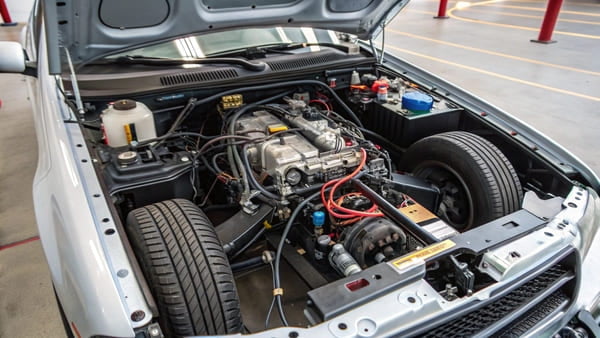
It's easy to get lost in the technical details of a vehicle. Every component seems important, but some are absolutely critical for the car to function safely and reliably. As a manufacturer, we deal with these parts every day, from the tiniest sensor to the largest body panel. Understanding the core components is the first step for anyone in the automotive industry, whether you are developing a new product line or sourcing parts for your business. In this article, we'll break down the most vital parts of a car, explain their functions in simple terms, and share some insights from our manufacturing experience.
What Are the Main Parts of a Car?
Struggling to picture how a car is put together? It's a complex puzzle of systems working in harmony. Let's look at the foundational pieces that form the complete vehicle.
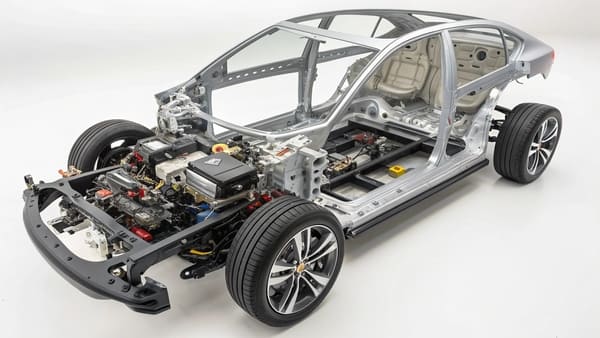
The main parts of a car are the chassis, the body, the engine, the drivetrain, the electrical system, and the interior.3 These systems work together to provide structure, power, control, and comfort, forming the complete vehicle we use every day.4
When we talk about the main parts, we're talking about the big picture. I've learned that even seemingly simple parts, like plastic components for the chassis or body, are incredibly difficult to manufacture correctly. Making core plastic automotive parts requires extremely high precision that standard injection molding machines just can't meet.5 The process involves multiple stages, and the cooling stage is by far the most challenging. I remember my first project with a client from Pakistan. We were producing core plastic components, and due to our inexperience at the time, the parts had a bit more "shrinkage" after cooling than the spec sheet called for. I was worried, but the client actually loved the result! It was a lucky break, and a valuable lesson in how material science and process control are everything in this business. High-precision machines, usually found in coastal regions like Fujian or near Shanghai, are essential for this work.6 Adding colors is also tricky because you have to stop, open the mold, and add the pigments, which complicates the cooling process even more.
| Main System | Key Components | Primary Function |
|---|---|---|
| Chassis & Body | Frame, suspension, wheels, axles, exterior panels | Provides structural support, holds everything together, and allows movement. |
| Engine & Drivetrain | Engine, transmission, driveshaft | Creates and delivers power to the wheels to make the car move. |
| Electrical System | Battery, alternator, wiring harness, ECU | Powers all electronics, from starting the engine to turning on the radio. |
| Interior | Seats, dashboard, controls, HVAC | Provides comfort, safety, and operational control for the driver and passengers. |
Which Car Parts Are Essential for Vehicle Performance?
Want to make a car handle better or feel faster? Simply adding power isn't the only answer. True performance comes from a balanced system of specialized components working together.
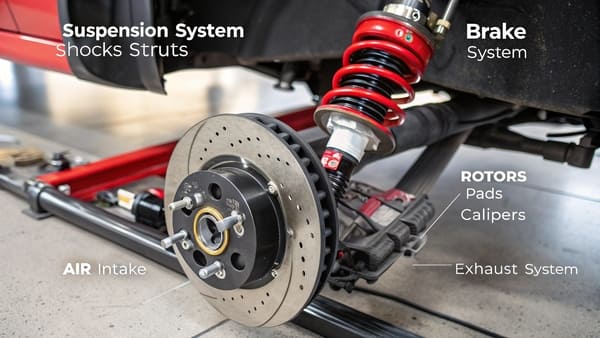
Parts essential for vehicle performance include the suspension system (shocks, struts, control arms), the brake system (rotors, pads, calipers), the air intake system, and the exhaust system.7 Upgrading these components improves handling, stopping power, and engine efficiency.8
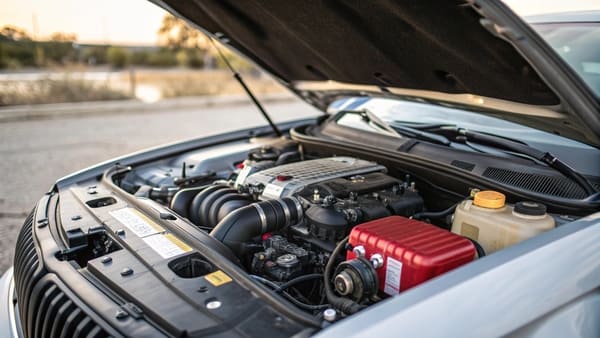
When we work with clients in the performance and aftermarket sector, the focus shifts from basic function to enhancement. It’s not just about making the car go; it’s about making it go better. A powerful engine is useless if the car can't stay on the road or stop quickly. That's why suspension and brakes are at the top of the list. The suspension system dictates how the car's tires connect with the road, affecting both comfort and handling. Upgrading parts like control arms and bushings, which we manufacture, can make a car feel much more responsive and stable in corners. Similarly, a high-performance brake system is a critical safety and performance upgrade. Better pads and rotors provide more consistent stopping power, especially under heavy use. Finally, helping the engine breathe better with an improved air intake system allows it to produce more power efficiently. It's a complete package.
| Performance System | Essential Parts | Impact on Performance |
|---|---|---|
| Suspension | Control arms, bushings, shocks, springs | Improves handling, cornering stability, and connection to the road. |
| Brakes | Performance rotors, brake pads, calipers | Increases stopping power, reduces brake fade, and enhances safety at high speeds. |
| Air Intake | High-flow air filter, intake manifold | Allows the engine to take in more air, increasing horsepower and throttle response. |
| Exhaust | Headers, catalytic converter, muffler | Helps waste gases exit the engine more efficiently, freeing up power. |
What Does the Engine Do in a Car?
Ever wonder what really happens when you press the gas pedal? It all starts with the engine, a complex machine designed for one main purpose: creating motion.
The engine is the heart of the car. It converts fuel and air into mechanical energy through a process called internal combustion.9 This energy creates a rotational force that is then sent to the wheels, making the car move forward.10
In the simplest terms, the engine is an air pump that explodes. It pulls in air, mixes it with a fine mist of fuel, compresses it, and ignites it with a spark. This tiny, controlled explosion pushes a piston down, which turns a crankshaft. This rotation is the power source for the entire vehicle. It sounds simple, but perfecting this process requires many supporting systems to work flawlessly. The ignition system must deliver a perfectly timed spark.%%%FOOTNOTE_REF11%%% [The cooling system must prevent the engine from overheating from all these explosions.](https://en.wikipedia.org/wiki/Radiator(engine_cooling))12 The fuel system must deliver the precise amount of gasoline or diesel. As a parts manufacturer, we supply many of these critical components, from ignition parts to cooling system components and electronic control modules that manage the whole process. Each part, no matter how small, plays a vital role in ensuring the engine runs smoothly, efficiently, and reliably for thousands of miles.
| Engine Support System | Key Components | Function |
|---|---|---|
| Ignition System | Spark plugs, ignition coils | Creates the high-voltage spark needed to ignite the air-fuel mixture. |
| Fuel System | Fuel pump, fuel injectors | Delivers the correct amount of fuel from the tank to the engine cylinders. |
| Cooling System | Radiator, water pump, thermostat | Circulates coolant to absorb and dissipate heat, preventing the engine from overheating. |
| Lubrication System | Oil pump, oil filter | Circulates engine oil to reduce friction between moving parts and help with cooling. |
Conclusion
Understanding a car's core parts—the engine, chassis, and performance systems—is key. This knowledge empowers better decisions for anyone in the automotive business, from manufacturing to sales.
"List of auto parts - Wikipedia", https://en.wikipedia.org/wiki/List_of_auto_parts. Automotive engineering textbooks and encyclopedias commonly identify the engine, transmission, chassis, and electrical system as the primary systems essential for a car's operation. Evidence role: expert_consensus; source type: encyclopedia. Supports: The most important parts of a car include the engine, transmission, chassis, and electrical system.. Scope note: This classification may vary slightly depending on vehicle type and technological advancements. ↩
"Chassis - Wikipedia", https://en.wikipedia.org/wiki/Chassis. Standard automotive engineering references describe the engine as generating power, the transmission as delivering it to the wheels, the chassis as providing structural support, and the electrical system as powering vehicle electronics. Evidence role: mechanism; source type: encyclopedia. Supports: The engine creates power, the transmission delivers it to the wheels, the chassis provides the structural frame, and the electrical system powers everything from the headlights to the onboard computer.. Scope note: Descriptions may be simplified for general audiences and may not cover all technical nuances. ↩
"List of auto parts", https://en.wikipedia.org/wiki/List_of_auto_parts. Automotive encyclopedias and educational resources typically list the chassis, body, engine, drivetrain, electrical system, and interior as the main parts of a car. Evidence role: definition; source type: encyclopedia. Supports: The main parts of a car are the chassis, the body, the engine, the drivetrain, the electrical system, and the interior.. Scope note: Some sources may group or name these systems differently depending on context or vehicle type. ↩
"Car Components 101: What Are Their Functions? | UTI", https://www.uti.edu/blog/automotive/car-components. Automotive engineering literature explains that the integration of structural, power, control, and comfort systems is fundamental to vehicle design and operation. Evidence role: mechanism; source type: education. Supports: These systems work together to provide structure, power, control, and comfort, forming the complete vehicle we use every day.. Scope note: The statement is a generalization and may not detail the specific interactions between systems. ↩
"Injection moulding - Wikipedia", https://en.wikipedia.org/wiki/Injection_moulding. Manufacturing research and industry reports indicate that producing core plastic automotive parts often requires high-precision injection molding beyond standard capabilities, due to strict tolerances and safety requirements. Evidence role: expert_consensus; source type: research. Supports: Making core plastic automotive parts requires extremely high precision that standard injection molding machines just can't meet.. Scope note: Precision requirements may vary depending on the specific part and manufacturer standards. ↩
"Automotive industry in China - Wikipedia", https://en.wikipedia.org/wiki/Automotive_industry_in_China. Industry analyses note that advanced manufacturing hubs for automotive parts, including high-precision plastic components, are concentrated in regions such as coastal China, including Fujian and Shanghai. Evidence role: case_reference; source type: research. Supports: High-precision machines, usually found in coastal regions like Fujian or near Shanghai, are essential for this work.. Scope note: The geographic distribution of high-precision manufacturing facilities may change over time and is not exclusive to these regions. ↩
"Car Components 101: What Are Their Functions? | UTI", https://www.uti.edu/blog/automotive/car-components. Automotive performance literature and educational resources identify the suspension, brake, air intake, and exhaust systems as key contributors to vehicle performance. Evidence role: expert_consensus; source type: education. Supports: Parts essential for vehicle performance include the suspension system (shocks, struts, control arms), the brake system (rotors, pads, calipers), the air intake system, and the exhaust system.. Scope note: Other systems may also influence performance depending on vehicle design and intended use. ↩
"How Suspension Upgrades Can Improve Your Vehicle Performance", https://postletire.com/how-suspension-upgrades-can-improve-your-vehicle-performance/. Automotive engineering studies and performance guides report that upgrading suspension, brake, air intake, and exhaust components can enhance handling, braking, and engine efficiency. Evidence role: general_support; source type: education. Supports: Upgrading these components improves handling, stopping power, and engine efficiency.. Scope note: The degree of improvement depends on the specific upgrades and vehicle context. ↩
"Internal combustion engine - Wikipedia", https://en.wikipedia.org/wiki/Internal_combustion_engine. Automotive textbooks and encyclopedias describe the engine as converting fuel and air into mechanical energy via internal combustion, serving as the primary power source for vehicles. Evidence role: definition; source type: encyclopedia. Supports: The engine is the heart of the car. It converts fuel and air into mechanical energy through a process called internal combustion.. Scope note: This definition applies to internal combustion engines and not to electric vehicles. ↩
"Torque converter - Wikipedia", https://en.wikipedia.org/wiki/Torque_converter. Engineering resources explain that the engine's mechanical energy is converted into rotational force (torque), which is transmitted to the wheels to propel the vehicle. Evidence role: mechanism; source type: education. Supports: This energy creates a rotational force that is then sent to the wheels, making the car move forward.. Scope note: The process may differ in hybrid or electric vehicles. ↩
"Ignition timing - Wikipedia", https://en.wikipedia.org/wiki/Ignition_timing. Automotive engineering texts state that the ignition system's primary function is to deliver a precisely timed spark to ignite the air-fuel mixture in the engine. Evidence role: mechanism; source type: education. Supports: The ignition system must deliver a perfectly timed spark.. Scope note: Modern engines may use electronic control for timing, and diesel engines use compression ignition instead. ↩
"Radiator (engine cooling) - Wikipedia", https://en.wikipedia.org/wiki/Radiator_(engine_cooling). Automotive engineering sources explain that the cooling system's role is to dissipate heat generated by combustion, preventing engine overheating. Evidence role: mechanism; source type: education. Supports: The cooling system must prevent the engine from overheating from all these explosions.. Scope note: The description is simplified and may not cover all aspects of engine thermal management. ↩