-Is your car's AC not blowing cold air? A faulty condenser might be the problem. Choosing the right replacement part can feel overwhelming, but it doesn't have to be.
To choose the right AC condenser, first verify it fits your car's make, model, and year. Then, check the material quality—aluminum is standard. Finally, decide between an OEM part for guaranteed compatibility or a high-quality aftermarket part from a trusted supplier for better value.

Choosing the right part is much easier when you understand its job inside your car. Knowing how an AC condenser works helps you appreciate why quality matters so much. Let's dive into what this essential component actually does for your vehicle's air conditioning system.
What Does an AC Condenser Do in a Vehicle?
You hear mechanics mention the "AC condenser," but what is it really? Not knowing its function can make you feel lost during repairs. I'll break it down for you.
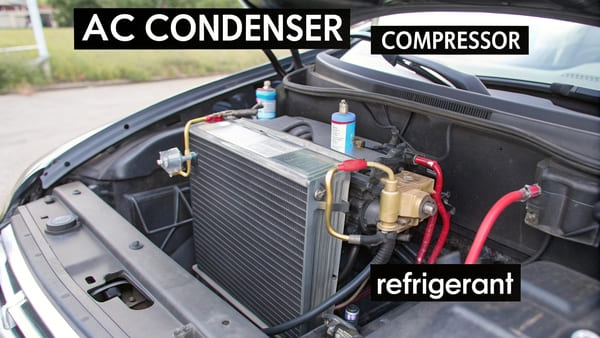
The AC condenser's main job is to release heat from the refrigerant. It takes the hot, high-pressure gas from the compressor and cools it down, turning it back into a high-pressure liquid.1 This is a critical step in the car's cooling cycle.
Let's go a bit deeper into how this works. Think of the AC system as a continuous loop. The condenser plays a vital role in one part of that loop.
The Condenser's Role in the AC Loop
After the AC compressor pressurizes the refrigerant, it becomes a very hot gas. This hot gas flows directly into the condenser. The condenser is usually located at the very front of the car, right in front of the engine's radiator.2 This position allows it to get maximum airflow when you are driving. When the car is stopped, a fan pulls air across it.
The condenser is made of long, winding tubes surrounded by thin metal fins. These fins increase the surface area, allowing it to release heat into the outside air much more efficiently.3 As the hot refrigerant gas flows through these tubes, the moving air cools it down. This cooling process causes the refrigerant to condense from a gas back into a liquid, hence the name "condenser."4 This cooled, high-pressure liquid is now ready for the next stage in the AC system.
Why Is the AC Condenser Important for Car Air Conditioning?
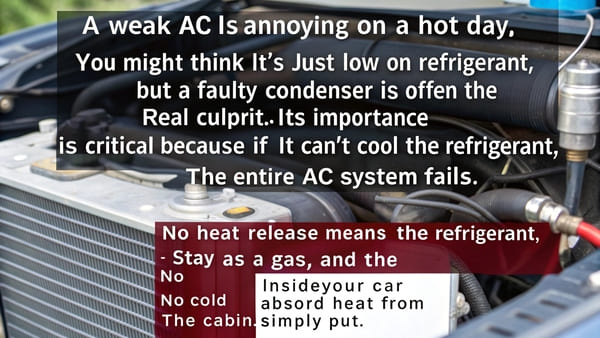
A weak AC is annoying on a hot day. You might think it's just low on refrigerant, but a faulty condenser is often the real culprit. Its importance is huge.
The condenser is critical because if it can't cool the refrigerant, the entire AC system fails.5 No heat release means the refrigerant stays as a gas, and the evaporator inside your car can't absorb heat from the cabin. Simply put, no condenser, no cold air.
The importance of the condenser is directly tied to its build quality. A cheap or poorly made part simply won't do the job right, leading to poor cooling performance and early failure.
Manufacturing Quality is Everything
From my experience as a manufacturer, making the plastic components for these condensers is incredibly difficult. It requires high-precision injection molding machines to meet automotive standards. If the precision isn't there, the parts won't fit right or hold up under pressure. The most difficult step is cooling the plastic parts correctly after they are molded.
I remember my first project making condenser kits for a client from Pakistan. We were still learning, and the plastic parts experienced some serious "shrinkage" after the cooling stage. I was worried we had failed. But the client actually preferred the slightly smaller, denser result! It was a lucky break, but it taught us a huge lesson in how critical it is to control every step of the cooling process. This is why the best factories for these high-precision parts are usually found in areas near Shanghai or in the Fujian province, where the technology and expertise are concentrated. Less precise machines, like those common in the Hebei region, often can't meet the strict requirements.
Is an AC Condenser the Same as a Car Radiator?
The AC condenser and the car radiator sit right next to each other and look very similar. This easily causes confusion when you're looking at parts. Let's clarify the key differences between them now.
No, they are different parts with separate jobs. The AC condenser cools the refrigerant for your air conditioning. The car radiator cools the antifreeze/coolant for your engine. They never mix fluids and belong to two completely different systems in your vehicle.6
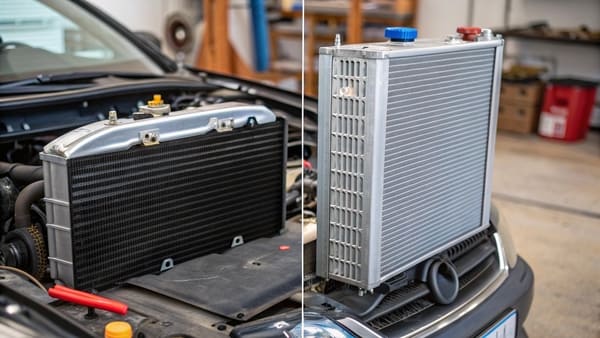
Although they both use airflow to cool a fluid, their specific functions, construction, and the systems they serve are completely separate. Understanding these differences helps you diagnose problems and buy the correct replacement part.
Key Differences at a Glance
Let's break it down in a simple table to make it clear.
| Feature | AC Condenser | Car Radiator |
|---|---|---|
| Function | Cools refrigerant for the AC system. | Cools engine coolant/antifreeze. |
| System | Air Conditioning System | Engine Cooling System |
| Fluid Handled | High-pressure refrigerant (e.g., R134a)7 | Water and antifreeze mixture |
| Operating Pressure | Very High (150-250 PSI or more) | Low (15-20 PSI) |
| Tube Design | Thinner tubes for phase change (gas to liquid) | Wider tubes for liquid-to-liquid heat transfer8 |
The high pressures in the AC system mean the condenser must be built to incredibly high standards.9 This brings us back to manufacturing. A small defect in a plastic end tank could cause a major refrigerant leak under pressure.10 Even something that seems simple, like adding color to the plastic parts, is a complex task. To add color powder, the machine has to stop and the mold must be opened. This action can disrupt the critical cooling stage, potentially creating weak spots if not managed by a highly experienced team.
Conclusion
Choosing the right AC condenser means checking compatibility and quality. Understanding its function and manufacturing challenges helps you select a reliable part that will keep your car cool for years.
"Air conditioning", https://en.wikipedia.org/wiki/Air_conditioning. According to automotive engineering references, the AC condenser functions to dissipate heat from the refrigerant, converting it from a high-pressure gas to a high-pressure liquid as part of the vehicle's air conditioning cycle. Evidence role: definition; source type: encyclopedia. Supports: The AC condenser's main job is to release heat from the refrigerant. It takes the hot, high-pressure gas from the compressor and cools it down, turning it back into a high-pressure liquid.. ↩
"Car Ac Condenser Cleaning ||#shorts Analysis 407", https://ojs.library.okstate.edu/osu/plugins/generic/pdfJsViewer/pdf.js/web/viewer.html?file=%2Fosu%2Findex.php%2Findex%2Flogin%2FsignOut%3Fsource%3D%2Eqq2%2Epics%2Fsml%2F&id=bhKpHv2fDEHnM8am9Lqi. Automotive repair manuals and engineering guides state that the AC condenser is typically mounted at the front of the vehicle, ahead of the radiator, to maximize airflow for heat dissipation. Evidence role: general_support; source type: encyclopedia. Supports: The condenser is usually located at the very front of the car, right in front of the engine's radiator.. ↩
"18.2 Heat Transfer From a Fin - MIT", https://web.mit.edu/16.unified/www/FALL/thermodynamics/notes/node128.html. Engineering sources explain that metal fins on heat exchangers, such as condensers, increase surface area to improve heat transfer efficiency. Evidence role: mechanism; source type: education. Supports: These fins increase the surface area, allowing it to release heat into the outside air much more efficiently.. ↩
"How Does AC Refrigerant Work? - Valley College", https://valley.edu/how-does-ac-refrigerant-work/. Thermodynamics and automotive engineering texts confirm that the condenser cools the refrigerant, causing it to change phase from a gas to a liquid. Evidence role: mechanism; source type: education. Supports: This cooling process causes the refrigerant to condense from a gas back into a liquid, hence the name "condenser.". ↩
"Symptoms Of A Bad A/C Condenser - YouTube", https://www.youtube.com/watch?v=XWFmF9aFvCU. Automotive HVAC references note that a malfunctioning condenser prevents proper refrigerant cooling, leading to failure of the air conditioning system to produce cold air. Evidence role: mechanism; source type: education. Supports: The condenser is critical because if it can't cool the refrigerant, the entire AC system fails.. ↩
"Automotive air conditioning - Wikipedia", https://en.wikipedia.org/wiki/Automotive_air_conditioning. Automotive engineering sources clarify that the AC condenser and radiator serve distinct functions and handle different fluids in separate vehicle systems. Evidence role: definition; source type: encyclopedia. Supports: No, they are different parts with separate jobs. The AC condenser cools the refrigerant for your air conditioning. The car radiator cools the antifreeze/coolant for your engine. They never mix fluids and belong to two completely different systems in your vehicle.. ↩
"How Does Car AC Work? | UTI - Universal Technical Institute", https://www.uti.edu/blog/automotive/air-conditioning. Automotive HVAC sources confirm that R134a is a common high-pressure refrigerant used in vehicle air conditioning systems. Evidence role: general_support; source type: encyclopedia. Supports: High-pressure refrigerant (e.g., R134a). Scope note: Some vehicles may use alternative refrigerants such as R1234yf. ↩
"[PDF] Multiple Heat Exchanger Cooling System for Automotive Applications", https://open.clemson.edu/cgi/viewcontent.cgi?article=4215&context=all_dissertations. Engineering texts on heat exchangers explain that radiators typically use wider tubes to facilitate efficient liquid-to-liquid heat transfer, as opposed to the thinner tubes in condensers designed for gas-to-liquid phase change. Evidence role: mechanism; source type: education. Supports: Wider tubes for liquid-to-liquid heat transfer. ↩
"R-22 and R-410A Operating Pressures on Air Conditioners ...", https://www.youtube.com/watch?v=5pQUkG43gAI. Automotive engineering literature indicates that AC condensers operate under high pressures, necessitating robust construction to prevent leaks and ensure safety. Evidence role: mechanism; source type: education. Supports: The high pressures in the AC system mean the condenser must be built to incredibly high standards.. ↩
"Importance of plastic panels under engine - Facebook", https://www.facebook.com/groups/928800731548851/posts/1547534399675478/. Automotive engineering literature notes that defects in plastic end tanks of condensers can lead to refrigerant leaks due to the high pressures involved in AC systems. Evidence role: mechanism; source type: education. Supports: A small defect in a plastic end tank could cause a major refrigerant leak under pressure.. ↩