The brake pad ceramic vs semi metallic question lands on my desk almost every week. An importer stocks one formulation across the entire catalog, and the result is noise complaints, dust disputes, and slow-moving inventory. The good news is that a structured evaluation helps you match each formulation to the right vehicles and markets before you commit.
Neither ceramic nor semi-metallic brake pads is universally better. Ceramic formulations generally favor comfort-oriented passenger cars because they tend to run quieter and produce less visible dust1. Semi-metallic formulations generally favor heavy loads and sustained heat because metal fibers transfer heat more effectively2. Importers should choose per vehicle segment, local conditions, and customer priorities — and verify each formulation's test evidence.
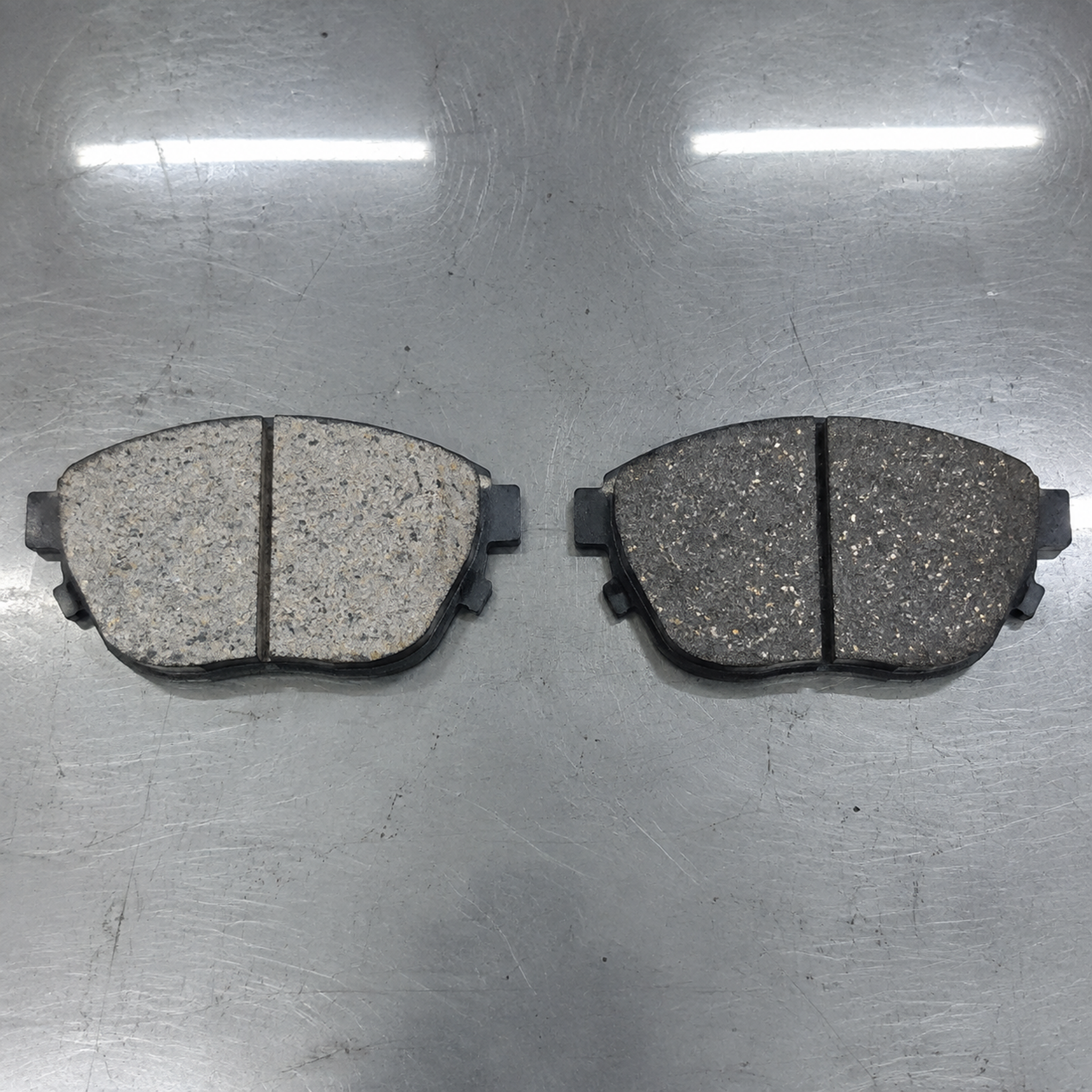
Below, I walk through the trade-offs, the fit factors, and the verification steps I use with buyers from Russia to Colombia. My goal is simple. I want to help you reduce mismatch risk and after-sales complaints, not just unit cost.
What Are the Practical Differences Between Ceramic and Semi-Metallic Brake Pads?
Many buyers ask me for "the better one," as if a single ranking exists. That framing causes costly stocking mistakes. In my experience, each material earns its place in a catalog under different duty conditions.
Ceramic brake pads typically combine ceramic fibers and non-ferrous fillers3, which tend to produce less visible dust and quieter operation. Semi-metallic pads typically embed steel and iron fibers, which tend to offer stronger heat transfer and firmer pedal feel under load. Neither label guarantees these traits; the specific formulation and its process control decide the final behavior.
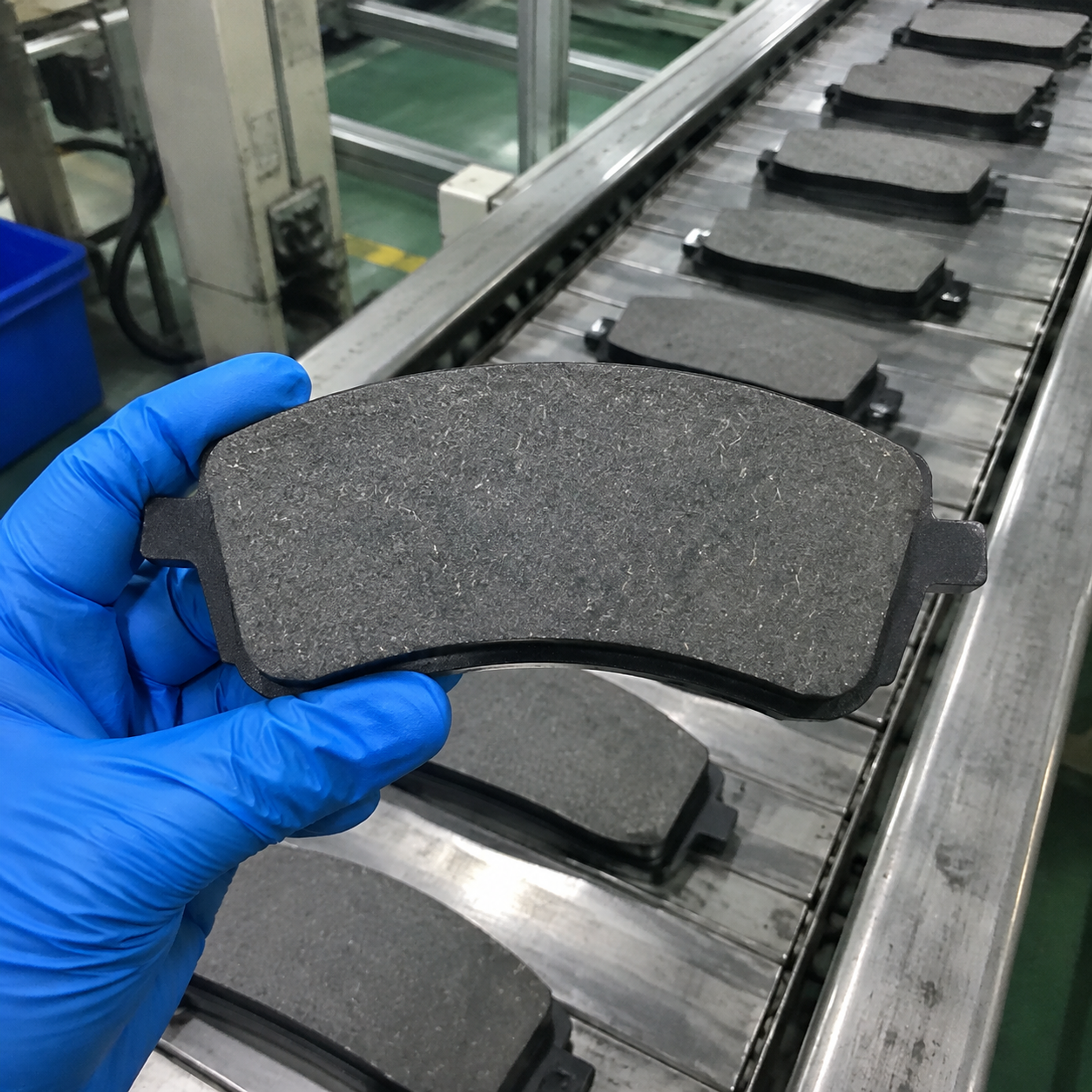
Composition Drives the Trade-Offs
Every brake pad mixes fibers, fillers, binders, and friction modifiers around a steel backing plate.4 The fiber package defines much of the behavior. Ceramic fibers are non-ferrous and thermally stable, so a well-made ceramic formulation tends to hold a consistent friction level through everyday driving. Metal fibers in semi-metallic pads conduct heat away from the friction surface, which supports performance under repeated hard braking5.
Our technical team summarizes the exchange this way. Semi-metallic formulations generally trade some comfort for heat capacity, while ceramic formulations generally trade some heat capacity for comfort. Neither side of that exchange is a defect. Each side is a design decision aimed at a duty cycle.
Side-by-Side Tendencies
| Attribute | Ceramic (typical tendency) | Semi-Metallic (typical tendency) |
|---|---|---|
| Noise tendency | Lower in well-controlled formulations | Higher risk in poor formulations |
| Dust character | Lighter color, less visible | Darker color, more visible |
| Heat dissipation | Moderate | Strong |
| Pedal feel | Softer initial response | Firmer, more immediate response |
| Cold-start behavior | Gradual engagement | Responsive from cold |
| Severe-duty suitability | Suited to normal passenger duty | Suited to heavy or sustained load |
| Rotor interaction | Typically gentler, formulation-dependent | Typically more abrasive, formulation-dependent6 |
| Material cost tendency | Higher | Lower |
Important caveat: This table describes tendencies, not guarantees. I have seen a premium ceramic formulation disappoint in severe duty, and I have seen a semi-metallic formulation out of place in a comfort-focused city car. The category sets the direction; the formulation sets the result.
A buyer in the Middle East once told me his previous "ceramic" stock squealed badly in summer traffic. Our technical team reviewed his failed samples and traced the issue to inconsistent curing, not to the ceramic category itself. The label had promised something the process did not deliver.
Which Vehicles and Duty Conditions Favor Each Brake Pad Material?
A distributor I work with once standardized on ceramic for his whole range, including a taxi fleet working long mountain descents. The complaints followed within months. That experience taught me to start every consultation with duty cycle, not with material preference.
For compact and mid-size sedans in gentle urban duty, ceramic formulations often fit customer priorities for quietness and clean wheels. For taxis, towing, laden commercial use, and repeated long descents, semi-metallic formulations often fit because heat management dominates. Climate and road conditions add a second decision layer that can shift the default either way.
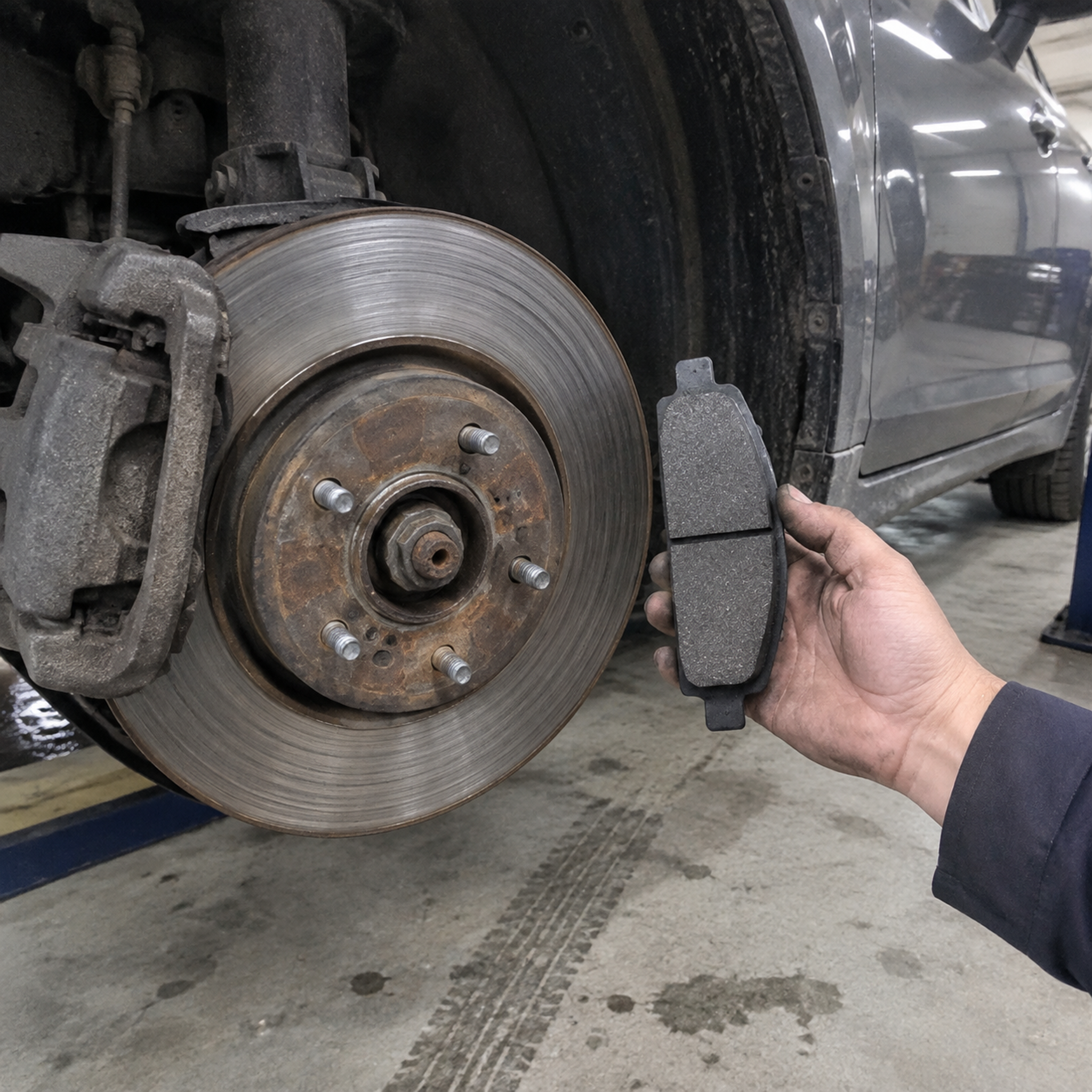
Matching Formulations to Duty Cycles
I recommend that importers map their catalog against vehicle parc data before ordering. The table below reflects the starting points I use in buyer discussions.
| Vehicle segment or duty | Formulation that often fits | Dominant priority |
|---|---|---|
| Compact sedans, city commuting | Ceramic | Low noise, low dust |
| Family SUVs, mixed driving | Either, verified by test | Balanced comfort and response |
| Taxi and high-mileage fleets | Semi-metallic or proven ceramic | Heat cycling, wear economics |
| Pickups, towing, laden operation | Semi-metallic, verify per spec | Heat dissipation under load |
| Trucks and buses | Heavy-duty formulations | Duty-specific products |
Climate and Roads Add a Second Layer
Hot coastal markets place different demands on friction material than cool highland cities. Long descents concentrate heat in ways that flat urban driving never does.7 Dusty roads accelerate abrasive wear and change how dust complaints appear to end users.
For example, that Colombian distributor eventually split his catalog. He moved the taxi segment to semi-metallic after controlled trials, and he kept ceramic for private city cars. His complaint volume dropped in the following reorder cycles. His solution was right for his roads and his fleet mix. It was not a universal verdict on either material.
Why Does the Ceramic vs Semi-Metallic Label Tell You Less Than You Expect?
Two cartons arrived at my office once, both marked "ceramic" by different suppliers. Our LINK dynamometer showed clearly different friction behavior between them. That comparison convinced me that a material label is a family name, not a specification.
A label like ceramic or semi-metallic describes a broad material family, not a performance level. Fiber content, abrasive packages, lubricants, hot-press parameters, and curing consistency all vary inside one category. Buyers should therefore request formulation-level test evidence and batch-control records instead of trusting the category name.
![LINK dynamometer test records comparing brake pad formulations]https://shuipet.com/wp-content/uploads/2026/09/5-placehold-iphone-the-brake-pad-ceramic_image-004_20260929_02a88794.png "Brake pad dynamometer test evidence")
What Varies Inside One Category
Formulators adjust many variables within a single family. The type and share of fibers, the choice of abrasives, the resin system, and additives for noise control all shift the final behavior. Process variables matter just as much. Our production sequence runs from backing plate blasting through hot pressing, oven curing, chamfering, and slotting8, and each stage influences consistency.
You can also compare the two-letter friction edge code printed on pads, which declares the friction class9 the manufacturer targets. That code gives you one comparable data point between offers, provided the supplier can back it with test records.
Why Batch Consistency Matters
A strong single test result does not guarantee a strong tenth container. I therefore encourage buyers to ask how a factory controls variation. Our process relies on raw material incoming inspection, in-process quality control at every production stage, per-batch dynamometer testing on our LINK bench, and pre-shipment inspection. These steps come from our own quality records, and I still advise every buyer to verify batch documentation independently rather than accept a summary claim.
What Evidence Should You Request Before Committing to an Order?
Approving samples by hand-feel alone is one of the most common mistakes I see among new importers. A pedal impression in a parking lot tells you almost nothing about behavior on a loaded descent in August. Evidence-based approval costs little, and it protects your brand.
Request verifiable documents rather than marketing language. The core set includes IATF 16949 and ISO 9001 certificates10, CCC certification where applicable11, third-party SGS test reports, dynamometer records with stated test conditions12, and batch traceability documents. Treat every certificate as a document to verify, not as proof by itself.
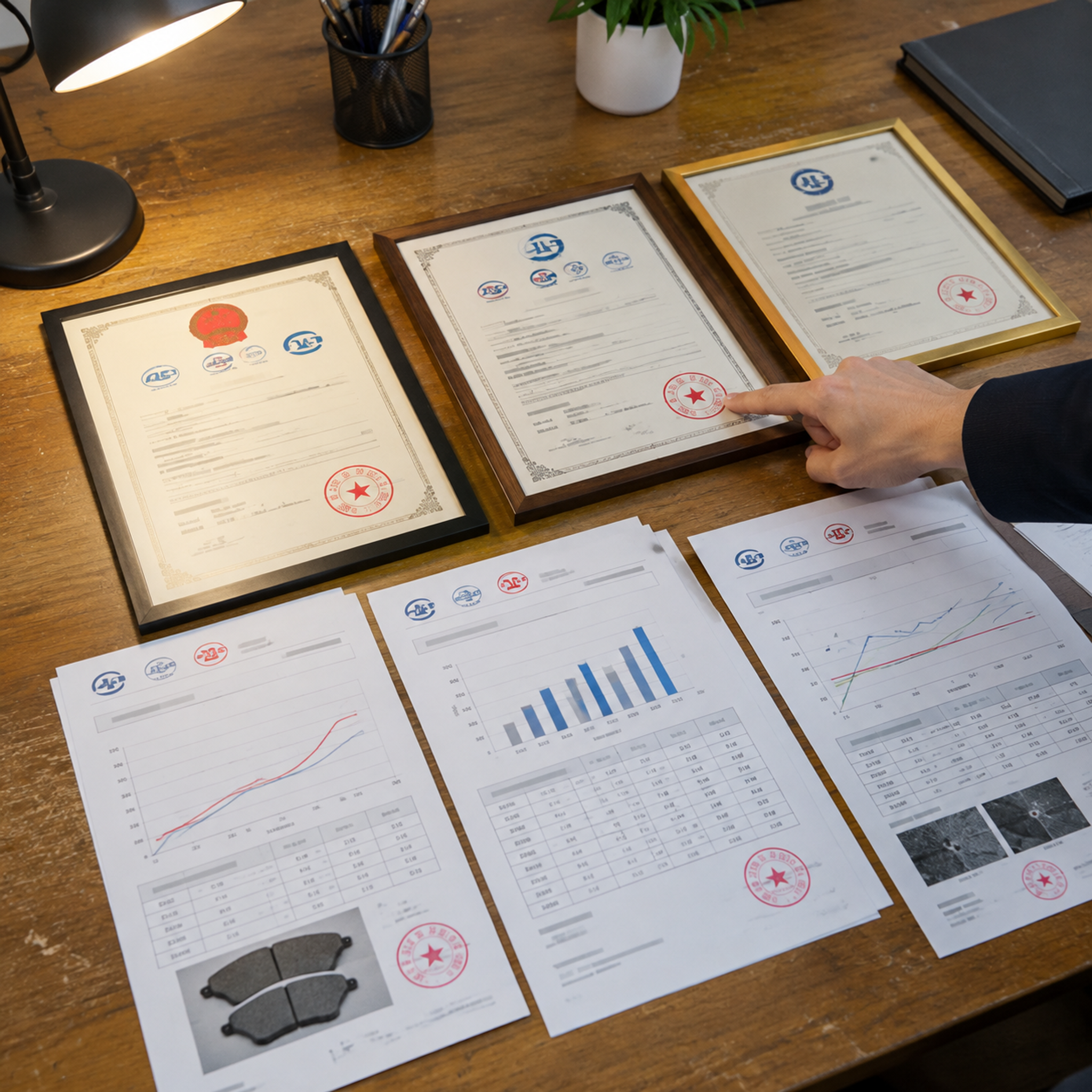
A Five-Step Verification Checklist
- Verify certificates with the issuing bodies. Check the certificate scope, validity dates, and covered sites. IATF 16949 status can be confirmed through the certification body's register.
- Request dynamometer reports with full test conditions. Ask for the speeds, pressures, temperatures, and inertia used. A result without conditions cannot be compared across suppliers.
- Ask about batch traceability. Confirm that each production batch links to raw material lots and final test records, so any field complaint can be traced quickly.
- Run a controlled market trial. Place samples with a small group of workshops before a full container commitment, and record noise, dust, and pedal-feel feedback.
- Define complaint thresholds in writing. Agree with your supplier on acceptable defect rates and remedies before the first shipment, not after the first dispute.
Our factory can supply these documents for both our ceramic and semi-metallic lines, including LINK bench records for reference formulations. I still encourage buyers to commission independent checks for application-critical programs. That recommendation comes from experience, and it has saved several of my customers from expensive mismatches.
Should Your Catalog Split Ceramic and Semi-Metallic Brake Pads by Market?
A single-SKU strategy looks simple on a spreadsheet until the complaint emails arrive. One formulation cannot serve a diverse vehicle parc well. Importers who segment deliberately usually see fewer disputes and faster stock turnover.
In most aftermarket catalogs, a segmented portfolio outperforms a single universal SKU. Split your range by vehicle segment, duty cycle, local climate, price sensitivity, and your own complaint history. Many importers source both ceramic and semi-metallic lines from one manufacturer to simplify logistics while still matching each market.
A Portfolio Beats a Single SKU
Market conditions push the decision in different directions. Buyers I work with in Russia often manage a broad, price-sensitive parc with mixed duty. Partners in Saudi Arabia prioritize formulations that cope with sustained heat. In Colombia and Kenya, altitude changes and varied road surfaces create demand for both comfort-oriented and heat-oriented products within one country.
| Market condition | Common catalog skew |
|---|---|
| Hot climate, urban stop-and-go | Ceramic-led, with tested heat margin |
| Mountainous routes, fleet duty | Semi-metallic-led for heat-heavy segments |
| Price-sensitive mass aftermarket | Semi-metallic entry lines, ceramic upgrade tier |
| Comfort-focused premium segment | Ceramic-led |
| Commercial trucks and buses | Dedicated heavy-duty formulations |
Practical Sourcing Notes
An OEM/ODM manufacturer can support this split under one supply relationship. Our factory, for example, produces ceramic as the main line, with low-metallic and semi-metallic options, across 26+ vehicle brands. That range lets a distributor differentiate tiers by formulation while keeping one quality system behind the whole catalog. When you plan the split, discuss minimum quantities per formulation with your supplier early, because tiered SKUs change your ordering pattern.
Frequently Asked Questions
Are ceramic brake pads safer than semi-metallic ones?
No material category is inherently safer. Safety depends on formulation quality, manufacturing consistency, and correct fit for the vehicle and duty cycle. A well-made semi-metallic pad matched to a heavy-duty application can outperform a mismatched ceramic pad. Buyers should judge each formulation on verified test evidence.
Do ceramic brake pads always last longer than semi-metallic pads?
No. Longevity depends on duty cycle, load, climate, and formulation quality. Under severe load and sustained heat, semi-metallic formulations often wear more predictably. Under gentle urban duty, quality ceramic formulations often satisfy customers on wear and cleanliness. Any supplier lifespan claim should be supported by test or field records.
Which formulation suits hot climates better?
Sustained severe heat generally favors semi-metallic formulations because metal fibers transfer heat efficiently. However, a properly engineered ceramic formulation serves typical passenger-duty conditions in hot markets well. Importers in hot regions should request heat-focused test data and run local trials before deciding.
How can I verify a brake pad manufacturer's claims?
Request IATF 16949 and ISO 9001 certificates, CCC and SGS reports, and dynamometer records with stated test conditions. Verify certificates with the issuing bodies. Then run a controlled sample trial in your market before committing to volume.
Can one supplier produce both ceramic and semi-metallic brake pads?
Yes. Many manufacturers, including ours, run ceramic as the primary line with low-metallic and semi-metallic options. Evaluate each formulation separately with its own test evidence, because quality in one category does not automatically transfer to another.
Conclusion
The brake pad ceramic vs semi metallic decision has no universal winner. Ceramic formulations tend to serve comfort-focused passenger segments, while semi-metallic formulations tend to serve heavy and heat-intensive duty. The material label is only a starting point. Formulation quality, manufacturing consistency, and verifiable test evidence determine what lands in your market. Importers who segment their catalog and verify supplier records reduce noise complaints, dust disputes, and dead stock.
If you want help mapping formulations to your vehicle parc, contact our overseas product manager Lucky Zhang on WhatsApp or WeChat at +86 15261452731, or email [email protected]. We can share LINK dynamometer records and arrange samples for your own market trial.
"Brake wear particle emissions: a review - PMC - NIH", https://pmc.ncbi.nlm.nih.gov/articles/PMC4315878/. Comparative tribological studies indicate that ceramic-based non-asbestos organic friction materials exhibit reduced vibration-induced high-frequency noise and yield light-colored non-ferrous dust compared to ferrous metal composites. Evidence role: mechanism; source type: paper. Supports: Ceramic friction composites produce finer, non-ferrous wear debris that adheres less visibly to wheel rims and generates lower squeal frequencies.. Scope note: Acoustic performance remains contingent on rotor dampening hardware, caliper geometry, and thermal conditioning. ↩
"Initial Selection of Disc Brake Pads Material based on ... - PMC", https://pmc.ncbi.nlm.nih.gov/articles/PMC7078729/. Thermophysical characterizations of automotive friction materials confirm that high volumetric fractions of steel fibers and metallic powders significantly enhance bulk thermal conductivity, dissipating localized interface heat into the backing plate and caliper. Evidence role: mechanism; source type: research. Supports: Semi-metallic friction linings have substantially higher effective bulk thermal conductivity than ceramic friction composites due to continuous metallic percolation networks.. Scope note: Increased thermal transfer to the caliper can induce higher brake fluid temperatures if cooling airflow is insufficient. ↩
"Compositions, Functions, and Testing of Friction Brake ... - INFO", https://info.ornl.gov/sites/publications/Files/Pub57043.pdf. Materials engineering taxonomies define ceramic friction materials as non-asbestos organic (NAO) composites primarily reinforced with ceramic, potassium titanate, or mineral fibers blended with non-ferrous soft metals and organic binders. Evidence role: definition; source type: paper. Supports: Automotive ceramic brake pads are classified as non-asbestos organic materials utilizing ceramic reinforcing fibers, mineral fillers, and non-ferrous friction modifiers.. ↩
"Compositions, Functions, and Testing of Friction Brake ... - INFO", https://info.ornl.gov/sites/publications/Files/Pub57043.pdf. Standard automotive engineering references define friction materials as complex multi-constituent composites containing structural fibers for mechanical integrity, phenolic binders for cohesion, friction modifiers for friction stability, and particulate fillers for volume and cost control. Evidence role: definition; source type: education. Supports: Automotive brake pads are composite assemblies categorized into structural reinforcement fibers, particulate fillers, polymeric resin binders, and friction modifiers bonded to a steel backing plate.. ↩
"Temperature Influence on Brake Pad Friction Coefficient ...", https://pmc.ncbi.nlm.nih.gov/articles/PMC10779514/. Experimental brake dynamometer investigations demonstrate that keeping the friction surface temperature below resin pyrolysis thresholds via rapid conductive cooling prevents brake fade under repeated high-energy deceleration cycles. Evidence role: mechanism; source type: paper. Supports: Efficient conductive heat removal from the pad-rotor contact interface retards thermal decomposition of the resin binder, thereby mitigating friction coefficient drop (fade).. Scope note: Fade resistance also depends heavily on resin thermal degradation thresholds and rotor thermal capacity. ↩
"Brake Pads: Semi-Metallic vs Ceramic? : r/MechanicAdvice", https://www.reddit.com/r/MechanicAdvice/comments/vx34w3/brake_pads_semimetallic_vs_ceramic/. Comparative tribometer wear testing indicates cast-iron disc thickness loss is generally higher when paired with semi-metallic pads because steel fibers and primary abrasives induce abrasive two-body and three-body wear mechanisms. Evidence role: mechanism; source type: research. Supports: Semi-metallic pads generate higher abrasive wear on cast-iron brake rotors than ceramic formulations due to hard steel fibers and coarse abrasive inclusions.. Scope note: Rotor metallurgy and disc surface coatings can significantly modulate the extent of mechanical abrasion. ↩
"Initial Selection of Disc Brake Pads Material based on ... - PMC", https://pmc.ncbi.nlm.nih.gov/articles/PMC7078729/. Vehicle testing protocols for mountain descents demonstrate sustained brake lining interface temperatures frequently exceeding 500 °C due to prolonged energy absorption without adequate convective cooling intervals. Evidence role: mechanism; source type: research. Supports: Continuous drag braking during long downgrades delivers sustained thermal energy into the brake assembly, elevating rotor and pad temperatures beyond transient urban braking peaks.. Scope note: Actual thermal accumulation varies with vehicle mass, grade percentage, downshifting technique, and vehicle aerodynamic drag. ↩
"How Brake Pads Are Made: Manufacturing Process", https://www.facebook.com/smartestworker/videos/how-brake-pads-are-made-manufacturing-process/1064561562746844/. Process engineering surveys of friction material manufacturing confirm that production universally relies on shot-blasting backing plates, high-pressure hot compression molding, post-cure oven heating to crosslink resin networks, and mechanical chamfering and slotting for noise control. Evidence role: general_support; source type: paper. Supports: Standard commercial manufacturing of bonded disc brake pads entails backing plate surface abrasion, composite hot compression molding, thermal post-cure cycling, and mechanical finishing such as slotting and chamfering.. ↩
"Compositions, Functions, and Testing of Friction Brake ... - INFO", https://info.ornl.gov/sites/publications/Files/Pub57043.pdf. Under SAE J661 and the Vehicle Equipment Safety Commission (VESC) V-3 regulation, friction materials are categorized by a two-letter designation where the first letter denotes normal friction and the second denotes hot friction coefficients. Evidence role: definition; source type: institution. Supports: The two-letter edge code represents friction coefficient ratings for normal and hot performance derived from standardized Chase machine dynamometer testing.. Scope note: Friction edge codes reflect controlled laboratory bench test classifications and do not directly predict full-vehicle stop distances. ↩
"IATF 16949", https://en.wikipedia.org/wiki/IATF_16949. The International Automotive Task Force established IATF 16949 as the harmonized global quality management standard for automotive production and service part organizations, operating in conjunction with ISO 9001. Evidence role: definition; source type: institution. Supports: IATF 16949 establishes comprehensive automotive-specific quality management requirements aligned with and supplementing ISO 9001 for serial parts production.. Scope note: Possession of an accredited quality management certificate validates system procedures but does not inspect or guarantee individual batch chemistry. ↩
"Limiting Copper in Brake Pads", https://dtsc.ca.gov/scp/limiting-copper-in-brake-pads/. Regulatory notices from the Certification and Accreditation Administration of China (CNCA) and national standard GB 5763 mandate CCC compliance and factory audits for automobile brake friction linings manufactured for or imported into the Chinese market. Evidence role: definition; source type: government. Supports: Automotive brake linings are cataloged under China Compulsory Certification (CCC) schemes, mandating compliance with national safety and performance standards such as GB 5763.. Scope note: CCC compliance applies specifically to commercialization within mainland China or to parts intended for Chinese-market vehicle assemblies. ↩
"Application of an inertia dynamometer to check braking ...", https://www.academia.edu/33074649/Application_of_an_inertia_dynamometer_to_check_braking_performance_against_theoretical_predictions. Standard testing protocols, notably SAE J2522 and ISO 26867 (AK Master), mandate strict reporting of initial temperatures, deceleration rates, line pressures, and rotational inertia to ensure comparability of brake friction and fade performance across test benches. Evidence role: expert_consensus; source type: institution. Supports: Standardized dynamometer procedures like SAE J2522 (AK Master) define specific sequences of speed, hydraulic pressure, interface temperature, and inertia to measure brake friction behavior objectively.. Scope note: Full-scale inertia dynamometer tests isolate the corner assembly and do not account for whole-vehicle chassis compliance or environmental weathering. ↩