
Have you ever looked at the brakes on a high-performance car and felt confused? They look so complex. Let's uncover why some cars use an advanced 8-pad brake setup.
Some high-performance cars use 8 brake pads1, with four pads per front wheel, to maximize the contact area with the brake rotor2. This design provides far greater stopping power3, improved heat management4, and more consistent braking performance5 under extreme conditions like track driving6 or racing.
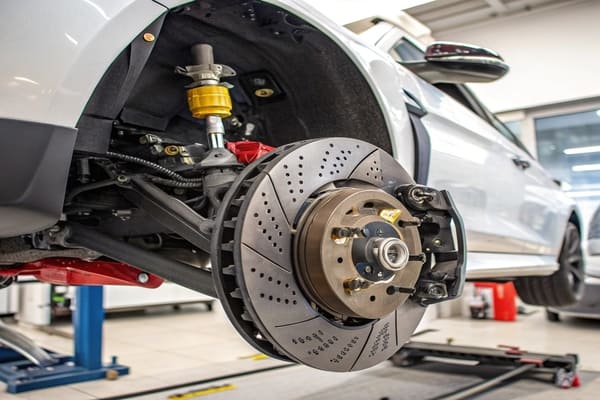
So, you understand the basic idea, but the world of braking systems is much deeper than just counting pads. This advanced technology isn't just about adding more parts; it involves a level of engineering that is fascinating and complex. Let's explore who really needs this setup, the challenges in making it, and how it all works together to stop a car on a dime.
Do all cars have 8 brake pads1?
You might be looking at your own car, wondering if you're missing four brake pads. This can cause confusion about whether your car is properly equipped for the road.
No, most cars do not have 8 brake pads1. The vast majority of passenger vehicles use a standard 4-pad system for the front axle. An 8-pad brake system is a specialized feature reserved for supercars, dedicated race cars, or some heavy-duty vehicles that demand extreme braking force.
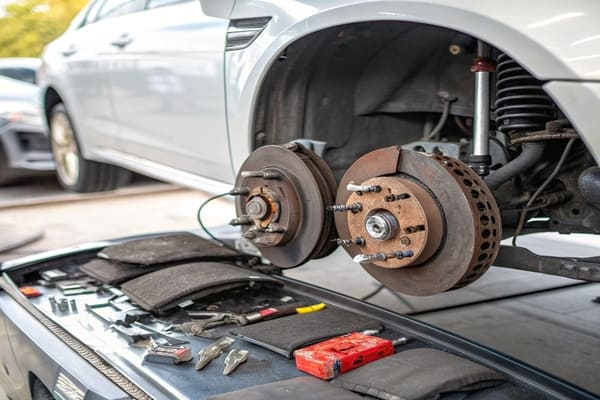
The car you drive every day is likely designed for reliability, comfort, and cost-effectiveness. A standard braking system, with one pad on the inner and one on the outer side of the brake rotor2, is perfectly adequate for this. It provides safe, consistent stopping power3 for commuting, errands, and highway driving. These systems are simple, easy to manufacture, and straightforward to service.
The Engineering Challenge of 8-Pad Systems
An 8-pad system, on the other hand, is built for one thing: maximum performance. From my experience as a manufacturer, producing these systems is incredibly difficult. The precision required is beyond what standard production equipment can handle. It takes highly specialized machinery, the kind you typically find in advanced factories in coastal Fujian or around Shanghai. The machines used in other industrial areas, like Hebei for instance, usually can't meet the tight tolerances needed. The entire process involves at least three critical stages, with the most difficult being the control of the caliper's pistons. If the pistons are not perfectly synchronized, the entire system's stability is compromised. This is why it remains a niche product for the top tier of the automotive world.
Comparing Brake Systems
| Feature | Standard System (4 Pads) | High-Performance System (8 Pads) |
|---|---|---|
| Vehicle Type | Most passenger cars, SUVs | Supercars, race cars, heavy-duty trucks |
| Primary Goal | Reliability and cost-effectiveness | Maximum stopping power3 and heat control |
| Manufacturing | Simple, mass-produced | Complex, requires specialized equipment |
| Cost | Lower | Significantly higher |
Do I need 4 or 8 brake pads1?
Are you wondering if upgrading to an 8-pad system is the right move for your car? Making the wrong choice can be a costly mistake and might not even improve your performance.
For almost every driver, a standard 4-pad system is all you need. An 8-pad system is only necessary if you have a high-horsepower car7 that you frequently take to the track, where managing extreme heat and preventing brake fade8 is a top priority.
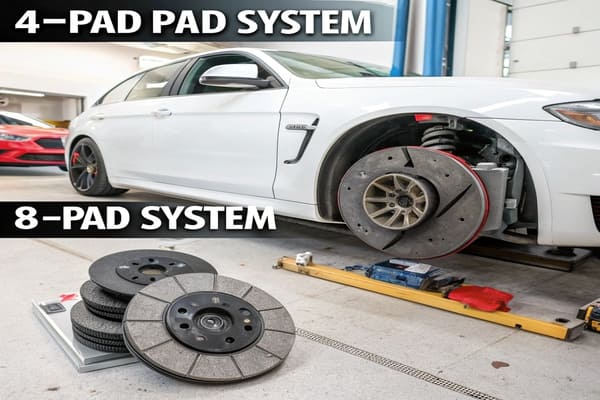
The real challenge with an 8-pad setup is making all the components work together in perfect harmony. These systems use a multi-piston caliper9, often with four pistons that push four separate pads against the rotor. The hardest part of manufacturing this is ensuring all those pistons move at the exact same time with the exact same force. If one piston engages a fraction of a second earlier than the others, it causes uneven pad wear and can make the car pull to one side during hard braking.
A Lesson Learned from Experience
I’ll never forget the first time my team produced an 8-pad system. It was for a client in Pakistan who was building a very powerful custom car. We were still new to the process, and after the client installed the brakes, he reported that the braking force felt uneven. I was worried we had made a huge mistake. But it turned out he loved it. For his specific high-horsepower application, the aggressive, slightly raw feedback gave him the feel he wanted. We got lucky. That experience taught us a crucial lesson. Since then, we have perfected our process. We learned that another major challenge is ensuring the friction material is perfectly consistent across all eight pads. This requires stopping the production line to open up the caliper's force model and make precise adjustments, a time-consuming but essential step for stable, reliable braking.
What is the 70 30 braking rule?
You have probably heard people mention the 70/30 braking rule10, but what does it actually mean? Not understanding this can lead to wrong ideas about how your car's brakes work.
The 70/30 braking rule10 is a general principle in vehicle dynamics. It states that when you brake, approximately 70% of the stopping force is handled by the front brakes, while the rear brakes manage the remaining 30%. This happens because the car's weight shifts forward.
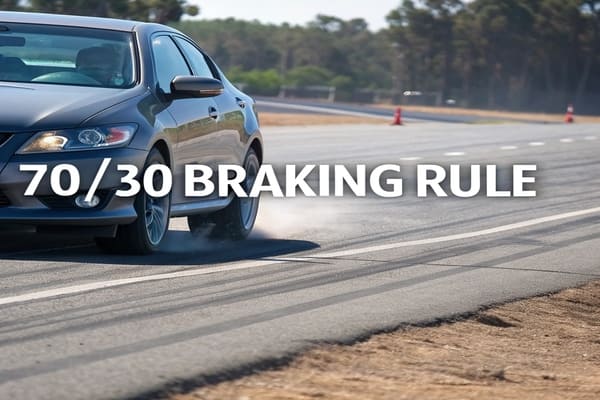
Think about what happens to your body when a car stops suddenly—you lurch forward. The car itself does the same thing. All that mass shifting forward puts immense pressure on the front tires, giving them much more grip on the road. Because the front tires have more grip, they can handle a much larger share of the braking work. This is physics in action. As manufacturers, we design braking systems based on this principle. Front brake rotor2s are almost always larger and thicker than rear ones, and their calipers are more powerful. It’s also why high-performance upgrades, like an 8-pad system, are almost exclusively installed on the front axle. They are designed to maximize the stopping potential where it matters most.
Modern Systems and How They Adapt
Of course, the 70/30 split is just a guideline. Modern cars are much smarter. They use systems like Electronic Brakeforce Distribution11 (EBD) to adjust this ratio in real-time. Sensors detect vehicle load, speed, and road conditions. If you have heavy cargo in the trunk, the EBD system will send more braking power to the rear wheels to keep the car stable, perhaps changing the split to 60/40. An 8-pad system on the front axle is the ultimate way to capitalize on this natural weight transfer, giving a driver the confidence to brake later and harder into a corner on a racetrack.
Conclusion
An 8-pad system delivers incredible stopping power3 for performance cars, but its complexity means a standard 4-pad setup is the right choice for nearly all daily drivers.
Explore the advantages of an 8 brake pad system for high-performance vehicles and how it enhances braking efficiency. ↩
Learn about the critical role of brake rotors in vehicle braking systems and their impact on performance. ↩
Learn about the importance of stopping power in braking systems and how it affects vehicle safety and performance. ↩
Discover how effective heat management in brakes can improve performance and prevent brake fade during extreme driving. ↩
Understand the key factors that affect braking performance and how they contribute to vehicle safety. ↩
Find out which braking systems are optimal for track driving and how they enhance performance. ↩
Find out which braking systems are best suited for high-horsepower cars to ensure safety and performance. ↩
Explore the causes of brake fade and effective strategies to prevent it for safer driving. ↩
Learn about multi-piston calipers and their role in enhancing braking efficiency and performance. ↩
Understand the 70/30 braking rule and its significance in vehicle dynamics and braking efficiency. ↩
Discover how Electronic Brakeforce Distribution optimizes braking performance in modern vehicles. ↩