
Your fleet's safety depends on reliable brakes1, but cheap aftermarket drums can fail. This leads to costly downtime and dangerous situations, so choosing a real manufacturer ensures quality and safety.
Choosing semi-truck brake drums2 from a real manufacturer is the first choice for fleets because of superior quality control3, precise material composition4, and advanced manufacturing process5es. This guarantees better heat dissipation6, longer service life7, and unmatched reliability, making them the safest and most cost-effective option.

But what really sets a professionally made brake drum apart from the rest? The difference is not just in the final product you can see, but in the hidden details of how it's made. Let's break down why these details are so important for the safety and efficiency of your entire fleet.
What Is a Semi Truck Brake Drum and Why Is It Still Used in Heavy-Duty Trucks?
You see disc brakes on most cars and wonder why big trucks still use drums. This might make you think the technology is outdated, but drum brakes have unique advantages.
A semi-truck brake drum is a cast-iron cylinder that rotates with the wheel. Brake shoes press against its inner surface to create friction and stop the truck. They are still used for their durability, powerful braking force8, and lower maintenance costs9 in heavy-duty applications.
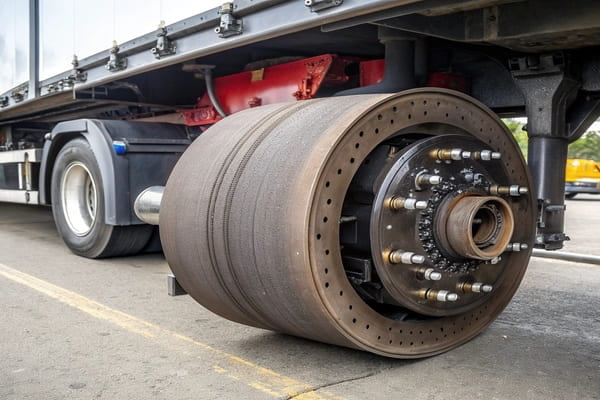
The brake drum is a core part of a truck's braking system. When the driver presses the brake pedal, air pressure pushes pistons that force the brake shoes outward. These shoes, lined with a friction material, press against the inside of the spinning drum. This friction converts the wheel's kinetic energy into heat, slowing and stopping the truck. It's a simple, powerful, and robust system that has been trusted for decades.
The Power of Drum Brakes in Heavy Hauling
While disc brakes are excellent at dissipating heat, drum brakes offer a larger contact surface area between the shoes and the drum. This creates a "self-energizing" effect, where the rotation of the drum pulls the shoes in tighter, amplifying the braking force8. This is a huge benefit when you need to stop a fully loaded, 80,000-pound vehicle. They are also enclosed, which protects the braking components from dirt, water, and road grime, reducing wear and tear.
Drum Brakes vs. Disc Brakes for Semi Trucks
| Feature | Drum Brakes | Disc Brakes |
|---|---|---|
| Stopping Power | Excellent, with self-energizing effect | Very good, but requires more force |
| Durability | High, enclosed design protects parts | Good, but exposed to elements |
| Maintenance | Less frequent, but more complex | More frequent, but easier to service |
| Cost | Lower manufacturing and replacement cost | Higher initial and replacement cost |
| Heat Dissipation | Good, but can fade with overuse | Excellent, less prone to fading |
For these reasons, many heavy-duty trucks use a combination system: disc brakes on the front axle for better steering control and heat management, and reliable drum brakes on the rear axles to handle the bulk of the braking force8.
Which Semi Truck Brake Drum Specifications Matter Most to Fleet Buyers?
Choosing the right brake drum feels complicated with all the different numbers and codes. Picking the wrong one means a poor fit, reduced performance, and serious safety risks for your drivers.
Fleet buyers must focus on the bolt circle diameter10, pilot diameter11, brake surface diameter12, and overall depth. These ensure a perfect fit. Also, the weight and balance rating are critical because they directly impact performance, wear life, and vehicle stability on the road.
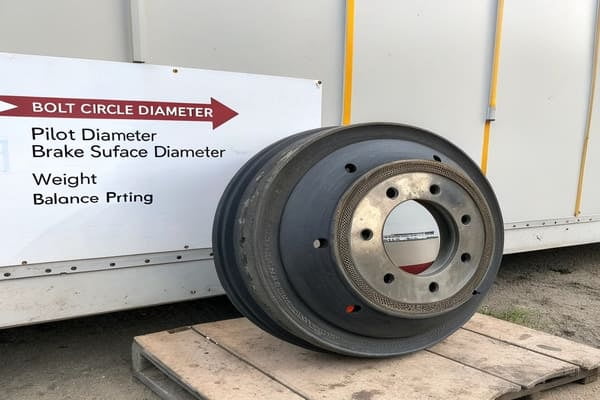
When you're sourcing parts for an entire fleet, getting the specifications right is everything. A small mistake can lead to big problems, from parts that simply won't fit to ones that fail prematurely. I learned this the hard way on one of my first big orders for a client in Southeast Asia. We produced a batch of drums, but after the final annealing process13, some of them had a slight "roundness deviation." I was worried it was a total loss. Luckily, my client was modifying heavy-duty trucks for extreme loads, and this slight imperfection actually suited their custom setup better. It was a lucky break, but it taught me a valuable lesson: every single specification matters, and precision is key.
Core Fitment Dimensions
These are the non-negotiable measurements that determine if the drum will even mount to the truck.
- Bolt Circle Diameter: The diameter of the circle that the mounting bolts run through. If this is wrong, you can't attach the wheel.
- Pilot Diameter: The size of the large central hole that centers the drum on the axle hub. An incorrect pilot size will cause dangerous vibrations.
- Brake Surface Diameter: The inside diameter of the drum. This must match the brake shoes perfectly for effective braking.
Performance and Safety Metrics
These specs tell you how the drum will perform under pressure.
| Specification | Why It Matters |
|---|---|
| Brake Surface Width | A wider surface means more contact area, better stopping power, and more effective heat distribution. |
| Overall Depth | This affects clearance with other suspension and wheel components. |
| Weight | A heavier drum often means more material to absorb and dissipate heat, but it must be balanced correctly. |
| Balance Rating | An unbalanced drum will cause severe vibrations at high speed, leading to uneven tire wear and driver fatigue. |
Always cross-reference these specifications with the truck's OEM service manual or a trusted supplier. Getting them right from the start saves time, money, and prevents serious safety issues down the road.
What Materials Are Best for Heavy-Duty Semi Truck Brake Drums?
You hear terms like "cast iron" and "special alloys," but what does that mean for brake performance? Using a drum with the wrong material leads to cracking and fast wear under pressure.
High-quality gray cast iron14 with specific alloys is the best material. Professional manufacturers add elements like chromium, molybdenum, and copper to improve heat resistance, reduce wear, and prevent cracking under extreme braking, ensuring both safety and a long service life7.
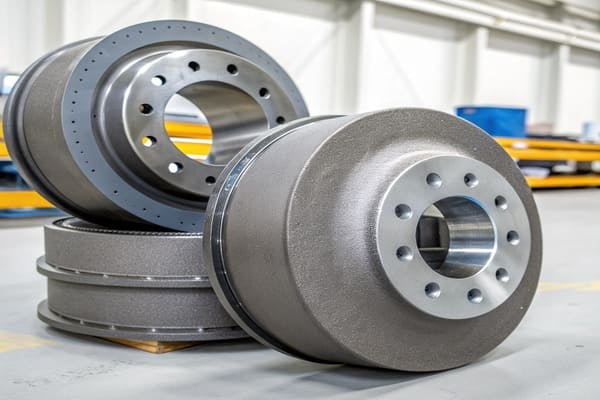
The material of a brake drum is its most important feature. It has to be strong enough to handle massive forces but also able to manage intense heat. The foundation for almost all heavy-duty brake drums is gray cast iron14. This material is excellent at absorbing heat and dampening vibrations, which translates to smoother, quieter braking. However, standard cast iron isn't enough for the demands of a modern semi-truck. The real magic is in the precise recipe of alloys that we add to the mix. One of the hardest parts of the entire manufacturing process5 is getting this recipe exactly right. When we are blending the materials, the machine has to stop to open the silo and add the different elements. This moment is critical because it can create inconsistencies in the mixture. It takes a lot of skill and very advanced equipment to ensure every single drum has a perfectly uniform material composition4.
The Foundation: Gray Cast iron
Gray cast iron gets its name from the gray color of the metal when it fractures, which is due to the presence of graphite. This graphite structure is what gives the drum its excellent heat conductivity and vibration-dampening properties. It’s the perfect starting point for a high-performance brake drum.
The Importance of Alloy Additives
To take the performance to the next level, we introduce specific elements into the molten iron. Each one serves a distinct purpose.
| Alloy Additive | Primary Benefit | Why It's Important for Brakes |
|---|---|---|
| Chromium (Cr) | Increases hardness and wear resistance | Prevents the brake surface from wearing down too quickly, extending the drum's life. |
| Molybdenum (Mo) | Improves strength at high temperatures | Resists warping and cracking when the brakes get extremely hot during long descents. |
| Copper (Cu) | Enhances heat conductivity | Helps pull heat away from the braking surface more quickly, reducing brake fade. |
| Vanadium (V) | Refines grain structure for strength | Creates a stronger, more durable drum that is less prone to catastrophic failure. |
A cheap, low-quality drum might just use basic cast iron. But a professional-grade drum from a dedicated manufacturer will have a carefully controlled blend of these alloys, designed and tested for maximum safety and longevity.
How Are Semi Truck Brake Drums Manufactured in a Professional Foundry?
A brake drum looks like a simple, heavy piece of metal. How hard can it be to make? But many cheap drums fail because they skip critical, complex manufacturing steps in the process.
Professional manufacturing involves precise material blending, automated casting for uniformity, and precision machining for balance. The most crucial step is high-temperature annealing, which removes internal stress from the casting to prevent warping and cracking during use, ensuring the drum remains stable.
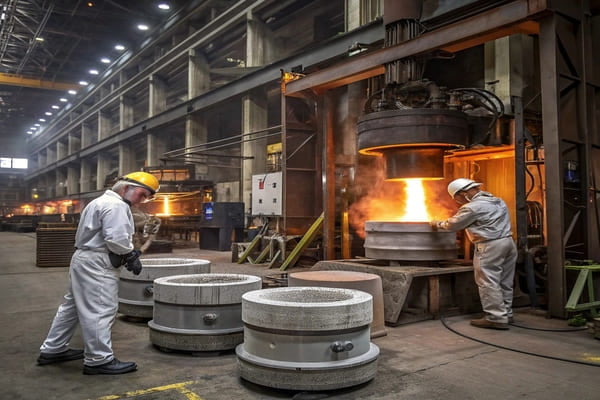
Making a reliable brake drum is an incredibly precise and difficult process. It's not something a small workshop can do well. The tolerances are tight, and the material science is complex. I've seen firsthand that only foundries with very specific, high-end equipment can get it right. These specialized factories are often found in industrial hubs like Liaocheng in Shandong or around Wuxi in Jiangsu. They have the machinery and expertise to handle the most difficult steps. The single hardest, and most important, step is the high-temperature annealing. This is where the rough casting is heated up and then slowly cooled down. This process releases all the internal stress that builds up in the metal as it cools from a liquid to a solid. If you skip this step or do it improperly, the drum will warp and crack as soon as it gets hot on the road.
From Molten Iron to a Rough Casting
The process begins with melting the specific blend of cast iron and alloys in a furnace. The molten metal is then poured into a sand mold. Advanced foundries use automated pouring systems to ensure that each mold is filled consistently, which is the first step in creating a balanced and uniform drum. After the casting cools and solidifies, it is removed from the mold. At this point, it is a rough, unfinished part.
The Critical Finishing Processes
The rough casting goes through several more stages before it's ready for a truck.
| Manufacturing Step | Purpose | Why It's Critical |
|---|---|---|
| 1. Machining | The casting is put on a lathe to machine the braking surface, pilot hole, and bolt holes to exact dimensions. | This ensures the drum is perfectly round, balanced, and will fit the axle hub correctly. |
| 2. Annealing | The machined drum is heated to a very high temperature and then cooled slowly in a controlled environment. | This relieves internal stresses in the metal, preventing future warping or cracking from heat cycles. This is the most important step for safety. |
| 3. Final Balancing | The drum is spun at high speed on a balancing machine, and small amounts of material are drilled out to ensure perfect balance. | An unbalanced drum causes vibrations that destroy tires, wheel bearings, and suspension components. |
| 4. Quality Inspection | Every dimension is checked, and the drum is inspected for any cracks or defects before being painted and packaged. | This is the final guarantee that the part meets all safety and performance standards. |
Small workshops often lack the expensive, precision equipment needed for proper annealing and balancing. This is why drums from real, professional manufacturers15 are the only choice for fleets that prioritize safety and long-term reliability.
Conclusion
Choosing brake drums from a real manufacturer is about more than just the part. It's about ensuring safety, performance, and peace of mind for your entire heavy-duty fleet.
Explore the key features that contribute to reliable braking systems in trucks. ↩
Explore the advantages of high-quality semi-truck brake drums for safety and performance. ↩
Learn how quality control ensures the reliability and safety of brake drums. ↩
Discover how the right materials enhance brake drum performance and longevity. ↩
Get an inside look at the complex manufacturing process that ensures brake drum reliability. ↩
Understand the role of heat dissipation in preventing brake fade and ensuring safety. ↩
Find out how to maximize the service life of your brake drums for cost-effectiveness. ↩
Learn about the differences in braking force and their implications for safety. ↩
Get insights into the long-term maintenance costs of drum brakes versus disc brakes. ↩
Understand the significance of bolt circle diameter in ensuring proper brake drum installation. ↩
Learn how pilot diameter affects the stability and performance of brake drums. ↩
Discover the impact of brake surface diameter on overall braking performance. ↩
Understand the importance of annealing in preventing warping and ensuring safety. ↩
Find out why gray cast iron is the preferred material for high-performance brake drums. ↩
Find out what sets professional manufacturers apart in terms of quality and reliability. ↩