
Finding a straight answer to this question is tough. The market is complex and divided. I'm here to break down the major players for you.
The title of "biggest" car parts distributor in the USA is highly contested and depends on the market segment. For commercial distribution to repair shops, Genuine Parts Company (NAPA) and LKQ Corporation are the dominant forces. They operate vast networks supplying parts to the professional DIFM1 market.
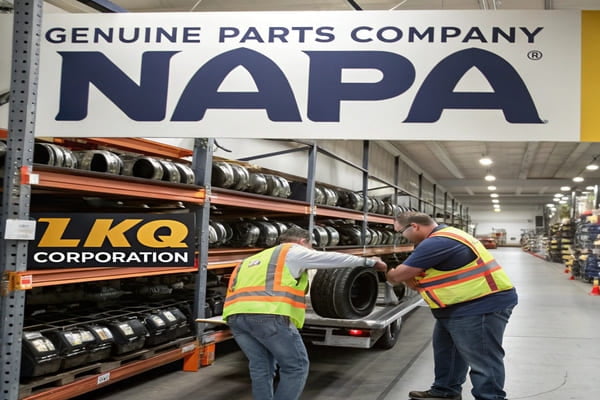
The world of auto parts is much bigger than just the corner store. You have retailers who sell to you, distributors who sell to garages, and massive global suppliers who sell directly to car makers. To understand who is the biggest, we first need to look at these different areas. Let's dive deeper into each part of this huge industry.
Who is the largest auto parts retailer in the US?
You see their stores everywhere, but who is the king of retail? The competition is fierce. Let's clarify who leads the pack in selling directly to consumers.
AutoZone2 is the largest automotive parts retailer in the United States by revenue and store count. It narrowly leads competitors like O'Reilly Auto Parts3 and Advance Auto Parts. These companies primarily serve do-it-yourself (DIY) customers and local repair shops through their commercial programs.
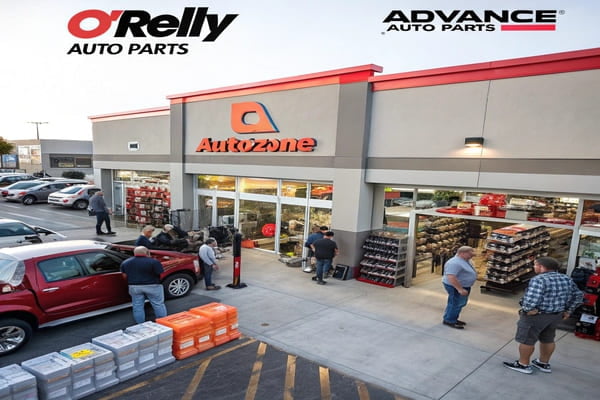
When you need to buy a part for your own car, you likely go to a retailer. These are the names you know well. But their business model is a clever mix. They serve two main customers: the DIY enthusiast who fixes their car on the weekend and the small professional garage down the street. This second part is their "commercial" or "DIFM1" (Do-It-For-Me) business. As a manufacturer, we see how these giants build their own private-label brands. They partner with factories like ours to create exclusive product lines, from brake pads to electronics, giving them a competitive edge.
Retail Giants: A Closer Look
These companies dominate the American landscape. Their success comes from having a massive physical footprint and a dual DIY/DIFM1 sales strategy.
| Company | Approx. Revenue (Annual) | Primary Focus | Key Feature |
|---|---|---|---|
| AutoZone2 | ~$17.5 Billion | DIY, Commercial (DIFM1) | Largest store network, strong private-label brands. |
| O'Reilly Auto Parts3 | ~$15.8 Billion | DIY, Commercial (DIFM1) | Excellent inventory, strong professional focus. |
| Advance Auto Parts | ~$11.3 Billion | DIY, Commercial (DIFM1) | Owner of Carquest, strong ties to independent shops. |
Their strategy is to be everywhere, have the part you need, and get it to you fast.
Who is the world's largest automotive parts supplier?
Thinking nationally is too small for the car business. The industry is truly global. So, let's zoom out and see who the biggest player is on the world stage.
Robert Bosch GmbH4, a German engineering and technology company, is widely recognized as the world's largest automotive parts supplier by revenue. They provide a vast range of components, from electronics to braking systems, primarily to original equipment manufacturers (OEMs) like Ford, Toyota, and Volkswagen.
The largest global suppliers are in a different league. They are "Tier 1" suppliers. This means they work directly with car manufacturers to design, engineer, and produce parts for new vehicles rolling off the assembly line. They are deeply involved in research and development, creating the next generation of automotive technology. This is very different from the aftermarket distributors and retailers we talked about. We, as an ODM/OEM manufacturer, often occupy a specialized niche. We develop specific electronic or lighting systems for brands that need a custom solution, something the global giants may not focus on.
The Global Titans of Auto Parts
These companies are the backbone of the global automotive manufacturing industry. They don't just make parts; they invent the technology that goes into modern cars.
| Company | Country of Origin | Approx. Revenue (Automotive) | Specialization |
|---|---|---|---|
| Robert Bosch | Germany | ~$50 Billion | Electronics, Powertrain, Chassis Systems |
| Denso5 | Japan6 | ~$47 Billion | Thermal, Powertrain, Mobility Systems |
| ZF Friedrichshafen7 | Germany | ~$42 Billion | Driveline and Chassis Technology |
| Magna International | Canada8 | ~$40 Billion | Complete Vehicle Engineering, Components |
These titans shape the future of the automobile, from electric vehicle batteries to autonomous driving sensors.
Who are the top 5 auto parts companies?
The term "auto parts company" is tricky. It can mean a retailer, a distributor, or a supplier. So, let's create a list that shows the leaders across these categories.
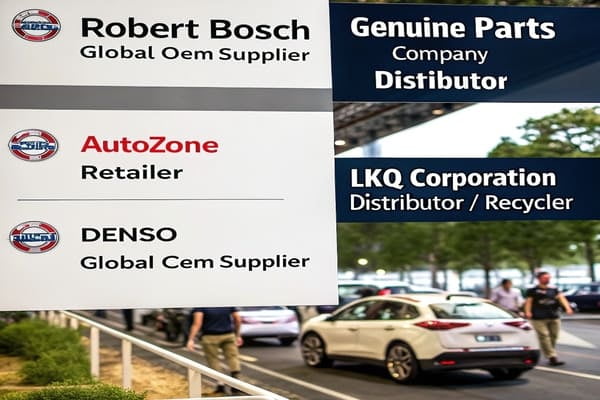
A list of the top 5 auto parts companies must include leaders from different sectors: Robert Bosch (Global OEM Supplier), Genuine Parts Company (Distributor), AutoZone2 (Retailer), LKQ Corporation (Distributor/Recycler), and Denso5 (Global OEM Supplier). Each dominates its specific area of the industry.
To truly succeed as a major distributor in the U.S., it's not just about having big warehouses. The technical requirements are incredibly high. The single biggest hurdle is data. You must be able to manage and standardize millions of pieces of information perfectly. If you get it wrong, nothing works. This is where many smaller players fail. They simply can't handle the complexity of the data standards9 required to operate at scale.
The Real Challenge: Data and Integration
Being a top distributor like GPC (NAPA) or LKQ involves more than just logistics. It's about mastering information.
ACES and PIES10: The Language of Parts
The entire US aftermarket runs on two data standards9: ACES (Aftermarket Catalog Exchange Standard) and PIES (Product Information Exchange Standard). In simple terms, ACES ensures a part fits a specific vehicle (Year/Make/Model/Engine). PIES contains all the product details, like weight, dimensions, and images. Getting this right is incredibly difficult. I remember my first distribution partnership project with a client from Pakistan. We were inexperienced with these US data standards9. We faced serious "part fitment deviation" issues. Our data didn't match the physical parts perfectly. Luckily, his market focused on custom modifications, so they actually liked the slightly different parts. It was a stressful but valuable lesson: in the US market, perfect data is not optional. It is everything.
DIFM1 and Network Synergy
Another huge challenge is coordinating the "Do-It-For-Me" (DIFM1) business with the store network. When a garage orders a part, the system must seamlessly find it in the vast inventory and get it delivered in under an hour. This requires opening up your entire supply chain and inventory system, which is a massive operational and technical hurdle.
Where does the US get most of their car parts?
Many people think car parts are made in the US. The reality is that the supply chain is a complex global web. Let's trace where these components actually come from.
The US sources car parts globally, with Mexico11 and China12 being the two largest suppliers by value. They are followed by Canada8, Japan6, and Germany. The origin of the parts depends heavily on whether they are for new car production (OEM) or for the aftermarket.
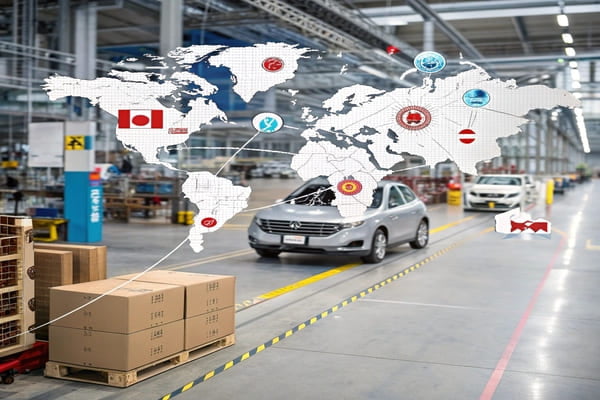
The source of a car part depends on its final destination. Is it going into a brand-new Ford F-150 on the assembly line, or is it going to an AutoZone2 shelf to be sold to a consumer? These two supply chains are very different. As a manufacturer based in China12, we are a critical link in this global network. US-based brands and distributors partner with us for our OEM and ODM capabilities. We can design, tool, and mass-produce a custom product line for them, helping them compete in this crowded market.
OEM vs. Aftermarket Supply Chain
The journey of a car part is determined by its end-user.
| Country | Primary Contribution to US Market | Key Products |
|---|---|---|
| Mexico11 | OEM & Aftermarket | Electrical systems, wiring harnesses, engine parts |
| China12 | Primarily Aftermarket, some OEM | Electronics, lighting, accessories, diverse components |
| Canada8 | Primarily OEM | Powertrain, body components, final assembly |
| Japan6 | OEM & Aftermarket | Engines, transmissions, high-tech electronics |
| Germany | OEM & Aftermarket | Performance parts, luxury components, engineering |
The OEM supply chain is heavily influenced by trade agreements like the USMCA, which favors production in Mexico11 and Canada8. For the aftermarket, things are different. Factors like cost, manufacturing flexibility, and the ability to produce a wide variety of parts are more important. This is where China12's manufacturing power plays a huge role, providing the incredible diversity of parts needed to service the millions of cars already on the road.
Conclusion
The "biggest" player in the US auto parts market depends on how you define it. The industry has distinct leaders in retail, distribution, and global OEM supply.
Explore the significance of the Do-It-For-Me model in the auto parts supply chain. ↩
Discover AutoZone's strategies that make it a leader in the retail sector and its extensive store network. ↩
Find out how O'Reilly Auto Parts excels in inventory management and professional service. ↩
Learn about Bosch's extensive range of automotive components and its global influence. ↩
Discover Denso's specialization in thermal and mobility systems and its market impact. ↩
Discover Japan's expertise in high-tech electronics and its importance in the auto parts supply chain. ↩
Explore ZF's advancements in driveline and chassis technology that shape modern vehicles. ↩
Learn about Canada's role in supplying OEM parts and its significance in the industry. ↩
Understand the critical role of data standards in managing complex supply chains effectively. ↩
Understand the importance of ACES and PIES in ensuring accurate part fitment and product information. ↩
Discover Mexico's contributions to both OEM and aftermarket parts in the automotive industry. ↩
Explore China's manufacturing capabilities and its impact on the diversity of auto parts available. ↩