
Struggling to find a reliable brake pad supplier1? The market is full of options, making it hard to spot real quality. Choosing the wrong partner can lead to poor performance and safety risks.
The leading brake pad manufacturers are defined by their advanced technology2, strict quality control3, and material expertise4. Global players like Brembo, Akebono, and Federal-Mogul are well-known, but true leadership comes from precision engineering and certified processes, which many specialized OEM/ODM suppliers5 also possess.
Organic, ceramic, semi-metallic... the different types of brake pads can be confusing. Choosing the wrong material can result in noise, a lot of brake dust, or poor stopping power for your customers.
Top manufacturers typically offer three main types of brake pads: organic, semi-metallic, and ceramic. Organic pads are quiet for daily driving, semi-metallic pads offer powerful braking for heavy use, and ceramic pads provide a clean, smooth, and consistent performance.)
Finding the right manufacturing partner is about more than just picking a big name off a list. It's about understanding what goes into making a safe, reliable, and high-performance brake pad. You need to look behind the brand and into the factory itself. Let's dig deeper to see what really separates the best from the rest.
What Defines a Top-Tier Brake Pad Manufacturer in the Automotive Industry?
All manufacturers claim they are the best, but how do you see past the marketing? Without clear standards, you might partner with a supplier who simply can't deliver the quality you need.
A top-tier brake pad manufacturer is defined by their investment in precision machinery, deep expertise in friction material formulation6, and rigorous quality control3 systems. They don't just assemble parts; they engineer safety and performance from the ground up, ensuring every single pad is consistent and reliable.
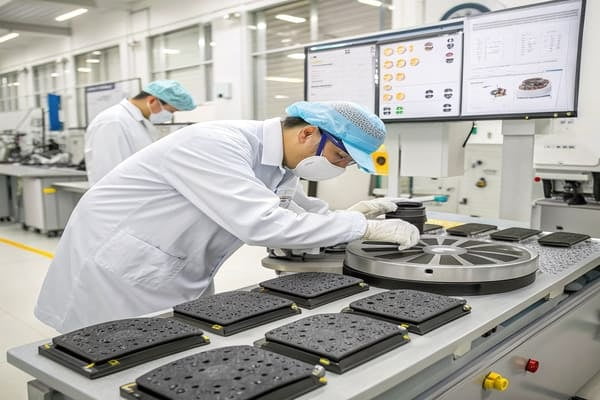
The process of making brake pads is actually very difficult. It’s not something any workshop can do well. Real quality comes from a few key areas that I've learned to focus on over the years.
Precision Manufacturing Technology
The first thing is the equipment. Standard hot-press machines just don't have the precision needed to make high-quality brake pads. The process requires at least three main steps, with high-temperature heat treatment being the most challenging. Machines that can handle this level of precision are typically found in advanced industrial areas, like the Yangtze River Delta and around Chongqing in China7. I've seen machinery from smaller workshops in other regions, and they usually can't meet the required accuracy. This leads to inconsistencies in the final product.
Expertise in Material Formulation
Another incredibly difficult part is mixing the friction materials. When you're creating a batch, the machine has to stop to open the material hopper for loading. This moment is critical because it can easily throw off the precise ratio of ingredients. Getting this wrong affects everything from stopping power to noise and wear. A top-tier manufacturer has processes to control this, ensuring every batch has the exact same formulation.
| Attribute | Top-Tier Manufacturer | Average Manufacturer |
|---|---|---|
| Machinery | High-precision, automated hot-press | Standard, manual--operation machines |
| Process Control | Strict temperature and pressure monitoring | Basic process checks |
| Material Mixing | Automated, contamination-controlled | Manual or semi-manual, risk of errors |
| Location | Located in advanced industrial hubs | Can be located anywhere, less access to talent |
How Do Global Brake Pad Manufacturers Compare in Quality and Certification Standards?
Certifications can be confusing. Do they really mean a manufacturer is good? Sourcing parts without the right compliance can cause huge problems with imports, legal issues, and even safety recalls8 down the line.
Leading manufacturers prove their quality by adhering to strict international standards like IATF 169499 for quality management and ECE R9010 for performance. These certifications are not just paperwork; they are proof that a supplier meets global benchmarks for safety, consistency, and reliability.
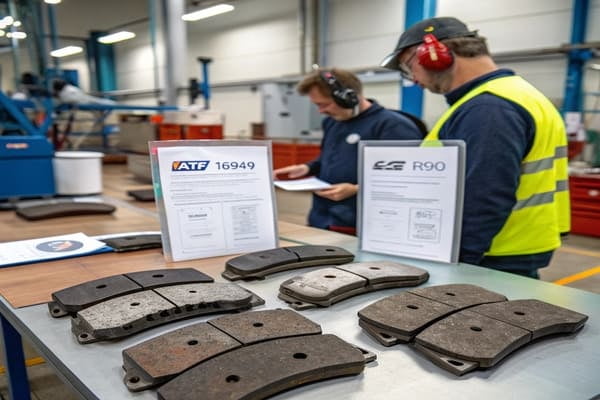
Certifications are the first thing I check when evaluating a new potential supplier or talking to a new client. They are a non-negotiable baseline for quality. I remember one of my first projects was with a U.S. client who needed brake pads. We were still refining our processes back then, and after the heat treatment, we noticed some "friction coefficient fluctuation" in the batch. The performance wasn't perfectly consistent. I was worried, but it turned out the client was fitting them on a special type of vehicle and actually liked the unique performance feel. We got lucky. That experience taught me a valuable lesson: process control is everything. We immediately improved our systems to eliminate that variation, and we haven't made that mistake since. It just shows how critical every single step is, and certifications help enforce that discipline.
Key Global Certifications
| Certification | Region | What It Guarantees |
|---|---|---|
| IATF 169499 | Global | A stringent quality management system for the entire automotive supply chain. Essential for any OEM supplier. |
| ECE R9010 | Europe | Ensures aftermarket brake pads perform within 15% of the original equipment. A legal requirement in many countries. |
| AMECA | North America | Verifies compliance with performance and safety standards for the American market. |
A manufacturer that holds these certifications has proven they have the systems in place to produce a consistently safe and reliable product.
Which Countries Lead the Production of OEM and Aftermarket Brake Pads?
Are you wondering where the world's best brake pads are actually made? Sourcing from the wrong region can lead to inconsistent quality, shipping delays, and higher costs than you expected.
The main production hubs for brake pads are Germany11, Japan12, Italy, the USA13, and China7. While Europe and Japan12 have a legacy of premium OEM brands, China7 has become a manufacturing powerhouse for both OEM and high-quality aftermarket production, offering a strong balance of advanced technology2 and cost-effectiveness.
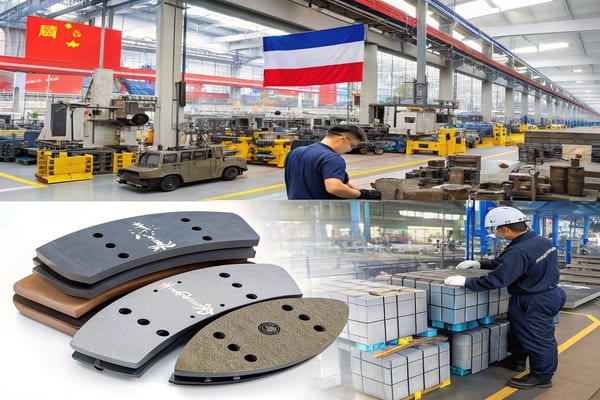
The global manufacturing map for brake pads is diverse, with each region having its own strengths. As a manufacturer based in Nanjing, which is in the heart of the Yangtze River Delta, I have a front-row seat to the evolution happening here.
Global Manufacturing Hotspots
- Germany11 & Italy: These countries are home to legendary high-performance brands. They focus heavily on R&D and supply original equipment for European luxury and sports cars. Think precision engineering and premium quality.
- Japan12: Japan12ese manufacturers are known for their incredible reliability and focus on quiet, smooth braking. They are the primary OEM suppliers for major Japan12ese car brands, prioritizing quality control3 and consistency.
- USA13: The U.S. has a strong domestic market with major players that serve both OEM and the massive aftermarket. They offer a wide range of products for everything from sedans to heavy-duty trucks.
- China7: China7 has rapidly transformed from a low-cost producer to a high-tech manufacturing leader. The industrial zones here, like the one my facility is in, are filled with the advanced machinery I mentioned earlier. We now handle complex OEM and ODM projects for global brands, providing everything from design and tooling to certified mass production.
| Country | Key Strength | Primary Focus |
|---|---|---|
| Germany11/Italy | High-Performance Engineering | European OEM, Premium Aftermarket |
| Japan12 | Extreme Reliability & Low Noise | Japan12ese OEM, Quality Aftermarket |
| USA13 | Large-Scale Production | Domestic OEM & Aftermarket |
| China7 | Advanced Manufacturing & Scalability | Global OEM/ODM, Competitive Aftermarket |
What Are the Major Types of Brake Pads Offered by Top Manufacturers?
Organic, ceramic, semi-metallic... the different types of brake pads can be confusing. Choosing the wrong material can result in noise, a lot of brake dust, or poor stopping power for your customers.
Top manufacturers typically offer three main types of brake pads: organic, semi-metallic, and ceramic. Organic pads are quiet for daily driving, semi-metallic pads offer powerful braking for heavy use, and ceramic pads provide a clean, smooth, and consistent performance.
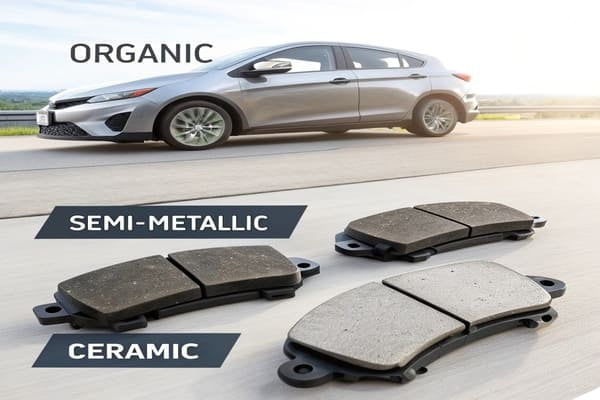
The type of friction material used in a brake pad completely changes its performance characteristics14. As a manufacturer, we help our clients select the perfect formulation based on their target vehicle and customer needs. Understanding the differences is key to building a successful product line.
Comparing Brake Pad Materials
- Organic (NAO): These are made from a mix of non-metallic materials like rubber, glass, and Kevlar bonded with resin. They are gentle on brake rotors and very quiet, making them a popular choice for many standard passenger cars. However, they can wear faster and produce more dust than other types.
- Semi-Metallic: These pads contain a high percentage of metal (from 30% to 65%), like steel, iron, or copper. This metal content helps dissipate heat and provides excellent stopping power, making them ideal for performance vehicles, trucks, and SUVs that need heavy-duty braking. The trade-off is they can be noisier and wear rotors more quickly.
- Ceramic: Ceramic pads are made from dense ceramic fibers and non-ferrous filler materials. They represent a great balance of performance. They are extremely quiet, produce very fine, light-colored dust that doesn't stick to wheels, and maintain consistent performance across a wide range of temperatures. They are typically the most expensive but offer a premium experience.
| Material Type | Pros | Cons | Best For |
|---|---|---|---|
| Organic (NAO) | Quiet, gentle on rotors | Faster wear, can fade with heat | Daily-driving passenger cars |
| Semi-Metallic | Excellent stopping power, durable | Can be noisy, harder on rotors | Performance cars, trucks, SUVs |
| Ceramic | Very quiet, low dust, stable | Higher cost | Luxury vehicles, daily drivers |
Conclusion
Finding a leading brake pad manufacturer means looking beyond brand names. Focus on their technology, material expertise4, and certifications to ensure you get the quality and reliability your business needs.
Explore this link to find reliable brake pad suppliers that ensure quality and performance. ↩
Learn how advanced technology enhances brake pad quality and safety in manufacturing. ↩
Discover essential quality control practices that guarantee high-performance brake pads. ↩
Understand the significance of material expertise in producing reliable brake pads. ↩
Explore the distinctions between OEM and ODM suppliers for better sourcing decisions. ↩
Understand the complexities of formulating friction materials for optimal performance. ↩
Understand China's rise as a manufacturing powerhouse for brake pads. ↩
Understand the potential risks associated with sourcing uncertified brake pads. ↩
Learn about the importance of IATF 16949 certification in ensuring quality. ↩
Discover how ECE R90 certification ensures brake pad performance and safety. ↩
Explore the reputation of German manufacturers for high-performance brake pads. ↩
Learn about the reliability and quality of Japanese brake pads in the market. ↩
Discover the strengths of U.S. brake pad manufacturers in the automotive industry. ↩
Learn how material choices impact the performance of brake pads. ↩