
Choosing a brake pad supplier is a critical business decision. A wrong move can lead to quality issues, customer complaints, and a damaged reputation. It's a risk.
The best brake pad manufacturers in 2026 combine advanced material science, precision manufacturing, and strict quality control. Choosing the right supplier means evaluating their production capabilities, certifications, and ability to meet your specific market needs, whether for OEM, aftermarket, or specialized vehicles.
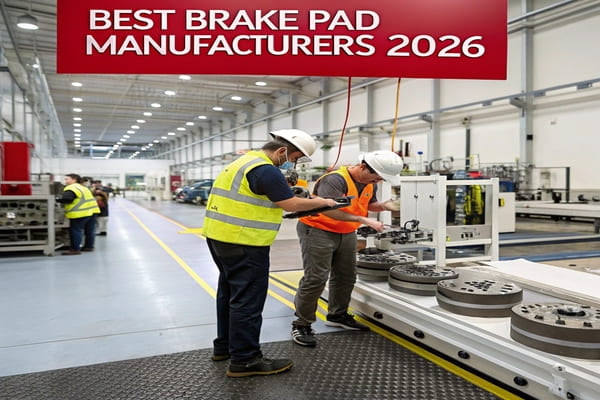
But finding that perfect supplier is about more than just looking at a catalog or a price list. The real value is in their process, their expertise, and their ability to be a true partner. Let's break down exactly what you need to look for to secure a partnership that drives your business forward and protects your brand.
What Key Qualities Separate a Reliable Brake Pad Manufacturer From the Rest?
Are you unsure what to look for in a new supplier? Picking the wrong one can lead to inconsistent products, supply chain headaches, and constant problems for your business.
A reliable manufacturer excels in three key areas: consistent material formulation, precision in the manufacturing process, and rigorous quality control. They invest in advanced machinery, like high-precision hot presses and vacuum mixers, and can prove their product's performance through testing and certifications.
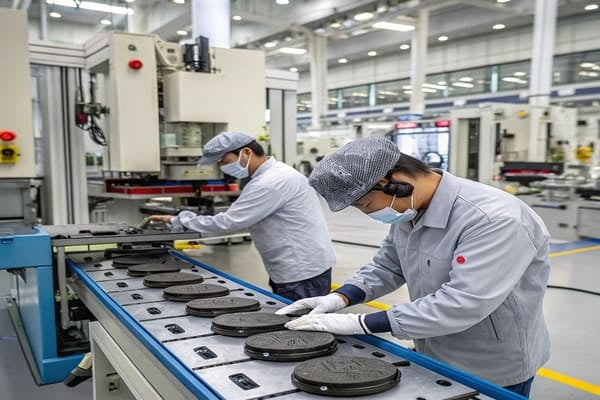
Making a quality brake pad is much harder than most people think. It's not something you can do with basic equipment. The precision required, especially from the hot-pressing machines, is incredibly high. From my experience, the best factories with this level of machinery are typically found in China's Yangtze River Delta and around the Guangrao area in Shandong. A small workshop just can't achieve the required accuracy.
I learned this the hard way. Early in my career, I took on a project for an American client who needed pads for special engineering vehicles. We were still learning, and our process wasn't perfect. The most difficult step in making brake pads is the "high-temperature isothermal curing," and another major challenge is the "vacuum mixing of friction materials." When you mix the materials, you have to stop the machine and open the silo, which can make it difficult to get a perfectly uniform blend. In our first batch for that client, we saw a pretty serious "friction coefficient fluctuation" after the pads were cured. I thought the project was a failure, but luckily, the client's vehicles actually performed better with this slight inconsistency. We got lucky, but it was a huge lesson. Now, our process is perfected to ensure absolute consistency.
| Key Manufacturing Process | Why It's Critical for Quality |
|---|---|
| Friction Material Vacuum Mixing | Ensures every pad has the same ingredients, providing consistent braking feel and preventing premature wear. |
| High-Precision Hot Pressing | Guarantees the correct density and structural integrity of the pad, which is vital for its lifespan and performance under pressure. |
| High-Temperature Isothermal Curing | Creates a stable friction coefficient, reduces brake fade under heavy use, and ensures the pad performs reliably in all conditions. |
How Is the Global Brake Pad Market Changing With New Materials and EV Requirements?
The auto industry is changing faster than ever. Are your products keeping up with new trends like electric vehicles and strict environmental rules? Sticking with old technology is falling behind.
The market is shifting towards low-copper or copper-free ceramic and organic materials to meet environmental regulations. For electric vehicles (EVs), the focus is on reducing brake dust and noise, and developing pads optimized for regenerative braking systems, which changes wear patterns and material requirements.
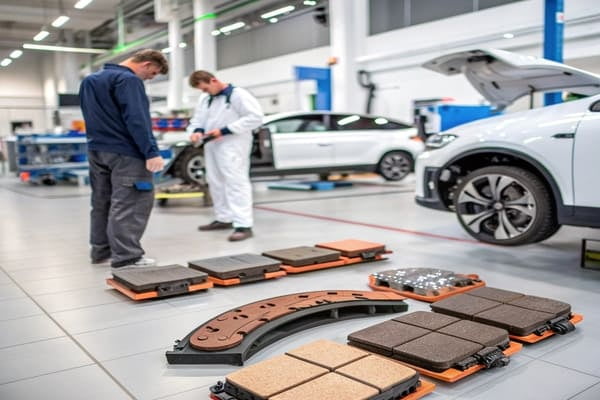
The move away from traditional materials is a big deal. For years, semi-metallic pads were the standard, but the copper in them is harmful to the environment, especially aquatic life. New regulations, particularly in places like California, are forcing the industry to adopt copper-free formulas. This has led to a huge rise in the popularity of NAO (Non-Asbestos Organic) and advanced ceramic formulations. These materials not only comply with the new laws but also offer great performance, low noise, and less dust.
Electric vehicles have completely changed the game for brake pads.
- Regenerative Braking: EVs use their motors to slow down, which means the physical brake pads are used much less often. When they are needed, however, they have to work perfectly and instantly. This creates a new challenge: corrosion. Pads can rust from moisture and disuse, so they need special coatings and materials to stay ready.
- Noise, Vibration, and Harshness (NVH): Without a loud gasoline engine, every little squeak and squeal from the brakes is noticeable. EV owners expect a silent ride, so manufacturers like us have to engineer pads that are exceptionally quiet.
- Brake Dust: Many EVs have aerodynamic wheels that make brake dust very visible. Low-dust ceramic formulas are now essential for maintaining a clean, premium look.
As an OEM and ODM supplier, we work with clients to develop custom formulations specifically to meet these new demands for both eco-friendly and EV applications.
Which Brake Pad Manufacturers Lead the Industry in OEM, Aftermarket, and Heavy-Duty Segments?
Different markets require very different products. A one-size-fits-all supplier can't meet the specific demands of OEM, aftermarket, or heavy-duty applications. Choosing the wrong one costs you sales.
In the OEM space, brands like Akebono and TRW are trusted by carmakers for quality and consistency. The aftermarket is led by giants like Bosch and Brembo, offering a range of options. For heavy-duty, companies specializing in robust, high-temperature materials are the go-to suppliers.
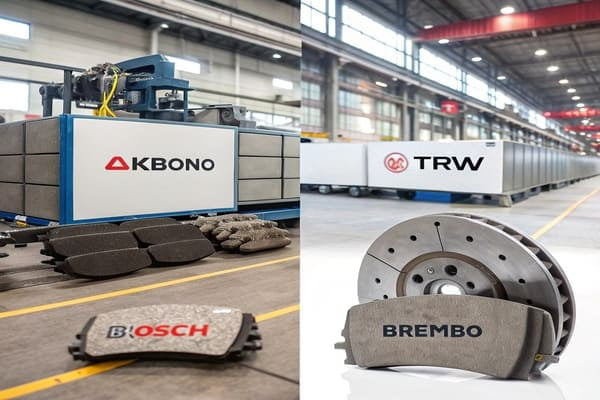
Understanding the differences between these market segments is key to choosing the right partner for your business. Each one has unique priorities and challenges. As a manufacturer that serves all three, we have to be experts in balancing these different needs for our clients.
The OEM (Original Equipment Manufacturer) Market
This is all about precision and trust. When a car company like Toyota or Ford chooses a supplier, they need to know that every single part will be identical and meet their exact specifications. The development process is long and involves intense testing for performance, durability, and especially NVH. The goal is to create a part that integrates perfectly with the vehicle from day one. In our OEM projects, we work hand-in-hand with automotive brands to engineer solutions from the ground up.
The Aftermarket
The aftermarket is driven by choice, availability, and value. Here, a brand might offer several tiers of products—a budget-friendly option, a standard OEM-equivalent, and a premium performance pad. The key to success is offering a reliable product that mechanics and consumers trust. Branding, packaging, and having a strong distribution network are just as important as the product itself. We help our clients build their private-label brands for this market, developing different formulas to hit specific performance and price targets.
The Heavy-Duty Segment
This segment is for trucks, buses, and industrial machinery. The demands are extreme. Brake pads for these vehicles have to withstand incredible heat and pressure while stopping immense weight, over and over again. Durability and safety are the only things that matter. The materials are typically robust semi-metallic or specialized composites designed for high-temperature performance. The manufacturing process is even more demanding, as these pads are much larger and thicker than those for passenger cars.
What Makes Top Brands Like Brembo, Akebono, Bosch, and TRW Stand Out in 2026?
You see these big brand names everywhere in the industry. But what do they actually do that makes them market leaders? It’s not just marketing; it comes down to a few core strengths.
Top brands stand out through massive investment in R&D, global manufacturing footprints, and strong brand trust built over decades. They lead in material innovation, maintain strict quality control across all plants, and have deep relationships with the world's largest automakers, setting industry standards.
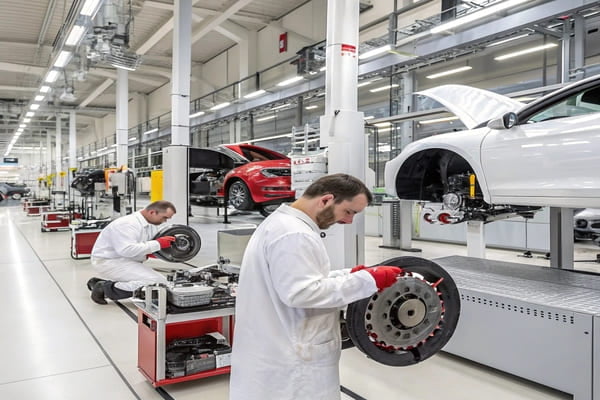
Each of these top-tier brands has carved out a specific area where they dominate, and their strategies provide a great roadmap for any business in the auto parts industry. As an OEM/ODM manufacturer, we study what they do to help our clients build their own competitive advantages.
Brembo: The Performance Leader
When you think of high-performance racing or luxury sports cars, you think of Brembo. Their entire brand is built on a reputation for incredible stopping power, resistance to brake fade, and cutting-edge technology. They are an aspirational brand that signifies the best in performance.
Akebono: The OEM Specialist
Akebono is a giant in the OEM world, especially for Japanese and North American car manufacturers. They are the masters of refinement. Their specialty is creating ultra-quiet, smooth, and low-dust ceramic brake pads that provide the comfortable driving experience that carmakers want for their new vehicles.
Bosch: The Global Aftermarket Giant
Bosch's strength is its sheer scale and engineering depth. They offer a massive catalog of parts for nearly every car on the road, available all over the world. They provide reliable, high-quality parts for the aftermarket at various price points, backed by a name that mechanics and consumers trust.
TRW (Part of ZF): The Safety and Systems Integrator
TRW is a massive OEM supplier that thinks beyond just the brake pad. They focus on total vehicle safety, ensuring their braking components work flawlessly with modern electronic systems like ABS and stability control. Their strength is this holistic, integrated approach to vehicle dynamics and safety.
Conclusion
Choosing the right brake pad manufacturer means looking at their process, materials, and market focus. Partner with an expert to ensure your business gets the quality and reliability it needs.