
Trying to supply parts to Tesla feels impossibly complex. The high standards can be overwhelming, but understanding their system is the first step to getting your foot in the door.
Tesla’s supply chain1 is a carefully balanced mix of in-house manufacturing and a global network of specialized suppliers. Key partners provide critical components like battery cells2 and electronics under extremely strict quality and logistical controls3, making it a highly integrated and demanding system.
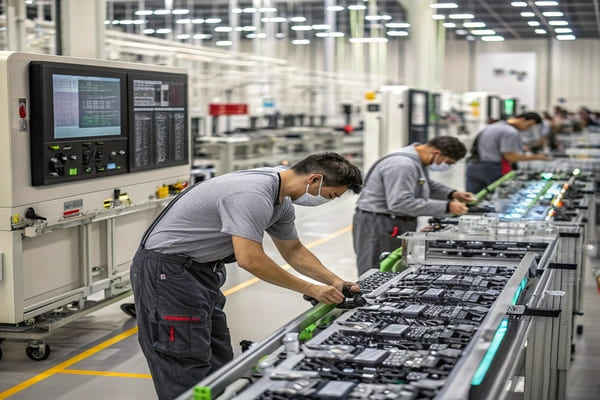
It's more than just a list of company names. The way Tesla manages its suppliers is a masterclass in modern manufacturing, a system built on precision, speed, and absolute control. To truly grasp how it works, you have to look beyond the surface. Let's break down what it really means to be part of this exclusive automotive network4.
What Does “Tesla Parts Supplier” Actually Mean in the Real Automotive Supply Chain?
The term "supplier" seems simple, but for Tesla, it means something entirely different. Misunderstanding this distinction can lead to failed partnerships and a lot of wasted resources for your business.
A Tesla parts supplier is a company that meets extreme standards for quality, traceability, and logistics. They are not just vendors; they are deeply integrated partners in a synchronized system5, often categorized as Tier-1 (direct) or Tier-2 (indirect) suppliers.

Becoming a supplier for a company like Tesla isn't about just having a good product. The level of integration and precision they demand is on another level. From my experience, many ordinary parts manufacturers simply can't meet the standards for accuracy and compliance. The entire supply chain operates with at least three core processes, but the hardest one is ensuring complete parts quality traceability from start to finish. This requires a level of data management and process control6 that is incredibly difficult to achieve. It’s no surprise that the manufacturers who can successfully integrate into this system are often concentrated in highly advanced industrial hubs7, like China’s Yangtze River Delta and the areas around Shenzhen. These regions have the infrastructure and technical expertise to build such a high-precision supply chain. For smaller, less specialized parts makers, meeting these requirements is almost impossible.
| Supplier Tier | Role in Tesla's Supply Chain | Key Requirements |
|---|---|---|
| Tier-1 | Directly supplies assembled components or systems to Tesla's factories (e.g., seats, brake systems). | JIT (Just-In-Time) delivery, deep system integration, perfect quality, full traceability. |
| Tier-2 | Supplies sub-components or materials to Tier-1 suppliers8 (e.g., foam for seats, sensors for brake systems). | High-quality standards set by Tier-1, stable production, cost-efficiency. |
| Tier-3/Raw Material | Provides the basic raw materials (e.g., lithium, aluminum, plastic resins) to Tier-2 suppliers9. | Long-term supply contracts10, ethical sourcing11, price stability. |
Which Tesla Components Are Made In-House vs Outsourced to External Suppliers?
Tesla is famous for its vertical integration12, but what do they actually make themselves? Assuming everything is built in-house is a common mistake that can cost you business opportunities.
Tesla manufactures core technology13 like battery packs, electric motors, and its unique software in-house. However, it strategically outsources battery cells2, semiconductors, displays, seating, and many chassis parts to specialized suppliers to leverage their expertise and scale.
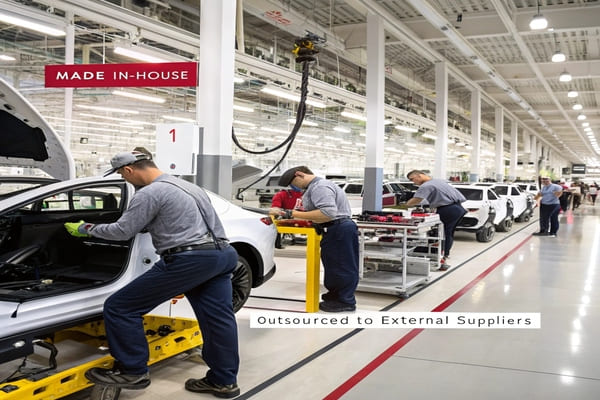
Tesla's strategy is all about control. They keep the technology that defines their cars—the "brains" and the "heart"—under their own roof. This includes the battery pack design and assembly (though not the individual cells), the powerful electric motors, and the software that runs the entire vehicle. They even brought body manufacturing to a new level with the Giga Press14 for large single-piece castings. But they are also practical. They don't try to reinvent the wheel for every single part. For components where other companies have decades of experience and massive economies of scale, Tesla outsources. This includes things like tires, glass, brake calipers, and interior seating. One of the biggest challenges in this model is matching the production rhythm with inventory levels. It’s an incredibly dynamic process. To properly match supply with demand, the entire data system needs to be opened up, which can temporarily halt the flow and create logistical hurdles. This constant balancing act between in-house production and external supply is a huge coordination challenge.
| Component Type | In-House (Made by Tesla) | Outsourced (Made by Suppliers) |
|---|---|---|
| Core Technology | Electric Motors, Battery Pack Assembly, Powertrain Control Units, Autopilot Software, Infotainment OS | Battery Cells, Semiconductors (AI Chips, Processors), Large-Screen Displays |
| Chassis & Body | Large Body Castings (Giga Press14), Some Stamped Panels | Brake Systems, Suspension Components, Axles, Bearings, Wheels, Tires |
| Interior | - | Seats, Airbags, Steering Wheels, Interior Trim, Carpets |
| Exterior | - | Windshields & Glass, Mirrors, Lighting Assemblies, Paint |
Who Are Tesla’s Tier-1 and Tier-2 Parts Suppliers by Component Category?
To find your place in the ecosystem, you need to know the key players. Trying to navigate Tesla's supply chain without this knowledge is like shooting in the dark.
Key Tier-1 suppliers8 include Panasonic, LG, and CATL for battery cells2, Bosch for critical electronic modules, and Brembo for performance brakes. Tier-2 suppliers9 provide the sub-components and materials that feed into these larger partners, creating a complex global network.
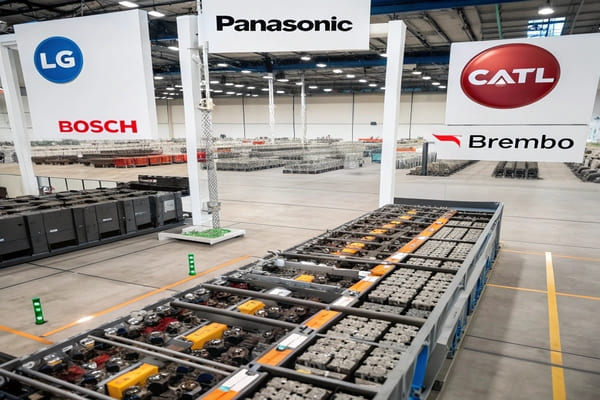
I learned firsthand just how demanding this supply chain is. Early in my career, we worked with a client from Pakistan on a supply chain integration15 project. I was less experienced then, and we faced serious delivery delays because we underestimated the complexity of synchronizing everything. We were worried it would ruin the relationship. However, the client was so impressed with the high quality and precision of the parts themselves that they were more than happy to overlook the initial delays. That experience taught me a critical lesson: in Tesla’s world, quality is not just a goal, it’s the price of entry. Since then, we have perfected our processes and never made that mistake again. This network is a web of specialists. For example, while Tesla designs the battery pack, the actual cells inside come from giants like Panasonic or CATL. This allows Tesla to focus on its core tech while leveraging the massive production scale of its partners.
| Component Category | Key Tier-1 & Tier-2 Suppliers |
|---|---|
| Battery & Powertrain | Panasonic (Japan), LG Energy Solution (S. Korea), CATL (China) for battery cells2. |
| Electronics & Autopilot | NVIDIA (USA) for AI chips, Samsung (S. Korea) for camera modules, Bosch (Germany) for radar sensors. |
| Chassis & Braking | Brembo (Italy) for performance brake systems, ZF Friedrichshafen (Germany) for steering components. |
| Interior & Displays | Adient (USA) for seats, LG Display (S. Korea) for the central touchscreen. |
Which Companies Supply Critical Materials Like Lithium, Nickel, and Aluminum to Tesla?
Electric cars are built from very specific raw materials. The supply of these metals is often volatile, and it affects the price and production of every vehicle made.
Tesla sources critical raw materials16 from a global network of mining companies. Lithium comes from firms like Ganfeng Lithium and Albemarle, nickel is supplied by Vale, and aluminum is secured through direct deals with producers like Rio Tinto.
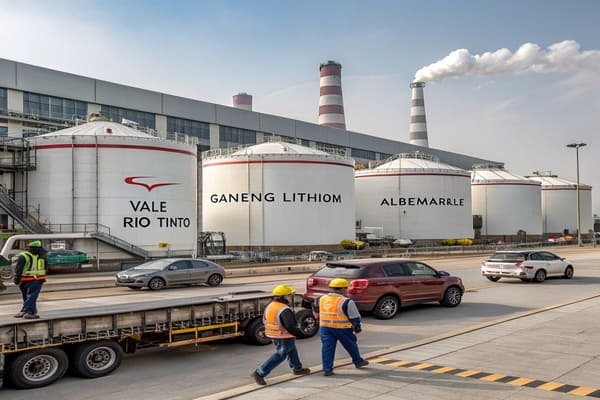
This is the very foundation of the EV supply chain. To protect itself from price swings and shortages, Tesla often goes straight to the source, signing long-term deals directly with mining companies. This strategy cuts out intermediaries and gives them a more stable and predictable supply of the materials they need most. For example, they secure lithium, the key ingredient in their batteries, from major players in China and the Americas. For nickel, another critical battery component, they've signed agreements with companies in Brazil and Australia. They've also worked to reduce their reliance on cobalt, which has a notoriously difficult and ethically-challenged supply chain, by developing new battery chemistries. As a parts manufacturer, we may not buy raw lithium directly, but the stability of its supply chain impacts us deeply. It affects the cost and availability of the components we produce, like battery management systems17, onboard chargers, and wiring harnesses. Understanding this raw material landscape is crucial for anticipating market shifts.
| Raw Material | Key Corporate Suppliers | Major Sourcing Countries |
|---|---|---|
| Lithium | Ganfeng Lithium, Albemarle, Livent | China, Chile, Australia, USA |
| Nickel | Vale S.A., BHP Group, Talon Metals | Brazil, Australia, Indonesia, Canada |
| Cobalt | Glencore | Democratic Republic of Congo, Australia |
| Aluminum | Rio Tinto, Alcoa | Canada, Russia, USA |
Conclusion
Tesla's supply chain is a demanding system of in-house innovation and strategic partnerships. Success requires extreme precision, traceability, and a deep understanding of every tier in the network.
Explore how Tesla's supply chain operates to understand its complexity and efficiency. ↩
Learn about the major players in battery cell supply, crucial for Tesla's production. ↩
Discover the importance of quality and logistics in maintaining supply chain integrity. ↩
Explore the dynamics of being part of a complex automotive supply network. ↩
Learn about the importance of synchronization in effective supply chain management. ↩
Understand how process control ensures quality and efficiency in manufacturing. ↩
Explore how advanced industrial hubs contribute to high-precision manufacturing. ↩
Find out which companies are critical partners in Tesla's supply chain. ↩
Understand the significance of Tier-2 suppliers in supporting Tier-1 partners. ↩
Learn about the role of long-term contracts in stabilizing supply chains. ↩
Discover the significance of ethical sourcing in the supply chain for sustainability. ↩
Learn how vertical integration benefits Tesla's manufacturing and supply chain. ↩
Explore the technologies Tesla keeps in-house to maintain competitive advantage. ↩
Find out how the Giga Press revolutionizes Tesla's manufacturing process. ↩
Understand the concept of supply chain integration and its impact on efficiency. ↩
Discover the essential materials that power electric vehicles like Tesla. ↩
Understand the role of battery management systems in electric vehicle performance. ↩