
Identifying the top automotive lighting suppliers1 can be confusing. Choosing the wrong partner can hurt your brand. We'll break down the key players leading the market right now.
The global automotive lighting industry is led by a handful of Tier 1 giants2, including Koito3, Valeo4, Marelli5, Hella (Forvia)6, and Stanley Electric7. These companies dominate the OEM market8, but leadership in specific technologies like adaptive lighting9 or interior systems10 varies among them.
The names I just mentioned are the titans of the industry. They have massive factories and deep relationships with the world's biggest car brands. But to really understand the market, you need to look closer at the technologies they develop and the specific segments they control. Let's dive into the details to see who is leading in which areas.
How Has the Automotive Lighting Market Evolved Toward LED, Matrix, and Laser Technologies?
Old halogen lights look dated on modern vehicles. If your products use old tech, they might seem behind the times. Let's look at the evolution to today's advanced systems.
The market has moved from basic halogen to brighter HID xenon11, and then to highly efficient and flexible LEDs. Now, the industry is driven by Matrix LED12, Adaptive Driving Beam (ADB)13, and laser technologies14, which offer huge gains in safety, design freedom, and performance.
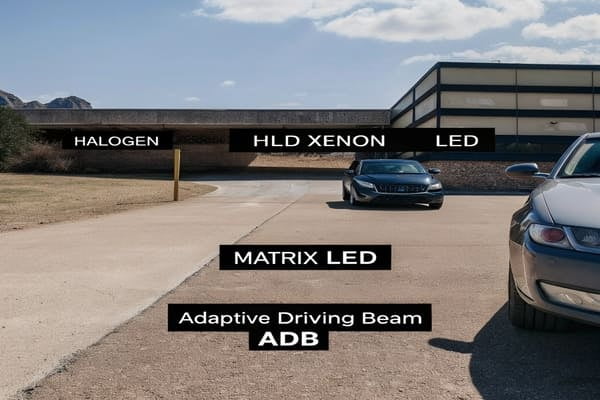
The journey of automotive lighting has been incredible to watch. For decades, the simple halogen bulb was the standard. It was cheap and did the job. The first big change was the introduction of High-Intensity Discharge (HID) or Xenon lights. They offered a much brighter, whiter light and gave cars a more premium look. Then came the LED revolution. LEDs changed everything. They are incredibly energy-efficient, last for the entire life of the vehicle, and are very small. This small size gave designers the freedom to create the signature headlamp and tail light designs we see today. Now, we are in the era of smart lighting. Technologies like Matrix LED12 and ADB use dozens of individually controlled LEDs to shape the light beam in real-time. This allows drivers to use their high beams all the time without blinding other cars. At the very top end, laser headlights use a laser to create an intensely bright and long-range beam, pushing visibility further than ever before.
Which Global Manufacturers Dominate the Headlamp and Exterior Lighting Segment?
The exterior lighting market seems crowded. It can be hard to tell which companies truly control the OEM supply chain. Here are the manufacturers that dominate the segment.
The "Big Five" global manufacturers dominate exterior lighting: Koito3 (Japan), Valeo4 (France), Marelli5 (Italy/Japan), Hella (Forvia, Germany), and Stanley Electric7 (Japan). Together, they hold a massive share of the OEM market8 for headlamps, tail lights, and signal lamps.
These companies are on top for a reason. They have huge R&D budgets, global manufacturing footprints, and decades-long relationships with carmakers. But the barrier to entry is also extremely high because making these parts is incredibly difficult. From my own experience, the precision required for injection molding a headlamp lens is far beyond what a standard machine can do. The hardest step is polishing the optical lens. I remember our first project with a German client where we had issues with "light transmission distortion" after polishing. Luckily, they were fitting the part to a high-end vehicle and actually liked the unique effect, but it taught us a hard lesson about precision. Even the process of applying the reflective coating inside the reflector bowl is a challenge. You have to open the mold, which makes maintaining a perfect vacuum environment very tough. These technical hurdles are why only a few large, experienced companies can consistently deliver the quality and scale that automakers demand.
| Manufacturer | Home Country | Key Strengths |
|---|---|---|
| Koito3 | Japan | Global market leader, dominant in Asia |
| Valeo4 | France | Strong in Europe, leader in lighting technology |
| Marelli5 | Italy/Japan | Strong OEM ties, global production network |
| Hella (Forvia)6 | Germany | Leader in electronics and lighting integration |
| Stanley Electric7 | Japan | Expert in automotive and motorcycle lighting |
What Companies Are Driving Innovation in Adaptive, ADB, and Smart Lighting Systems?
Static headlights that just turn on and off are becoming obsolete. Your competitors are offering smarter, safer lighting systems. Let's see which companies are leading the charge.
Hella (Forvia)6, Valeo4, and ZKW Group (owned by LG) are at the forefront of adaptive and smart lighting. They lead in developing Adaptive Driving Beam (ADB)13 and other systems that integrate cameras, sensors, and software to react intelligently to the driving environment.
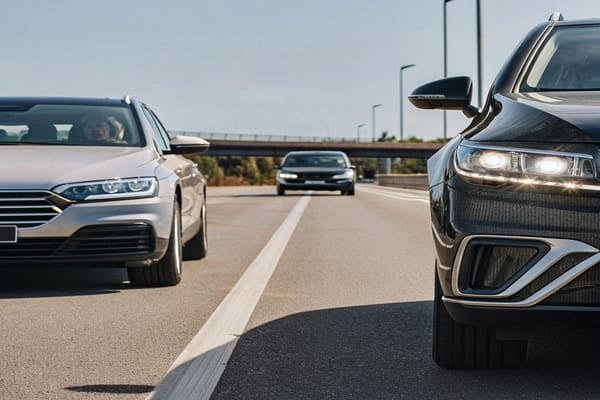
Smart lighting is about much more than just illumination. It's about perception, reaction, and communication. The key technology here is Adaptive Driving Beam, or ADB. These systems use a forward-facing camera to detect other vehicles. The system's processor then tells individual LEDs in the headlamp to turn off or dim, creating a "dark box" around the other car. This keeps the high beams on for the driver, lighting up the rest of the road, without dazzling anyone else. The next step in this evolution is Digital Light. Companies like Valeo4 and Hella are using Digital Micromirror Devices (DMDs), similar to what's in a movie projector, to control millions of pixels of light. This allows the headlights to not only illuminate the road but also project warning symbols, lane markings, or other helpful information directly onto the pavement. This level of innovation requires deep expertise in optics, electronics, and software, which is why a few highly specialized Tier 1 suppliers are leading the way.
Which Suppliers Lead in Interior Ambient Lighting and Human-Machine Interface Illumination?
A car's interior is now a key selling point. A dull, poorly lit cabin can make an otherwise great vehicle feel cheap. Let's find out who leads in creating amazing interior light.
Companies like Hella (Forvia)6, Valeo4, and OSRAM (ams OSRAM) are leaders in interior ambient lighting15. They provide complete, customizable LED systems that integrate with a vehicle's controls to enhance the cabin's feel and communicate information to the driver.
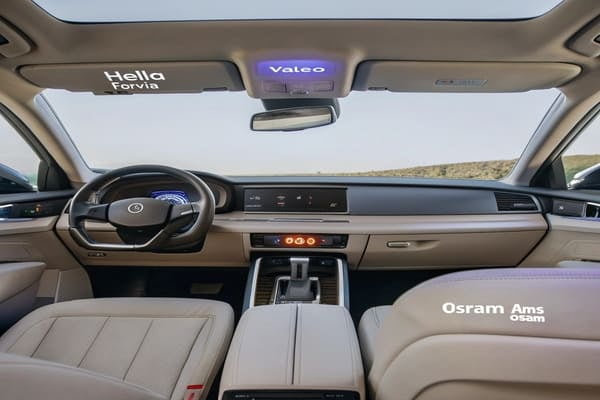
Interior lighting has gone from a simple dome light to a sophisticated experience. It now serves two main purposes. The first is aesthetics. Multi-color, dynamic ambient lighting15 can make a cabin feel more spacious, luxurious, and personalized. Brands like Mercedes-Benz have made it a core part of their brand identity. The second purpose is function. Lighting is becoming a key part of the Human-Machine Interface (HMI)16. For instance, a light strip in the door panel might flash red to warn you of an approaching cyclist when you go to open the door. Or, the dashboard lighting might pulse green to show the charging status of an electric vehicle. The technology behind this involves advanced RGBW LEDs17, complex light guides to distribute the light evenly, and sophisticated control modules. The challenge is ensuring perfect color and brightness consistency across the entire cabin, which is why automakers turn to experienced suppliers like Hella and OSRAM for complete, integrated solutions.
How Do European, Japanese, and North American Lighting Giants Compare in Capabilities?
Not all global lighting suppliers are the same. Regional strengths and priorities can impact their technology and business approach. Let's compare the giants from each major region.
Generally, European suppliers like Hella and Valeo4 lead in advanced electronics and smart systems. Japanese giants like Koito3 and Stanley excel at high-volume, high-quality manufacturing. North American suppliers often focus on the domestic truck and SUV market and aftermarket segments.
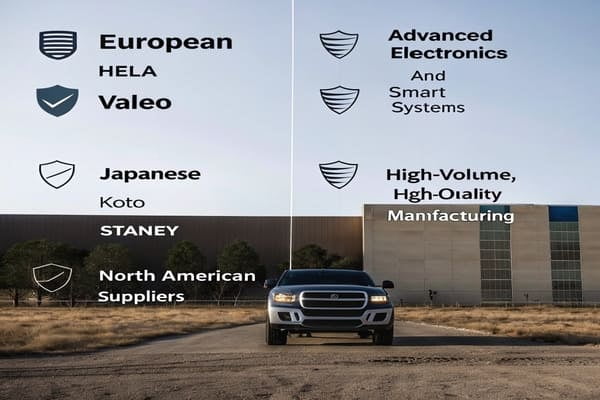
The "best" supplier often depends on what a carmaker is looking for. Each region has its own distinct strengths, shaped by its local auto industry. European suppliers work closely with premium German brands, so they are often the first to market with cutting-edge technology like Matrix LED12, ADB, and digital projection systems18. They are masters of electronics and software integration. Japanese suppliers, on the other hand, are famous for their manufacturing process excellence. They are experts in lean manufacturing, quality control, and producing reliable lighting systems at a massive scale for global automakers. In North America, while there are fewer giant lighting-specific suppliers, larger Tier 1s like Magna have strong lighting divisions. They are very good at integrating lighting into the large body structures of trucks and SUVs, which dominate the local market. The choice for an automaker comes down to their priority: bleeding-edge technology from Europe, unmatched production scale from Japan, or integrated solutions for the North American market.
| Region | Key Players | Core Strengths |
|---|---|---|
| Europe | Hella (Forvia)6, Valeo4, ZKW | Technology leadership, electronics, ADB/Matrix systems |
| Japan | Koito3, Stanley Electric7 | Manufacturing excellence, high-volume quality, reliability |
| North America | Magna, Flex-N-Gate | System integration, focus on trucks and SUVs, strong aftermarket |
Conclusion
The automotive lighting world is led by a few giants, but innovation never stops. Choosing the right OEM/ODM manufacturing partner with deep technical expertise is absolutely crucial for success.
Explore this link to discover the leading suppliers shaping the automotive lighting market. ↩
Learn about the major players in automotive lighting and their market influence. ↩
Find out how Koito leads the market and its impact on automotive lighting technology. ↩
Discover Valeo's contributions to lighting technology and its market position. ↩
Explore Marelli's strengths and its role in the automotive lighting landscape. ↩
Learn about Hella's innovations and its significance in the lighting industry. ↩
Understand Stanley Electric's expertise and its impact on the lighting market. ↩
Understand the importance of the OEM market for lighting suppliers. ↩
Explore the concept of adaptive lighting and its benefits for modern vehicles. ↩
Discover the latest trends in interior lighting systems and their importance. ↩
Learn about the benefits of HID xenon technology in automotive lighting. ↩
Find out how Matrix LED technology enhances vehicle safety and performance. ↩
Learn about ADB technology and its role in improving driving safety. ↩
Discover the advancements laser technologies bring to automotive lighting. ↩
Explore how ambient lighting enhances the driving experience and vehicle appeal. ↩
Understand the connection between HMI and lighting in modern vehicles. ↩
Learn about RGBW LEDs and their role in creating dynamic lighting experiences. ↩
Discover how digital projection systems are changing the way we see the road. ↩