
Sourcing brake pads feels like a gamble. Poor quality leads to recalls and damages your brand. You need a partner you can trust to deliver consistent, safe products.
A reliable brake pad manufacturer1 in 2025 combines advanced manufacturing capabilities, high-quality raw materials2, and strict certifications like IATF 169493. They prove their quality through rigorous testing, ensuring every batch meets performance and safety standards for the global market.
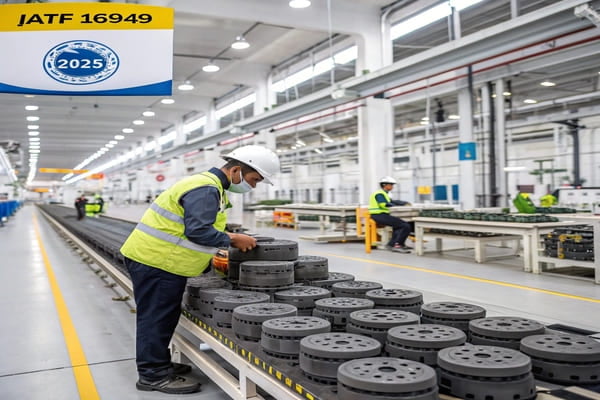
Finding a supplier like this isn't easy. You have to look beyond the price tag and ask the right questions to understand what's happening behind the factory doors. Let's break down exactly what you should be looking for. It all starts with their factory and what they can actually do.
What Manufacturing Capabilities Define a True Brake Pad Factory?
Many suppliers claim to be factories but are just assembly workshops. This lack of control leads to inconsistent quality. You need to know what real manufacturing looks like to avoid problems.
A true brake pad factory has in-house control over key processes like material mixing4, hot pressing, and high-temperature sintering5. They use high-precision machinery, not just basic equipment, to ensure every pad meets exact specifications for density, shape, and performance.
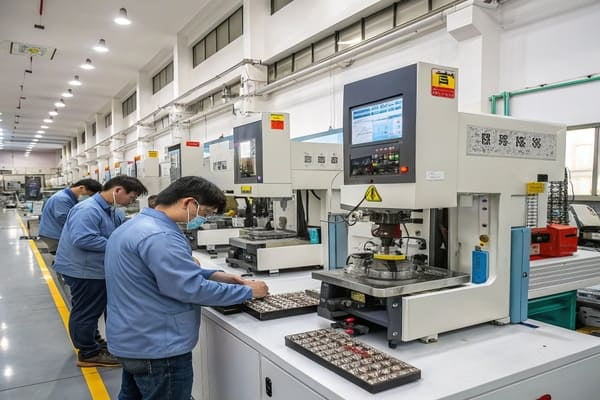
When I started in this business, I learned that making good brake pads is incredibly difficult. It’s not something you can do with basic equipment. The real test of a factory is its control over the most critical production steps.
The Importance of Precision Hot Pressing
A standard hot press machine just can't achieve the precision needed for modern brake pads. The process requires immense and even pressure to form the friction material correctly. We learned that the best machines for this work are typically made in specific industrial regions, like the Yangtze River Delta or around Dongguan. Factories using lower-grade machines, often from smaller workshops, usually struggle to meet the tight tolerances required. This can result in pads with inconsistent density, which directly impacts braking performance and wear.
The Sintering and Formulation Challenge
The hardest step is high-temperature sintering5. This is where the pad is baked to bond all the materials together. It requires extremely stable temperatures. Another tricky part is mixing the friction material formula6. When we add different materials to the mixer, the machine has to stop and the silo opens up. This can cause the temperature to fluctuate, which affects the final consistency of the material. A top-tier factory has systems in place to manage these temperature changes and ensure every batch of friction material is identical.
| Capability | True Factory (Reliable) | Assembly Workshop (Risky) |
|---|---|---|
| Material Mixing | In-house, proprietary formulas, temperature control | Buys pre-mixed compounds |
| Hot Pressing | High-precision, automated machines | Basic, manually operated presses |
| Sintering | Controlled, multi-stage ovens | Outsourced or uses simple ovens |
| Process Control | Fully integrated and monitored | Limited or no process control |
How Do Raw Materials Impact Brake Pad Performance and Lifespan?
Using cheap materials creates brake pads that wear out fast or fail completely. This puts drivers at risk and can destroy your brand's reputation. Choosing the right material mix is everything.
The raw material formulation is the heart of a brake pad. The choice of abrasives, binders, and fillers directly determines the friction coefficient, noise level, heat resistance, and lifespan. A reliable manufacturer has a deep understanding of material science.
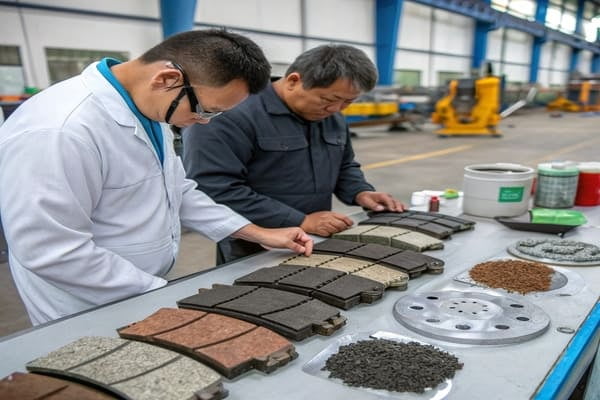
The formula for the friction material is a closely guarded secret for most top manufacturers. It's a delicate balance. I remember an early project with a German client where we were still refining our process. After sintering, the brake pads showed a slightly uneven friction coefficient. I was worried, but it turned out to be a lucky mistake. The client used them on heavy-duty vehicles, and the drivers actually preferred the braking feel. We learned a huge amount from that experience about how small changes in the formula can have big effects. We fixed the issue for standard vehicles, but it taught us to be experts in material science.
The Three Main Types of Materials
Most brake pads fall into one of three categories, and a good manufacturer should be able to produce all of them.
- Organic (NAO): These are made from a mix of fibers and fillers like rubber, glass, and Kevlar. They are quiet and easy on the rotors but wear faster and don't perform as well under high heat.
- Semi-Metallic: These contain 30% to 65% metal, like steel, iron, or copper. They offer excellent heat transfer and are very durable, but they can be noisy and wear down rotors more quickly.
- Ceramic: These are made from ceramic fibers, non-ferrous fillers, and a small amount of metal. They offer the best of both worlds: quiet operation, low dust, stable performance across a wide range of temperatures, and long life. They are also the most expensive to produce.
A skilled OEM partner can help you choose or develop the right formula for your target market and price point.
| Material Type | Noise Level | Dust Level | Stopping Power | Lifespan |
|---|---|---|---|---|
| Organic | Very Low | Low | Good | Fair |
| Semi-Metallic | High | High | Excellent | Good |
| Ceramic | Very Low | Very Low | Very Good | Excellent |
What Certifications Should a Qualified Brake Pad Manufacturer Hold?
A supplier's promises are worthless without proof. Uncertified parts can be blocked by customs or fail inspections. You need a partner with internationally recognized qualifications to protect your business.
A qualified brake pad manufacturer1 must have IATF 169493, the global standard for automotive quality management. Other key certifications include ISO 90017, ECE R908 for Europe, and AMECA9 for North America.
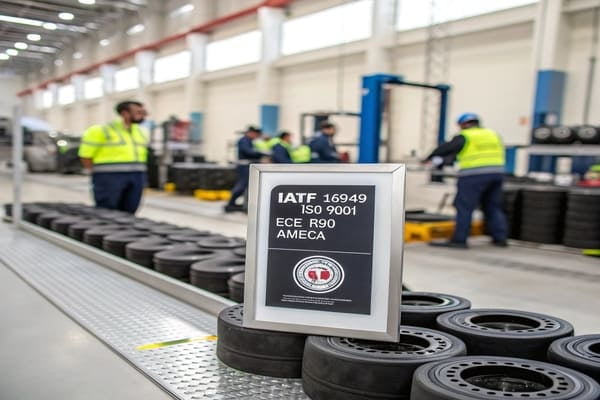
When you're importing auto parts, these certifications are not just nice to have—they are essential. They are proof that a manufacturer has a documented, repeatable, and traceable system for producing quality parts. Without them, you are taking a massive risk on every shipment. These documents show that a factory is serious about its quality and is committed to meeting global standards. It saves you from potential legal issues, customs delays, and quality failures down the road.
IATF 169493: The Automotive Gold Standard
This is the most important certification for any automotive parts supplier. It goes far beyond a basic quality standard like ISO 90017. IATF 169493 requires a manufacturer to have strong processes for risk management, contingency planning, and continuous improvement. It proves they operate at the same level as the world's top automotive companies. If a potential partner doesn't have this, I would be very cautious.
ECE R908: The European Benchmark
For anyone selling brake pads in Europe, this is a legal requirement. The ECE R908 standard dictates that aftermarket brake pads must perform within 15% of the original equipment (OE) part. The pads go through rigorous tests for speed sensitivity, cold performance, and friction behavior. A manufacturer with this certification has proven their products are a safe and reliable replacement for OE parts in the European market.
AMECA9: Access to the North American Market
In the United States, many states require brake pads to be registered with the Automotive Manufacturers Equipment Compliance Agency (AMECA9). This involves testing the friction material to ensure it meets specific performance and safety criteria. While not a federal law, it's a practical necessity for selling in North America. It shows the manufacturer has done its due diligence for that specific market.
How Does the Production Process Ensure Consistent Quality Control?
One good sample doesn't mean a good bulk order. Inconsistencies during mass production can lead to unreliable and dangerous products. You need a manufacturer with a process that guarantees quality every single time.
A robust production process10 uses quality gates at every single stage. This includes raw material inspection11, precise mixing, automated pressing12, controlled curing and sintering, and final finishing. This ensures every brake pad performs identically to the approved sample.
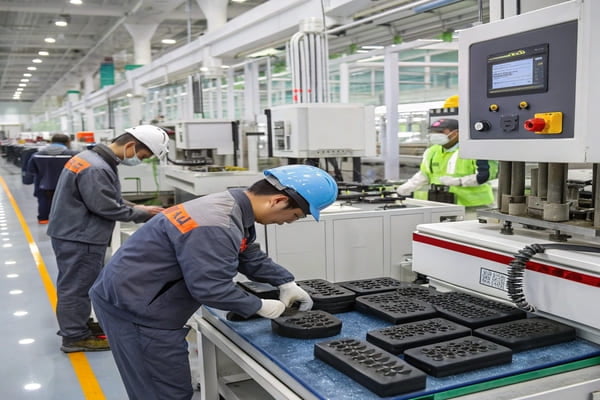
A reliable production line is all about control. Every step is an opportunity for something to go wrong, so a great manufacturer builds quality checks into the entire process, not just at the end. It's about preventing defects, not just catching them. For us, this means having documented procedures and automated checks from the moment raw materials arrive until the finished product is boxed. This is the only way to ensure that the 10,000th brake pad is exactly the same as the first one.
A Controlled Journey from Powder to Pad
Here's a simplified look at the key stages where quality control13 is critical:
- 1. Raw Material Inspection: Before anything begins, all incoming raw materials—the powders, resins, and fibers—are tested to confirm they meet our specifications. If the ingredients are wrong, the final product will be wrong.
- 2. Automated Mixing and Weighing: The friction formula is mixed in precise, computer-controlled batches. This eliminates human error and, as I mentioned, we use systems to manage temperature during this step to ensure a consistent compound.
- 3. Precision Hot Pressing: The mixed compound is pressed onto the backing plate under immense pressure and heat. Our machines monitor pressure, temperature, and time for every single pad to ensure uniform density.
- 4. Curing and Sintering: The pads are baked in long, multi-zone ovens. Each zone has a specific temperature profile to properly cure the pad and activate the binders. This step is monitored 24/7.
- 5. Finishing and Final Inspection: Finally, the pads are ground to the exact thickness, painted, and marked. Every pad goes through a final visual and dimensional inspection before it can be packaged.
What Testing Standards Prove a Manufacturer’s Reliability?
A manufacturer can claim their pads are great, but how do they really know? Without proper, standardized testing, you're just trusting their word. This is a huge risk for your business.
Reliable manufacturers prove their quality with extensive in-house and third-party testing. This includes dynamometer tests14 for friction performance (like SAE J2522), shear strength tests15, and noise/vibration/harshness (NVH) analysis to ensure safety, durability, and a smooth driving experience.
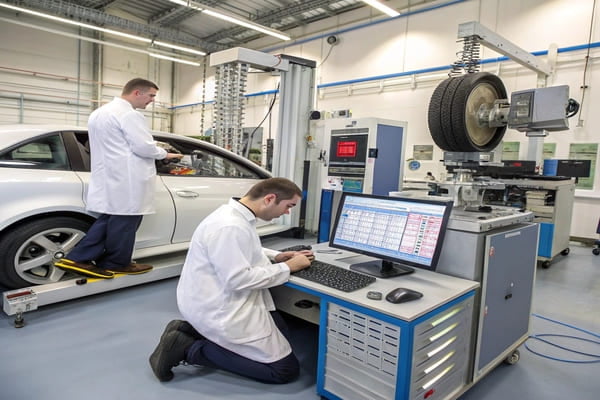
Data is everything. Claims are easy to make, but test results are hard proof. A serious manufacturer invests heavily in their own testing lab. This allows them to validate new formulas, perform quality control13 on production batches, and ensure they meet international standards. When you ask a potential supplier for test reports, they should be able to provide them immediately. If they hesitate or say they don't have a lab, it's a major red flag. It means they are not in full control of their product's performance.
Key Tests That Matter
You don't need to be a testing expert, but you should know what to ask for. These are the most important tests that separate the good from the bad.
- Dynamometer (Dyno) Testing: This is the most critical test. A dynamometer is a machine that simulates real-world driving and braking conditions. It measures the friction coefficient, fade resistance at high temperatures, and wear rate. Standards like SAE J2522 are used to get objective, repeatable data on how the pad will perform.
- Shear Strength Test: This test measures how strongly the friction material is bonded to the steel backing plate. It applies force to the pad until the material shears off. A high shear strength is critical for safety, as it prevents the friction block from detaching during heavy braking.
- NVH (Noise, Vibration, Harshness) Analysis: No one wants squealing brakes. NVH testing is done on a dyno or a real vehicle to identify and eliminate unwanted noise and vibration. A manufacturer that invests in NVH analysis16 shows a commitment to creating a high-quality end-user experience.
| Test Type | What It Measures | Why It's Important for You |
|---|---|---|
| Dynamometer Test | Friction, fade, and wear | Confirms stopping power and durability. |
| Shear Strength Test | Bond strength of friction material | Ensures the pad won't fall apart under pressure. |
| NVH Analysis | Brake noise and vibration | Guarantees a quiet, smooth product for your customers. |
Conclusion
Finding a reliable brake pad partner means looking for a true manufacturer with in-house capabilities, a deep knowledge of materials, key certifications, and a commitment to rigorous process control and testing.
Explore top manufacturers to ensure you partner with a reliable source for high-quality brake pads. ↩
Discover how quality materials impact performance and longevity of brake pads. ↩
Learn about this crucial certification that ensures automotive quality management and safety. ↩
Explore how proper mixing affects the final product's quality and performance. ↩
Gain insights into this critical step that ensures durability and performance of brake pads. ↩
Discover how the right formula affects braking performance and safety. ↩
Understand how this certification ensures quality management in manufacturing processes. ↩
Learn about this essential certification for brake pads sold in Europe and its implications. ↩
Explore the significance of AMECA certification for accessing the North American market. ↩
Gain insights into the critical steps that ensure high-quality brake pads. ↩
Understand how inspecting raw materials ensures the quality of the final product. ↩
Learn about the advantages of automation in achieving consistent product quality. ↩
Discover the processes that ensure consistent quality in brake pad production. ↩
Learn how these tests validate the performance and safety of brake pads. ↩
Understand the importance of this test in ensuring the safety and reliability of brake pads. ↩
Explore how NVH analysis contributes to a quiet and smooth braking experience. ↩