
Confused by all the different lights on your car's front end? Using the wrong one can be dangerous. Let's clarify what each light does to keep you safe.
The front lights on a car are a complete system designed for visibility and safety. This system includes headlights (low and high beam1s), daytime running lights (DRLs), turn signals2, and often fog lights. Each component works together so you can see the road and others can see you.
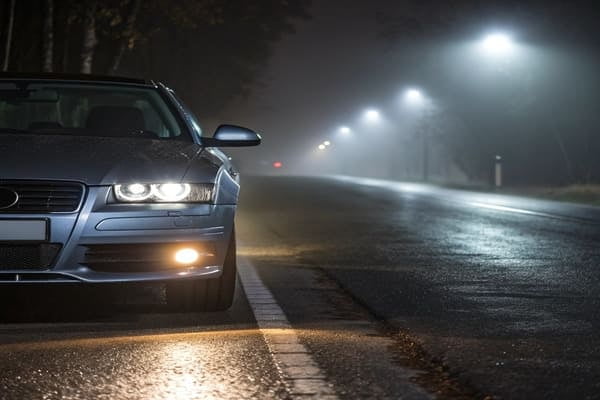
It’s easy to take your car’s front lights for granted. You flip a switch, and the road ahead lights up. But behind that simple action is a complex system of lights, each with a specific job. As someone who manufactures these systems for global brands, I know how much engineering goes into making them work perfectly. Understanding this system is not just for mechanics; it's crucial for every driver who wants to stay safe on the road. Let's break down each part of the forward lighting system3 so you know exactly what they are and how to use them.
What Are Front Lights on a Car and What Are They Officially Called?
Ever wondered about the official names for your car's front lights? Calling them by the wrong name can cause confusion, especially when you need to replace a part.
Officially, the assembly is called the "forward lighting system3." This includes headlamps4 (for high and low beam5s), daytime running lamps (DRLs), turn signals2, and front position lamps (or parking lights). Some vehicles also include front fog lamps6 as part of this system.
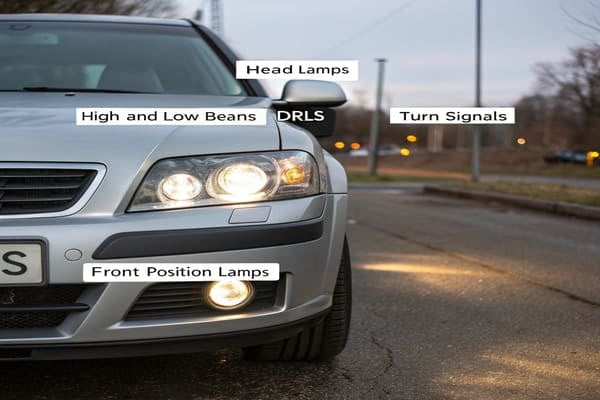
In the automotive parts industry, precision is everything. We don't just call them "front lights." We use specific terms because each component has a distinct function and is subject to different regulations, like those from the DOT in the US or ECE in Europe. Using the right name ensures you get the right part. For example, asking for a "headlight" might just get you the main beam unit, when what you really needed was the entire assembly with the integrated turn signal and DRL. This level of detail is critical in our OEM and ODM projects7 to make sure the final product is fully compliant and meets the client's exact specifications.
Key Components of the Forward Lighting System
| Official Name | Common Name | Primary Function |
|---|---|---|
| Headlamp (Low Beam) | Headlights, Dipped Beams | Illuminates the road ahead without dazzling oncoming traffic. |
| Headlamp (High Beam) | High Beams, Full Beams | Provides maximum illumination on empty roads. |
| Daytime Running Lamp | DRLs | Increases vehicle visibility during the day. |
| Front Position Lamp | Parking Lights, Sidelights | Marks the vehicle's position when parked or in low light. |
| Turn Signal Lamp | Blinker, Indicator | Signals your intention to turn or change lanes. |
| Front Fog Lamp | Fog Lights | Improves visibility in fog, heavy rain, or snow. |
Are Headlights the Same as Front Lights or Just One Part of the System?
Many people use "headlights" and "front lights" to mean the same thing. This common mistake overlooks other critical safety lights that are part of the same system.
Headlights are just one part of the front light system. The term "front lights" describes the entire group of lights at the front, including turn signals2 and DRLs. Headlights specifically refer to the main low and high beam1s used for driving at night.
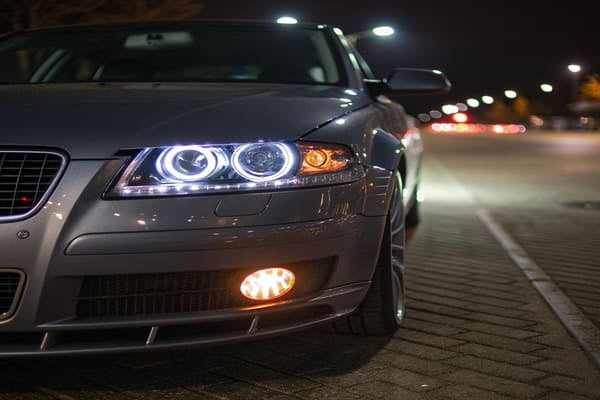
Think of it this way: your headlights are the main actors, but the other lights are the essential supporting cast. Without them, the show can't go on safely. When a client approaches us for a new "front light assembly," our first step is always to clarify every single component. Do they need just the headlamp housing? Or a fully integrated module with DRLs, turn signals2, and the electronic control unit? This precision is vital in OEM/ODM manufacturing to prevent very expensive mistakes.
I remember working on a new LED headlight module for a client from Pakistan. The initial prototypes had a beam pattern8 that was fully compliant, but the calibration of the projector lens was incredibly sensitive. We found a small "dark spot" just below the main cutoff line. Adjusting the tooling for the lens mount by just a few microns was a huge challenge. We worried the client would reject the batch. To our surprise, they actually preferred the beam pattern8 as it was. They said it reduced glare on the uniquely reflective road signs used in their region. It was a great lesson in how critical precise engineering is, and how important it is to understand the client's specific market needs.
What Types of Front Lights Are Installed on Modern Cars?
Car lighting technology is changing faster than ever before. It can be hard to keep up with all the new types like LED, Laser, and Matrix headlights.
Most modern cars use one of three main types of headlights. Halogen is the basic, older technology. HID lights9 are brighter and more efficient. LED lights10 are now the most popular choice due to their long life, energy efficiency, and design flexibility.
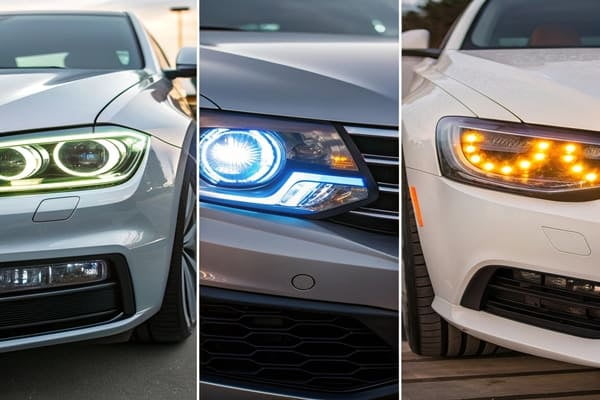
The technology inside a headlight has a massive impact on its performance, cost, and lifespan. As a manufacturer, we produce all types to meet different market demands and price points. Halogen bulbs are simple and cheap, making them great for entry-level vehicles. HIDs were a major step up, offering much more light, but they require complex ballasts to operate.
Today, LEDs dominate the market. They are incredibly versatile. We can create unique DRL signatures that become a core part of a car brand's identity. They also enable advanced features like Adaptive Driving Beams11 (ADB), or Matrix lighting. These smart systems use a camera to detect other vehicles and can selectively turn off individual LEDs in the matrix. This allows you to keep your high beam1s on for maximum visibility without dazzling other drivers. It’s an amazing safety feature that we are now integrating into more and more of our OEM projects.
Headlight Technology Comparison
| Technology | Brightness | Lifespan | Energy Use | Key Feature |
|---|---|---|---|---|
| Halogen | Standard | ~1,000 hours | High | Low cost and simple to replace. |
| HID/Xenon | Very Bright | ~2,000 hours | Medium | Intense, blue-white light. |
| LED | Excellent | 20,000+ hours | Very Low | Long-lasting, efficient, and design-flexible. |
| Laser | Extreme | 20,000+ hours | Low | Farthest reaching beam, used with high beam1s. |
What Is the Difference Between Headlights and Driving Lights?
Driving lights and high beam1s seem to do the same thing, which is light up the road far ahead. But using them incorrectly can be illegal and dangerous for others.
Headlights provide your standard low and high beam1s. Driving lights are separate, auxiliary lights12 that supplement your high beam1s for even greater distance. They are too bright to be used with any oncoming traffic and are often for off-road or rural use.
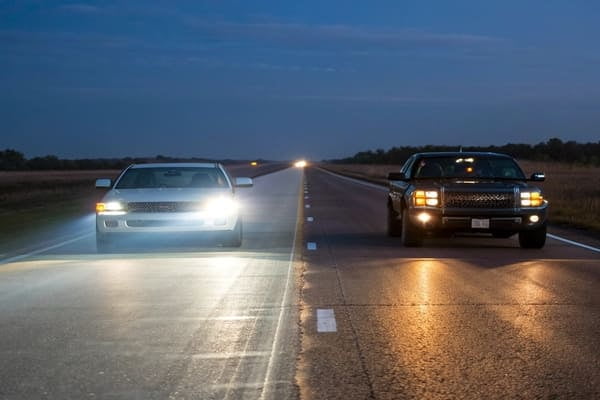
The key difference is the beam pattern8 and intensity. Your car's built-in high beam1s are designed to provide a balance of distance and width. They have a specific pattern that is regulated by law. Auxiliary driving lights13, on the other hand, are designed for one thing: maximum forward distance. They produce a very narrow, focused, and intense beam of light, almost like a spotlight. Because they are so powerful, in most places it is illegal to use them when other cars are present. Legally, they must be wired so they can only be turned on when your high beam1s are already active.
As a manufacturer, we get requests for "driving lights13" all the time. We always have to ask for clarification. Does the client need an ECE or DOT-compliant high beam1, or a true, high-performance auxiliary lamp for an off-road vehicle? The engineering, optics, and mounting hardware are completely different for each. Making this distinction is the first step in building a product that is both safe and effective for its intended purpose.
Conclusion
Understanding your car's front lights is key to safety. Each light, from headlights to DRLs, has a specific job. Using them correctly keeps you and other drivers safe.
Learn about the advantages of high beam headlights for better visibility. ↩
Understand the importance of turn signals for safe driving and communication on the road. ↩
Explore this link to understand the complete system that ensures visibility and safety while driving. ↩
Learn about headlamps and their crucial role in vehicle safety and visibility. ↩
Explore the significance of low beam headlights for safe nighttime driving. ↩
Find out how fog lamps improve visibility in adverse weather conditions. ↩
Explore the differences between OEM and ODM in the context of automotive lighting. ↩
Learn about the importance of beam patterns for safe and effective lighting. ↩
Discover the benefits of HID lights in automotive lighting technology. ↩
Explore the advantages of LED lights, including energy efficiency and longevity. ↩
Learn how ADB technology enhances safety by adjusting light patterns. ↩
Explore the role of auxiliary lights in enhancing visibility for off-road driving. ↩
Understand the purpose of driving lights and their specific applications. ↩