
Ever press your brake pedal and just trust it to work? A failure in any part can be dangerous. Understanding the system is the first step to ensuring your safety.
A car's brake system1 uses hydraulic pressure2 to stop your vehicle. Its main parts are the brake pedal, master cylinder3, brake lines4, and the brake assemblies5 at each wheel. When you press the pedal, the master cylinder3 turns that force into hydraulic pressure2, which activates the brakes.
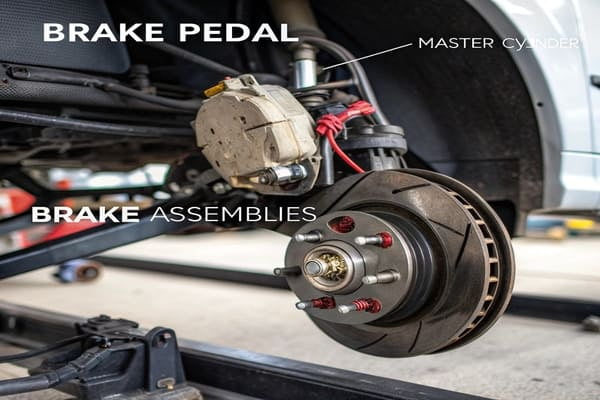
I've been manufacturing and supplying automotive parts for years, and the brake system1 is one of the most complex. It’s not just a collection of parts; it's a finely tuned system where every piece has a critical job. A tiny mistake in manufacturing or assembly can have big consequences. People see a brake caliper6 or a rotor7 and think it's a simple piece of metal, but the engineering, materials, and precision required are incredibly high. Let's break down how all these parts work together to bring your car to a safe stop.
What Are the Main Parts of a Car Brake System?
Your car's brake system1 feels like a single unit. But it is actually a complex network of different components. Let’s break down the core parts for you.
The main parts are the brake pedal, a master cylinder3 that creates pressure, a brake booster8 to help your foot, brake lines4 to carry fluid, and the wheel components. These wheel parts are either disc brakes9 (caliper6, pads, rotor7) or drum brakes10 (wheel cylinder11, shoes, drum).
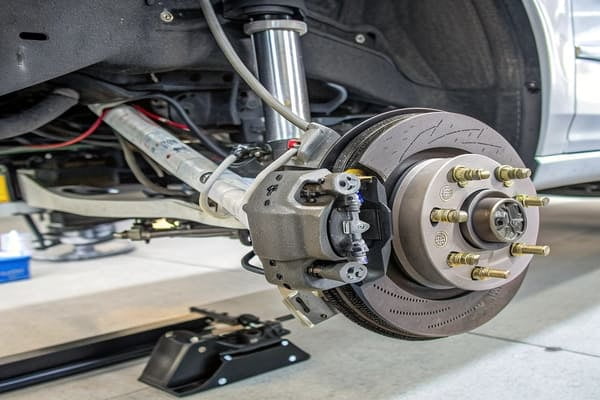
When you press the brake pedal, you are starting a chain reaction. The first part is the brake booster8. It uses engine vacuum or an electric pump to multiply the force from your foot. This makes it much easier to press the pedal. That force then moves to the master cylinder3. I think of the master cylinder3 as the heart of the system. It's a small but powerful hydraulic pump. Inside it, a piston pushes brake fluid12 into the brake lines4. These lines are strong metal tubes and flexible hoses that run to each wheel of your car. They act like arteries, carrying the high-pressure fluid. When we manufacture master cylinder3s for our clients, the internal tolerances are measured in micrometers. Any leak or imperfection means the entire system could fail. It’s a part that demands absolute precision, from the raw materials to the final assembly.
| Main Component | Primary Function |
|---|---|
| Brake Pedal | The input from the driver's foot. |
| Brake Booster | Multiplies the force from the driver's foot. |
| Master Cylinder | Converts foot pressure into hydraulic pressure2. |
| Brake Lines | Transport high-pressure brake fluid12 to the wheels. |
| Brake Assemblies | The parts at the wheel that create friction to stop the car. |
How Do Disc Brake Parts Differ from Drum Brake Parts?
Not all brakes are the same. Using the wrong parts for your system can hurt performance and safety. So let's compare disc and drum brakes10 to see how they differ.
Disc brakes use a caliper6 to squeeze brake pads13 against a spinning rotor7. Drum brakes use a wheel cylinder11 to push brake shoes14 outward against the inside of a spinning drum. Disc brakes are better at handling heat and provide stronger stopping power15, so they are usually on the front wheels.
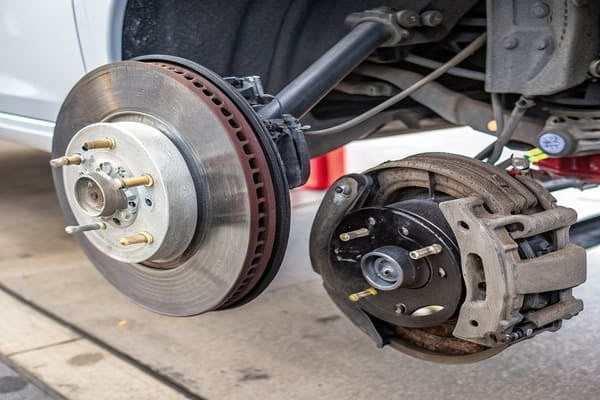
Let's look deeper at the differences. A disc brake system1 is like a bicycle brake, but much stronger. The main parts are the rotor7, the caliper6, and the brake pads13. The rotor7 is a heavy metal disc that spins with the wheel. The caliper6 is a clamp that fits over the edge of the rotor7. Inside the caliper6 are the brake pads13. When you press the brake pedal, hydraulic fluid pushes a piston inside the caliper6, which squeezes the brake pads13 against the rotor7. This friction slows the car down.
A drum brake system1 works differently. It has a hollow drum that spins with the wheel. Inside the drum are brake shoes14, which are curved pads with friction material. A small wheel cylinder11 sits at the top. When you brake, fluid pushes pistons out of the wheel cylinder11. These pistons push the shoes outward against the inside surface of the drum. This friction stops the car. Drum brakes are often used on the rear wheels of less expensive cars because they are cheaper to make.
| Feature | Disc Brake | Drum Brake |
|---|---|---|
| Main Friction Part | Brake Pads | Brake Shoes |
| Rotating Part | Rotor (Disc) | Drum |
| Actuator | Caliper | Wheel Cylinder |
| Performance | Better heat dissipation, less fade | More prone to overheating |
| Cost | Generally more expensive | Less expensive |
Which Brake Parts Are Responsible for Stopping Power?
Do you want more stopping power15 for your car? Just upgrading one single part often is not enough. Understanding which components create the force is key to a real upgrade.
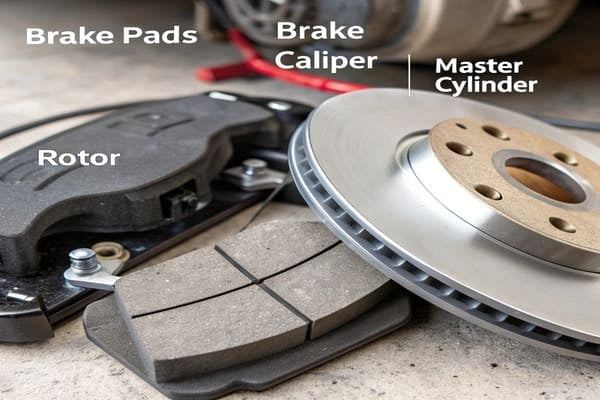
Stopping power comes from the friction created by brake pads13 (on discs) or brake shoes14 (on drums). The caliper6 and master cylinder3 provide the clamping force, while the brake pad's material determines the friction level. The rotor7's ability to manage heat is also critical for consistent power.
Stopping power is a team effort. It's a balance between clamping force, friction, and heat management. I learned this the hard way early in my career. We had a new project with a European client who needed complete brake system1s. It was one of our first big OEM orders for a full system. We manufactured everything to spec, but the final tuning was new to us. This process, called brake force distribution tuning16, is incredibly difficult. It requires special equipment to make sure each wheel gets the right amount of braking pressure. Most small workshops don't have this equipment; you can only find it in specialized factories. After we assembled and tuned the systems, the brakes felt "soft." I was worried we had failed. But the client installed them on family commuter cars. They called back and said their customers actually loved the softer, more progressive feel. It was pure luck. We learned a valuable lesson and invested in better tuning equipment right away. Since then, we've never made that mistake again. The experience taught me that stopping power15 isn't just about one part. It’s about how the pads, rotor7s, and hydraulic force work together in a perfectly calibrated system.
What Is the Function of Each Brake Component?
A brake system1 has many small parts. If just one of these parts fails, the whole system is at risk. So let's look at what each individual part does.
The master cylinder3 creates pressure. The booster helps your foot. Brake lines move the fluid. Calipers squeeze pads against rotor7s to create friction. Brake pads provide the friction surface. Rotors are the discs that the pads clamp onto to stop the wheel's rotation.
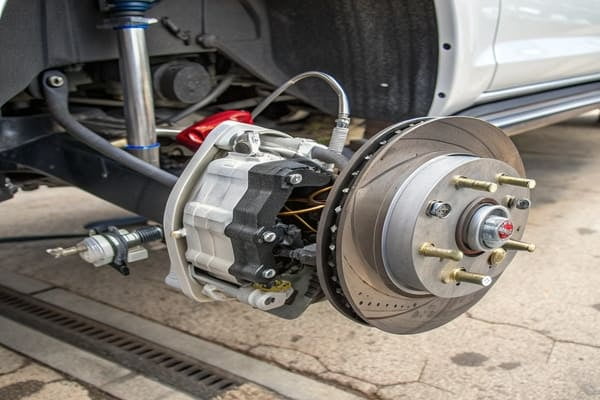
Breaking down the system helps you see why quality in every single part matters. When we assemble a full brake system1 for a client, we have a very strict process. One of the hardest steps is filling the system with brake fluid12. The assembly machine has to pause for this step. We have to open the reservoir, which can cause the hydraulic pressure2 to become unstable. You need very precise equipment to fill the fluid to the exact level without introducing air bubbles or losing pressure. An air bubble in a brake line can make the pedal feel spongy and dangerously reduce stopping power15. That’s why everything, from the seals in the master cylinder3 to the material of the brake hoses, must be perfect. Each part has a job, and they all rely on each other to bring you to a safe stop, every time.
| Component | Function in the Brake System |
|---|---|
| Brake Fluid | A special hydraulic fluid that transfers pressure and resists heat and compression. |
| ABS Module17 | The Anti-lock Braking System module prevents wheels from locking up during hard braking. |
| Caliper | Squeezes the brake pads13 against the rotor7 using hydraulic pressure2 from the brake fluid12. |
| Brake Pads | The friction material that makes contact with the rotor7 to create friction and heat. |
| Rotor (Disc) | The metal disc that spins with the wheel. It's the surface the pads clamp onto. |
| Wheel Cylinder | In drum brakes10, this small cylinder uses hydraulic pressure2 to push the brake shoes14 out. |
| Brake Shoes | The curved friction material that presses against the inside of the brake drum. |
| Drum | The metal drum that spins with the wheel. The shoes press against its inner surface. |
Conclusion
A vehicle's brake system1 is an ecosystem of parts. Each one must be made with precision and work together perfectly to ensure your safety and control on the road.
Understanding the brake system is crucial for vehicle safety and performance. ↩
Learn about the role of hydraulic pressure in stopping your vehicle effectively. ↩
Discover why the master cylinder is often referred to as the heart of the brake system. ↩
Understand the critical role brake lines play in transporting brake fluid. ↩
Learn about the components that create friction to stop your vehicle. ↩
Discover the caliper's role in applying pressure to brake pads. ↩
Understand how the rotor interacts with brake pads to stop your car. ↩
Explore how a brake booster enhances braking efficiency and reduces pedal effort. ↩
Find out why disc brakes are preferred for better performance and safety. ↩
Explore the mechanics of drum brakes and their cost-effectiveness. ↩
Learn how the wheel cylinder operates to engage the brake shoes. ↩
Explore the properties of brake fluid that ensure effective braking. ↩
Learn about the importance of brake pads in creating friction. ↩
Understand the function of brake shoes in the braking process. ↩
Discover the elements that enhance your vehicle's braking performance. ↩
Discover the significance of tuning for optimal braking performance. ↩
Learn how the ABS module enhances safety during hard braking. ↩