
Are you struggling to find a brake pad supplier1 who can deliver consistent quality across a wide range of models? It’s a challenge that can risk your brand’s reputation and profits.
To find a reliable brake pad manufacturer, you must verify their production capabilities2, check for comprehensive quality certifications3s](https://shuipet.com/brake-pad-manufacturer/)%%%FOOTNOTE_REF_4%%% like IATF 169495, and confirm they offer a full product catalog6. This proves their investment in tooling, R&D, and supply chain management7 for consistent, high-quality output.
Are you missing out on sales because your supplier can't provide brake pads for a specific popular car model in your region? This gap in your product line forces your customers to go elsewhere.
Wide vehicle coverage is crucial because it allows you to be a one-stop shop for your customers. It simplifies your logistics8, reduces sourcing costs, and enables you to capture a larger market share9 by serving a diverse range of cars, from Japanese sedans to European SUVs.)
Finding the right partner for your automotive parts business10 is one of the most critical decisions you will make. A great manufacturer acts as an extension of your own company, providing the quality and reliability you need to grow. But a bad one can cause endless headaches, from product recalls11 to angry customers. The key is knowing exactly what to look for and which questions to ask. So, let’s dig into the details to ensure you partner with a factory that can truly support your business goals and deliver products you can be proud of.
What Key Factors Should You Check When Evaluating a Brake Pad Manufacturer?
Are you worried that a potential supplier is just a middleman? It's a common fear that a trading company12 might not have control over quality, leading to inconsistent products for you.
When evaluating a manufacturer, focus on three core areas: their in-house production capabilities2, their quality control systems13, and their material science expertise14. A true factory will own its production lines, have documented quality checks at every stage, and employ engineers who understand friction material formulation.
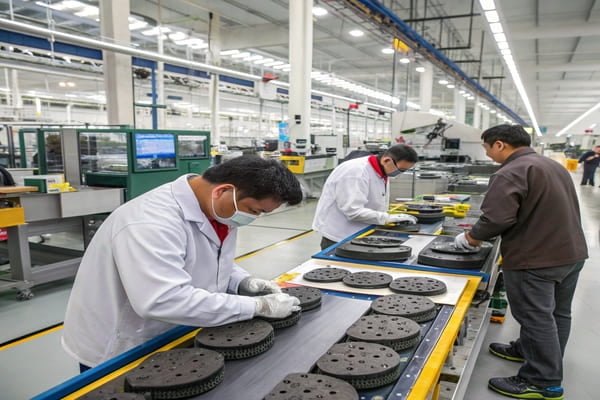
Evaluating a manufacturer goes beyond just looking at their prices. You need to understand their entire operation to see if they are a genuine, capable partner or just a trading company12 with a nice website. We believe transparency is key. A real factory should be able to show you everything from raw material sourcing15 to the final packaging line. This isn't just about showing off machinery; it's about proving they have full control over the process. This control is what guarantees the consistency and quality your business depends on. We've seen many importers get burned by partners who outsource production, leading to unpredictable quality batch after batch. A deep dive into their factory floor, processes, and team is the only way to be sure.
Production and Quality Systems
A manufacturer's real strength is visible on their factory floor. You should look for modern machinery for mixing, pressing, curing, and finishing. But equipment is only half the story. Ask about their quality control (QC) process. Do they perform checks on raw materials? Do they test friction coefficient, wear rate, and noise levels during production? A reliable partner will have clear, documented QC procedures.
Material Science and R&D
Brake pads are not simple products. They are a complex blend of materials engineered for specific performance characteristics16. A top-tier manufacturer will have an in-house R&D team dedicated to formulating and testing new friction materials. This is crucial for developing pads for different applications, like performance vehicles, heavy-duty trucks, or quiet-running passenger cars.
| Factor | Reliable Manufacturer | Trading Company / Small Workshop |
|---|---|---|
| Production Line | Owns and operates the entire line | Outsourced or uses basic equipment |
| Quality Control | Documented, multi-stage QC process | Inconsistent or only final inspection |
| Material R&D | In-house engineers and testing lab | Relies on generic, pre-made formulas |
| Transparency | Welcomes factory audits and questions | Vague about production details |
How Does a Full Product Catalog Prove a Manufacturer’s Production Strength?
Do you find it frustrating to deal with multiple suppliers for different car models? Juggling various contacts and quality standards for American, European, and Asian vehicles wastes time and creates risk.
A full product catalog6 demonstrates a manufacturer's significant investment in tooling and molds for thousands of different backing plates. It also proves their R&D capability to develop multiple friction formulas (ceramic, semi-metallic, organic) and their ability to manage a complex supply chain for diverse raw materials.
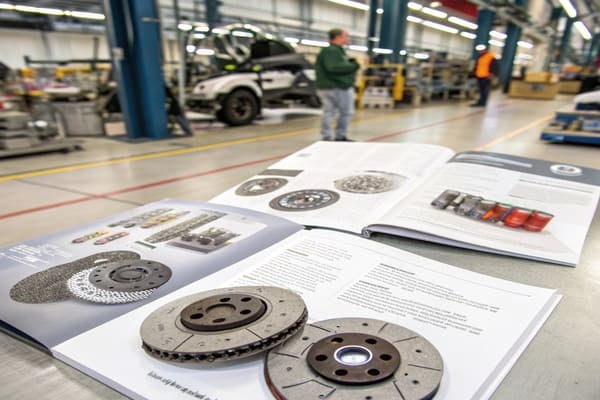
A manufacturer’s catalog is like their resume. A short, limited catalog might suggest they are a small workshop or a newcomer. But a thick catalog covering thousands of part numbers tells a much different story. It shows a long-term commitment to the industry. Each part number represents a unique mold for the backing plate, which is a significant capital investment. We didn’t build our catalog overnight. It took years of investing in new tooling, testing materials for different vehicle platforms, and refining our supply chain to handle hundreds of raw components. This depth is a clear indicator of a manufacturer's stability, experience, and production strength. It’s proof that they are a serious, long-term player in the global automotive market.
Investment in Tooling and Molds
Every unique brake pad shape requires a specific set of molds for the backing plate and the friction material press. A catalog with thousands of applications, covering models from Honda to Mercedes-Benz, means the factory has invested hundreds of thousands, if not millions, of dollars in tooling. This level of investment is a barrier to entry that separates serious manufacturers from small-time operators. It shows they are committed to serving a broad market and have the financial stability to support large-scale production.
Expertise in Multiple Friction Formulas
Different vehicles and driving styles require different brake pad formulations17. A comprehensive catalog usually means the manufacturer can produce various types:
- Ceramic: For low dust and quiet operation.
- Semi-Metallic: For high-performance and heavy-duty use.
- Organic (NAO): For standard daily driving.
Offering all these types requires a deep understanding of material science and sophisticated mixing and curing processes. This versatility proves their technical competence and ability to meet diverse market needs. It shows they are not a one-trick pony but a versatile production partner.
Why Does Wide Vehicle Coverage Matter for Distributors and Importers?
Are you missing out on sales because your supplier can't provide brake pads for a specific popular car model in your region? This gap in your product line forces your customers to go elsewhere.
Wide vehicle coverage is crucial because it allows you to be a one-stop shop for your customers. It simplifies your logistics8, reduces sourcing costs, and enables you to capture a larger market share9 by serving a diverse range of cars, from Japanese sedans to European SUVs.
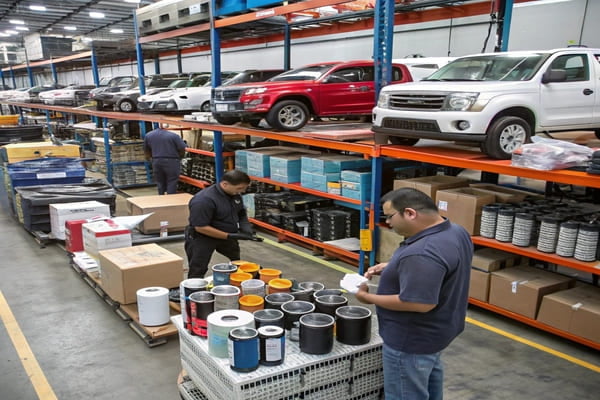
For a distributor or an importer, your supplier's product range directly impacts your business's potential. If your manufacturer can only produce pads for the top 10 most popular cars, you are leaving a lot of money on the table. The real value comes from a partner who can support your growth into new market segments. I remember a project with a client from the Middle East. They needed a special semi-metallic brake pad for a fleet of modified American trucks that operated in extreme heat. Our standard formula wasn't quite right; early tests showed some brake fade under heavy load. Instead of giving up, our engineers developed a new formula with higher copper content for better heat dissipation. It took a few tries, but the final product was perfect. The client was so happy they made us their exclusive supplier. That’s what wide coverage really means: having the capability to not only offer many parts but also to solve specific customer problems.
Simplifying Your Supply Chain
Working with one manufacturer who can cover 95% of the vehicles in your target market is a huge advantage. It means:
- One point of contact: No more juggling emails and calls with multiple suppliers.
- Consolidated shipping: Lower freight costs per unit.
- Consistent quality: The same quality standard applies across your entire product line.
- Easier inventory management: Streamlined ordering and stocking processes.
Capturing More Market Share
A broad catalog allows you to serve more customers. Whether a customer drives a Toyota Camry, a BMW X5, or a Ford F-150, you have a solution for them. This builds your reputation as a reliable and comprehensive parts provider. You become the go-to source in your market, which strengthens customer loyalty18 and gives you a competitive edge. It allows you to say "yes" to more inquiries and win more business.
What Certifications Should a True Brake Pad Factory Have to Ensure Quality?
Are you concerned that the products you import might not meet international safety and quality standards? Selling uncertified parts can lead to legal trouble, product recalls11, and irreparable damage to your brand.
A reliable brake pad factory must have IATF 169495 certification, which is the global automotive industry standard for quality management. Other key certifications4 include ISO 9001 for general quality systems and ECE R90 for the European market, which guarantees performance equivalent to original equipment.
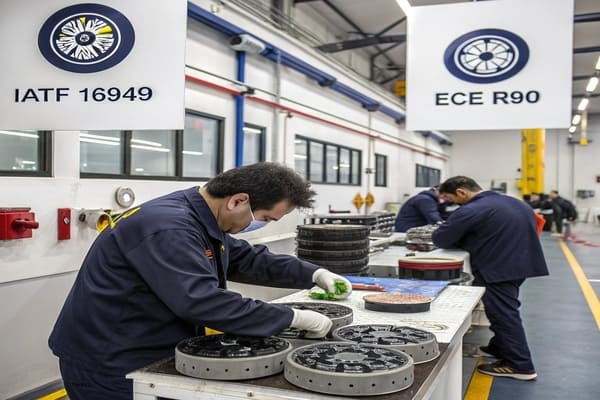
Certifications are not just pieces of paper to hang on the wall. They are proof that a manufacturer has committed to a rigorous, internationally recognized system for managing quality. Achieving a certification like IATF 169495 is a long and expensive process. It requires a factory to document every single step of their production, from how they choose their raw material suppliers to how they calibrate their machinery and train their staff. It means they are subject to regular audits by third-party experts who verify that they are following these strict procedures. When we went through our IATF 169495 certification, it forced us to improve and standardize every aspect of our operations. It's a commitment to excellence and a guarantee to our clients that every brake pad we ship meets the highest possible standards for safety and reliability.
Key Certifications and What They Mean
You should always ask for copies of a manufacturer's certifications4. Here are the most important ones for brake pads:
| Certification | What It Guarantees | Why It's Important for You |
|---|---|---|
| IATF 169495 | A strict, process-oriented quality management system specifically for the automotive supply chain. | This is the gold standard. It proves the factory can meet the demanding requirements of major car manufacturers. |
| ISO 9001 | A general quality management system that ensures consistent processes and a focus on customer satisfaction. | A foundational certification that shows the company is organized and serious about quality. |
| ECE R90 | A European standard that mandates aftermarket brake pads perform within a close margin of the original equipment (OE) parts. | Essential for selling in Europe and a strong indicator of high-quality, safe products for any market. |
If a potential supplier cannot provide these certifications4, it is a major red flag. It likely means they haven't invested in the systems required to produce consistently safe and reliable automotive parts.
Conclusion
Choosing the right brake pad manufacturer is about verifying their production depth, quality systems, and market coverage. Look for certifications4 and a full catalog to ensure a reliable, long-term partnership.
Explore this link to find top-rated brake pad suppliers known for their quality and reliability. ↩
Find insights on evaluating a manufacturer's production capabilities to ensure quality and reliability. ↩
Learn about essential quality certifications that ensure safety and reliability in brake pad manufacturing. ↩
Learn about the essential certifications that ensure quality and safety in brake pad production. ↩
Discover the significance of IATF 16949 certification in ensuring high-quality automotive parts. ↩
Understand how a comprehensive product catalog reflects a manufacturer's capabilities and commitment. ↩
Discover the importance of supply chain management in ensuring consistent quality in brake pads. ↩
Explore how streamlined logistics can reduce costs and improve efficiency for distributors. ↩
Learn strategies for capturing market share through effective partnerships with manufacturers. ↩
Explore the essential factors that contribute to success in the automotive parts industry. ↩
Learn about the common causes of product recalls and how to avoid them in brake pad production. ↩
Learn how to distinguish between genuine manufacturers and trading companies in brake pad sourcing. ↩
Explore effective quality control systems that guarantee consistent brake pad quality. ↩
Learn how material science expertise impacts the performance and safety of brake pads. ↩
Understand the impact of raw material sourcing on the overall quality of brake pads. ↩
Find out the key performance characteristics that make brake pads effective and reliable. ↩
Discover the various brake pad formulations and their specific applications in the automotive industry. ↩
Discover how high-quality brake pads can enhance customer loyalty and satisfaction. ↩